144. The Story of a Tail [NanÄguææha-Jātaka]
At one time Buddha was living in the Jeta Grove. Behind the Jeta grove temple, there was a community of NigaÏæha ascetics. They did austerities, claiming that these gained them merit. Among them, some ascetics were standing on one leg only with the other leg raised high, some were squatting on their heels, some were balancing themselves on their toes, and some were lying between four fires and looking up at the sun at midday—which penance they called Pañcatāpa [five scorchings]. They made vows to practice such penances.
Many monks saw these naked ascetics practicing such vows. On seeing this, they came to the Buddha and asked, “Venerable sir, these naked ascetics are practicing such-and- such vows, saying they are doing these in the name of penance. By doing these, do they have any benefit in the future?” The Buddha replied, “Oh monks, what kind of a benefit can be gained by such vows? In the ancient times, even some noble ones taking their birth-fire went into the forest thinking that if they protected that fire, there would be future benefits. They protected that fire for long times, and gained nothing. Giving that up afterwards, they practiced meditation. As a result of that practice, they gained mental absorption and gained a more powerful mental status, and were reborn in the Brahma realm.”
How it was:
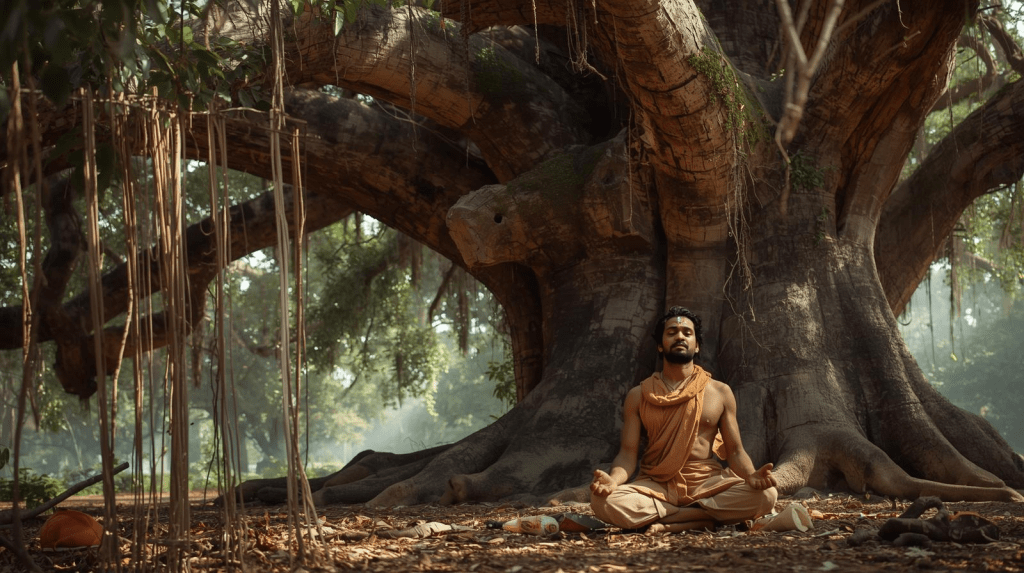
At one time, a king called Brahmadatta ruled Benares. At that time, the Enlightenment Being was born in a well- known Brahmin family. The Brahmin family preserved the Enlightenment Being’s birth-fire for twelve years. When he became twelve years old, his parents said, “Our son, this fire we have protected from your birth to the present. It is more powerful than sacred fire. Take this fire, and go into the forest and offer it to the god of fire. By so offering it, you can gain merit to go to the Brahma world. Whenever you do so, if you would like to go to the Brahma world, stay in the forest and protect that fire. If you want to marry a girl and live a lay life, you can instead do so.” On hearing this, the Enlightenment Being thought, “What is the use of a lay life to me? Instead, I will take my birth-fire, go to the forest, and I will sacrifice to the god of fire.”
While he was living in the forest, one day he went to a remote village collecting alms. He was given a bull as an offering. He took the bull to the forest with happiness, thinking he would be able to make a good sacrifice to the god of fire. When he returned to his hermitage, he tied the bull to a nearby tree, and he was getting ready to sacrifice the bull to the god. But he found that he did not have salt and lemon juice so as to make the offering tasty. So he went back to the village in search of salt and lemons.
While he was away from his hermitage, unfortunately there came some aboriginal hunters who saw this bull that had on it much meat. They killed the bull on the spot, used the ascetic’s birth-fire to cook the meat, and ate as much as they could. Leaving the four legs and the tail, they left carrying away all the remainder of the bull.
The Enlightenment Being, who was the ascetic at that time, returned home carrying salt and lemons so as to sacrifice the bull. He saw his fire, and near it he saw the remaining four legs of the bull and the tail. He saw the bull had been eaten. On seeing this, he got very angry. He realized that there was no use in protecting the fire, as it did not have even the little power to protect the bull that was going to be sacrificed to it. Realizing this, he put out the fire, saying, “Why did I protect this fire as it does not even have the power to protect its own sacrifice? It is not good to help such a powerless god who is not grateful enough to help even its protector. How can it protect me if it cannot protect its own sacrifice?”
He gave up his practice of maintaining his birth-fire. He put it out using the hair on the end of the bull’s tail and water. He began to meditate, and through his meditation he was capable of developing concentration in his mind. Later, in the course of time, he was clever enough to obtain the five higher knowledges [pañcābhiññā]—miraculous knowledge, divine eye, divine ear, thought reading, and knowledge of reminiscence, and the eightfold mental absorptions [aææha- samāpatti]—first mental absorption [paæhama-jhāna], second mental absorption [dutiya-jhāna], third and fourth mental absorptions [tatiya- and catuttha-jhāna], mental absorption of the emptiness, mental absorption of consciousness, mental absorption of nothingness, and mental absorption of neither perception nor non-perception. In the end, he died without falling from the mental absorptions. Maintaining his absorptions, he gained birth in the Brahma world.
“The ascetic of that time was I who am today the Buddha.” Saying so, he ended this Jātaka story of a tail.
The moral: “Blind faith can mislead even the wise.”
144. The Story of a Tail [NanÄguææha-Jātaka]
Link: https://hhdorjechangbuddhaiiiinfo.com/2025/11/13/144-the-story-of-a-tail-nanaguaeaeha-jataka/
#Buddhisttalesforyoungandold #Buddhiststories #storiesforkids #moralstories #Buddha #Jatakastories #PansiyaPanasJataka #JatakaTalesofSakyamuniBuddha #JatakaTales #SakyamuniBuddha’sPast

 頂禮 H.H. 第三世多杰羌佛- 眾善奉行