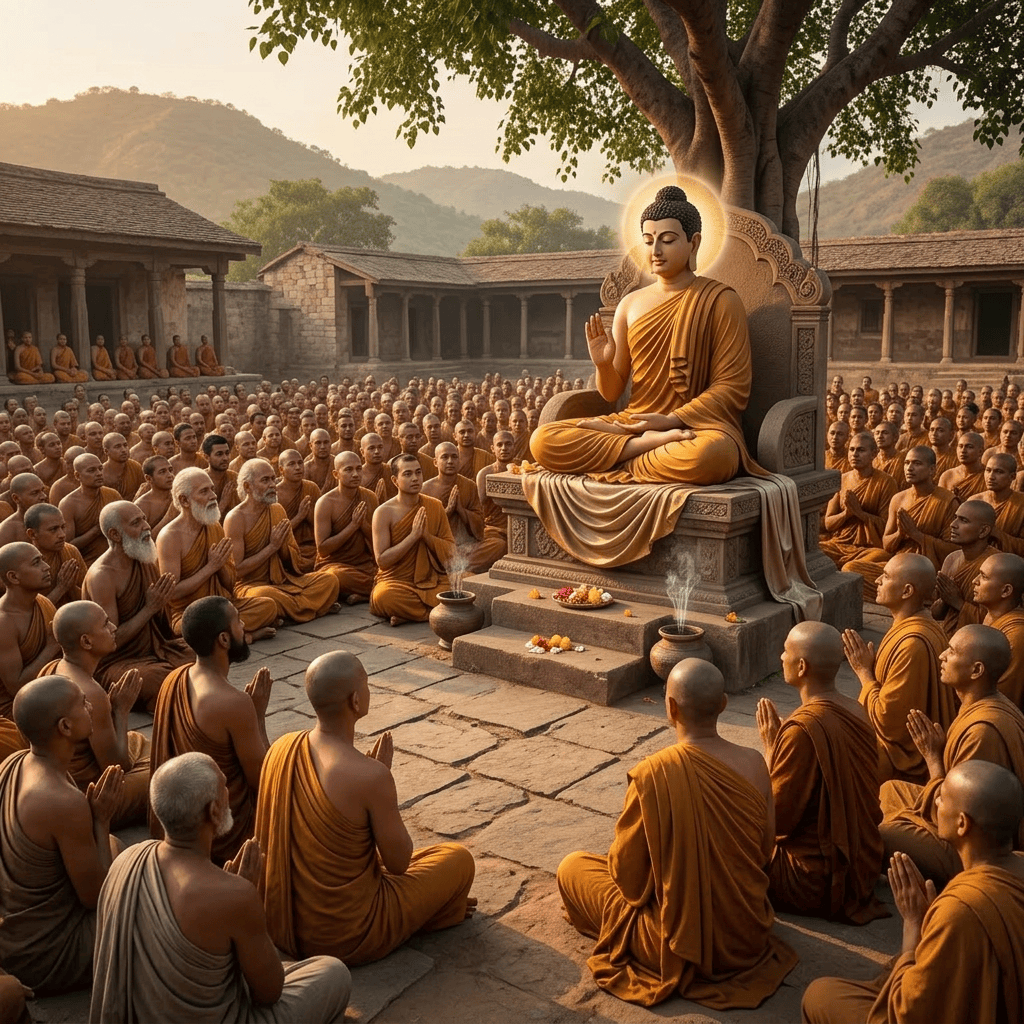
Do you know that each year, there is a moment set aside to honor quiet kindness?
National Volunteer Week in 2026 falls on April 19–25.
A small offering of time… A simple act of care… Like a drop in still water, it ripples farther than we can see.
H.H. Dorje Chang Buddha III teaches that compassion is not only something we contemplate. It is something we live. In fact our practice continues in our actions, in how we show up for others.
When we extend a hand, offer our time or talents, or simply listen, we bring the teachings into the world.
There is even a flower that reflects this spirit—Clematis ‘Samaritan Jo’, named for those who help others in times of distress. It’s easy to grow, and with a little care and good deadheading, it can bloom for up to six months—a gentle reminder that compassion, too, can be continuous.
Your time. Your presence. Your kindness.
These are seeds.
When planted, they not only bring joy to others, they quietly deepen your own sense of purpose in life.
Hua Zang Si has always upheld and propagated the authentic teachings of H.H. Dorje Chang Buddha III and Namo Sakyamuni Buddha. With the great compassionate Bodhicitta, the temple brings loving-kindness into practice, extending it to every sentient being in this world.
Since launching the “Love without Limits ” donation drive during its 20th anniversary in 2024, the monastics and volunteers have personally visited communities, carefully assessed needs, and thoughtfully selected three organizations to support:
San Francisco-Marin Food Bank
Muttville Senior Dog Rescue
HPP (Homeless Prenatal Program)
On December 19, 2024, Hua Zang Si delivered its first round of donated supplies. This year, that compassion continues without interruption.
On March 13 & 17, 2026, the group set out once again.
First Stop: San Francisco-Marin Food Bank
With inflation and rising living costs, many families are struggling to meet basic needs. This time, Hua Zang Si donated approximately 3.200 pounds of essential supplies, including rice, black beans, peanut butter, and various canned fruits and vegetables. May each item provide a bit more support and strength for families facing hardship.
Second Stop: Muttville Senior Dog Rescue
Here live elderly dogs who, despite their age, still long to be loved. Hua Zang Si donated 187 items, including collars, leashes, harnesses, pet beds, fleece blankets, dog poop bags, and cleaning supplies. These seemingly ordinary items bring real comfort and dignity to these senior dogs. With the devoted care of staff and volunteers, they are no longer alone. The principle of “equality of all beings” is truly embodied through these everyday acts of compassion.
Third Stop: HPP (Homeless Prenatal Program)
HPP has long supported underserved families and homeless pregnant women by providing essential supplies, housing assistance, education, and employment resources. This time, Hua Zang Si donated 100 items, including baby bottle gift sets, portable booster seats, strollers, infant carriers, baby portable bouncers, collapsible wagon carts , dehumidifiers, and baby bath gift sets. They help expectant mothers feel supported and hopeful during difficult times.
Through these actions, Hua Zang Si puts the Buddha’s teachings into practice—loving and benefiting all beings. Every act of giving is a reminder of one’s own cultivation. True practice lies not only in inner awareness, but in bringing compassion into everyday life. May this boundless love flow like water, nourishing more lives and making the world warmer through kindness and love.
When the Buddha was in Jetavanārāma, the king Ajātasattu was friendly with Devadatta. Even though unrighteous and sinful, Ajātasattu was pleased with him. He built for Devadatta a temple in Gayāsīsa, which he gave to him. And he assisted him by giving him all the necessary perquisites. In the meantime, following Devadatta’s words, he sent the elephant NāÀāgiri to kill the Buddha and he sent bowmen to shoot at the Buddha. Many bad things such as these were done by him. After that, his father who was a very righteous king and who was one who had attained the stream entrance state of mind [sotāpanna], was killed by him through the persuasion of Devadatta.
Later, he heard that Devadatta had died and had gone to hell sinking down through the earth. On hearing this, he became afraid for his life believing that if anything happened to Devadatta, no doubt it would happen to him, too. He was very much afraid day and night. He spent the daytime in the routine activities of his daily life. But at night, when he went to bed, he dreamed that he was falling through the earth that had opened up and was shooting forth the fires of hell. From this, he became even more afraid as if he were a chicken that had its neck twisted and had been thrown into the hot sun to die. In this way, he suffered day and night despite his royal luxuries.
He had a keen interest in questioning the Buddha about the dream he was having, but he was reluctant to express that interest to Jīvaka. One day he saw the moonlight bright as if it were daylight, and he said to his minister Jīvaka, “The moonlight is so clear that one can see the distance of forty- five arrow shots as if it were daytime. It is not good to waste our time by staying here. This night is pleasant, calm, attractive, and beautiful. Let us go to a good ascetic, to someone like that, to listen to the Dhamma. I have now such an intention. Do you know to whom we can go?” The other ministers who heard him started to mention the names of the various religious masters to whom they each paid obeisance. Most of them were NigaÏæha-s. One minister said, “There is the ascetic PūraÏa Kassapa. He is a Buddha. Let us go to see him.” Another minister said, “It would be good to go to the Buddha Makkhali Gosāla.” Another minister said, “Instead of going to him, let us go to the Buddha Ajita Keśakambala.” Then some other minister wanted to go to the Buddha Kakudha Kaccāyana. After, another said, “I think it would be good to go to the Buddha Sañjaya Belaææhiputta.” The sixth one said, “I suggest that more than any other Buddha, NigaÏæha Nāthaputta is the best one to whom to go.”
In this way, all the ministers said what they thought, mentioning various NigaÏæha-s, all of who were like children [with regard to spiritual advancement]. The king did not listen to them seriously, thinking, “No doubt Jīvaka will respond to my question.” But Jīvaka was silent.
Understanding his silence, the king addressed Jīvaka. He asked, “Jīvaka, these people are all praising their own Buddha-s whom each of them follows. Why do you not say something? Do you have no such a Buddha?”
Jīvaka heard this and got up from his seat. He paid respect toward the direction in which the Buddha was, and he recited the nine-fold virtuousness of the Buddha. He said, “Such a virtuous, omnipresent one is now living in my mango park followed by 1,800 monks. Therefore, I suggest that it would be good for your lordship to go there.”
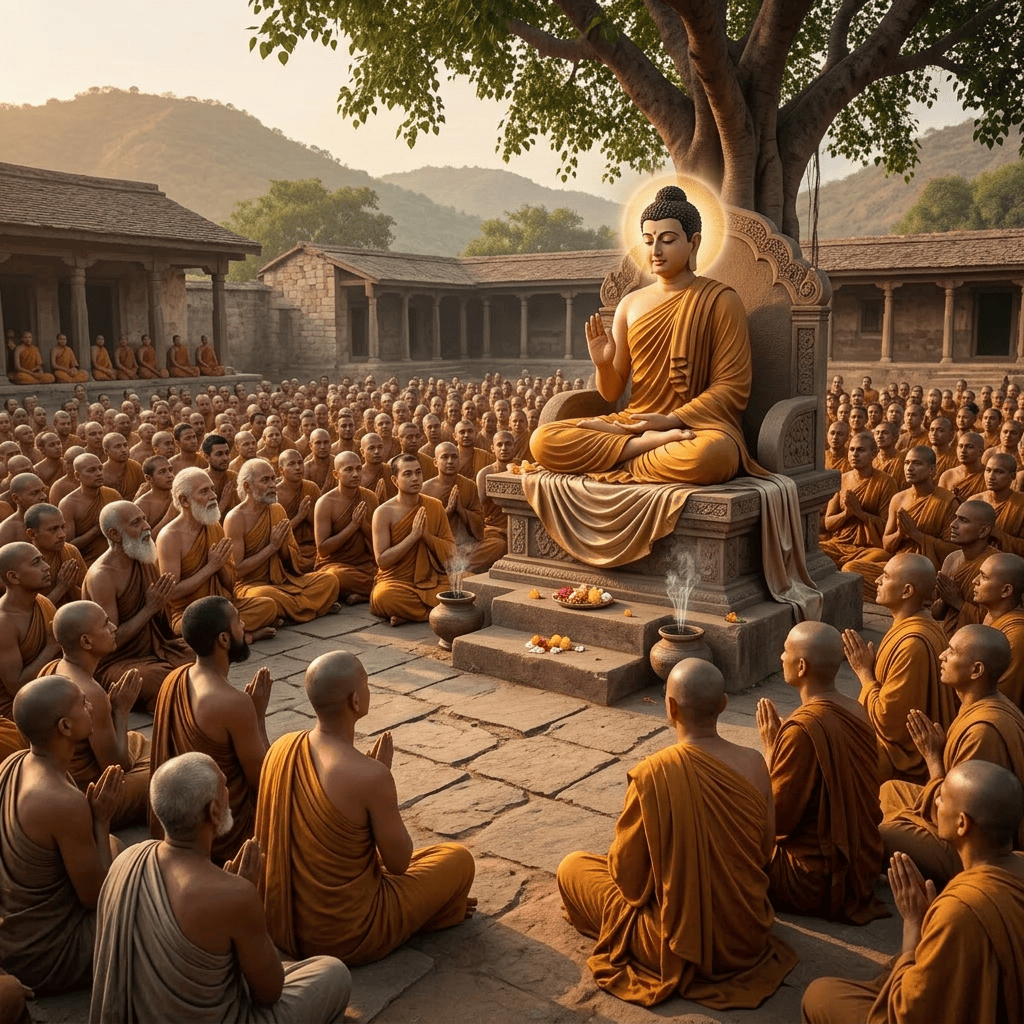
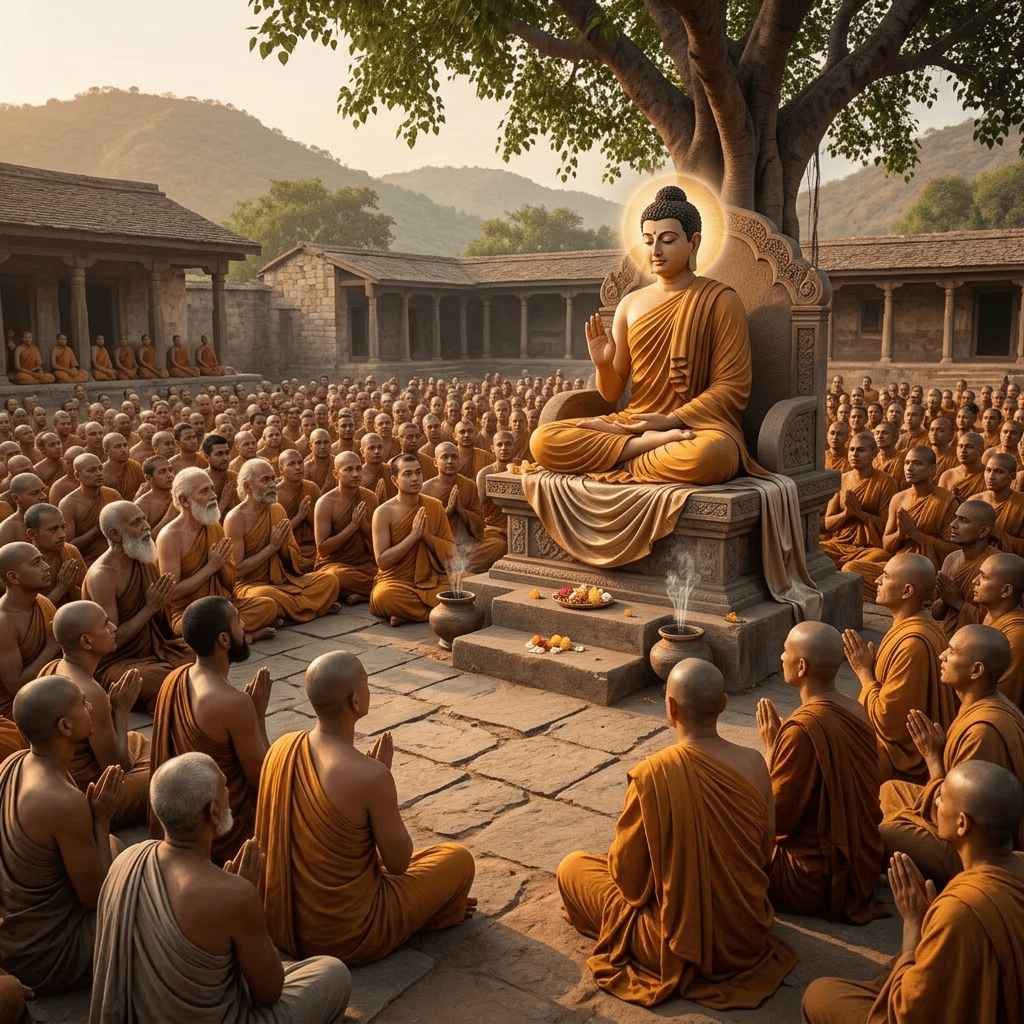
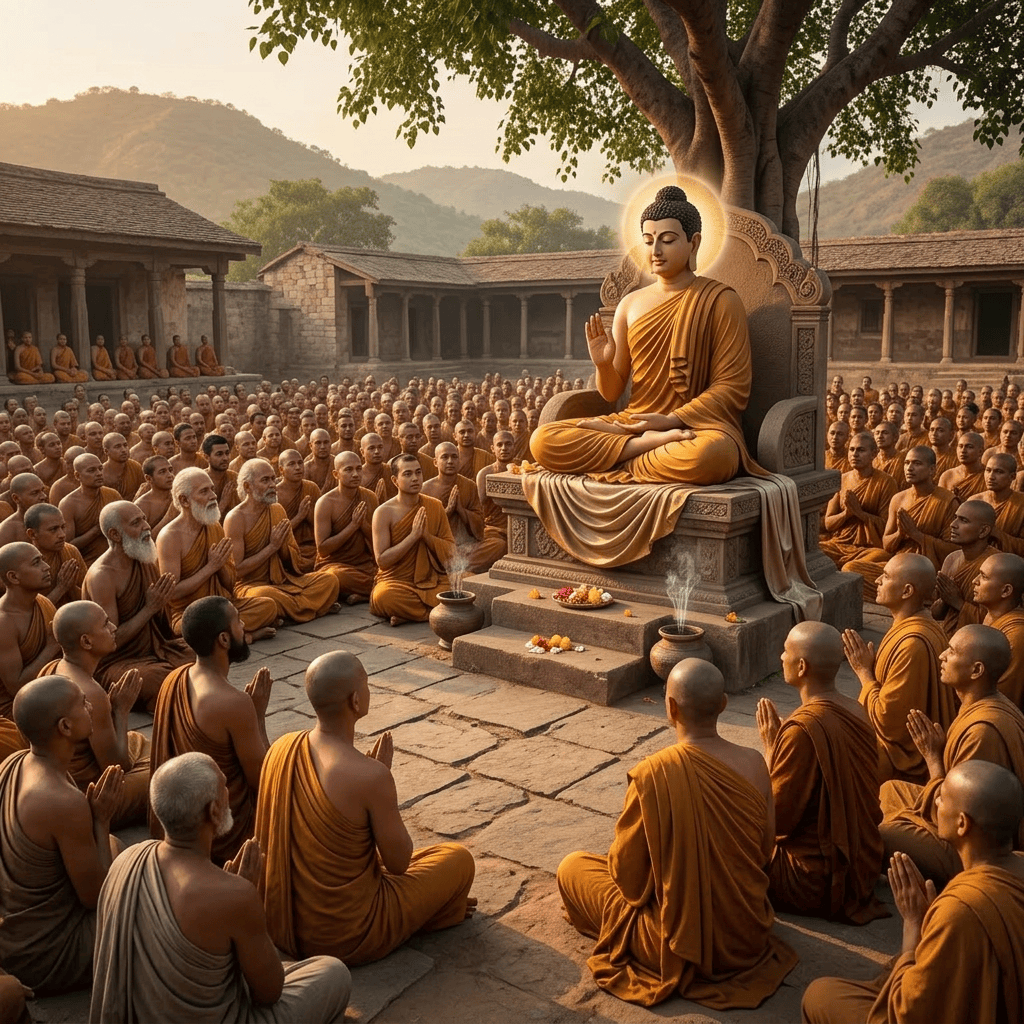
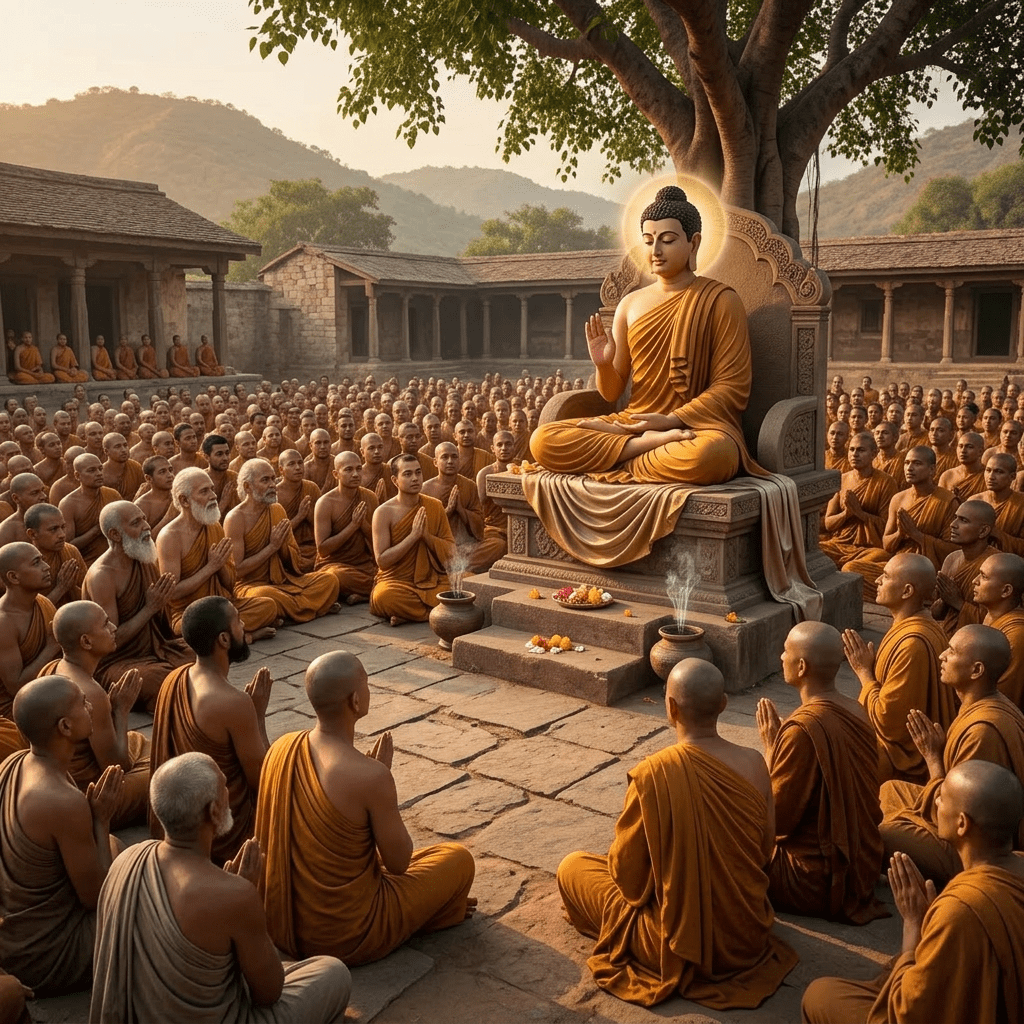
On listening to him, the king said, “It is wonderful. Let us go there.” And he made arrangements to go there by elephants together with his retinue. He went to the Buddha in royal magnificence. He approached the Buddha’s residence and dismounted his elephant. He then came to the followers of the Buddha who were wearing neat and clean clothes, who had tranquil faculties, who all were seated still with arms and feet close to their bodies, and of whom not even one sneezed or coughed. He was very pleased by seeing this. First he paid his respects to the monks, and then to the Buddha. He sat down and said, “Sir, I would like to ask a question.” “Well, your lordship, ask your question.” Then the king said, “Venerable sir, what is the result that one can gain by being a monk?” The Buddha said the discourse called the Sāmaññaphala Sutta divided into two sections [bhāÏavāra-s] and into 500 points to be explained [grantha-s].23
After this preaching, Ajātasattu knelt down in the presence of the Buddha to pay his respect and said, “Revered sir, please excuse my wrong deeds that I have done out of ignorance.” Buddha accepted his apology, and the king went away.
Then the Buddha addressed the monks, saying, “Oh monks, this King Ajātasattu by being associated with a bad person both killed his father and at the same time ruined his chance for future salvation. If he did not do so, he would today be one who has entered into the stream entrance state of mind [sotāpanna].”
The next day, the monks assembled in the preaching hall were discussing how King Ajātasattu had lost his good fortune to become a Sotāpanna. The fully enlightened one entered the preaching hall then and asked the monks, “Oh monks, what were you discussing before I came here?” The monks mentioned the previous day’s incident. And the Buddha said, “Oh monks, not only in this life but even in the past, Ajātasattu by associating with evil ones created for himself misfortune.” The monks invited the Buddha to disclose the past story.
“At one time, when King Brahmadatta was ruling in Benares, the Enlightenment Being was born in a Brahmin family in that city. When he was grown, he went to a well- known teacher who used to teach in the city and began to study under him. After studying under him, he started to teach students on his own.
“While he was teaching students like this, he had a student named Sañjīvaka. He taught him a spell that could be used to bring the dead to life. And when they gain life, they can walk—but only a short distance. He did not teach him the spell to immobilize them if they come near.
“Once, that student went with a group of other students to fetch firewood from the forest. On their way, they saw a dead tiger on the ground. Sañjīvaka said to the other students, ‘Do you want to see my power? I will bring this tiger back to life.’ The other students said, ‘How can you bring a dead being back to life? It will never happen.’ Sañjīvaka said, ‘Just look at what I do.’ And he started to recite the spell. The other students said, ‘Who knows what will happen!’ And they climbed up trees.
“While Sañjīvaka was repeating the spell, he threw some pebbles toward the dead body of the tiger. When he was throwing the pebbles, the tiger started to get up. He came forward, and jumping up on the very person who was chanting the spell, he killed him. The tiger that had been brought back to life also fell dead at that spot.
“The other students collected the firewood and returned to where they were studying. They told the teacher what had happened. On hearing the news, the teacher said to the students, “It is not good to help an evil friend. If you do so, such is the result.” And he advised them to live generous and peaceful lives. He himself lived such a life, did many meritorious deeds, and acquired much merit. At the end of his life he died, and was born in heaven.
“Sañjīvaka was King Ajātasattu at that time. The teacher of Benares was I who have become the Buddha.” In this way, the Buddha ended the story of Sañjīva.
23 The Sāmaññaphala Sutta is to be found in the Dīghanikāya, but it is not divided there into two sections.
When the Buddha was living in the city of Vesāli, he lived in the mansion called, “The Gabled House”. At that time, the city of Vesāli was surrounded by three walls each the distance of sixteen Gāvuta-s21 one from the other, and each having gates and watchtowers. In addition there were 7,707 crowned kings to rule the country, with an equal number of viceroys, generals, and treasurers. Among these there was one bad prince, who was known as Wicked [Duææha]. He was aggressive, rough, and if one would speak something to him, he would use insulting words toward that one. Everyday he was like a snake that had been beaten with a stick. He was consumed with anger, and this shone forth to others. When people came to see him, they did not get a chance to speak more than two or three words. Parents, younger brothers, other relatives, and even his own children were uncomfortable in his presence. His wife and all his friends were afraid of him as if he were a snake that bit off flesh little piece by little piece, or as if they had come to a forest in which there were thieves, or as if they had seen a demon. Every time they saw him, they were in fear.
On hearing of this from someone, the Buddha went to see him and advised him: “A man who behaves fiercely like you, no doubt will be reborn in the fourfold hell and suffer from birth to birth. When people get angry, their face is unpleasant looking even though it had been beautiful like a lotus. It looks like a golden mirror covered with filth. In such anger, men hit themselves, or die by hanging themselves with a rope around the neck, or die falling down off a high precipice. By whatever way he dies, in his next birth he will be reborn in hell. After suffering a lot in hell, whenever he gets a human birth, he will suffer from the day of his birth with eye diseases, ear diseases, and so forth, endlessly. If he lives with loving kindness toward living beings, or with gentleness, compassion, and kindness, then he will not be confronted with such situations. He will be able to enjoy all kinds of happiness without such sufferings.”
From the time the prince heard this, he gave up his pride and anger. He became gentle and restrained like a cobra whose venom had been extracted, like a crab whose claw had been broken, and like a bull with cut horns. If someone hit him, or hurt him, or verbally abused him, he kept silent, not even asking whom it was who did this. If someone behind him mocked him or laughed at him, he did not even turn his head to see who it was. He behaved in this way from that point on.
One day the monks assembled in the preaching hall were talking about this. One monk said, “It is amazing that even his parents constantly advising the prince could not change him. But the Buddha tamed him with a single admonition as a mahout tames an elephant.” Then another monk said, “It is commendable, of course, that a horse trainer breaking in his horse guides his horse from east to west, and south to north, according to his will. Just so an elephant trainer and an ox trainer. Also, in the same way, the Buddha goes to wherever there are beings, whether in the human world, heaven, or the Brahma world, and guides them aright. Who can do like that except the Buddha?” Then the Buddha entered, and said, “Oh monks, what were you talking about before I came?” The monks told him they were talking about the taming of the prince. The Buddha said, “Not only today, even in the past I tamed him with a single admonition.” And the monks invited the Buddha to disclose the hidden story.
The Buddha disclosed the story:
At one time King Brahmadatta was ruling the city of Benares. At that time the Enlightenment Being was born in a well-known Brahmin family. After his parents’ death, he renounced their wealth and went to the Himalayan Mountains to become an ascetic. After a while, he returned to Benares in search of salt and sours.22 He wandered the streets of Benares for alms.
The king saw him walking on the street and sent one of his ministers to bring him. The minister went to him and told him of the king’s invitation. The ascetic said to the minister, “Sir, I have no previous acquaintance with the king. I live in the Himalayan Mountains as an ascetic. Further, since I am an ascetic, I have no close association with him. Therefore, why should he invite me to his palace?”
Hearing this, the minister returned to the palace and said to the king, “Your lordship, he will not come!” Then the king said, “Tell him that I have no close association with any ascetic. Further, up to now, I have not seen an ascetic. Therefore, please come.” Saying so, he sent the minister for the second time.
The ascetic, on hearing this, came to the palace. The king paid him obeisance and asked, “Where do you go, and where do you live?” The ascetic said, “Your lordship, I live in the Himalayan forest. And as it is time to observe the rainy season retreat, I am searching now for a place to live.” The king, hearing him, said, “Please live in my pleasure garden.” Saying so, he gave him food to eat.
After that, the king led the ascetic to his pleasure garden. He requested the watchman to make arrangements for the ascetic to stay there, and told him to look after the ascetic very carefully. Giving the watchman this responsibility, the king returned to his palace. Since then, the king would go two or three times a day to see the ascetic.
At this time, the king had a son called Wicked [Duææha]. The young prince was very rough and arrogant, and always acted with anger as if he were a snake hit with a stick. He paid no attention to the words of his parents, his relatives, his friends, or others. The king, worried about this situation, took the prince one day to see the ascetic. He said, “Reverend sir, my son is very rough and arrogant. Kindly tame him.” Saying so, the king handed over the prince to the ascetic’s care, and he went away.
The ascetic became friendly with the prince. Holding his hand while walking in the pleasure garden, he showed him a young neem tree shoot that had only two leaves on it. He said, “Look at this neem tree shoot. Take one of its leaves and taste it.” The prince did so, and as the leaf was very bitter, he spit it out with saliva. He then uprooted the young tree with one hand, and said, “If this is bitter like this now, when it becomes a big tree no doubt it will cause unhappiness for many.”
The ascetic said, “Look at this. The neem tree was bitter so you uprooted it. In the same way, your father’s ministers think of you that you are very rough and arrogant, and that if you become the king no doubt you will do many disastrous things. Thinking so, they too will kill you. Therefore, you must decide not to be rough, arrogant, and bad to people, and must live in a righteous and gentle way.” The ascetic advised the prince to be tame in this way.
On hearing this advice, the prince started to lead a life that was not rough and arrogant. After the death of his father, the king, he passed a very righteous and peaceful life and the people of the country prospered. In the end, he passed away leading a righteous life.
“At that time, the wicked prince was the wicked prince of today. The king at that time was the Venerable Ānanda. And the ascetic was I who am today the Buddha who is supreme in the whole world.” Saying this, the Buddha ended this Jātaka story.
The moral: “Wise advice can help one change.”
21 1 Gāvuta = ¼ Yojana, or a little less than 2 miles.
22 Salt and sours are not obtainable in the forest. In ancient times it was believed that these things were necessary to maintain one’s bodily health.