150. The Story of Sañjīva [Sañjīva-Jātaka]
When the Buddha was in Jetavanārāma, the king Ajātasattu was friendly with Devadatta. Even though unrighteous and sinful, Ajātasattu was pleased with him. He built for Devadatta a temple in Gayāsīsa, which he gave to him. And he assisted him by giving him all the necessary perquisites. In the meantime, following Devadatta’s words, he sent the elephant NāÀāgiri to kill the Buddha and he sent bowmen to shoot at the Buddha. Many bad things such as these were done by him. After that, his father who was a very righteous king and who was one who had attained the stream entrance state of mind [sotāpanna], was killed by him through the persuasion of Devadatta.
Later, he heard that Devadatta had died and had gone to hell sinking down through the earth. On hearing this, he became afraid for his life believing that if anything happened to Devadatta, no doubt it would happen to him, too. He was very much afraid day and night. He spent the daytime in the routine activities of his daily life. But at night, when he went to bed, he dreamed that he was falling through the earth that had opened up and was shooting forth the fires of hell. From this, he became even more afraid as if he were a chicken that had its neck twisted and had been thrown into the hot sun to die. In this way, he suffered day and night despite his royal luxuries.
He had a keen interest in questioning the Buddha about the dream he was having, but he was reluctant to express that interest to Jīvaka. One day he saw the moonlight bright as if it were daylight, and he said to his minister Jīvaka, “The moonlight is so clear that one can see the distance of forty- five arrow shots as if it were daytime. It is not good to waste our time by staying here. This night is pleasant, calm, attractive, and beautiful. Let us go to a good ascetic, to someone like that, to listen to the Dhamma. I have now such an intention. Do you know to whom we can go?” The other ministers who heard him started to mention the names of the various religious masters to whom they each paid obeisance. Most of them were NigaÏæha-s. One minister said, “There is the ascetic PūraÏa Kassapa. He is a Buddha. Let us go to see him.” Another minister said, “It would be good to go to the Buddha Makkhali Gosāla.” Another minister said, “Instead of going to him, let us go to the Buddha Ajita Keśakambala.” Then some other minister wanted to go to the Buddha Kakudha Kaccāyana. After, another said, “I think it would be good to go to the Buddha Sañjaya Belaææhiputta.” The sixth one said, “I suggest that more than any other Buddha, NigaÏæha Nāthaputta is the best one to whom to go.”
In this way, all the ministers said what they thought, mentioning various NigaÏæha-s, all of who were like children [with regard to spiritual advancement]. The king did not listen to them seriously, thinking, “No doubt Jīvaka will respond to my question.” But Jīvaka was silent.
Understanding his silence, the king addressed Jīvaka. He asked, “Jīvaka, these people are all praising their own Buddha-s whom each of them follows. Why do you not say something? Do you have no such a Buddha?”
Jīvaka heard this and got up from his seat. He paid respect toward the direction in which the Buddha was, and he recited the nine-fold virtuousness of the Buddha. He said, “Such a virtuous, omnipresent one is now living in my mango park followed by 1,800 monks. Therefore, I suggest that it would be good for your lordship to go there.”
On listening to him, the king said, “It is wonderful. Let us go there.” And he made arrangements to go there by elephants together with his retinue. He went to the Buddha in royal magnificence. He approached the Buddha’s residence and dismounted his elephant. He then came to the followers of the Buddha who were wearing neat and clean clothes, who had tranquil faculties, who all were seated still with arms and feet close to their bodies, and of whom not even one sneezed or coughed. He was very pleased by seeing this. First he paid his respects to the monks, and then to the Buddha. He sat down and said, “Sir, I would like to ask a question.” “Well, your lordship, ask your question.” Then the king said, “Venerable sir, what is the result that one can gain by being a monk?” The Buddha said the discourse called the Sāmaññaphala Sutta divided into two sections [bhāÏavāra-s] and into 500 points to be explained [grantha-s].23
After this preaching, Ajātasattu knelt down in the presence of the Buddha to pay his respect and said, “Revered sir, please excuse my wrong deeds that I have done out of ignorance.” Buddha accepted his apology, and the king went away.
Then the Buddha addressed the monks, saying, “Oh monks, this King Ajātasattu by being associated with a bad person both killed his father and at the same time ruined his chance for future salvation. If he did not do so, he would today be one who has entered into the stream entrance state of mind [sotāpanna].”
The next day, the monks assembled in the preaching hall were discussing how King Ajātasattu had lost his good fortune to become a Sotāpanna. The fully enlightened one entered the preaching hall then and asked the monks, “Oh monks, what were you discussing before I came here?” The monks mentioned the previous day’s incident. And the Buddha said, “Oh monks, not only in this life but even in the past, Ajātasattu by associating with evil ones created for himself misfortune.” The monks invited the Buddha to disclose the past story.
“At one time, when King Brahmadatta was ruling in Benares, the Enlightenment Being was born in a Brahmin family in that city. When he was grown, he went to a well- known teacher who used to teach in the city and began to study under him. After studying under him, he started to teach students on his own.
“While he was teaching students like this, he had a student named Sañjīvaka. He taught him a spell that could be used to bring the dead to life. And when they gain life, they can walk—but only a short distance. He did not teach him the spell to immobilize them if they come near.
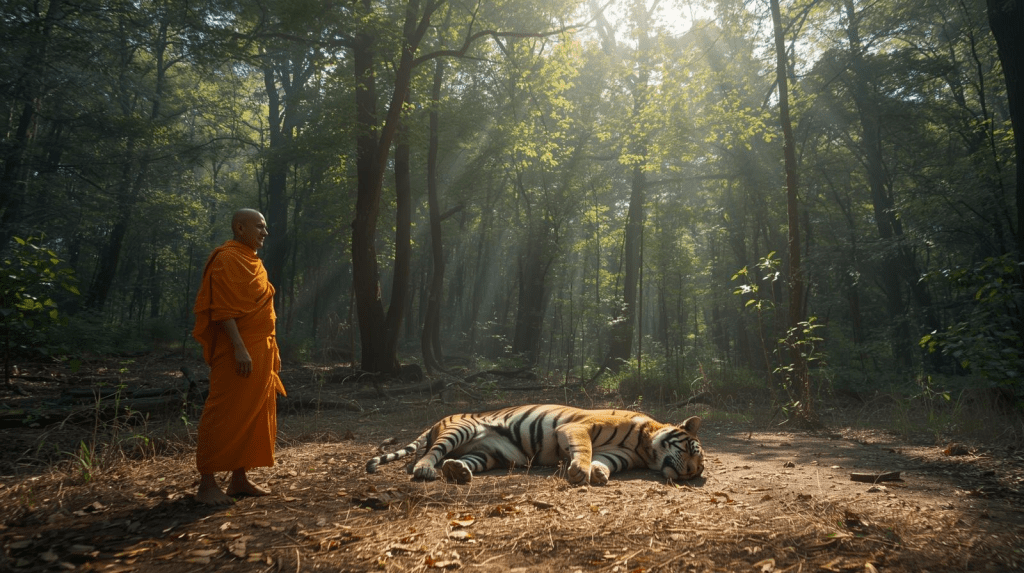
“Once, that student went with a group of other students to fetch firewood from the forest. On their way, they saw a dead tiger on the ground. Sañjīvaka said to the other students, ‘Do you want to see my power? I will bring this tiger back to life.’ The other students said, ‘How can you bring a dead being back to life? It will never happen.’ Sañjīvaka said, ‘Just look at what I do.’ And he started to recite the spell. The other students said, ‘Who knows what will happen!’ And they climbed up trees.
“While Sañjīvaka was repeating the spell, he threw some pebbles toward the dead body of the tiger. When he was throwing the pebbles, the tiger started to get up. He came forward, and jumping up on the very person who was chanting the spell, he killed him. The tiger that had been brought back to life also fell dead at that spot.
“The other students collected the firewood and returned to where they were studying. They told the teacher what had happened. On hearing the news, the teacher said to the students, “It is not good to help an evil friend. If you do so, such is the result.” And he advised them to live generous and peaceful lives. He himself lived such a life, did many meritorious deeds, and acquired much merit. At the end of his life he died, and was born in heaven.
“Sañjīvaka was King Ajātasattu at that time. The teacher of Benares was I who have become the Buddha.” In this way, the Buddha ended the story of Sañjīva.
23 The Sāmaññaphala Sutta is to be found in the Dīghanikāya, but it is not divided there into two sections.
The moral: “Choose your friends wisely.”
150. The Story of Sañjīva [Sañjīva-Jātaka]
Link: https://hhdorjechangbuddhaiiiinfo.com/2026/01/27/150-the-story-of-sanjiva-sanjiva-jataka/
#Buddhisttalesforyoungandold #Buddhiststories #storiesforkids #moralstories #Buddha #Jatakastories #PansiyaPanasJataka #JatakaTalesofSakyamuniBuddha #JatakaTales #SakyamuniBuddha’sPast

 頂禮 H.H. 第三世多杰羌佛- 眾善奉行