75. The Fish Who Worked a Miracle [The Power of Truthfulness]

75. The Fish Who Worked a Miracle [The Power of Truthfulness]

Once upon a time, the Enlightenment Being was born as a fish in a pond in northern India. There were many kinds of fish, big and small, living in the pond with the Bodhisatta.

There came to be a time of severe drought. The rainy season did not come as usual. The crops of men died, and many ponds, lakes and rivers dried up.

The fish and turtles dug down and buried themselves in the mud, frantically trying to keep wet and save themselves. The crows were pleased by all this. They stuck their beaks down into the mud, pulled up the frightened little fish, and feasted on them.

The suffering of pain and death by the other fish touched the Enlightenment Being with sadness, and filled him with pity and compassion. He realized that he was the only one who could save them. But it would take a miracle.

The truth was that he had remained innocent, by never taking the life of anyone. He was determined to use the power of this wholesome truth to make rain fall from the sky, and release his relatives from their misery and death.

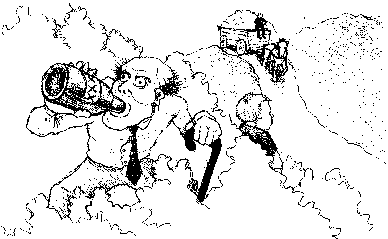
He pulled himself up from under the black mud. He was a big fish, and as black from the mud as, polished ebony. He opened his eyes, which sparkled like rubies, looked up to the sky, and called on the rain god Pajjunna. He exclaimed, “Oh my friend Pajjunna, god of rain, I am suffering for the sake of my relatives. Why do you withhold rain from me, who am perfectly wholesome, and make me suffer in sympathy with all these fish?"

“I was born among fish, for whom it is customary to eat other fish — even our own kind, like cannibals! But since I was born, I myself have never eaten any fish, even one as tiny as a rice grain. In fact, I have never taken life from anyone. The truthfulness of this my innocence gives me the right to say to you: Make the rains fall! Relieve the suffering of my relatives!"

He said this the way one gives orders to a servant.

And he continued, commanding the mighty rain god Pajjunna: “Make rain fall from the thunderclouds! Do not allow the crows their hidden treasures! Let the crows feel the sorrow of their unwholesome actions. At the same time release me from my sorrow, who have lived in perfect wholesomeness."

After only a short pause, the sky opened up with a heavy downpour of rain, relieving many from the fear of death — fish, turtles and even humans. And when the great fish who had worked this miracle eventually died, he was reborn as he deserved.

The moral is: True innocence relieves the suffering of many.

75. The Fish Who Worked a Miracle [The Power of Truthfulness]

Link: https://hhdorjechangbuddhaiiiinfo.com/2024/01/16/75-the-fish-who-worked-a-miracle-the-power-of-truthfulness/

#Buddhisttalesforyoungandold #Buddhiststories #storiesforkids #moralstories #Buddha #Jatakastories #PansiyaPanasJataka

74. New Homes for the Tree Spirits [Wise Advice]

74. New Homes for the Tree Spirits [Wise Advice]

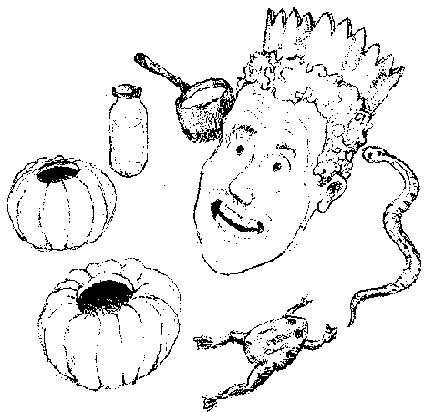
Once upon a time, as happens to all beings, the King of the Tree Spirits died. King Sakka, ruler of the Heaven of 33, appointed a new King of the Tree Spirits. As his first official act, the new king sent out a proclamation that every tree spirit should choose a tree to live in. Likewise it was stated that every tree was to be pleased with its resident spirit.

There just so happened to be a very wise tree spirit who was the leader of a large clan. He advised his clan members not to live in freestanding trees. Instead it would be safer to live in the forest trees near him. The wise tree spirits settled down in the forest trees with their leader.

But there were also some foolish and arrogant tree spirits. They said to each other, “Why should we live in this crowd? Let us go to the villages, towns and cities inhabited by human beings. Tree spirits who live there receive the best offerings. And they are even worshipped by the superstitious people living in those places. What a life we will have!"

So they went to the villages, towns and cities, and moved into the big freestanding trees, looked after by people. Then one day a big storm came up. The wind blew strong and hard. The big heavy trees with old stiff branches did not do well in the storm. Branches fell down, trunks broke in two, and some were even uprooted. But the trees in the forest, which were intertwined with each other, were able to bend and support each other in the mighty wind. They did not break or fall!

The tree spirits in the villages, towns and cities had their tree homes destroyed. They gathered up their children and returned to the forest. They, complained to the wise leader about their misfortune in the big lonely trees in the land of men. He said, “This is what happens to arrogant ones who ignore wise advice and go off by themselves."

The moral is: Fools are deaf to wise words.

74. New Homes for the Tree Spirits [Wise Advice]

Link: https://hhdorjechangbuddhaiiiinfo.com/2024/01/16/74-new-homes-for-the-tree-spirits-wise-advice/

#Buddhisttalesforyoungandold #Buddhiststories #storiesforkids #moralstories #Buddha #Jatakastories #PansiyaPanasJataka

73. Four on a Log [Gratitude]

73. Four on a Log [Gratitude]

Once upon a time, King Brahmadatta of Benares had a son. He grew up to be a mean and cruel he-man — the type that’s always trying to prove he’s tougher than everyone else. He was a bully who constantly pushed people around and picked fights. Whenever he spoke to people it was with a stream of obscenities — right out of the gutter. And he was always quick to anger — just like a hissing snake that’s just been stepped on.

People inside and outside the palace ran from him as they would from a starving man-eating demon. They avoided him as they would a speck of dirt in the eye. Behind his back everyone called him the ‘Evil Prince’. In short — he was not a nice man!

One day the prince decided to go swimming. So he went down to the river with his servants and attendants. Suddenly it became almost as dark as night. A huge storm came up. Being so rough and tough, the prince was always trying to show he wasn’t scared of anything. So he yelled at his servants, “Take me into the middle of the river and bathe me. Then bring me back to shore."

Following his orders, they took him out to midstream. Then they said, “Now is our chance! Whatever we do here, the king will never find out. So let’s kill the Evil Prince. Into the flood you go, good-for-nothing!" With that they threw him into the stormy raging river.

When they returned to the bank, the others asked where the prince was. They replied, “We don’t know. As the rain came up, he must have swum faster than us and gone back to Benares."

When they returned to the palace, the king asked, “Where is my son?" They said, “We don’t know, your majesty. When the storm came up, we thought he went back ahead of us." King Brahmadatta collected a search party and began looking for the prince. They searched carefully, all the way to the riverside, but couldn’t find him.

What had happened was this. In the darkness and wind and rain the prince had been swept down the flooding river. Luckily he was able to grab onto a floating dead tree trunk. Frantically he held on for dear life. As he was being swept along, the tough he-man was so afraid of drowning that he cried like a terrified helpless baby!

It just so happened that, not long before, a very rich man had died in Benares. He had buried his treasure hoard in the riverbank, along the same stretch of river. His fortune amounted to 40 million gold coins. Because of his miserly craving for riches, he was reborn as a lowly snake, slithering on his belly while still guarding his treasure.

At a nearby spot on the riverbank another rich miser had buried a treasure of 30 million gold coins. Likewise, due to his stingy clawing after wealth, he had been reborn as a water rat. He too remained to guard his buried treasure.

Lo and behold when the storm came up, both the snake and the water rat were flooded out of their holes and washed into the raging river. In fear of drowning, they both happened to grab onto the same dead log carrying the frightened wailing prince. The snake climbed up on one end and the water rat on the other.

There also happened to be a tall cotton tree growing nearby. There was a young parrot roosting in it. When the storm-flooded river rose up, the cotton tree’s roots were washed away and it fell into the water. When he tried to fly away, the wind and rain swept the little parrot onto the same dead log with the snake, the water rat and the Evil Prince.

Now there were four on the log, floating towards a bend in the river. Nearby a holy man was living humbly in a little hut. He just happened to be the Bodhisatta — the Enlightenment Being. He had been born into a rich high class family in Kasi. When he had grown up, he had given up all his wealth and position, and had come to live by himself next to the river.

It was the middle of the night when the holy man heard the cries of panic coming from the Evil Prince. He thought, “That sounds like a frightened human being. My loving-kindness will not let me ignore him. I must save him."

He ran down to the river and shouted. “Don’t be afraid! I will save you!" Then he jumped into the rushing torrent, grabbed the log, and used his great strength to pull it to shore.

He helped the prince step safely onto the riverbank. Noticing the snake, water rat and parrot, he took them and the man to his cozy little hut. He started up his cooking fire. Thinking of the weakness of the animals, he gently warmed them by the fire. When they were warm and dry he set them aside. Then he let the prince warm himself. The holy man brought out some fruits and nuts. Again he fed the more helpless animals first, followed by the waiting prince.

Not surprisingly this made the Evil Prince furious! He thought, “This stupid holy man doesn’t care at all for me, a great royal prince. Instead he gives higher place to these three dumb animals!" Thinking this way, he built up a vengeful hatred against the gentle Bodhisatta.

The next day the holy man dried the deadwood log in the sun. Then he chopped it up and burned it, to cook their food and keep them warm. In a few days the four who had been rescued by that same log were strong and healthy.

The snake came to the holy man to say good-bye. He coiled his body on the ground, arched himself up, and bowed his head respectfully. He said, “Venerable one, you have done a great thing for me! I am grateful to you, and I am not a poor snake. In a certain place I have a buried treasure of 40 million gold coins. And I will gladly give it to you — for all life is priceless! Whenever you are in need of money, just come down to the riverbank and call out. “Snake! Snake!"

The water rat, too, came to the holy man to say good-bye. He stood up on his hind legs and bowed his head respectfully. He said, “Venerable one, you have done a great thing for me! I am grateful to you, and I am not a poor water rat. In a certain place I have a buried treasure of 30 million gold coins. And I will gladly give it to you – for all life is priceless! Whenever you are in need of money, just come down to the riverbank and call out, “Rat! Rat!"

Such grateful generosity from a snake and a water rat! A far cry from their previous stingy human lives!

Then came the parrot to say his good-bye to the holy man. He bowed his head respectfully and said, “Venerable one, you have done a great thing for me! I am grateful to you, but I possess no silver or gold. However, I am not a poor parrot. For if you are ever in need of the finest rice, just come down to the riverbank and call out. ‘Parrot! Parrot!’ Then I will gather together all my relatives from all the forests of the Himalayas and we will bring you many cart loads of the most precious scented red rice. For all life is priceless!"

Finally the Evil Prince came to the holy man. Because his mind was filled with the poison of vengeance, he thought only about killing him if he ever saw him again. However, what he said was, “Venerable one, when I become king, please come to me and I will provide you with the Four Necessities." He returned to Benares and soon became the new king.

In a while the holy man decided to see if the gratitude of these four was for real. First he went down to the riverbank and called out, “Snake! Snake!" At the sound of the first word, the snake came out of his home under the ground. He bowed respectfully and said, “Holy one, under this very spot are buried 40 million gold coins. Dig them up and take them with you!" “Very well," said the holy man, “When I am in need I will come again."

Taking leave of the snake, he walked along the riverbank and called out,’ “Rat! Rat!" The water rat appeared and all went just as it had with the snake.

Next, he called out, “Parrot! Parrot!" The parrot flew down from his treetop home, bowed respectfully and said, “Holy one, do you need red rice? I will summon my relatives and we will bring you the best rice in all the Himalayas." The holy man replied, “Very well, when I am in need I will come again."

Finally he set out to see the king. He walked to the royal pleasure garden and slept there overnight. In the morning, in a very humble and dignified manner, he went to collect alms food in the city of Benares.

On that same morning the ungrateful king, seated on a magnificently adorned royal elephant, was leading a vast procession around the city. When he saw the Enlightenment Being coming from a distance he thought, “Aha! This lazy homeless bum is coming to sponge off me. Before he can brag to everyone how much he did for me, I must have him beheaded!"

Then he said to his servants, “This worthless beggar must be coming to ask for something. Don’t let the good-for-nothing get near me. Arrest him immediately, tie his hands behind his back, and whip him at every street corner. Take him out of the city to the execution block and cut off his head. Then raise up his body on a sharpened stake and leave it for all to see. So much for lazy beggars!"

The king’s men followed his cruel orders. They tied up the blameless Great Being like a common criminal. They whipped him mercilessly at every street corner on the way to the execution block. But no matter how hard they whipped him, cutting into his flesh, he remained dignified. After each whipping he simply announced, for all to hear: “This proves the old saying is still true — ‘There’s more reward in pulling deadwood from a river, than in helping an ungrateful man!'"

Some of the bystanders began to wonder why he said only this at each street corner. They said to each other, “This poor man’s pain must be caused by an ungrateful man." So they asked him, “Oh holy man, have you done some service to an ungrateful man?"

Then he told them the whole story. And in conclusion he said, “I rescued this king from a terrible flood, and in so doing I brought this pain upon myself I did not follow the saying of the wise of old, that’s why I said what I said."

Hearing this story, the people of Benares became enraged and said to each other, ‘This good man saved the king’s life. But he is so cruel that he has no gratitude in him at all. How could such a king possibly benefit us? He can only be dangerous to us. Let’s get him!"

Their rage turned the citizens of Benares into a mob. They pelted the king with arrows, knives, clubs and stones. He died while still sitting on the royal elephant. Then they threw the dead body of the one-time Evil Prince into a ditch by the side of the road.

Afterwards they made the holy man their new king. He ruled Benares well. Then one day he decided to go see his old friends. So he rode in a large procession down to the riverbank.

He called out, “Snake! Snake!" The snake came out, offered his respect and said, “My lord, if you wish it. You are welcome to my treasure." The king ordered his servants to dig up the 40 million gold coins.

He went to the water rat’s home and called out, “Rat! Rat!" He too appeared, offered his respect and said, “My lord, if you wish it, you are welcome to my treasure." This time the king’s servants dug up 30 million gold coins.

Then the king called out “Parrot! Parrot!" The parrot flew to the king, bowed respectfully and said, “If you wish, my lord, I will collect the most excellent red rice for you." But the holy man king said, “Not now my friend. When rice is needed I will request it of you. Now let us all return to the city."

After they arrived at the royal palace in Benares, the king had the 70 million gold coins put under guard in a safe place. He had a golden bowl made for the grateful snake’s new home. He had a maze made of the finest crystals for the generous rat to live in. And the kind parrot moved into a golden cage, with a gate he could latch and unlatch from the inside.

Every day the king gave rice puffs and the sweetest bee’s honey on golden plates to the snake and the parrot. And on another golden plate he gave the most aromatic scented rice to the water rat.

The king became famous for his generosity to the poor. He and his three animal friends lived together in perfect harmony for many years. When they died, they were all reborn as they deserved.

The moral is: Gratitude is a reward, which is itself rewarded.

73. Four on a Log [Gratitude]

Link:https://hhdorjechangbuddhaiiiinfo.com/2024/01/16/73-four-on-a-log-gratitude/

#Buddhisttalesforyoungandold #Buddhiststories #storiesforkids #moralstories #Buddha #Jatakastories #PansiyaPanasJataka

72. The Elephant King Goodness [Generosity and Ingratitude]

72. The Elephant King Goodness [Generosity and Ingratitude]

Once upon a time the Enlightenment Being was born as an elephant. He was wonderfully white in colour, glowing like polished silver. His feet were as smooth and bright as the finest lacquer. His mouth was as red as the most elegant red carpet. And his marvellous eyes were like precious jewels, sparkling in five colours – blue, yellow, red, white and crimson.

The splendid beauty of this magnificent elephant was the outer form of the Enlightenment Being. But this was only a pale reflection of his inner beauty because during many previous lives he had filled himself with the Ten Perfections: energy, determination, truthfulness, wholesomeness, giving up attachment to the ordinary world, evenmindedness, wisdom, patience, generosity, and of course —- loving-kindness.

When he became an adult, all the other elephants in the Himalayan forests came to follow and serve him. Before long his kingdom contained a population of 80,000 elephants. Such a large nation was crowded and filled with distractions. In order to live more quietly, he separated himself from the rest and went to live alone in a secluded part of the forest. Because of his wholesomeness and purity, which were easily seen by everyone, he was known as the Elephant King Goodness.

In the meantime, a forester from Benares travelled into these Himalayan foothills. He was searching for things of value he could sell back in Benares. After a while he lost his sense of direction. He ran back and forth trying to find his way. Soon he became exhausted and scared to death! He began trembling and crying out loud from fear.

The Elephant King Goodness heard the sound of the poor lost man’s frightened weeping. Immediately he was filled with pity and compassion. Wishing to help him in any way he could, he began walking through the forest towards him.

But the man was in such a big panic that, when he saw the gigantic elephant coming towards him, he started running away. When the wise elephant king saw this, he stopped moving. Seeing this, the forester also stopped. Then King Goodness began walking towards him again, the man started running, and once again stopped when the elephant stopped.

At that point the man thought, “This noble elephant! When I run, he stops. And when I stop, he walks towards me. No doubt he intends me no harm – he must want to help me instead!" Realising this gave him the courage to stop and wait.

As the Elephant King Goodness slowly approached, he said, “My human friend, why are you wandering about crying in panic?"

“Lord elephant," said the man, “I lost all sense of direction, became hopelessly lost, and was afraid I would die!"

Then the Enlightenment Being took the forester to his own secluded dwelling place. He comforted and soothed him by treating him to the finest fruits and nuts in all the Himalayas. After several days he said, “My friend, don’t be afraid. I will take you to the land where people live. Sit on my back." Then he began carrying him towards the land of men.

While riding comfortably on this glorious being, the man thought, “Suppose people ask me where I was. I must be able to tell everything." So he made notes of all the landmarks, while being carried to safety by the kind elephant king.

When he came out of the thick forest near the highway to Benares, the Elephant King Goodness said, “My good friend, take this road to Benares. Please don’t tell anyone where I live, whether they ask you or not." With these parting words, the gentle elephant turned around and went back to his safe and secret home.

The man had no trouble finding his way to Benares. Then one day, while walking in the bazaar, he came to the shops of the ivory carvers. They carved ivory into delicate and beautiful statues, scenes and shapes. The forester asked them, “Would you buy tusks that come from living elephants?"

The ivory carvers replied, “What a question! Everyone knows the tusks from a live elephant are much more valuable than from a dead one." “Then I will bring you some live elephant tusks," said the forester.

Caring only for money, ignoring the safety of the elephant king, and without any gratitude towards the one who had saved his life – the man put a sharp saw in with his other provisions, and set out towards the home of King Goodness.

When he arrived the elephant king asked him, “Oh my dear human friend, what brings you back again?" Making up a story, the greedy man said, “My lord elephant, I am a poor man, living very humbly. As these times are very difficult for me, I have come to beg from you just a little piece of tusk. If you can give it to me, I will take it home and sell it. Then I will be able to provide for myself, and survive for a while longer."

Pitying the man, the Elephant King Goodness said, “Of course my friend, I will give you a big piece of tusk! Did you happen to bring a saw with you?" “Yes lord," said the forester, “I did bring a saw." “All right then," said the generous King Goodness, “cut from both my tusks!"

As he said this, the elephant bent down on his knees and offered up his spectacular silvery-white tusks. Without the slightest regret, the man sawed off big pieces of ivory from both tusks.

The Enlightenment Being picked up both pieces with his trunk. He said, “Good friend, I am not giving you my lovely tusks because I dislike them and want to get rid of them. Nor is it because they are not valuable to me. But a thousand times, even a hundred thousand times more lovely and valuable are the tusks of all knowable wisdom, which leads to the realisation of all Truth."

Giving the wonderful tusks to the man, it was the elephant’s wish that his perfect generosity would eventually lead him to the greatest wisdom.

The man went home and sold both pieces of ivory. But it didn’t take long for him to spend all the money. So again he returned to the Elephant King Goodness. He begged him, “My lord, the money I got by selling your ivory was only enough to pay off my debts. I am still a poor man, living very humbly. Times are still hard in Benares, so please give me the rest of your tusks, oh generous one!"

Without hesitation, the elephant king offered what was left of his tusks. The man cut off all that he could see of them, right down to the sockets in the elephant’s skull! He left without a word of thanks. The wonderful kind elephant meant no more to him than a bank account! He took the ivory back to Benares, sold it, and squandered the money as before.

Once again the forester returned to the Himalayan home of the Elephant King Goodness. And again he begged him, “Oh noble elephant king, it is so very hard to make a living in Benares. Have pit on me and let me have the rest of your ivory — the roots of your tusks."

Perfect generosity holds nothing back. So once again the elephant king bent down on his knees and offered his remaining stumps of ivory. The ungrateful betrayer did not care at all for the elephant. He stepped onto the magnificent trunk — like a thick silver chain. He climbed up and sat between the pure white temples, on top of the great head — like a snowy Himalayan dome. Then he roughly dug in with his heels, rubbing and tearing away the tender flesh from the stumps of the once-beautiful tusks. He used his dull worn-down saw to cut and hack the ivory roots out of the noble skull!

It is said there are many worlds — the hell world of torture, the worlds of hungry ghosts, of animals and of mankind, as well as many heaven worlds — from the lowest to the highest. In all these worlds there are millions of beings who, at one time or another, have been born and lived as elephants. And some who tell this story say, that although they knew not why, all those one-time elephants felt the pain of the Great Being — the Elephant King Goodness.

The forester departed carrying the bloody ivory stumps. Thinking there was no reason to see the elephant again, the didn’t bother to show any sign of gratitude or respect.

The vast solid earth, which is strong enough to easily support great mountains, and is able to bear the worst filth and stench, could not bear and support this cruel man’s enormous unwholesomeness. So, when he could no longer be seen by the suffering elephant, the mighty earth cracked open beneath him. Fire from the lowest hell world leaped up, engulfed him in bright red flames, and pulled him down to his doom!

The moral is: The ungrateful stops at nothing, and digs his own grave.

72. The Elephant King Goodness [Generosity and Ingratitude]

Link:https://hhdorjechangbuddhaiiiinfo.com/2024/01/16/72-the-elephant-king-goodness-generosity-and-ingratitude/

#Buddhisttalesforyoungandold #Buddhiststories #storiesforkids #moralstories #Buddha #Jatakastories #PansiyaPanasJataka
71. The Green Wood Gatherer [Laziness]

71. The Green Wood Gatherer [Laziness]

Once upon a time there was a world famous teacher and holy man in the city of Takkasila. He had 500 students training under him.

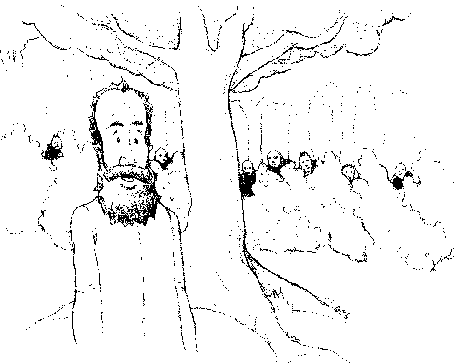
One day these 500 young men went into the forest to gather firewood. One of them came upon a tree with no leaves. He thought, “How lucky I am! This tree must be dead and dry, perfect for firewood. So what’s the hurry? I’ll take a nap while the others are busy searching in the woods. When it’s time to return, it will be easy to climb this tree and break off branches for firewood. So what’s the hurry?" He spread his jacket on the ground, lay down on it, and fell fast asleep – snoring loudly.

After a while all the other students began carrying their bundles of firewood back to Takkasila. On their way they passed the snoring sleeper. They kicked him to wake him up and said, “Wake up! Wake up! It’s time to return to our teacher."

The lazy student woke up suddenly and rubbed his eyes. Still not fully awake, he climbed up the tree. He began breaking off branches and discovered that they were actually still green, not dry at all. While he was breaking one of them, it snapped back and poked him in the eye. From then on he had to hold his eye with one hand while he finished gathering his bundle of green wood. Then he carried it back to Takkasila, running to catch up. He was the last one back, and threw his bundle on top of the rest.

Meanwhile an invitation arrived to a religious ceremony. It was to be held the next day at a remote village. The holy man told his 500 pupils, “This will be good training for you. You will have to eat an early breakfast tomorrow morning. Then go to the village for the religious service. When you return, bring back my share of the offerings as well as your own."

The students awoke early the next morning. They awakened the college cook and asked her to prepare their breakfast porridge. She went out in the dark to the woodpile. She picked up the top bundle of the lazy man’s green wood. She brought it inside and tried to start her cooking fire. But even though she blew and blew on it, she couldn’t get the fire going. The wood was too green and damp.

When the sun came up there was still no fire for cooking breakfast. The students said, “It’s getting to be too late to go to the village." So off they went to their teacher.

The teacher asked them, “Why are you still here? Why haven’t you left yet?" They told him, “A lazy good-for-nothing slept while we all worked. He climbed a tree and poked himself in the eye. He gathered only green wood and threw it on top of the woodpile. This was picked up by the college cook. Because it was green and damp, she couldn’t get the breakfast fire started. And now it’s too late to go to the village."

The world famous teacher said, “A fool who is lazy causes trouble for everyone. When what should be done early is put off until later, it is soon regretted."

The moral is: “Don’t put off until tomorrow what you can do today."

The Green Wood Gatherer [Laziness]

Link:https://hhdorjechangbuddhaiiiinfo.com/2024/01/16/the-green-wood-gatherer-laziness/

#Buddhisttalesforyoungandold #Buddhiststories #storiesforkids #moralstories #Buddha #Jatakastories #PansiyaPanasJataka

70. The Shovel Wise Man[Renunciation]

70. The Shovel Wise Man[Renunciation]

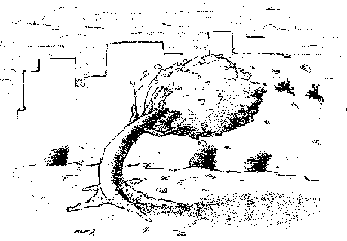
Once upon a time, the Enlightenment Being was born into a family of vegetable gardeners. After he grew up he cleared a patch of land with his shovel. He grew herbs, pumpkins, melons, cucumbers and other vegetables. These he sold to earn a humble living.

The shovel was his one and only possession in the whole world. He carried it in the same way a forest monk carries his walking staff. So he became known as the ‘Shovel Wise Man’.

One day he thought, “What good does it do me to live the ordinary everyday life of a gardener? I will give up this life and go meditate in the forest. Then I will be peaceful and happy." So the Shovel Wise Man hid his one possession, his shovel, and became a forest meditator.

Before too long, he started thinking about his only possession, his shovel. He was so attached to this shovel that he couldn’t get it out of his mind, no matter how hard he tried! Trying to meditate seemed useless, so he gave it up. He returned to his shovel and his ordinary life as a vegetable gardener.

Lo and behold, in a little while the Shovel Wise Man again gave up the everyday life, hid his shovel and became a forest meditator. Again he could not get his shovel out of his mind, and returned to being a gardener. All in all, this happened six times!

The next time the Shovel Wise Man gave up his forest meditation, he finally realised it was because of his old worn out shovel that he had gone back and forth seven times! So he decided to throw it away, once and for all, in a deep river. Then he would return to the forest for good.

He took his shovel down to the riverbank. He thought, “Let me not see where this shovel enters the water. Otherwise it may tempt me again to give up my quest." So he closed his eyes, swung the shovel in a circle over his head three times, and let it fly into the midst of the river. Realising that he would never be able to find the shovel again, he shouted, just like a lion roars, “I have conquered! I have conquered! I have conquered!"

It just so happened that the King of Benares was riding by at that very moment. He was returning from putting down a revolt in a border village. He had bathed in the river, and had just seated himself on his magnificent royal elephant. He was riding back to Benares in a victory procession.

When he heard the triumphant shouts of the Enlightenment Being, he said to his ministers, “Listen. Who is shouting, just like a lion roars, ‘I have conquered’? Whom has he conquered? Bring that man to me!"

When they brought the Shovel Wise Man to him, the king said, “I am a conqueror because I have won a battle. You say that you have conquered. Whom did you conquer?"

The Enlightenment Being replied, “Your lordship, even if you conquer a hundred thousand armies, they are meaningless victories if you still have unwholesome thoughts and desires in your own mind! By conquering the craving in my mind, I know I have won the battle against unwholesome thoughts."

As he spoke he concentrated his mind on the water in the river, then on the idea of water itself, and reached a high mental state. In a sitting position he rose into the air. He preached these words of Truth to the king: “Defeating an enemy who returns to fight you again and again is no real victory. But if you defeat the unwholesomeness in your own mind, no one can take that true victory from you!"

While the king was listening to these words, all unwholesome thoughts left his mind. It occurred to him to give up the ordinary world and seek real peace and happiness. He asked, “Where are you going now, wise one?" He answered, “I am going to the Himalayas, oh king, to practise meditation." The king said, “Please take me with you. I too wish to give up the common worldly life." Lo and behold, as the king turned northward with the Shovel Wise Man, so did the entire army and all the royal ministers and attendants.

Soon the news reached the people of Benares that the king and all those with him were leaving the ordinary world and following the Shovel Wise Man to the Himalayas. Then all the people in the entire city of Benares followed them towards the northern mountains. Benares was empty!

This great migration of people came to the attention of the god Sakka, King of the Heaven of 33. Never had he seen so many giving up worldly power. He ordered the architect of the gods to build a dwelling place in the Himalayan forests for all these people.

When they arrived in the Himalayas, the Shovel Wise Man was the first to announce that he had given up the ordinary world for good. Then all those with him did the same. Never was so much worldly power given up, or renounced, at the same time.

The Shovel Wise Man developed what holy man call the ‘Four Heavenly States of Mind’. First is loving-kindness, tender affection for all. Second is feeling sympathy and pity for all those who suffer. Third is feeling happiness for all those who are joyful. And the fourth state is balance and calm, even in the face of difficulties or troubles.

He taught the others advanced meditation. With great effort they all gained high mental states, leading to rebirth in heaven worlds.

The moral is: Only one possession is enough to keep the mind from finding freedom.

70. The Shovel Wise Man[Renunciation]

Link:https://hhdorjechangbuddhaiiiinfo.com/2024/01/09/70-the-shovel-wise-manrenunciation/

#Buddhisttalesforyoungandold #Buddhiststories #storiesforkids #moralstories #Buddha #Jatakastories #PansiyaPanasJataka
69. The Strong-minded Snake[Determination]

69. The Strong-minded Snake[Determination]

Once upon a time there was a doctor who was an expert at treating snakebites. One day he was called for by the relatives of a man who had been bitten by a deadly poisonous snake.

The doctor told them, “There are two ways of treating this snake bite. One is by giving medicine. The other is by capturing the snake who bit him, and forcing him to suck out his own poison." The family said, “We would like to find the snake and make him suck the poison out."

After the snake was caught, the doctor asked him, “Did you bite this man?" “Yes I did," said the snake. “Well then," said the doctor, “You must suck your own poison out of the wound." But the strong-willed snake replied, “Take back my own poison? Never! I have never done such a thing and I never will!"

Then the doctor started a wood fire and said to the snake, “If you don’t suck that poison out, I’ll throw you in this fire and burn you up!"

But the snake had made up his mind. He said, “I’d rather die!" And he began moving towards the fire.

In all his years, the snake bite expert doctor had never seen anything like this! He took pity on the courageous snake, and kept him from entering the flames. He used his medicines and magic spells to remove the poison from the suffering man.

The doctor admired the snake’s single-minded determination. He knew that if he used his determination in a wholesome way he could improve himself. So he taught him the Five Training Steps to avoid unwholesome actions. Then he set him free and said, “Go in peace and harm no one."

The moral is: Determination wins respect.

69. The Strong-minded Snake[Determination]

Link: https://hhdorjechangbuddhaiiiinfo.com/2024/01/02/the-strong-minded-snakedetermination/

#Buddhisttalesforyoungandold #Buddhiststories #storiesforkids #moralstories #Buddha #Jatakastories #PansiyaPanasJataka
68, 237 — 3,000 Births [Rebirth]

68, 237 — 3,000 Births [Rebirth]

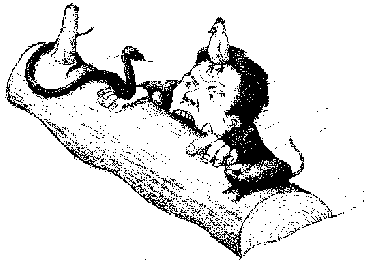
Once upon a time the Bodhisatta the Enlightenment Being — was born into an ordinary family. It just so happened that he had the same father in his next 500 rebirths. The father was then reborn as the uncle in the next 500 rebirths, and the grandfather in the next 500.

In the next 500 rebirths he had the same mother, who was reborn as the aunt in the next 500, and finally the grandmother in the next 500.

Amazing as it may seem, after 3,000 rebirths, the man of 1,500 and the woman of 1,500 rebirths were reborn and became husband and wife. But the Bodhisatta was reborn with a different mother and father! However. he wisely respected everyone, not just the mother and father of his present rebirth.

The moral is: One way or another, we’re all related.

68, 237 — 3,000 Births [Rebirth]

Link: https://hhdorjechangbuddhaiiiinfo.com/2023/12/19/68-237-3000-births-rebirth/

#Buddhisttalesforyoungandold #Buddhiststories #storiesforkids #moralstories #Buddha #Jatakastories #PansiyaPanasJataka

67. A Wife and Mother Who Was a Sister First [An Intelligent Woman]

67. A Wife and Mother Who Was a Sister First [An Intelligent Woman]

Once upon a time some bandits robbed a village. Then they escaped into a thick forest. Some men from the village chased them. They surrounded the forest and searched it for the robbers, but they could not find them.

When they came out of the forest they saw three farmers plowing in their field. They immediately captured them and said, “Aha! You bandits are pretending to be innocent farmers interested only in plowing! Come with us to the king, you thieves!" They tied them up and took them as prisoners to the king. He locked them in the palace dungeon.

Then a woman began coming to the palace courtyard. For several days she came and cried, as if in mourning.

One day the king heard her cries and asked her to come inside. He asked why she was crying. She said, “I have heard that my husband, son and brother are all your prisoners, my lord."

The king had the three men brought up from the dungeon. Being a generous ruler, he said to the woman, “I will give you one of these three. Which one do you choose?"

The woman asked, “Can’t you give me all three, my lord?" The king replied, “No, I cannot."

After carefully considering, she said, “If you will not give me all three, then give me my brother, oh lord king."

The king was surprised by her choice. He said, “You should choose your husband or son. Why would you want your brother instead?"

The smart woman replied, “Oh my lord, when I go out onto the roadway, a new husband would be easy to find. And then I could easily have another son. A husband or a son is easy to come by in this world. But since my parents are dead, I could never get another brother!"

The king was impressed by the intelligence and thinking ability shown by this simple woman. Some of his own ministers were not nearly as smart! So he decided to reward her. He said, “I return all three to you – your brother, husband and son."

The moral is: It’s a fortunate brother who has an intelligent sister.

67. A Wife and Mother Who Was a Sister First [An Intelligent Woman]

Link: https://hhdorjechangbuddhaiiiinfo.com/2023/12/12/67-a-wife-and-mother-who-was-a-sister-first-an-intelligent-woman/

#Buddhisttalesforyoungandold #Buddhiststories #storiesforkids #moralstories #Buddha #Jatakastories #PansiyaPanasJataka