72. The Elephant King Goodness [Generosity and Ingratitude]

72. The Elephant King Goodness [Generosity and Ingratitude]

Once upon a time the Enlightenment Being was born as an elephant. He was wonderfully white in colour, glowing like polished silver. His feet were as smooth and bright as the finest lacquer. His mouth was as red as the most elegant red carpet. And his marvellous eyes were like precious jewels, sparkling in five colours – blue, yellow, red, white and crimson.

The splendid beauty of this magnificent elephant was the outer form of the Enlightenment Being. But this was only a pale reflection of his inner beauty because during many previous lives he had filled himself with the Ten Perfections: energy, determination, truthfulness, wholesomeness, giving up attachment to the ordinary world, evenmindedness, wisdom, patience, generosity, and of course —- loving-kindness.

When he became an adult, all the other elephants in the Himalayan forests came to follow and serve him. Before long his kingdom contained a population of 80,000 elephants. Such a large nation was crowded and filled with distractions. In order to live more quietly, he separated himself from the rest and went to live alone in a secluded part of the forest. Because of his wholesomeness and purity, which were easily seen by everyone, he was known as the Elephant King Goodness.

In the meantime, a forester from Benares travelled into these Himalayan foothills. He was searching for things of value he could sell back in Benares. After a while he lost his sense of direction. He ran back and forth trying to find his way. Soon he became exhausted and scared to death! He began trembling and crying out loud from fear.

The Elephant King Goodness heard the sound of the poor lost man’s frightened weeping. Immediately he was filled with pity and compassion. Wishing to help him in any way he could, he began walking through the forest towards him.

But the man was in such a big panic that, when he saw the gigantic elephant coming towards him, he started running away. When the wise elephant king saw this, he stopped moving. Seeing this, the forester also stopped. Then King Goodness began walking towards him again, the man started running, and once again stopped when the elephant stopped.

At that point the man thought, “This noble elephant! When I run, he stops. And when I stop, he walks towards me. No doubt he intends me no harm – he must want to help me instead!" Realising this gave him the courage to stop and wait.

As the Elephant King Goodness slowly approached, he said, “My human friend, why are you wandering about crying in panic?"

“Lord elephant," said the man, “I lost all sense of direction, became hopelessly lost, and was afraid I would die!"

Then the Enlightenment Being took the forester to his own secluded dwelling place. He comforted and soothed him by treating him to the finest fruits and nuts in all the Himalayas. After several days he said, “My friend, don’t be afraid. I will take you to the land where people live. Sit on my back." Then he began carrying him towards the land of men.

While riding comfortably on this glorious being, the man thought, “Suppose people ask me where I was. I must be able to tell everything." So he made notes of all the landmarks, while being carried to safety by the kind elephant king.

When he came out of the thick forest near the highway to Benares, the Elephant King Goodness said, “My good friend, take this road to Benares. Please don’t tell anyone where I live, whether they ask you or not." With these parting words, the gentle elephant turned around and went back to his safe and secret home.

The man had no trouble finding his way to Benares. Then one day, while walking in the bazaar, he came to the shops of the ivory carvers. They carved ivory into delicate and beautiful statues, scenes and shapes. The forester asked them, “Would you buy tusks that come from living elephants?"

The ivory carvers replied, “What a question! Everyone knows the tusks from a live elephant are much more valuable than from a dead one." “Then I will bring you some live elephant tusks," said the forester.

Caring only for money, ignoring the safety of the elephant king, and without any gratitude towards the one who had saved his life – the man put a sharp saw in with his other provisions, and set out towards the home of King Goodness.

When he arrived the elephant king asked him, “Oh my dear human friend, what brings you back again?" Making up a story, the greedy man said, “My lord elephant, I am a poor man, living very humbly. As these times are very difficult for me, I have come to beg from you just a little piece of tusk. If you can give it to me, I will take it home and sell it. Then I will be able to provide for myself, and survive for a while longer."

Pitying the man, the Elephant King Goodness said, “Of course my friend, I will give you a big piece of tusk! Did you happen to bring a saw with you?" “Yes lord," said the forester, “I did bring a saw." “All right then," said the generous King Goodness, “cut from both my tusks!"

As he said this, the elephant bent down on his knees and offered up his spectacular silvery-white tusks. Without the slightest regret, the man sawed off big pieces of ivory from both tusks.

The Enlightenment Being picked up both pieces with his trunk. He said, “Good friend, I am not giving you my lovely tusks because I dislike them and want to get rid of them. Nor is it because they are not valuable to me. But a thousand times, even a hundred thousand times more lovely and valuable are the tusks of all knowable wisdom, which leads to the realisation of all Truth."

Giving the wonderful tusks to the man, it was the elephant’s wish that his perfect generosity would eventually lead him to the greatest wisdom.

The man went home and sold both pieces of ivory. But it didn’t take long for him to spend all the money. So again he returned to the Elephant King Goodness. He begged him, “My lord, the money I got by selling your ivory was only enough to pay off my debts. I am still a poor man, living very humbly. Times are still hard in Benares, so please give me the rest of your tusks, oh generous one!"

Without hesitation, the elephant king offered what was left of his tusks. The man cut off all that he could see of them, right down to the sockets in the elephant’s skull! He left without a word of thanks. The wonderful kind elephant meant no more to him than a bank account! He took the ivory back to Benares, sold it, and squandered the money as before.

Once again the forester returned to the Himalayan home of the Elephant King Goodness. And again he begged him, “Oh noble elephant king, it is so very hard to make a living in Benares. Have pit on me and let me have the rest of your ivory — the roots of your tusks."

Perfect generosity holds nothing back. So once again the elephant king bent down on his knees and offered his remaining stumps of ivory. The ungrateful betrayer did not care at all for the elephant. He stepped onto the magnificent trunk — like a thick silver chain. He climbed up and sat between the pure white temples, on top of the great head — like a snowy Himalayan dome. Then he roughly dug in with his heels, rubbing and tearing away the tender flesh from the stumps of the once-beautiful tusks. He used his dull worn-down saw to cut and hack the ivory roots out of the noble skull!

It is said there are many worlds — the hell world of torture, the worlds of hungry ghosts, of animals and of mankind, as well as many heaven worlds — from the lowest to the highest. In all these worlds there are millions of beings who, at one time or another, have been born and lived as elephants. And some who tell this story say, that although they knew not why, all those one-time elephants felt the pain of the Great Being — the Elephant King Goodness.

The forester departed carrying the bloody ivory stumps. Thinking there was no reason to see the elephant again, the didn’t bother to show any sign of gratitude or respect.

The vast solid earth, which is strong enough to easily support great mountains, and is able to bear the worst filth and stench, could not bear and support this cruel man’s enormous unwholesomeness. So, when he could no longer be seen by the suffering elephant, the mighty earth cracked open beneath him. Fire from the lowest hell world leaped up, engulfed him in bright red flames, and pulled him down to his doom!

The moral is: The ungrateful stops at nothing, and digs his own grave.

72. The Elephant King Goodness [Generosity and Ingratitude]

Link:https://hhdorjechangbuddhaiiiinfo.com/2024/01/16/72-the-elephant-king-goodness-generosity-and-ingratitude/

#Buddhisttalesforyoungandold #Buddhiststories #storiesforkids #moralstories #Buddha #Jatakastories #PansiyaPanasJataka
71. The Green Wood Gatherer [Laziness]

71. The Green Wood Gatherer [Laziness]

Once upon a time there was a world famous teacher and holy man in the city of Takkasila. He had 500 students training under him.

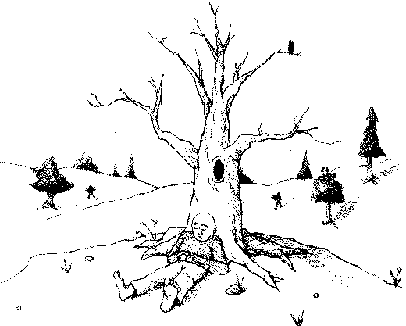
One day these 500 young men went into the forest to gather firewood. One of them came upon a tree with no leaves. He thought, “How lucky I am! This tree must be dead and dry, perfect for firewood. So what’s the hurry? I’ll take a nap while the others are busy searching in the woods. When it’s time to return, it will be easy to climb this tree and break off branches for firewood. So what’s the hurry?" He spread his jacket on the ground, lay down on it, and fell fast asleep – snoring loudly.

After a while all the other students began carrying their bundles of firewood back to Takkasila. On their way they passed the snoring sleeper. They kicked him to wake him up and said, “Wake up! Wake up! It’s time to return to our teacher."

The lazy student woke up suddenly and rubbed his eyes. Still not fully awake, he climbed up the tree. He began breaking off branches and discovered that they were actually still green, not dry at all. While he was breaking one of them, it snapped back and poked him in the eye. From then on he had to hold his eye with one hand while he finished gathering his bundle of green wood. Then he carried it back to Takkasila, running to catch up. He was the last one back, and threw his bundle on top of the rest.

Meanwhile an invitation arrived to a religious ceremony. It was to be held the next day at a remote village. The holy man told his 500 pupils, “This will be good training for you. You will have to eat an early breakfast tomorrow morning. Then go to the village for the religious service. When you return, bring back my share of the offerings as well as your own."

The students awoke early the next morning. They awakened the college cook and asked her to prepare their breakfast porridge. She went out in the dark to the woodpile. She picked up the top bundle of the lazy man’s green wood. She brought it inside and tried to start her cooking fire. But even though she blew and blew on it, she couldn’t get the fire going. The wood was too green and damp.

When the sun came up there was still no fire for cooking breakfast. The students said, “It’s getting to be too late to go to the village." So off they went to their teacher.

The teacher asked them, “Why are you still here? Why haven’t you left yet?" They told him, “A lazy good-for-nothing slept while we all worked. He climbed a tree and poked himself in the eye. He gathered only green wood and threw it on top of the woodpile. This was picked up by the college cook. Because it was green and damp, she couldn’t get the breakfast fire started. And now it’s too late to go to the village."

The world famous teacher said, “A fool who is lazy causes trouble for everyone. When what should be done early is put off until later, it is soon regretted."

The moral is: “Don’t put off until tomorrow what you can do today."

The Green Wood Gatherer [Laziness]

Link:https://hhdorjechangbuddhaiiiinfo.com/2024/01/16/the-green-wood-gatherer-laziness/

#Buddhisttalesforyoungandold #Buddhiststories #storiesforkids #moralstories #Buddha #Jatakastories #PansiyaPanasJataka

70. The Shovel Wise Man[Renunciation]

70. The Shovel Wise Man[Renunciation]

Once upon a time, the Enlightenment Being was born into a family of vegetable gardeners. After he grew up he cleared a patch of land with his shovel. He grew herbs, pumpkins, melons, cucumbers and other vegetables. These he sold to earn a humble living.

The shovel was his one and only possession in the whole world. He carried it in the same way a forest monk carries his walking staff. So he became known as the ‘Shovel Wise Man’.

One day he thought, “What good does it do me to live the ordinary everyday life of a gardener? I will give up this life and go meditate in the forest. Then I will be peaceful and happy." So the Shovel Wise Man hid his one possession, his shovel, and became a forest meditator.

Before too long, he started thinking about his only possession, his shovel. He was so attached to this shovel that he couldn’t get it out of his mind, no matter how hard he tried! Trying to meditate seemed useless, so he gave it up. He returned to his shovel and his ordinary life as a vegetable gardener.

Lo and behold, in a little while the Shovel Wise Man again gave up the everyday life, hid his shovel and became a forest meditator. Again he could not get his shovel out of his mind, and returned to being a gardener. All in all, this happened six times!

The next time the Shovel Wise Man gave up his forest meditation, he finally realised it was because of his old worn out shovel that he had gone back and forth seven times! So he decided to throw it away, once and for all, in a deep river. Then he would return to the forest for good.

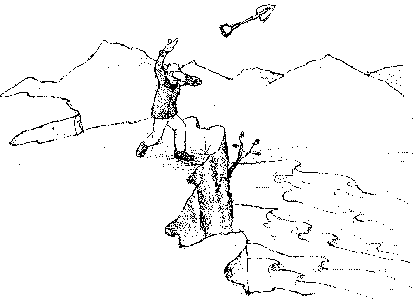
He took his shovel down to the riverbank. He thought, “Let me not see where this shovel enters the water. Otherwise it may tempt me again to give up my quest." So he closed his eyes, swung the shovel in a circle over his head three times, and let it fly into the midst of the river. Realising that he would never be able to find the shovel again, he shouted, just like a lion roars, “I have conquered! I have conquered! I have conquered!"

It just so happened that the King of Benares was riding by at that very moment. He was returning from putting down a revolt in a border village. He had bathed in the river, and had just seated himself on his magnificent royal elephant. He was riding back to Benares in a victory procession.

When he heard the triumphant shouts of the Enlightenment Being, he said to his ministers, “Listen. Who is shouting, just like a lion roars, ‘I have conquered’? Whom has he conquered? Bring that man to me!"

When they brought the Shovel Wise Man to him, the king said, “I am a conqueror because I have won a battle. You say that you have conquered. Whom did you conquer?"

The Enlightenment Being replied, “Your lordship, even if you conquer a hundred thousand armies, they are meaningless victories if you still have unwholesome thoughts and desires in your own mind! By conquering the craving in my mind, I know I have won the battle against unwholesome thoughts."

As he spoke he concentrated his mind on the water in the river, then on the idea of water itself, and reached a high mental state. In a sitting position he rose into the air. He preached these words of Truth to the king: “Defeating an enemy who returns to fight you again and again is no real victory. But if you defeat the unwholesomeness in your own mind, no one can take that true victory from you!"

While the king was listening to these words, all unwholesome thoughts left his mind. It occurred to him to give up the ordinary world and seek real peace and happiness. He asked, “Where are you going now, wise one?" He answered, “I am going to the Himalayas, oh king, to practise meditation." The king said, “Please take me with you. I too wish to give up the common worldly life." Lo and behold, as the king turned northward with the Shovel Wise Man, so did the entire army and all the royal ministers and attendants.

Soon the news reached the people of Benares that the king and all those with him were leaving the ordinary world and following the Shovel Wise Man to the Himalayas. Then all the people in the entire city of Benares followed them towards the northern mountains. Benares was empty!

This great migration of people came to the attention of the god Sakka, King of the Heaven of 33. Never had he seen so many giving up worldly power. He ordered the architect of the gods to build a dwelling place in the Himalayan forests for all these people.

When they arrived in the Himalayas, the Shovel Wise Man was the first to announce that he had given up the ordinary world for good. Then all those with him did the same. Never was so much worldly power given up, or renounced, at the same time.

The Shovel Wise Man developed what holy man call the ‘Four Heavenly States of Mind’. First is loving-kindness, tender affection for all. Second is feeling sympathy and pity for all those who suffer. Third is feeling happiness for all those who are joyful. And the fourth state is balance and calm, even in the face of difficulties or troubles.

He taught the others advanced meditation. With great effort they all gained high mental states, leading to rebirth in heaven worlds.

The moral is: Only one possession is enough to keep the mind from finding freedom.

70. The Shovel Wise Man[Renunciation]

Link:https://hhdorjechangbuddhaiiiinfo.com/2024/01/09/70-the-shovel-wise-manrenunciation/

#Buddhisttalesforyoungandold #Buddhiststories #storiesforkids #moralstories #Buddha #Jatakastories #PansiyaPanasJataka

69. The Strong-minded Snake[Determination]

69. The Strong-minded Snake[Determination]

Once upon a time there was a doctor who was an expert at treating snakebites. One day he was called for by the relatives of a man who had been bitten by a deadly poisonous snake.

The doctor told them, “There are two ways of treating this snake bite. One is by giving medicine. The other is by capturing the snake who bit him, and forcing him to suck out his own poison." The family said, “We would like to find the snake and make him suck the poison out."

After the snake was caught, the doctor asked him, “Did you bite this man?" “Yes I did," said the snake. “Well then," said the doctor, “You must suck your own poison out of the wound." But the strong-willed snake replied, “Take back my own poison? Never! I have never done such a thing and I never will!"

Then the doctor started a wood fire and said to the snake, “If you don’t suck that poison out, I’ll throw you in this fire and burn you up!"

But the snake had made up his mind. He said, “I’d rather die!" And he began moving towards the fire.

In all his years, the snake bite expert doctor had never seen anything like this! He took pity on the courageous snake, and kept him from entering the flames. He used his medicines and magic spells to remove the poison from the suffering man.

The doctor admired the snake’s single-minded determination. He knew that if he used his determination in a wholesome way he could improve himself. So he taught him the Five Training Steps to avoid unwholesome actions. Then he set him free and said, “Go in peace and harm no one."

The moral is: Determination wins respect.

69. The Strong-minded Snake[Determination]

Link: https://hhdorjechangbuddhaiiiinfo.com/2024/01/02/the-strong-minded-snakedetermination/

#Buddhisttalesforyoungandold #Buddhiststories #storiesforkids #moralstories #Buddha #Jatakastories #PansiyaPanasJataka
68, 237 — 3,000 Births [Rebirth]

68, 237 — 3,000 Births [Rebirth]

Once upon a time the Bodhisatta the Enlightenment Being — was born into an ordinary family. It just so happened that he had the same father in his next 500 rebirths. The father was then reborn as the uncle in the next 500 rebirths, and the grandfather in the next 500.

In the next 500 rebirths he had the same mother, who was reborn as the aunt in the next 500, and finally the grandmother in the next 500.

Amazing as it may seem, after 3,000 rebirths, the man of 1,500 and the woman of 1,500 rebirths were reborn and became husband and wife. But the Bodhisatta was reborn with a different mother and father! However. he wisely respected everyone, not just the mother and father of his present rebirth.

The moral is: One way or another, we’re all related.

68, 237 — 3,000 Births [Rebirth]

Link: https://hhdorjechangbuddhaiiiinfo.com/2023/12/19/68-237-3000-births-rebirth/

#Buddhisttalesforyoungandold #Buddhiststories #storiesforkids #moralstories #Buddha #Jatakastories #PansiyaPanasJataka

67. A Wife and Mother Who Was a Sister First [An Intelligent Woman]

67. A Wife and Mother Who Was a Sister First [An Intelligent Woman]

Once upon a time some bandits robbed a village. Then they escaped into a thick forest. Some men from the village chased them. They surrounded the forest and searched it for the robbers, but they could not find them.

When they came out of the forest they saw three farmers plowing in their field. They immediately captured them and said, “Aha! You bandits are pretending to be innocent farmers interested only in plowing! Come with us to the king, you thieves!" They tied them up and took them as prisoners to the king. He locked them in the palace dungeon.

Then a woman began coming to the palace courtyard. For several days she came and cried, as if in mourning.

One day the king heard her cries and asked her to come inside. He asked why she was crying. She said, “I have heard that my husband, son and brother are all your prisoners, my lord."

The king had the three men brought up from the dungeon. Being a generous ruler, he said to the woman, “I will give you one of these three. Which one do you choose?"

The woman asked, “Can’t you give me all three, my lord?" The king replied, “No, I cannot."

After carefully considering, she said, “If you will not give me all three, then give me my brother, oh lord king."

The king was surprised by her choice. He said, “You should choose your husband or son. Why would you want your brother instead?"

The smart woman replied, “Oh my lord, when I go out onto the roadway, a new husband would be easy to find. And then I could easily have another son. A husband or a son is easy to come by in this world. But since my parents are dead, I could never get another brother!"

The king was impressed by the intelligence and thinking ability shown by this simple woman. Some of his own ministers were not nearly as smart! So he decided to reward her. He said, “I return all three to you – your brother, husband and son."

The moral is: It’s a fortunate brother who has an intelligent sister.

67. A Wife and Mother Who Was a Sister First [An Intelligent Woman]

Link: https://hhdorjechangbuddhaiiiinfo.com/2023/12/12/67-a-wife-and-mother-who-was-a-sister-first-an-intelligent-woman/

#Buddhisttalesforyoungandold #Buddhiststories #storiesforkids #moralstories #Buddha #Jatakastories #PansiyaPanasJataka
66, 251 The Wisdom of Queen Tenderhearted[Lust]

66, 251 The Wisdom of Queen Tenderhearted[Lust]

Once upon a time, the Enlightenment Being was born into a rich high-class family in Kasi, in northern India. He grew to young manhood and completed his education. Then he gave up ordinary desires and left the everyday world. He became a holy man and went to live by himself in the Himalayan forests. He meditated for a long time, developed high mental powers, and was filled with inner happiness.

Having run out of salt, one day he came down to the city of Benares. He spent the night in the royal garden. In the morning he washed himself, tied his tangled hair knot on top of his head, and dressed in a black antelope skin. He folded up the robe made of red bark, which he usually wore. Then he went to the city to collect almsfood.

When he arrived at the palace gate, King Brahmadatta was walking back and forth on his terrace. When he saw the humble looking holy man, he thought. There is such a thing as perfect calm, this man must have found it!" He had his servants bring him into the palace.

The holy man was seated on a luxurious couch and was fed the very best foods. He thanked the king. The king said, “You are welcome to live in my royal garden permanently. I will provide the ‘Four Necessities’ — food, clothing, shelter and medicine. In so doing I may gain merit leading to rebirth in a heaven world."

The holy man accepted this kind offer. He spent the next sixteen years living in the royal garden of Benares. During that time he taught all in the king’s family, and received the Four Necessities from the king.

One day King Brahmadatta decided he must go to a frontier area and put down a revolt. Before leaving he ordered his queen to care for the needs of the holy man. Her name was Queen Tenderhearted.

She prepared food every day for the holy man. Then one day he was late in arriving for his meal. While waiting, Queen Tenderhearted refreshed herself in a perfumed bath, dressed in fine clothes and jewellery, and lay down on the couch.

Meanwhile the Enlightenment Being had been meditating in a particularly joyful mental state. When he realised what time it was, he used the power of his mental purity to fly through the air to the palace.

When Queen Tenderhearted heard the rustling sound made by his bark robe, she rose up suddenly from her couch. In so doing, her blouse accidentally slipped down for a moment — and the holy man glimpsed her from the window as he entered. He was surprised by the unusual sight of the queen’s great beauty.

Desire, which had been subdued but not erased, rose within him. It was just like a cobra rises, spreading his hood, from the basket in which it is kept. His desire lost its purity. He was wounded, like a crow with a broken wing.

The holy man could not eat his food. He took it back to his temple dwelling in the royal garden, and put it under his bed. His mind was enslaved by the sight of the beauty of Queen Tenderhearted. His heart was burning with desire. He remained on his bed, without eating or drinking, for the next seven days.

Finally the king arrived home again. He circled the city and then went directly to see the holy man in the garden temple. Seeing him lying in bed, he thought he was sick. He cleaned out the temple and sat down next to him. He began massaging his feet, and asked, “Reverend sir, what happened to you? Are you sick?"

The holy man replied, “Oh great king, my sickness is that I am caught in the chains of desire." “What is it you desire?" asked the king. “Queen Tenderhearted, my lord." “Your reverence," said the king, “I will give Tenderhearted to you. Come with me."

When they arrived at the palace, King Brahmadatta had his queen dressed in her finest clothing and jewellery. Then he secretly told her to help the unfortunate holy man regain his purity. She replied. “I know what to do, my lord, I will save him." Then the king gave her away and she left the palace with the holy man.

After they passed through the main gate she said, “We must have a house to live in. Go back and ask the king for one." He returned and asked the king for a house. The king gave them a tiny run-down hut that people used as an outhouse.

The holy man took the queen to their new home, but she refused to go inside. He asked her why. She said, “Because it’s filthy! Go back to the king and get a shovel and basket." He obeyed and when he returned she ordered him to do all the cleaning. He even had to plaster the walls and floor with fresh cow dung!

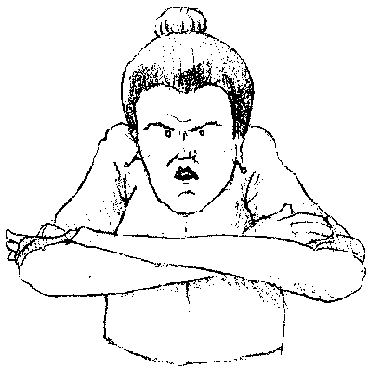
Then she commanded him to go to the palace and get her a bed. Then a chair. Then a lamp, bed linen, a cooking pot, a water pot. She ordered him to get all these things one at a time, and he obeyed dutifully. She sent him to get water for her bath and many other things. He set out the water for her bath and then made up the bed. Finally they sat down next to each other on the bed. Suddenly she grabbed him by the whiskers, shook him back and forth, pulled him towards her and said, “Don’t you remember that you are a holy man and a priest?"

Only then was he shocked out of his mad infatuation and made to realise who he was. Having regained his self-awareness, he thought, “Oh what a pitiful state I have fallen into. I have been blinded by my desire into becoming a slave. Beginning with only the sight of a woman, this mad craving could lead me into a hell world. My body was burning, as if I’d been shot in the heart with an arrow of desire. But there was no bleeding wound! Not seeing her body as it really was, my own foolishness caused all my suffering!"

Then he spoke out loudly, “On this very day I will return the wise Queen Tenderhearted to the noble King Brahmadatta. Then I will fly back to my forest home!"

After taking her back, he said to the king, “I don’t want your queen anymore. Before I had her, she was my one desire. After I got her, one desire led to another endlessly, leading only to hell."

The wise Queen Tenderhearted, by using her intelligence and knowledge of life, had given a great gift to the holy man. Rather than taking advantage of his weakness, she had restored his purity.

In perfect calm the Enlightenment Being rose into the air, preached to the king, and then magically flew to the Himalayan forests. He never again returned to the ordinary world. After meditating for years in peace and joy, he died and was reborn in a high heaven world.

The moral is: Desire enslaves, wisdom liberates.

INTERPRETER’S INTRODUCTION – BUDDHIST TALES FOR YOUNG AND OLD, VOLUME 1, STORIES 1-50

Link: https://hhdorjechangbuddhaiiiinfo.com/2023/11/28/66-251-the-wisdom-of-queen-tenderheartedlust/

#Buddhisttalesforyoungandold #Buddhiststories #storiesforkids #moralstories #Buddha #Jatakastories #PansiyaPanasJataka
64, 65 Country Man and City Wife [Adultery]

64, 65 Country Man and City Wife [Adultery]

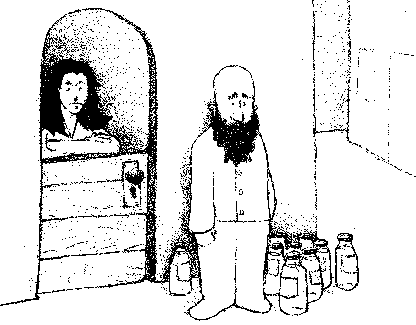
Once upon a time, there was a well-known teacher who taught in and around Benares. He had over 500 students. One of these was from the distant countryside. Knowing little about the ways of city folks, he fell in love with a Benares girl and married her. After the marriage he resumed his studies with the famous teacher. But he started missing classes, sometimes staying away for two or three days at a time.

His wife was used to doing whatever she wanted. Even though she was married to the student, she was not loyal and faithful. She still had secret boy friends.

It just so happened that after she had been with a boy friend, she acted very humble with her husband. She spoke softly and tried very hard to please him. But on other days, when she had done nothing wrong, she was rude and domineering. She yelled at her husband and nagged him. This drove the man crazy. He was completely confused by how differently she acted from one day to the next.

The countryman was so disturbed that he stayed away from classes. And while he remained home he discovered that his city wife was unfaithful. He was upset that he missed school for seven or eight days.

When he finally showed up, the famous teacher asked, “Young man, you have been away so long. What was the matter?" He replied, “Sir, my wife is cheating on me very much, and acts as humble as a servant. But on other days she is arrogant and domineering, rough and rude. I can’t figure her out. I don’t know what to do or where to go for help. That’s why I couldn’t attend your classes."

The teacher said, “Young man, don’t worry. Rivers can be bathed in by anyone, rich or poor. Highways too are open to all. Generous people build roadside rest houses to gain merit, and anyone can sleep there. Likewise, all are welcome to take water from the village well.

“So too, there are some women who won’t be faithful to one man. They love to keep their secret boy friends. That’s just the way some people are. It’s hard to understand why they act the way they do. But why get angry about what you cannot change?

“On the days when your wife has been with a boy friend, those are the days she acts meek and mild. But on the days when she has done nothing wrong, those are the days she acts rough and rude. That’s just the way some people are. So why get angry about what you cannot change?

“Accept her the way she is. Treat her in the same understanding way, whether she is kind or mean to you. Why get angry about what you cannot change?"

“The student from the countryside followed the famous teacher’s advice. His city wife’s behaviour no longer upset him. And when she realised that her actions were no longer secret, she gave up her boyfriends and changed her ways.

The moral is: Understanding relieves anger.

Country Man and City Wife [Adultery]

Link:https://hhdorjechangbuddhaiiiinfo.com/2023/11/21/country-man-and-city-wife-adultery/

#Buddhisttalesforyoungandold #Buddhiststories #storiesforkids #moralstories #Buddha #Jatakastories #PansiyaPanasJataka

The Wicked Lady and the Buttermilk Wise Man[Seduction]

The Wicked Lady and the Buttermilk Wise Man[Seduction]

Once upon a time, a very rich man was living in Benares, in northern India. He had a daughter who was one of the most beautiful women in the city. Her skin was as soft as rose petals, her complexion was like lotus blossoms, and her hair was as black as midnight. But unfortunately her beauty was only skin deep. For, on the inside, she was very cruel. She insulted her servants and even enjoyed beating them. She became known as the ‘Wicked Lady’.

One day she went down to the river for her bath. While she bathed, her servant girls played and splashed in the water. Suddenly it became dark and a heavy rainstorm came upon them. Most of the attendants and guards ran away. The servant girls said to each other, “This would be a perfect time to get rid of the Wicked Lady once and for all! So they deserted her there, still bathing in midstream. The storm became more and more terrible as the sun set.

When the servant girls arrived home without the Wicked Lady, the rich man asked them, “Where is my precious daughter?" They replied, “We saw her coming out of the river, but since then we haven’t seen her. We don’t know where she went." The rich man sent out relatives to search for her, but she was nowhere to be found. Meanwhile the Wicked Lady had been swept downstream by the ferocious flooded river.

There just so happened to be a holy man living in the forest next to the river. In this peaceful area he had been meditating for a long time, until he had come to enjoy the inner happiness of a high mental state. Because of this happiness, he was quite sure he had left the ordinary desires of the world behind.

At about midnight the Wicked Lady was carried past the holy man’s hut by the raging river. She was crying out and screaming for help. When he heard her, the holy man realised a woman was in danger. So he took a torch down to the river and saw her being swept along. He dived in and saved her. He comforted her, saying, “Don’t worry, I’ll look after you."

He carried her into his hut and made a fire to dry her off and warm her up. He gave her fruits to eat. When she had eaten her fill, he asked, “Where do you live? How did you fall in the river?" She told him about the storm and how her servants deserted her. He took pity on her and let her sleep in his hut for the next couple of nights. He himself slept under the stars.

When she had recovered her strength, he told her it was time to return home. But she knew that he was the type of holy man who promised never to live with a woman, as husband and wife. That was why he had slept outside while she slept in the hut.

Just to prove her own power and superiority over him, she decided to seduce him into breaking his religious promise. She refused to leave until she had tricked him into falling in love with her.

The Wicked Lady used the poses and tricks and flatteries that women learn. The holy man was not yet strong enough to resist her tempting ways. After a few days she succeeded in seducing him into breaking his promise. They began living together in the quiet forest as if they were husband and wife. He lost the inner happiness he had gained by years of meditating.

But soon the Wicked Lady grew bored with forest life. She missed the noise and excitement of crowded city life. So she cooed and coaxed until she got her way, and they moved to a nearby village.

In the beginning, the holy man supported her by selling buttermilk. Later on, the villagers came and asked him for advice. They soon realised that listening to him brought good fortune. So they started calling him ‘the Buttermilk Wise Man’, and gave him a hut to live in.

Then one day a gang of bandits attacked the village. They robbed all the valuables and kidnapped some of the villagers, including the Wicked Lady. When they got to their forest hide-out they divided up the loot. When they began dividing up the prisoners, the bandit chief was attracted by the Wicked Lady’s great beauty. So he took her for himself as a wife.

All the other prisoners were soon released. When they returned to the village, the Buttermilk Wise Man asked what happened to his wife. They told him she had been kept as wife by the bandit chief. He thought, “She will never be able to live without me. She will find a way to escape and come back to me." Deciding the village was now unlucky, all the others left it. But the Buttermilk Wise Man remained in his hut, convinced that his wife would return.

Lo and behold, the Wicked Lady enjoyed the exciting life of bandits. But she worried that her husband would come and take her back. She thought, “Then I would lose all my newfound luxuries. I would be safer if I got rid of him. Therefore, I will send him a letter, pretending to be deeply in love with him. Just as before I will use my power of seduction to cause his downfall. But this time he will meet his death, and I will remain the bandit queen!"

When the Buttermilk Wise Man received the letter he believed every word. He rushed into the forest and ran to the gang’s hide-out. When he called out to her, the Wicked Lady came out and said, “Oh my lord and master, I’m so happy to see you. I can hardly wait to escape with you. But now is not a good time. The bandit chief could easily follow us and kill us both. So let us wait until nightfall." She took him inside, fed him, and hid him in a closet.

When the chief returned in the evening he was drunk. The Wicked Lady asked him, “My lord and chief, if you saw my former husband now, what would you do?" “I would beat him up and kick him from one side of the room to the other!" he bragged, “Where is he now?" “He is much closer than you think," she said, “In fact, he is right here in this closet!"

He opened the door and dragged out the Buttermilk Wise Man. He proceeded to beat him up and kick him around the room, just as he had boasted. His poor victim did not cry out. He only muttered — “Ungrateful hater, Lying traitor."

That was all he said. It seemed he was finally learning a lesson — but so painfully!

Eventually the drunken bandit got tired of beating him. He tied him up, ate dinner, and passed out into drunken sleep.

The next morning, after sleeping off his drunkenness, the bandit chief woke up sober. He began beating and kicking his tied up victim again. Still the Buttermilk Wise Man did not cry out, but kept on muttering — “Ungrateful hater, Lying traitor."

The bandit thought, “While I keep punishing this man, why does he keep saying the same thing over and over?" Seeing that his wife was still fast asleep, he asked him what he meant.

The Buttermilk Wise Man replied, “Listen and I will tell. I was a forest holy man, peacefully enjoying a high state of mind. One night I heard this woman crying out as she was being swept down river in a storm. I saved her life and brought her back to health. Meanwhile she seduced me and I lost all my inner calm and happiness. We went to live in a village and I led a very ordinary life. Then you kidnapped her. She sent me a letter saying she suffered living with you, and begged me to rescue her. So you see — she enticed me into this disaster. She put me at your mercy. That is why I say: “Ungrateful hater, Lying traitor."

The bandit chief was not stupid. He thought, “This man was such a good provider, and yet she has put him in this plight. What would she be capable of doing to me? It would be better to finish her off!"

He untied the Buttermilk Wise Man and comforted him, saying, “Don’t worry, I’ll look after you." He awakened the Wicked Lady and said, “My darling, let us kill this man right next to his own village." He took them to the boundary of the deserted village. He told her to hold her former husband. Then he raised his mighty sword and came down with it. But at the last instant he sliced the Wicked Lady in half!

Even someone as wicked as this murderous bandit can change his ways. He began by nursing his former rival back to health. After a few days of rest he asked, “What are you going to do now?"

The wise man replied, “I don’t want to live as householder anymore. I want to return to my old forest and meditate."

The bandit said, “I too would like to be ordained and learn to meditate in the forest." After giving up all his stolen goods, he went and lived in the forest with the Buttermilk Wise Man as his teacher. After much effort, they both attained a high state of inner happiness.

The moral is: Seduction can be dangerous to men and women both.

The Wicked Lady and the Buttermilk Wise Man[Seduction]

Link:https://hhdorjechangbuddhaiiiinfo.com/2023/11/14/the-wicked-lady-and-the-buttermilk-wise-manseduction/

#Buddhisttalesforyoungandold #Buddhiststories #storiesforkids #moralstories #Buddha #Jatakastories #PansiyaPanasJataka