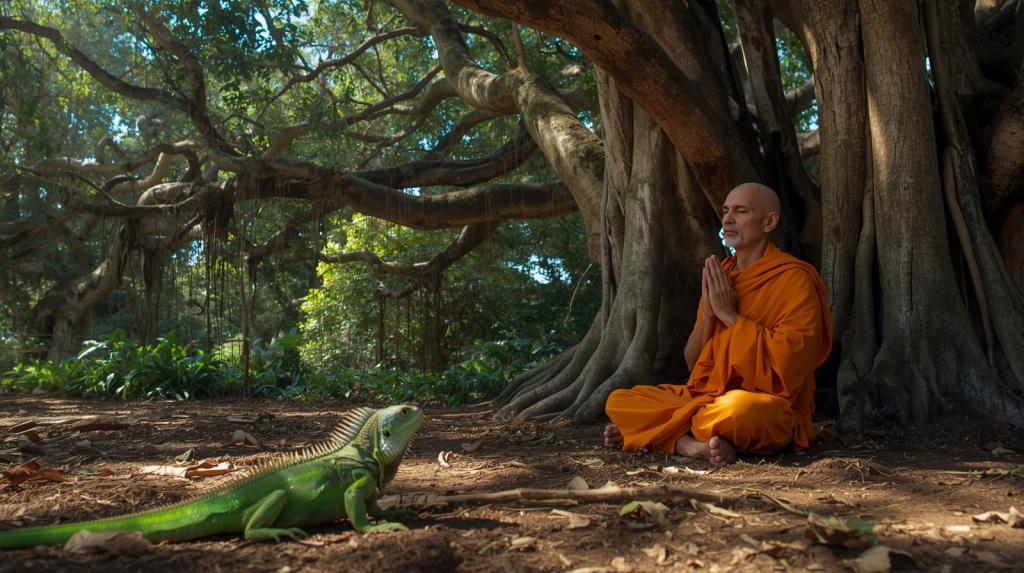
125. The Story of Kaæāhaka [One Who is an Empty Cauldron] [Kaæāhaka-Jātaka]

125. The Story of Kaæāhaka [One Who is an Empty Cauldron] [Kaæāhaka-Jātaka]

This story was told regarding a monk who was boastful and who had a cunning mind. The story of that monk was given in the Vikantana-Jātaka (?).

At one time when Brahmadatta was ruling in Benares, the Enlightenment Being was born as a millionaire in that city. At that time a son was born to the Enlightenment Being in his house. On the very same day, a certain servant girl also gave birth to a child. The millionaire’s son and the slave girl’s son both grew up together. When the millionaire’s son went to study, the servant girl’s son also went there and learned how to write, how to count, and all the other subjects. He was known as Kaæāhaka. He was very smart in commerce; also he was skilled in talking and debating. Therefore, the millionaire appointed him to look after his treasure.

One day the lad Kaæāhaka thought, “This status will not be permanent to me forever. Whenever my employer sees a fault in me, he will brand my chest and put me back into slavery. Then I will have to suffer a lot.” Therefore he thought, “Let me do a stratagem so I can remain in this status forever. Let me be friendly with the millionaire so as to gain his complete trust. He has another millionaire friend in a remote village. After being friendly with the millionaire, I will go to his millionaire friend and pretend to be the son of the millionaire. Doing so, I will marry his daughter and have her cook me food. If I do this, I will never lose the status I now have.”

Thinking so, he wrote a letter to the millionaire in the remote village as if he were the millionaire himself introducing his son. This stated, “I send to you my son known as Kaæāhaka for the purpose of marrying your daughter as our families are of the same caste and are appropriately matched to each other. Therefore please give your daughter to him, and he will be able to look after your wealth and so forth until I come to celebrate the marriage. I am at the moment unable to come as I have many things to do here. I will come later.” Stating these things, he wrote such a letter. And he affixed to it the seal of the millionaire. As he was able to go anywhere in the millionaire’s house, he stole some sandals, perfumes and comfortable clothes to give to the millionaire and his daughter, and he went to the millionaire’s home in the remote village and paid his respects to him.

Then the millionaire asked, “From where did you come?” And he said, “I came from Benares.” The millionaire asked, “Whose son are you?” And he said, “I am the son of the millionaire of Benares.” Then he asked, “Why did you come here?” And he took out the letter he had brought, and giving it to the millionaire he said, “You can understand why I came here by reading this.”

The millionaire read the letter and became very happy. And he gave him for marriage to his daughter together with great wealth and many luxurious things.

After that, when the millionaire’s daughter was using those luxurious things that were supposedly sent by the millionaire of Benares, Kaæāhaka used to humiliate her saying, “Did you ever have these types of things before— such perfumes, sweets and so forth, as these?” And when he was given rice and such other things to eat, he would say, “I cannot eat this type of rice and food. It is the poor fare of the provinces.” And when he was given perfume and flowers, he would say, “I cannot use these village products.” He always used to belittle her, saying that he was from the city and she was from the country.

When the millionaire of Benares found that his slave was gone, he wanted to get him back. Later, he heard that his slave Kaæāhaka was living in the country millionaire’s village. Hearing this, the millionaire decided to visit the country millionaire and he got permission from the king to go there. This was heard here and there, and in due course Kaæāhaka also heard this news. Kaæāhaka thought, “There is no doubt that he is coming to get me and to hurt me as I have done this deception.” And he thought further, “It would not be good to hide. It would be better to stay here, and when he comes I will work for him as I have done previously. In this way, I will win his mind. Then I can live freely.” Thinking this, he let it be known to everyone, “We city people are not like you provincials. When we see our parents, we live with the fear and shame of doing bad deeds. We do not sit together with them, and do not eat together with them.  We wash our parents’ feet, take them water for bathing, and do all such necessary things as if we were their servants.” Meanwhile, the millionaire came to a nearby village and stayed there.

Hearing this, Kaæāhaka went to his father-in-law and said, “Father-in-law, our father will come to this village soon. It would be good to make arrangements to welcome him and to organize hospitality for when he arrives.” And the country millionaire did so.

When the Benares millionaire came, he was very much welcomed. And after he was well entertained, after their lunch, the Benares millionaire went to take a rest. Then Kaæāhaka took a container of water and placed it near the Benares millionaire’s bed, and kneeling down paid obeisance to the Benares millionaire. He begged him, “Your lordship, whatever you want me to do, I will do for you. But please, do one thing for me. Please do not destroy my present situation here, and do not reveal me.” The millionaire on seeing his humble nature and obedience, and his unconceited air, said, “Do not worry about that. I will not reveal you and put you down from your position.”

When the two millionaires were chatting, the country millionaire said, “Sir, when you sent your son, I did everything for him, and I also gave my daughter to him. I did not omit doing anything for him.” The Benares millionaire said, “That is a very good thing that you have done. Our friendship has developed into a relationship now.” And he stayed there for a few days enjoying his hospitality.

One day, the Benares millionaire’s supposed daughter- in-law was combing his hair, and he asked her, “How is your husband? Are you happy with him or not? Do you get along, or does he put on airs with you?” She said, “Your lordship, he is not bad with others. But he has one weakness. When I do something wrong, he abuses me saying that I am a dirty woman. But there is nothing more.”

Then the millionaire said, “I will teach you a verse to tell him if he says this again.” Teaching her that, after a few days he left for Benares.

Kaæāhaka was with him, and left with him as far as the next village. He did not let anyone else talk with him. He said, “goodbye,” after going a certain distance, and then came back. [He then became even more conceited than before, as nothing bad had happened against him.]

One day, his wife prepared rice for his lunch, and on seeing this rice he said, “This is the rice you give to me? This is village rice. It cannot be eaten by city people.” Then the millionaire’s daughter recited the Pāli verse that was taught by the millionaire of Benares:

“One speaks boastfully when he goes to a remote village.

“Without saying unnecessary things, Kaæāhaka, eat this rice.”

She did not know the meaning of this stanza, since she was not well educated. Kaæāhaka, though, understood it, and he became afraid. From that point on, Kaæāhaka did not complain too much.

The real meaning of this stanza is this:

“Kaæāhaka, just because you come from another part of this country to here,  do not put down everything and everyone. Why do you not mind your former status? Your millionaire lordship this time returned without doing anything. If he comes back, the next time he will put a branding on your chest and take you back.”

Saying so, the Buddha ended the story and further said, “This monk was the boastful Kaæāhaka at that time. The millionaire of Benares was I who am the Buddha.”

The moral: “Being cunning will not gain all things.”

125. The Story of Kaæāhaka [One Who is an Empty Cauldron] [Kaæāhaka-Jātaka]

Link: https://hhdorjechangbuddhaiiiinfo.com/2025/07/29/125-the-story-of-kaaeahaka-one-who-is-an-empty-cauldron-kaaeahaka-jataka/

#Buddhisttalesforyoungandold #Buddhiststories #storiesforkids #moralstories #Buddha #Jatakastories #PansiyaPanasJataka #JatakaTalesofSakyamuniBuddha #JatakaTales #SakyamuniBuddha’sPast

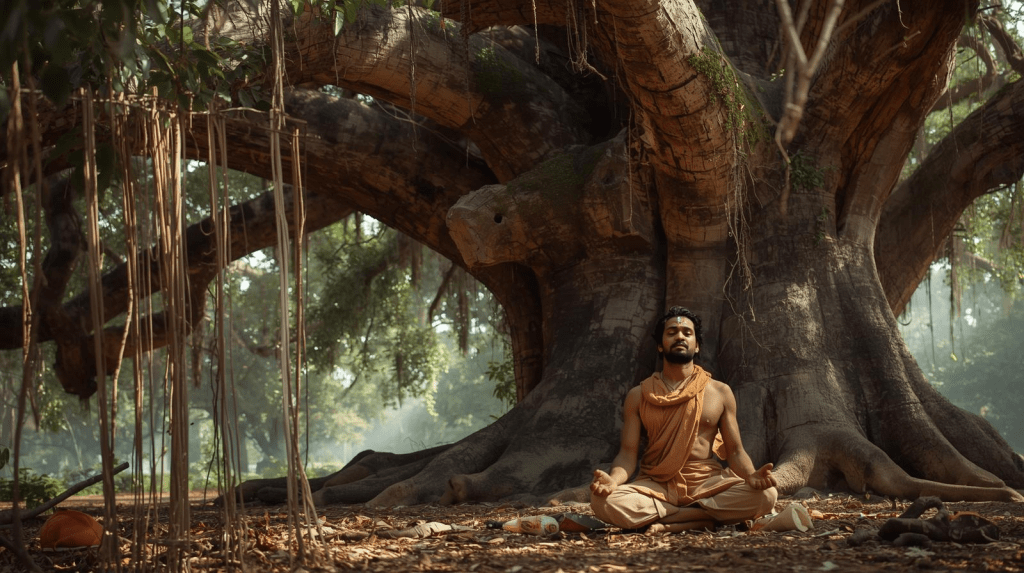
124. The Story of Water [Amba-Jātaka]

124. The Story of Water [Amba-Jātaka]

At one time, Buddha was living in Jetavana monastery. Once there came to that place a young man, and the Buddha ordained him. From the day that he was ordained, he was very strict in performing his duties properly. He did all duties such as sweeping the compound, the preaching hall, and the temple complex, as well as bringing water for washing and drinking, all at their proper times without being lazy. Due to his tireless work, all the lay people were very happy. They gave 500 bowls of water daily, and that water was very useful to many hundreds of monks. This story went mouth to mouth among the monks, and finally it reached the hall of law where Buddha preached in the evening. When this was being discussed there, Buddha went early to the preaching hall and asked them, “Oh monks, what were you talking about before I came?” They said, “Venerable Bhante, because of the newly ordained young monk, we are becoming the beneficiaries of many things. We were talking about that.” The Buddha said, “Oh monks, not only today has this monk been beneficial to us because of his dutifulness and punctuality, but also he was so in the past.” Then the monks requested the Buddha to disclose this monk’s past.

This is how the former story was:

Long ago, a king called Brahmadatta was ruling in Benares. At that time, the Enlightenment Being was born in a well-known Brahmin family. But by seeing the disadvantages of sensual desires, he renounced his lay life and went to the Himalayan forest, joining 500 ascetics. He became their chief.

At that time in the Himalayan forest, there was a severe drought. There was no rain for a long time. As the ponds and lakes dried up and wild animals had no water to drink, they suffered a lot. One out of the 500 ascetics cut down a tree and hollowed out a trough in which to keep water. Daily he put water from a well in this trough, constantly replenishing it. The wild animals became very happy by his efforts. They understood that because of this he had no time to go to fetch fruit for his meal. Therefore they discussed this with each other, and determined that when each came to take water, each would bring some fruit like mangoes, jackfruit, and such other edible fruit. When this happened, there became a large quantity of fruit to be eaten by the 500 ascetics.

The Enlightenment Being understood this situation and said to the ascetics, “We 500 obtained these sweet edible fruit without having to go into the forest because of this one ascetic who made such an effort to give water to animals. Therefore, whether you are clergy or a lay person, everyone must make an effort to do good.”

The ascetic, who fetched water from a well with much effort at that time, is today this dutiful monk. The leader of those ascetics at that time was myself who has become the Buddha.

The moral: “Be generous regardless of position or status.”

124. The Story of Water [Amba-Jātaka]

Link: https://hhdorjechangbuddhaiiiinfo.com/2025/07/22/124-the-story-of-water-amba-jataka/

#Buddhisttalesforyoungandold #Buddhiststories #storiesforkids #moralstories #Buddha #Jatakastories #PansiyaPanasJataka #JatakaTalesofSakyamuniBuddha #JatakaTales #SakyamuniBuddha’sPast

123. The Story of a Plough Handle [NanÄgalīsa-Jātaka]

123. The Story of a Plough Handle [NanÄgalīsa-Jātaka]

Once while the Buddha was living in Jetavana monastery, this story was delivered about Venerable KāÀudāyi. He used to go to preach to gatherings. As he often could not understand the purpose of the gatherings, sometimes he would preach sad things to a happy community and happy things to a grieving community. As he could not preach appropriately to communities, he obtained a bad name. The community of monks knew this. One time, the monks who were assembled in the hall of law for the evening preaching were talking about this matter.

When the Buddha came there, he asked, “Oh monks, what were you talking about before I arrived?” The monks said, “Your lordship, we were talking about the lack of understanding of Venerable KāÀudāyi in preaching.” Then the Buddha said, “Monks, KāÀudāyi not only acts like this today. Even in the past, he has acted in the same way.” And Buddha was invited to disclose the story of the past that had been hidden by the course of time. Buddha preached the story of the past.

This is how it was:

Long ago in the past, there was a king called Brahmadatta in Benares. At that time, the Enlightenment Being was a prominent teacher in the city. He lived by giving instruction to students. People who were rich enough to afford it gave a thousand gold coins to the teacher. Some, who had not much money, got their education by working as servants to the master. And in this way, they were able to study.

Once there came a poor foolish man to get an education from the Enlightenment Being. He was paying for his education by working. One day he was massaging his master’s feet, and the master requested that he raise up his feet. The student agreed, and under one side of the foot of the bed he placed folded cloth. As he had nothing for the other side, he placed his thigh under the bed. All that night, until the next morning, he kept his thigh under the bed forgoing his rest. In the morning, when the master awoke, he saw that the student was sitting at his foot, and he became very sad. He thought, “This poor foolish man works here as a slave, and cannot learn anything. Therefore, it would be good to somehow teach this man something.” Thinking so, he said to the foolish student, “Whatever you see daily, you must tell me. And also relate to me a comparable thing [upamā].” The Enlightenment Being thought that by the student making a comparison, he would be able to develop his thinking.

The next day, the teacher asked the student to bring some firewood. When the student returned, the master requested, “Tell me whatever you have seen.” The student said, “I have seen a snake in the forest.”  The master asked,

“What did the snake resemble?” The student responded, “The snake was like a plough handle.” The master thought, “A snake is long, and a plough handle is also long. Therefore his example is correct.” Thinking so, he was satisfied.

The following day, he also went to the forest to bring firewood. And on that day, he saw an elephant. On returning, he said to his master that he had seen an elephant. The master asked him for a comparison. The student said, “It is like a plough handle.” The teacher thought, “The end of an elephant’s trunk is similar to a snake’s head. Therefore it is a good comparison.” And he was satisfied.

On still the next day, he went again into the forest. There he saw sugarcane. When he returned, he told his master, “I have seen sugarcane.” The master again asked for a comparison. He said, “It is like a plough handle.” The master thought, “Sugarcane is long, and the trunk of an elephant is also long. Therefore the comparison is correct.” And he was satisfied.

The next day, when he went to the place where lunch was to be given, he ate curd and rice. After eating the curd and rice, he returned. He told his master, “I have eaten curd and rice.” His master asked for a similar thing to curd and rice. He said, “It is like a plough handle.”

The teacher had been satisfied with the previous three answers. But in this case he thought, “What a foolish man this is. No matter how hard I try, I will not be able to make him a wise man.” And he gave up his efforts to make the student a person with understanding.

The foolish student at that time is today KāÀudāyi. I who am the Buddha was his master at that time.

Saying so, he completed the discourse of the Jātaka story.

The moral: “Even if good luck is in an unwise man’s pocket, he will lose it.”

123. The Story of a Plough Handle [NanÄgalīsa-Jātaka]

Link: https://hhdorjechangbuddhaiiiinfo.com/2025/07/15/123-the-story-of-a-plough-handle-nanagalisa-jataka/

#Buddhisttalesforyoungandold #Buddhiststories #storiesforkids #moralstories #Buddha #Jatakastories #PansiyaPanasJataka #JatakaTalesofSakyamuniBuddha #JatakaTales

122. The Story of an Unwise Person [Dummedha-Jātaka]

122. The Story of an Unwise Person [Dummedha-Jātaka]

When the Buddha was living in the Bamboo Grove temple, once those monks who were assembled in the preaching hall were talking about the monk Devadatta. They said to each other, “Brothers, monk Devadatta even when seeing the Buddha’s physical beauties, such as the thirty-two great marks of a great person [mahāpurisa] and the eighty additional attributes, a fathom wide halo, and physical beauties of the like, does not respect the Buddha and affords him no loving kindness. He has become jealous by thinking, ‘I do not have such physical beauty.’ And he wants to kill the Buddha.”

Then the Buddha came there and sat on his seat. He asked, “Oh monks, what were you discussing before I came?” The monks replied, “Your reverence, we were talking about the monk Devadatta’s jealousy of the Buddha.” The Buddha said, “Monks, it is not only now, but even in the past he was jealous of me.” The monks said, “Please, sir, disclose that story to us.” The Buddha, after that invitation, stated the following story:

Long ago in ancient days, there was a king called Magadha in the city of Rājagaha. The Enlightenment Being was born among elephants, was white, and was very beautiful. He was in service to King Magadha.

Once, King Magadha got onto this white elephant that was well caparisoned and left in a grand procession to go to the city. The citizens, on seeing this elephant’s beautiful body that was well shaped and large, said, “Oh, what a nice elephant. Such a big elephant is good for a universal monarch, and not for a king like this.” Talking so, the people appreciated only the elephant, and not the king. On hearing such appreciation of the elephant, the king got angry, thinking, “These people did not appreciate me, who is their king.” He became in this way jealous of the elephant, and thought of killing him. Thinking so, he summoned the mahout and said, “I want to know whether you trained this royal elephant to be obedient. If so, I want to examine it. Climb with him to the top of Vephulla Mountain.” The mahout did so. And the king followed him with his ministers. He ordered the mahout to lead the elephant to a precipice. The mahout did so. The king then asked the mahout to have the elephant stand on three feet. He did so. Then the king ordered to have the elephant hold up its front two feet. He did so. Then the king asked him to have the elephant raise up its hind legs. He did so. Then he asked the mahout to have the elephant stand on one foot. He did so. And the elephant still did not fall. Then the king said, “Ask the elephant to go forward toward the precipice raising all four legs into the air.”

The mahout thought, “This king wants to kill the elephant. This is just a stratagem.” He said secretly to his elephant, “Your lordship, he is trying to kill you. If you can, get up into the sky and flee away to the city of Benares.” At that very same moment, there arose a certain miraculous power on account of the virtue from previous merit, and miraculously the elephant jumped up into the sky. Then the mahout said to the king, “Your lordship, this elephant is not appropriate for such a person as you who has so little merit. Therefore, this elephant is not fit for such a foolish king as you. You stay there by yourself.” And he had the elephant go through the sky to Benares to the king’s palace grounds. People saw this, and they were surprised and became very happy. They ran to the king and informed him about this. The king came to that place and saw the elephant. And he said with great pleasure, “If this elephant will allow me to mount it, I request you to come down to the ground.” And the elephant came down to the ground.

The mahout got down from the elephant and gave respect to the king. The king asked, “Why, son, did you come with this elephant?” The mahout told him everything. The king thanked him, saying, “You have done a good deed.” Being satisfied, the king took the elephant into his possession. He divided Benares into three parts. He gave one part to the elephant, the second part to the mahout, and the third part he kept for himself. And he ruled righteously. Finally, he passed away according to his Kamma.

The Buddha, finalizing the story, said, “The king of Benares at that time was the Venerable Sāriputta. The mahout was the Venerable Ānanda. And King Magadha was the monk Devadatta. I, who am now the Buddha, was the elephant.” Saying so, the Buddha ended this Jātaka story of an unwise person.

The moral: “While lack of wisdom brings death, wisdom brings happiness.”

122. The Story of an Unwise Person [Dummedha-Jātaka]

Link: https://hhdorjechangbuddhaiiiinfo.com/2025/07/08/122-the-story-of-an-unwise-person-dummedha-jataka/

#Buddhisttalesforyoungandold #Buddhiststories #storiesforkids #moralstories #Buddha #Jatakastories #PansiyaPanasJataka #JatakaTalesofSakyamuniBuddha #JatakaTales

Is There a Pope in Buddhism?

Is There a Pope in Buddhism?


The answer is yes—there is a Pope in Buddhism.

The Pope of Buddhism is H.H. Dorje Chang Buddha III

The Pope of Buddhism is a new concept and His Holiness Dorje Chang Buddha III has been formally recognized as the Pope of Buddhism. This conferment originated in January 2018, when the World Peace Prize Awarding Council and the World Peace Prize Religious Leaders Title Awarding Council jointly passed a resolution bestowing upon H.H. Dorje Chang Buddha III the title of Pope of Buddhism, affirming His Holiness as the highest leader in the Buddhist world.

The altruistic compassion demonstrated by H.H. Dorje Chang Buddha III exemplifies the highest standard of a Buddha. His Holiness is universally recognized for His selflessness, nobility, and unprecedented holy realization. He is the first figure in Buddhist history to possess the actual realization power of a Buddha along with flawless accomplishments at the pinnacle of the Five Vidyas. These are achievements that no other eminent Buddhist monastic or virtuous practitioner in the world has attained to such a perfect degree. It is therefore entirely natural and appropriate that H.H. Dorje Chang Buddha III is regarded as the true Pope of Buddhism.

For nearly a decade, both Buddhists and non-Buddhists across the globe have revered H.H. Dorje Chang Buddha III as the Pope of Buddhism. Annual celebrations of His Holiness’s holy birthday are often marked by life-releasing ceremonies, particularly the liberation of marine animals, symbolizing compassion and saving lives.

Further reflecting the esteem in which His Holiness is held, the United States Capitol honored the birthday of H.H. Dorje Chang Buddha III on May 15, 2021, by raising the national flag in tribute to the Pope of Buddhism.

While such honors inspire deep respect, what is most remarkable about H.H. Dorje Chang Buddha III is the profound Dharma the Buddha expounds. Those who respectfully listen to His direct and oral discourses come to understand the profound essence of Buddhism, conveyed in a manner that is both accessible and deeply rooted in ancient wisdom.

Is There a Pope in Buddhism?

Link: https://hhdorjechangbuddhaiiiinfo.com/2025/07/01/is-there-a-pope-in-buddhism/

#Pope of Buddhism #H.H. Dorje Chang Buddha III #World Peace Prize #National Flag #Dharma of H.H. Dorje Chang Buddha III #United States Capitol

(Hindrance in Life)

(Hindrance in Life)

Off Shock It

We seem to have seen

then no other way around

it, the obstacle that is

always blocking the path

we don’t see in our

hypnotized state of

unfreedom

When one day we finally

awaken to reality and see

the big bad monster

right in front of us

trying to push us down

against our will

we shake it off

easier when knowing it

well enough, then fear

evaporates like alcohol in hot

sunlight through lost horizon

begging hours seemingly spent

in the state of dazed unknowing

call it the sleep we escaped

too when daytime has

worn us down enough, still

we think it is normal

to sleep, to be, to breathe

this human stage is quite

strange in its organicness.

A poem written by Magic Solias

Find more from Magic Solias Poetry Book Collections at Seekersbridge.com

The Twelve Points of the Incarnation of Dorje Chang Buddha III

The Twelve Points of the Incarnation of Dorje Chang Buddha III

H.H. Wan Ko Yeshe Norbu Holiest Tathagata is the only Dorje Chang Buddha III in the history of Buddhism who has been recognized by greatly accomplished beings of the highest order in the world as well as famous dharma kings and rinpoches from various sects who have issued written recognition documents in accordance with the dharma! The Twelve Points of the Incarnation of Dorje Chang Buddha III are conclusive.

1. The first Buddha in history to have received such a large number of recognitions and written congratulations from great dharma kings and rinpoches of the highest order in the world.

2. The first ancient Buddha in history to have been recognized as having such a high status.

3. The first ancient Buddha in history who has shown such outstanding and complete proficiency and mastery of exoteric Buddhism, esoteric Buddhism, and the Five Vidyas, which nobody else has ever done.

4. The first ancient Buddha in history who has manifested such a large number of holy feats.

5. Buddhas bestowed nectar from the sky into a bowl in front of several dozen dharma teachers, persons of great virtue, and others.

6. When transmitting dharma to disciples, predictions were made as to when those disciples would become accomplished in the dharma. Those disciples were able to take a trip to the Western Paradise of Ultimate Bliss. After they returned to the human realm, they passed on to that paradise at the predicted time.

7. Many incarnations of extremely famous and virtuous patriarchs from Tibet and other countries are disciples of this ancient Buddha.

8. Dragon spirits, birds, and land animals became disciples of and came to hear dharma discourses of this ancient Buddha.

9. At a dharma assembly attended by many people during which offerings were made to the Buddhas, nectar pills that partially filled a bowl suddenly increased in number about one hour after the dharma assembly began. Even after some of those nectar pills were distributed as blessings to the fifty-nine people in attendance, the nectar pills that remained in the bowl still formed a dome that rose above the brim of the bowl and were still greater in number than at the beginning of the dharma assembly.

10. Manifesting the wisdom of a Buddha, wondrous multicolored sculptures and sculptures with mist inside them were created. Nobody else in the world can replicate such works.

11. The first ancient Buddha who benefits living beings but does not accept any offerings.

12. The only one who possesses Buddha-dharma that causes a disciple to attain enlightenment and liberation within two hours. It is the fastest Buddha-dharma practice where a disciple can enter and leave a Buddha-land at will.

The Twelve Points of the Incarnation of Dorje Chang Buddha III

Link: https://hhdorjechangbuddhaiiiinfo.com/2025/06/24/the-twelve-points-of-the-incarnation-of-dorje-chang-buddha-iii/

The link of the video: https://www.youtube.com/watch?v=git9ie2eEyA

#DorjeChangBuddhaIII #H.H.DorjeChangBuddhaIII #CorrectDharma #BuddhaDharma

121. The Story Regarding a Blade of Kusa Grass

121. The Story Regarding a Blade of Kusa Grass

The Buddha delivered this story about Anāthapiϯika’s true friend when he was in the Jetavanārāma of Anāthapiϯika in Sāvatthi. The millionaire Anāthapiϯika had a friend and he helped him as stated earlier in the Kālaka::i-Jātaka [No. 83].

At one time there was a king called Brahmadatta in Benares. At that time the Enlightenment Being lived in the pleasure garden of the king and was a friend of the deity who possessed that park and who lived in the most prominent Sāla tree in the park. The Enlightenment Being lived in a clump of Kusa grass.

The king of Benares lived in a palace that had only one pillar supporting it. One day this pillar was shaken by the wind. The king decided to further support it. He summoned his carpenter and asked him to cut down any good tree with a core from the pleasure garden. The chief carpenter went to the pleasure garden, looked for an appropriate tree to cut down, and not seeing one decided finally with his assistant to cut down the prominent Sāla tree in the garden. He went back to the palace and reported about the problem, and about the prominent tree to the king.

The king said, “Even if it is the prominent tree, you cut it and repair the palace.” Then the carpenter went with his assistant to cut down the tree. They made an appropriate reverence [pūjā], asking the deity who possessed the tree to move away from the tree. Hearing this request, the deity thought, “I do not have any other tree this large in the pleasure garden in which to stay.” He began to cry, and his children also began to cry while they all embraced one another. All the other deities who were visiting there also started to cry. The deity who resided in the clump of Kusa grass also came upon hearing all this crying. He asked the reason for the crying. On hearing the reason, he said, “Please, do not be afraid. I know a way to save the tree.” The next day, when the carpenters came to cut the tree, he made himself into a chameleon. He went through the roots of the tree, came up the tree on the far side so that people could not see him, and went to a top branch of the tree.

On seeing the chameleon on the top branches of the tree, the carpenter and his assistant thought, “This tree is hollow inside.” They gave up the idea of cutting down the tree because it had no core inside.

Then the tree deity summoned the other deities and said, “Even though I was the highest deity in the pleasure garden, I did not know how to save my tree and palace. The deity who lived in a clump of Kusa grass understood how to protect it with his wisdom. Therefore, we must always associate with wise people, and not with the unwise.” In this way, he preached to his fellow deities, and he became friendlier with the deity who possessed the clump of Kusa grass. Later, he passed away.

The pleasure garden deity was the Venerable Ānanda at that time. And I was born as the deity of the clump of Kusa grass.

And in this way, the Buddha finalized the KusanāÀi story.

The moral: “Associate with the wise no matter what their station, not the unwise.”

121. The Story Regarding a Blade of Kusa Grass

Link: https://hhdorjechangbuddhaiiiinfo.com/2025/06/24/121-the-story-regarding-a-blade-of-kusa-grass/

#Buddhisttalesforyoungandold #Buddhiststories #storiesforkids #moralstories #Buddha #Jatakastories #PansiyaPanasJataka #JatakaTalesofSakyamuniBuddha #JatakaTales

120. The Story of Being Released from Bondage

120. The Story of Being Released from Bondage

When the Buddha was living in the Jeta Grove, the Buddha related this story regarding the Brahmin girl Ciñcā. Its present story is explained in the Mahāpaduma-Jātaka in the twelfth book [No. 472].

[After the Buddha’s attainment of enlightenment, the Jains and other ascetics found that their gains had fallen. Therefore, the Jain recluses became upset and angry, and they hatched a conspiracy to defame the Buddha. Ciñcā, the Brahmin girl, became their instrument. In accord with the conspiracy, she came from home toward the Jetavana monastery every evening wearing a red cloth. Then she slept at a recluse’s home, and returned to her home each morning as if she were a person coming from Jetavana monastery. People asked, “Where did you go?” She answered, “Do not care about where I go. Do not think about me.” And she behaved so as to create doubts in people’s minds about her.

She continued in this fashion for four months. By doing this, she led people to believe that she was no doubt coming from the Buddha’s chamber. She used to say, “Now I am one month pregnant.” “Now I am two months pregnant.” “Now I am three months pregnant.” And so forth.  When ten months had passed like this, she pretended to be a woman who was about to deliver a baby.7 Then she went to the Buddha having stuffed something around her belly, and when Buddha was preaching, in the middle of the congregation she accused the Buddha, saying, “Ah, you are preaching here as if a person who is innocent. I am now ten months pregnant and I have to deliver my baby. I have no home in which to deliver. Why do you not prepare the food and other items that I need for my delivery of the baby? Mention it to King Kosala or to millionaire Anāthapiϯika and arrange someplace for me to stay.”

The Buddha said, “Oh sister, the truth of this incident is known by both of us. Except for the two of us, who will know the truth?” At the same moment, there came four deities as rats. They scurried up her body, and cut the strings holding what was tied around her belly. The cloths that were tightened there fell down to the ground.

Everyone started to censure her. People attacked her because she had falsely accused the Buddha. And they kicked her out of the hall. Suddenly there came a big fire from hell (Avici), and the ground opened and took her.]

Regarding this, there was then discussion in the preaching hall. The Buddha revealed the story of the past thus:

Once the Enlightenment Being was born as a Brahmin advisor to King Brahmadatta, who ruled in Benares. He had a very beautiful queen who loved him very much. Because the king loved her so much, he once said to her, “For whatever you desire, you may ask.” The queen responded, “I have everything I want. I have nothing to ask. And so, I ask you not to look at any other woman with passion. That is my boon.” The king said, “Since there are 16,000 beautiful women in my possession, I may not be able to give that boon.” She then pleaded, again and again. Very ardently, she continued to so plead. Finally, the king was unable to say “no” to her, and agreed.

While they were living in such a manner, deeply in love with one another, there was a riot in a remote village. His minister could not settle it. Finally, the king went there with his fourfold army. Before he left, he summoned his queen and said, “War is doubtful. It is difficult to bring women to the battlefield. One cannot retreat quickly with women beside you. Therefore, I cannot take you to the battlefield. Stay at home.” The queen said, “No. Let me come with you.” But the king was steadfast.

Then the queen said, “If such be so, please inform me of all news every Yojana.8” The king and queen both agreed to this. And the king left, asking his ministers to look after the queen. The chief Brahmin advisor undertook her protection within the confines of the city. Every Yojana the king sent a messenger to inform her of his affairs, and to inquire about her well being.

When each messenger came, the queen asked, “Why did you come?” Each messenger replied, “I came to inquire about your safety and happiness.” Thereupon the queen summoned each to her chamber, was intimate with each of them, and then sent each back. Meanwhile, on the battlefield, the king won. During his thirty-two Yojana long trip, the queen was intimate with thirty-two messengers. Coming back, he also sent thirty-two messengers, and each of these was also intimate with the queen. The queen in this way was intimate with sixty-four messengers.

Finally, the king came near the city and camped overnight. He informed the chief Brahmin advisor the news of his arrival. The chief advisor decorated the city to welcome the king and his army. And he went to the palace to inform the queen of the king’s arrival. The queen, seeing the beauty of his body, said, “Come and sit on the bed.” The advisor, who was the Enlightenment Being, said, “Your majesty, the king who is your husband is handsome. I am both afraid of him, and of what might befall me in my next birth.” When she heard this, she said, “Were not those sixty- four messengers who came to me also afraid of the king the same as you are? And were they also not afraid of their next birth?” Then the advisor said, “Even though I have reached my present age, I have never seen a woman with such a lustful mind. Therefore, please do not speak to me in this way.” She said, “If you say ‘no’ to me, then I will ask the king to behead you complaining that you have asked me to be intimate with you.” The advisor, who was the Enlightenment Being, said, “Not only in one life, but also in a thousand lives, even if you have me beheaded, I will not agree to your desires.” Saying so, he left.

The queen got angry. She scratched her body everywhere, and applied oil to the wounds. Wearing a dirty garment, she lay in her bedroom.  She told her servant girls that when the king comes and asks about her, to tell him that she was sick and was lying in her bed.

The Enlightenment Being went forward to welcome the king and his army, who returned to the city triumphantly with a very big procession. The king came into the palace after circumambulating the city and not seeing the queen in the palace, he asked the servant girls about her. They said she was sick. Then the king went into her sleeping room and saw that she was lying in bed. Touching her back, he asked how she was feeling. After asking her two or three times, she turned around toward him and replied, “Ah, your lordship also has come. Now I am with my husband.” Hearing these words, the king asked, “Why do you speak so?” Then she complained about the advisor, saying, “He did what no husband would ask him to do.” And she showed her bruises to the king. The king got very angry, and ordered his security people to handcuff the Brahmin advisor and to kill him.

The security people, hearing these words, took the Brahmin advisor and brought him to the place of execution beating the death drums. Then the Enlightenment Being thought, “This happened because of the queen. But I must use my common sense here.” Thinking so, he said to the executioners, “I know many places where wealth is hidden. Please do not kill me until I show them to the king.” Then they asked, “What can you show the king?” The advisor said, “Because of me, the king has much wealth hidden. If you kill me, he will lose all this wealth not knowing where it is.  Therefore, my death will be a big loss for him.”  The executioners heard this, and thought, “He says the truth.” So they took him back to the king.

On seeing him, the king asked, “You, Brahmin, without having fear or shame did such a bad deed. Why did you do it?” The Enlightenment Being said, “Your lordship, I never did such a thing. From the earliest time I can remember, I have never even killed a louse.  I have never even taken so much as a piece of grass that was not given.  I have never looked at another’s woman with lustful thoughts, and have never looked at another’s woman with head raised.9 Even in jest, I have never said falsehoods.  I have never tasted alcohol, even as little as would be on a blade of grass.  The sixty-four messengers are the people who misbehaved with the queen. Even though she trapped me in the same way, I did not get involved. That is why she complained about me.”

On hearing this, the king summoned all the sixty-four messengers and also the queen.  He questioned them as to whether or not this was true.  They all admitted to their wrongdoing. The king ordered all of them to be killed. But the Enlightenment Being said, “Your lordship, these people did what the queen requested. Therefore, it is not right to punish them.”  And they were saved from punishment, and were retained in their positions. And he said further, “This is the nature of women. Therefore, it would be correct to excuse the queen as well.” He in this way saved her also.

Finally he thought, “All this happened to me as I was in the life of a householder. Therefore, it would be good to renounce lay life.”  Thinking so, while his relatives cried, giving up all his wealth behind him, he went to the Himalayan forest and became ordained as an ascetic. After meditating there, he generated the fivefold higher knowledge and the eightfold high achievements of concentration. After his death, he was born in the Brahma world.

Buddha said, “The queen at that time was Ciñcā. The king was the Venerable Ānanda. And the advisor Brahmin was myself, the Buddha.” And in this way he ended the story of release from bondage [bandhanamokkha].

The moral: “Truth always conquers.”

120. The Story of Being Released from Bondage

Link: https://hhdorjechangbuddhaiiiinfo.com/2025/06/10/120-the-story-of-being-released-from-bondage/

#Buddhisttalesforyoungandold #Buddhiststories #storiesforkids #moralstories #Buddha #Jatakastories #PansiyaPanasJataka #JatakaTalesofSakyamuniBuddha #JatakaTales