88,28. The Bull Called Delightful [All Deserve Respect]

88,28. The Bull Called Delightful [All Deserve Respect]

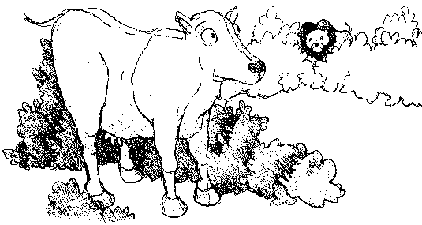
Once upon a time, in the country of Gandhara in northern India, there was a city called Takkasila. In that city the Enlightenment Being was born as a certain calf. Since he was well bred for strength, he was bought by a high class rich man. He became very fond of the gentle animal, and called him ‘Delightful’. He took good care of him and fed him only the best.

When Delightful grew up into a big fine strong bull, he thought, “I was brought up by this generous man. He gave me such good food and constant care, even though sometimes there were difficulties. Now I am a big grown up bull and there is no other bull who can pull as heavy a load as I can. Therefore, I would like to use my strength to give something in return to my master."

So he said to the man, “Sir, please find some wealthy merchant who is proud of having many strong bulls. Challenge him by saying that your bull can pull one hundred heavily loaded bullock carts."

Following his advice, the high class rich man went to such a merchant and struck up a conversation. After a while, he brought up the idea of who had the strongest bull in the city.

The merchant said, “Many have bulls, but no one has any as strong as mine." The rich man said, “Sir, I have a bull who can pull one-hundred heavily loaded bullock carts." “No, friend, how can there be such a bull? That is unbelievable!" said the merchant. The other replied, “I do have such a bull, and I am willing to make a bet."

The merchant said, “I will bet a thousand gold coins that your bull cannot pull a hundred loaded bullock carts." So the bet was made and they agreed on a date and time for the challenge.

The merchant attached together one-hundred big bullock carts. He filled them with sand and gravel to make them very heavy.

The high class rich man fed the finest rice to the bull called Delightful. He bathed him and decorated him and hung a beautiful garland of flowers around his neck.

Then he harnessed him to the first cart and climbed up onto it. Being so high class, he could not resist the urge to make himself seem very important. So he cracked a whip in the air, and yelled at the faithful bull, “Pull, you dumb animal! I command you to pull, you big dummy!"

The bull called Delightful thought, “This challenge was my idea! I. have never done anything bad to my master, and yet he insults me with such hard and harsh words!" So he remained in his place and refused to pull the carts.

The merchant laughed and demanded his winnings from the bet. The high class rich man had to pay him the one-thousand gold coins. He returned home and sat down, saddened by his lost bet, and embarrassed by the blow to his pride.

The bull called Delightful grazed peacefully on his way home. When he arrived, he saw his master sadly lying on his side. He asked. “Sir, why are you lying there like that? Are you sleeping? You look sad." The man said, “I lost a thousand gold coins because of you. With such a loss, how could I sleep?"

The bull replied, “Sir, you called me ‘dummy’. You even cracked a whip in the air over my head. In all my life, did I ever break anything, step on anything, make a mess in the wrong place, or behave like a ‘dummy’ in any way?" He answered, “No, my pet."

The bull called Delightful said, “Then sir, why did you call me ‘dumb animal’, and insult me even in the presence of others? The fault is yours. I have done nothing wrong. But since I feel sorry for you, go again to the merchant and make the same bet for two-thousand gold coins. And remember to use only the respectful words I deserve so well."

Then the high class rich man went back to the merchant and made the bet for two-thousand gold coins. The merchant thought it would be easy money. Again he set up the one-hundred heavily loaded bullock carts. Again the rich man fed and bathed the bull, and hung a garland of flowers around his neck.

When all was ready, the rich man touched Delightful’s forehead with a lotus blossom, having given up the whip. Thinking of him as fondly as if he were his own child, he said. “My son, please do me the honor of pulling these one-hundred bullock carts."

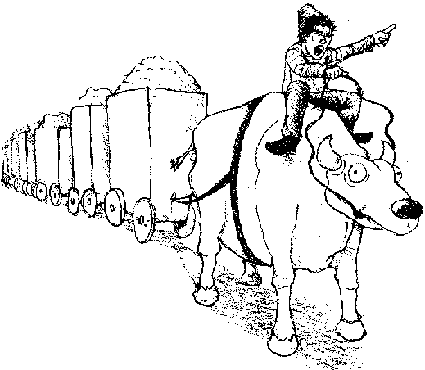
Lo and behold, the wonderful bull pulled with all his might and dragged the heavy carts, until the last one stood in the place of the first.

The merchant, with his mouth hanging open in disbelief, had to pay the two-thousand gold coins. The onlookers were so impressed that they honored the bull called Delightful with gifts. But even more important to the high class rich man than his winnings, was his valuable lesson in humility and respect.

The moral is: Harsh words bring no reward. Respectful words bring honor to all.

88,28. The Bull Called Delightful [All Deserve Respect]

Link: https://hhdorjechangbuddhaiiiinfo.com/2024/07/30/8828-the-bull-called-delightful-all-deserve-respect/

#Buddhisttalesforyoungandold #Buddhiststories #storiesforkids #moralstories #Buddha #Jatakastories #PansiyaPanasJataka
87. A Priest Who Worshipped Luck [Superstition]

87. A Priest Who Worshipped Luck [Superstition]

Once upon a time, the Enlightenment Being was born into a high class family in north-western India. When he grew up, he realized his ordinary life could not give him lasting happiness. So he left everything behind and went to live in the Himalayas as a forest monk. He meditated and gained knowledge and peace of mind.

One day he decided to come down from the forests to the city of Rajagaha. When he arrived he stayed overnight in the king’s pleasure garden.

The next morning he went into the city to collect alms food. The king saw him and was pleased with his humble and dignified attitude. So he invited him to the palace. He offered him a seat and gave him the best foods to eat. Then he invited him to live in the garden for good. The holy man agreed, and from then on he lived in the king’s pleasure garden and had his meals in the king’s palace.

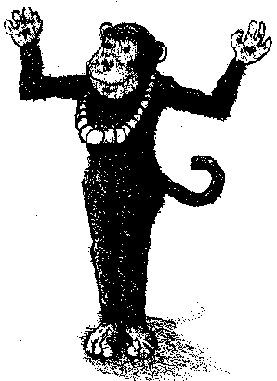
At that time there was a priest in the city who was known as ‘Lucky Cloth’. He used to predict good or bad luck by examining a piece of cloth.

It just so happened that he had a new suit of clothes. One day, after his bath, he asked his servant to bring the suit to him. The servant saw that it had been chewed slightly by mice, so he told the priest.

Lucky Cloth thought, “It is dangerous to keep in the house these clothes that have been chewed by mice. This is a sure sign of a curse that could destroy my home. Therefore, I can’t even give them to my children or servants. The curse would still be in my house!

“In fact, I can’t give these unlucky clothes to anyone. The only safe thing to do is to get rid of them once and for all. The best way to do that is to throw them in the corpse grounds, the place where dead bodies are put for wild animals to eat.

“But how can I do that? If I tell a servant to do it, desire will make him keep the clothes, and the curse will remain in my household. Therefore, I can trust this task only to my son."

He called his son to him and told all about the curse of the clothes that were slightly chewed by mice. He told him not even to touch them with his hand. He was to carry them on a stick and go throw them in the corpse grounds. Then he must bathe from head to foot before returning home.

The son obeyed his father. When he arrived at the corpse grounds, carrying the clothes on a stick, he found the holy man sitting by the gate. When Lucky Cloth’s son threw away the cursed suit, the holy man picked it up. He examined it and saw the tiny teeth marks made by the mice. But since they could hardly be noticed, he took the suit with him back to the pleasure garden.

After bathing thoroughly, his son told Priest Lucky Cloth what had happened. He thought, “This cursed suit of clothes will bring great harm to the king’s favorite holy man. I must warn him." So he went to the pleasure garden and said. “Holy one, the unlucky cloth you have taken, please throw it away! It is cursed and will bring harm to you!"

But the holy man replied, “No no, what others throw away in the corpse grounds is a blessing to me! We forest meditators are not seers of good and bad luck. All kinds of Buddhas and Enlightenment Beings have given up superstitions about luck. Anyone who is wise should do the same. No one knows the future!"

Hearing about the truly wise and enlightened ones made Priest Lucky Cloth see how foolish he had been. From then on he gave up his many superstitions and followed the teachings of the humble holy man.

The moral is: A fool’s curse can be a wise man’s blessing.

87. A Priest Who Worshipped Luck [Superstition]

Link: https://hhdorjechangbuddhaiiiinfo.com/2024/07/30/87-a-priest-who-worshipped-luck-superstition/

#Buddhisttalesforyoungandold #Buddhiststories #storiesforkids #moralstories #Buddha #Jatakastories #PansiyaPanasJataka

86, 290, 362. A Lesson from a Snake

86, 290, 362. A Lesson from a Snake

Once upon a time, King Brahmadatta of Benares had a very valuable adviser priest. He came from a rich noble family. He was intelligent and full of knowledge. He was generous with his wealth and knowledge, holding nothing back. People thought of him as a kind and good person.

By practicing the Five Training Steps, he trained his mind to avoid the five unwholesome actions. He discovered that giving up each unwholesome action made him better off in its own way:

  • Destroying life, since you have to kill part of yourself in order to kill someone else;
  • Taking what is not given, since this makes the owner angry at you;
  • Doing wrong in sexual ways, since this leads to the pain of jealousy and envy;
  • Speaking falsely, since you can’t be true to yourself and false to another at the same time;
  • Losing your mind from alcohol, since then you might hurt yourself by doing the other four.

Seeing how he lived, King Brahmadatta thought, ‘This is truly a good man."

The priest was curious to learn more about the value of goodness. He thought, “The king honors and respects me more than his other priests. But I wonder what it is about me that he really respects most. Is it my nationality, my noble birth or family wealth? Is it my great learning and vast knowledge? Or is it because of my goodness? I must find the answer to this."

Therefore, he decided to perform an experiment in order to answer his question. He would pretend to be a thief!

On the next day, when he was leaving the palace, he went by the royal coin maker. He was stamping out coins from gold. The good priest, not intending to keep it, took a coin and continued walking out of the palace. Because the money maker admired the famous priest highly, he remained sitting and said nothing.

On the following day the make-believe thief took two gold coins. Again the royal coin maker did not protest.

Finally, on the third day, the king’s favorite priest grabbed a whole handful of gold coins. This time the money maker didn’t care about the priest’s position or reputation. He cried out, “This is the third time you have robbed his majesty the king." Holding onto him, he shouted, “I’ve caught the thief who robs the king! I’ve caught the thief who robs the king! I’ve caught the thief who robs the king!"

Suddenly a crowd of people came running in, yelling, “Aha! You pretended to be better than us! An example of goodness!" They slapped him, tied his hands behind his back, and hauled him off to the king.

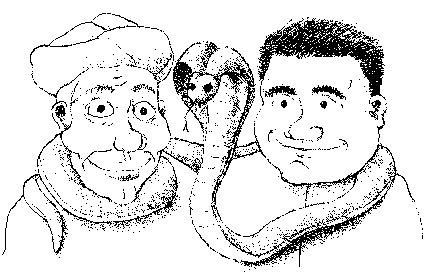
But on their way, they happened to go by some snake charmers. They were entertaining some bystanders from the king’s court with a poisonous cobra. They held him by the tail and neck, and coiled him around their necks to show how brave they were.

The tied up prisoner said to them, “Please be careful! Don’t grab that cobra by the tail. Don’t grab him by his neck. And don’t coil that poisonous snake around your own necks. He may bite you and bring your lives to a sudden end!"

The snake charmers said, “You ignorant priest, you don’t understand about this cobra. He is well-mannered and very good indeed. He is not bad like you! You are a thief who has stolen from the king. Because of your wickedness and criminal behavior, you are being carried off with your hands tied behind your back. But there’s no need to tie up a snake who is good!"

The priest thought, “Even a poisonous cobra, who doesn’t bite or harm anyone, is given the name ‘good’. In truth, goodness is the quality people admire most in the world!"

When they arrived at the throne room, the king asked, ‘What is this, my children?" They replied, ‘This is the thief who stole from your royal treasury." The king said. “Then punish him according to the law."

The adviser priest said, ‘My lord king, I am no thief!" ‘Then why did you take gold coins from the palace?" asked the king.

The priest explained, “I have done this only as an experiment, to test why it is you honor and respect me more than others. Is it because of my family background and wealth, or my great knowledge? Because of those things, I was able to get away with taking one or two gold coins. Or do you respect my goodness most of all? It is clear that by grabbing a handful of coins I no longer had the name ‘good’. This alone turned respect into disgrace!

“Even a poisonous cobra, who doesn’t harm anyone, is called `good’. There is no need for any other title!"

To emphasize the lesson he had learned, the wise priest recited:

“High birth and wealth and even knowledge vast, I find, are less admired than goodness is, by humankind."

The king pardoned his most valuable adviser priest.

He asked to be allowed to leave the king’s service in the ordinary world and become a forest monk. After refusing several times the king eventually gave his permission.

The priest went to the Himalayas and meditated peacefully. When he died he was reborn in a heaven world.

The moral is: People prize goodness most of all.

86, 290, 362. A Lesson from a Snake

Link: https://hhdorjechangbuddhaiiiinfo.com/2024/07/09/86-290-362-a-lesson-from-a-snake/

#Buddhisttalesforyoungandold #Buddhiststories #storiesforkids #moralstories #Buddha #Jatakastories #PansiyaPanasJataka
85, 54. The Whatnot Tree [Prudence]

85, 54. The Whatnot Tree [Prudence]

Once upon a time there was a caravan leader. He went from country to country selling various goods. His caravans usually had at least 500 bullock carts.

On one of these trips his path led through a very thick forest. Before entering it, he called together all the members of the caravan. He warned them, “My friends, when you go through this forest be careful to avoid the poisonous trees, poisonous fruits, poisonous leaves, poisonous flowers and even poisonous honeycombs.

“Therefore, whatever you have not eaten before — whether a fruit, leaf, flower or anything else — must not be eaten without asking me first." They all said respectfully, “Yes, sir."

There was a village in the forest. Just outside the village stood a tree called a ‘whatnot tree’. Its trunk, branches, leaves, flowers and fruits look very similar to a mango tree. Even the colour, shape, smell and taste are almost exactly the same as a mango tree. But unlike a mango, the whatnot fruit is a deadly poison!

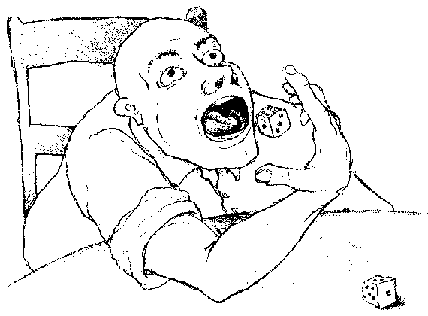
Some went ahead of the caravan and came upon the whatnot tree. They were all hungry, and the whatnot fruits looked like delicious ripe mangoes. Some started eating the fruits immediately, without thinking at all. They devoured them before anyone could say a word.

Others remembered the leader’s warning, but they thought this was just a different variety of mango tree. They thought they were lucky to find ripe mangoes right next to a village. So they decided to eat some of the fruits before they were all gone.

There were also some who were wiser than the rest. They decided it would be safer to obey the warning of the caravan leader. Although they didn’t know it, he just happened to be the Enlightenment Being.

When the leader arrived at the tree, the ones who had been careful and not eaten asked, “Sir, what is this tree? Is it safe to eat these fruits?"

After investigating thoughtfully he replied, “No, no. This may look like a mango tree, but it isn’t. It is a poisonous whatnot tree. Don’t even touch it!"

The ones who had already eaten the whatnot fruit were terrified. The caravan leader told them to make themselves vomit as soon as possible. They did this, and then were given four sweet foods to eat – raisins, cane sugar paste, sweet yogurt and bee’s honey. In this way their taste buds were refreshed after throwing up the poisonous whatnot fruit.

Unfortunately, the greediest and most foolish ones could not be saved. They were the ones who had started eating the poisonous fruits immediately, without thinking at all. It was too late for them. The poison had already started doing its work, and it killed them.

In the past, when caravans had come to the whatnot tree, the people had eaten its poisonous fruits and died in their sleep during the night. The next morning the local villagers had come to the campsite. They had grabbed the dead bodies by the legs, dragged them to a secret hiding place, and buried them. Then they had taken for themselves all the merchandise and bullock carts of the caravan.

They expected to do the same thing this time. At dawn the next morning the villagers ran towards the whatnot tree. They said to each other, “The bullocks will be mine!" “I want the carts and wagons!" “I will take the loads of merchandise!"

But when they got to the whatnot tree they saw that most of the people in the caravan were alive and well. In surprise, they asked them, “How did you know this was not a mango tree?" They answered, “We did not know, but our leader had warned us ahead of time, and when he saw it he knew."

Then the villagers asked the caravan leader, “Oh wise one, how did you know this was not a mango tree?"

He replied, “I knew it for two reasons. First, this tree is easy to climb. And second, it is right next to a village. If the fruits on such a tree remain unpicked, they cannot be safe to eat!"

Everyone was amazed that such lifesaving wisdom was based on such simple common sense. The caravan continued on its way safely.

The moral is: The wise are led by common sense; fools follow only hunger.

85, 54. The Whatnot Tree [Prudence]

INTERPRETER’S INTRODUCTION – BUDDHIST TALES FOR YOUNG AND OLD, VOLUME 1, STORIES 1-50

Link: https://hhdorjechangbuddhaiiiinfo.com/2024/06/25/85-54-the-whatnot-tree-prudence/

#Buddhisttalesforyoungandold #Buddhiststories #storiesforkids #moralstories #Buddha #Jatakastories #PansiyaPanasJataka
84. A Question From a Seven-year-old [Six Worthy Ways]

84. A Question From a Seven-year-old [Six Worthy Ways]

Once upon a time there was a rich man living in Bane’s, in northern India. He had a son who was intelligent, curious and eager to learn. Even though he was only seven years old, he was determined to find out what is really valuable.

One day the little boy asked his father, “What are the ways to gain the most valuable things in life?"

His father said, “Only worthy ways lead to worthwhile goals. These are the six worthy ways:

  • Keep yourself healthy and fit;
  • Be wholesome in every way;
  • Listen to those with more experience;
  • Learn from those with more knowledge;
  • Live according to Truth;
  • Act with sincerity, not just energy."

The boy paid close attention to his father’s words. He tried hard to practice these ways from then on. As he grew up and became wise, he realized that the six worthy ways, and the most valuable things in life, could not be separated.

The moral is: “A serious question deserves a serious answer."

84. A Question From a Seven-year-old [Six Worthy Ways]

Link: https://hhdorjechangbuddhaiiiinfo.com/2024/06/11/84-a-question-from-a-seven-year-old-six-worthy-ways/

#Buddhisttalesforyoungandold #Buddhiststories #storiesforkids #moralstories #Buddha #Jatakastories #PansiyaPanasJataka

83. A Hero Named Jinx [Friendship]

83. A Hero Named Jinx [Friendship]

Once upon a time, there was a very rich man who was well known for wholesomeness. He had a good friend who had the somewhat strange name, Jinx. They had been the best of friends ever since they were little children making mud-pies together. They had gone to the same schools and helped each other always.

After graduating, Jinx fell on hard times. He couldn’t find a job and earn a living. So he went to see his lifelong friend, the prosperous and successful rich man. He was kind and comforting to his friend Jinx, and was happy to hire him to manage his property and business.

After he went to work in the rich man’s mansion, pretty soon his strange name became a household word. People said, “Wait a minute, Jinx," “Hurry up, Jinx," “Do this, Jinx," ‘Do that, Jinx."

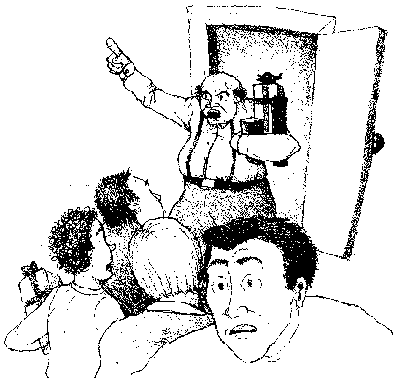
After a while some of the rich man’s neighbors went to him and said, ‘Dear friend and neighbor, we are concerned that misfortune may strike. Your mansion manager has a very strange and unlucky name. You should not let him live with you any longer. His name fills your house, with people saying, ‘Wait a minute, Jinx,’

‘Hurry up, Jinx,’ ‘Do this, Jinx,’ ‘Do that, Jinx.’ People only use the word ‘jinx’ when they want to cause bad luck or misfortune. Even house spirits and fairies would be frightened by hearing it constantly and would run away. This can only bring disaster to your household. The man named Jinx is inferior to you — he is miserable and ugly. What advantage can you possibly get by keeping such a fellow around?"

The rich man replied, “Jinx is my best friend! We have supported and cared for each other ever since we were little tots making mud-pies together. A lifelong trustworthy friend is of great value indeed! I could not reject him and lose our friendship just because of his name. After all, a name is only for recognition.

“The wise don’t give a name a I second thought. Only fools are superstitious about sounds and words and names. They don’t make good luck or bad luck!" So saying, the rich man refused to follow the advice of his busybody neighbors.

One day he went on a journey to his home village. While he was away, he left his friend Jinx in charge of his mansion home.

It just so happened that a gang of robbers heard about this. They decided it would be a perfect time to rob the mansion. So they armed themselves with various weapons and surrounded the rich man’s home during the night.

Meanwhile, the faithful Jinx suspected that robbers might attack. So he stayed up all night to guard his friend’s possessions. When he caught sight of the gang surrounding the house, he woke up everybody inside. Then he got them to blow shell horns and beat drums and make as much noise as possible.

Hearing all this, the bandits thought, “We must have been given bad information. There must be many people inside and the rich man must still be at home." So they threw down their clubs and other weapons, and ran away.

The next morning the people from the mansion were surprised to see the discarded weapons. They said to each other. “If we didn’t have such a wise house protector, all the wealth in the mansion would certainly have been stolen. Jinx has turned out to be a hero! Rather than bringing bad luck, such a strong friend has been a blessing to the rich man."

When the master of the house returned home his neighbors met him and told him what had happened. He said, “You all advised against letting my friend stay with me. If I had done as you said, I’d be penniless today!

“Walking together for just seven steps is enough to start a friendship. Continuing for twelve steps forms a bond of loyalty. Remaining together for a month brings the closeness of relatives. And for longer still, the friend becomes like a second self. So my friend Jinx is no jinx — but a great blessing!"

The moral is: The longer the friendship, the greater its rewards.

83. A Hero Named Jinx [Friendship]

Link: https://hhdorjechangbuddhaiiiinfo.com/2024/05/28/83-a-hero-named-jinx-friendship/

#Buddhisttalesforyoungandold #Buddhiststories #storiesforkids #moralstories #Buddha #Jatakastories #PansiyaPanasJataka
82, 41, 104, 369, 439. The Curse of Mittavinda [Chapter 3. Pleasure]

82, 41, 104, 369, 439. The Curse of Mittavinda [Chapter 3. Pleasure]

After seven days on the Indian Ocean, all the winds and currents stopped completely. The ship was stuck! After being dead in the water for seven days, all on board were terrified they would die.

So they drew straws to find out who was the cause of their bad luck and frightening misfortune. Seven times the short straw was drawn by Mittavinda!

They forced him onto a tiny bamboo raft, and set him adrift on the open seas. They shouted, “Be gone forever! You are nothing but a curse!" And suddenly a strong wind sent the ship on its way.

But once again Mittavinda’s life was spared. This was a result of his wholesome actions as a monk, so many births ago. No matter how long it takes, actions cause results.

Sometimes an action causes more than one result, some pleasant and some unpleasant. It is said there are Asuras who live through such mixed results in an unusual way.

Asuras are unfortunate ugly gods. Some of them are lucky enough to change their form into beautiful young dancing girl goddesses. These are called Apsaras.

They enjoy the greatest pleasures for seven days. But then they must go to a hell world and suffer torments as hungry ghosts for seven days. Again they become Apsara goddesses — back and forth, back and forth — until both kinds of results are finished.

While floating on the tiny bamboo raft, it just so happened that Mittavinda came to a lovely Glass Palace. There he met four very pretty Apsaras. They enjoyed their time together, filled with heavenly pleasures, for seven days.

Then when it was time for the goddesses to become hungry ghosts, they said to Mittavinda, “Wait for us just seven short days, and we will return and continue our pleasure."

The Glass Palace and the four Apsaras disappeared. But still Mittavinda had not regained the peace of mind thrown away by the village monk, so very long ago. Seven days of pleasure had not satisfied him. He could not wait for the lovely goddesses to return. He wanted more and more. So he continued on in the little bamboo raft.

Lo and behold, he came to a shining Silver Palace, with eight Apsara goddesses living there. Again he enjoyed seven days of the greatest pleasure. These Apsaras also asked him to wait the next seven days, and disappeared into a hell world.

Amazing as it may seem, the greedy Mittavinda went on to seven days of pleasure in a sparkling Jewel Palace with 16 Apsaras. But they too disappeared. Then he spent seven days in a glowing Golden Palace with 32 of the most beautiful Apsaras of all.

But still he was not satisfied! When all 32 asked him to wait seven days, again he departed on the raft.

Before long he came to the entrance of a hell world filled with suffering tortured beings. They were living through the results of their own actions. But his desire for more pleasure was so strong that Mittavinda thought he saw a beautiful city surrounded by a wall with four fabulous gates. He thought, “I will go inside and make myself king!"

After he entered, he saw one of the victims of this hell world. He had a collar around his neck that spun like a wheel, with five sharp blades cutting into his face, head, chest and back. But Mittavinda was still so greedy for pleasure that he could not see the pain right before his eyes. Instead he saw the spinning collar of cutting blades as if it were a lovely lotus blossom. He saw the dripping blood as if it were the red powder of perfumed sandal wood. And the screams of pain from the poor victim sounded like the sweetest of songs!

He said to the poor man, “You’ve had that lovely lotus crown long enough! Give it to me, for I deserve to wear it now." The condemned man warned him, “This is a cutting collar, a wheel of blades." But Mittavinda said, “You only say that because you don’t want to give it up."

The victim thought, “At last the results of my past unwholesome deeds must be completed. Like me, this poor fool must be here for striking his mother. I will give him the wheel of pain." So he said, “Since you want it so badly, take the lotus crown!"

With these words the wheel of blades spun off the former victim’s neck and began spinning around the head of Mittavinda. And suddenly all his illusions disappeared — he knew this was no beautiful city, but a terrible hell world; he knew this was no lotus crown, but a cutting wheel of blades; and he knew he was not king, but prisoner. Groaning in pain he cried out desperately, “Take back your wheel! Take back your wheel!" But the other one had disappeared.

Just then the king of the gods arrived for a teaching visit to the hell world. Mittavinda asked him. “Oh king of gods, what have I done to deserve this torment?" The god replied, “Refusing to listen to the words of monks, you obtained no wisdom, but only money. A thousand gold coins did not satisfy you, nor even 120,000. Blinded by greed, you struck your mother on your way to grabbing greater wealth still.

“Then the pleasure of four Apsaras in their Glass Palace did not satisfy you. Neither eight Apsaras in a Silver Palace, nor 16 in a Jewel Palace. Not even the pleasure of 32 lovely goddesses in a Golden Palace was enough for you! Blinded by greed for pleasure you wished to be king. Now, at last, you see your crown is only a wheel of torture, and your kingdom is a hell world.

“Learn this, Mittavinda – all who follow their greed wherever it leads are left unsatisfied. For it is in the nature of greed to be dissatisfied with what one has, whether a little or a lot. The more obtained, the more desired – until the circle of greed becomes the circle of pain."

Having said this, the god returned to his heaven world home. At the same time the wheel crashed down on Mittavinda. With his head spinning in pain, he found himself adrift on the tiny bamboo raft.

Soon he came to an island inhabited by a powerful she-devil. She happened to be disguised as a goat. Being hungry, Mittavinda thought nothing of grabbing the goat by a hind leg. And the she-devil hiding inside kicked him way up into the air. He finally landed in a thorn bush on the outskirts of Benares!

After he untangled himself from the thorns, he saw some goats grazing nearby. He wanted very badly to return to the palaces and the dancing girl Apsaras. Remembering that a goat had kicked him here, he grabbed the leg of one of these goats. He hoped it would kick him back to the island.

Instead, this goat only cried out. The shepherds came, and captured Mittavinda for trying to steal one of the king’s goats.

As he was being taken as a prisoner to the king, they passed by the world famous teacher of Benares. Immediately he recognized his student. He asked the shepherds, “Where are you taking this man?"

They said, “He is a goat thief! We are taking him to the king for punishment!" The teacher said, “Please don’t do so. He is one of my students. Release him to me, so he can be a servant in my school." They agreed and left him there.

The teacher asked Mittavinda, “What has happened to you since you left me?"

He told the story of being first respected and then cursed, by the people of the remote village. He told of getting married and having two children, only to see them killed and eaten by demons in the haunted forest. He told of slapping his generous mother when he was crazy with the greed for money. He told of being cursed by his shipmates and being cast adrift on a bamboo raft. He told of the four palaces with their beautiful goddesses, and how each time his pleasure ended he was left unsatisfied. He told of the cutting wheel of torture, the reward for the greedy in hell. And he told of his hunger for goat meat that only got him kicked back to Benares without even a bite to eat!

The world famous teacher said, “It is clear that your past actions have caused both unpleasant and pleasant results, and that both are eventually completed. But you cannot understand that pleasures always come to an end. Instead, you let them feed your greed for more and more. You are left exhausted and unsatisfied, madly grasping at goat legs! Calm down, my friend. And know that trying to hold water in a tight fist, will always leave you thirsty!"

Hearing this, Mittavinda bowed respectfully to the great teacher. He begged to be allowed to follow him as a student. The Enlightenment Being welcomed him with open arms.

The moral is: In peace of mind, there is neither loss nor gain.

82, 41, 104, 369, 439. The Curse of Mittavinda [Chapter 3. Pleasure]

Link: https://hhdorjechangbuddhaiiiinfo.com/2024/05/21/82-41-104-369-439-the-curse-of-mittavinda-chapter-3-pleasure/

#Buddhisttalesforyoungandold #Buddhiststories #storiesforkids #moralstories #Buddha #Jatakastories #PansiyaPanasJataka

82, 41, 104, 369, 439. The Curse of Mittavinda [Chapter 2. Greed]

82, 41, 104, 369, 439. The Curse of Mittavinda [Chapter 2. Greed]

Little did poor Mittavinda know that his lives of constant hunger were about to come to an end. After wandering about, he eventually ended up in Benares.

At that time the Enlightenment Being was living the life of a world famous teacher in Benares. He had 500 students. As an act of charity, the people of the city supported these poor students with food. They also paid the teacher’s fees for teaching them.

Mittavinda was permitted to join them. He began studying under the great teacher. And at last, he began eating regularly.

But he paid no attention to the teachings of the wise master. He was disobedient and violent. During 500 lives as a hungry dog, quarrelling had become a habit. So he constantly got into fist fights with the other students.

It became so bad that many of the students quit. The income of the world famous teacher dwindled down to almost nothing. Because of all his fighting, Mittavinda was finally forced to run away from Benares.

He found his way to a small remote village. He lived there as a hard working laborer, married a very poor woman and had two children.

It became known that he had studied under the world famous teacher of Benares. So the poor villagers selected him to give advice when questions arose. They provided a place for him to live near the entrance to the village. And they began following his advice.

But things did not go well. The village was fined seven times by the king. Seven times their houses were burned. And seven times the town pond dried up.

They realized that all their troubles began when they started taking Mittavinda’s advice. So they chased him and his family out of the village. They shouted, ‘Be gone forever! You are nothing but a curse!"

While they were fleeing, they went through a haunted forest. Demons came out of the shadows and killed and ate his wife and children. But Mittavinda escaped.

‘He made his way to a seaport city. He was lonely, miserable and penniless. It just so happened that there was a kind generous rich merchant living in the city. He heard the story of Mittavinda’s misfortunes. Since they had no children of their own, he and his wife adopted Mittavinda. For better or worse they treated him exactly as their own son.

His new mother and father were very religious. They always tried to do wholesome things. But Mittavinda still had not learned his lesson. He did not accept any religion, so he often did unwholesome things.

Some time after his father’s death, his mother decided to try and help him enter the religious life. She said, “There is this world and there is the one to come. If you do bad things, you will suffer painful results in both worlds."

But foolish Mittavinda replied, “I will do whatever I enjoy doing and become happier and happier. There is no point considering whether what I do is wholesome or unwholesome. I don’t care about such things!"

On the next full moon holy day, Mittavinda’s mother advised him to go to the temple and listen all night long to the wise words of the monks. He said. “I wouldn’t waste my time!" So she said, “When you return I will give you a thousand gold coins."

Mittavinda thought that with enough money he could enjoy himself constantly and be happy all the time. So he went to the temple. But he sat in a. corner, paid no attention and fell asleep for the night. Early the next morning he went home to collect his reward.

Meanwhile his mother thought he would appreciate wise teachings. Then he would bring the oldest monk home with him. So she prepared delicious food for the expected guest. When she saw him returning alone, she said, “Oh my son, why didn’t you ask the senior monk to come home with you for breakfast?"

He said, “I did not go to the temple to listen to a monk or to bring him home with me. I went only to get your thousand gold coins!" His disappointed mother said, Never mind the money. Since there is so much delicious food prepared – only eat and sleep!" He replied, “Until you give me the money I refuse to eat!" So she gave him the thousand gold coins. Only then did he gobble up the food until all he could do was fall asleep.

Mittavinda did not think a thousand gold coins were enough for him to constantly enjoy himself. So he used the money to start a business, and before long he became very rich. One day he came home and said, “Mother, I now have 120,000 gold coins. But I am not yet satisfied. Therefore I will go abroad on the next ship and make even more money!"

She replied, “Oh my son, why do you want to go abroad? The ocean is dangerous and it is very risky doing business in a strange land. I have 80,000 gold coins right here in the house. That is enough for you. Please don’t go, my only son!"

Then she held him to keep him from leaving. But Mittavinda was crazy with greed. So he pushed his mother’s hand away and slapped her face. She fell to the floor. She was so hurt and shocked that she yelled at him, “Be gone forever! You are nothing but a curse!"

Without looking back, Mittavinda rushed to the harbor and set sail on the first departing ship.

82, 41, 104, 369, 439. The Curse of Mittavinda [Chapter 2. Greed]

Link: https://hhdorjechangbuddhaiiiinfo.com/2024/05/14/82-41-104-369-439-the-curse-of-mittavinda-chapter-2-greed/

#Buddhisttalesforyoungandold #Buddhiststories #storiesforkids #moralstories #Buddha #Jatakastories #PansiyaPanasJataka
82, 41, 104, 369, 439, The Curse of Mittavinda [Chapter 1. Jealousy]

82, 41, 104, 369, 439, The Curse of Mittavinda [Chapter 1. Jealousy]

Once upon a time, there was a monk who lived in a tiny monastery in a little village. He was very fortunate that the village rich man supported him in the monastery. He never had to worry about the cares of the world. His alms food was always provided automatically by the rich man.

So the monk was calm and peaceful in his mind. There was no fear of losing his comfort and his daily food. There was no desire for greater comforts and pleasures of the world. Instead, he was free to practice the correct conduct of a monk, always trying to eliminate his faults and do only wholesome deeds. But he didn’t know just how lucky he was!

One day an elder monk arrived in the little village. He had followed the path of Truth until he had become perfect and faultless.

When the village rich man saw this unknown monk, he was very pleased by his gentle manner and his calm attitude. So he invited him into his home. He gave him food to eat, and he thought himself very fortunate to hear a short teaching from him. He then invited him to take shelter at the village monastery. He said, “I will visit you there this evening, to make sure all is well."

When the perfect monk arrived at the monastery, he met the village monk. They greeted each other pleasantly. Then the village monk asked, “Have you had your lunch today?" The other replied, “Yes, I was given lunch by the supporter of this monastery. He also invited me to take shelter here."

The village monk took him to a room and left him there. The perfect monk passed his time in meditation.

Later that evening, the village rich man came. He brought fruit drinks, flowers and lamp oil, in honor of the visiting holy man. He asked the village monk, “Where is our guest?" He told him what room he had given him.

The man went to the room, bowed respectfully, and greeted the perfect monk. Again he appreciated hearing the way of Truth as taught by the rare faultless one.

Afterwards, as evening approached, he lit the lamps and offered the flowers at the monastery’s lovely temple shrine. He invited both monks to lunch at his home the next day. Then he left and returned home.

In the evening, a terrible thing happened. The village monk, who had been so contented, allowed the poison of jealousy to creep into his mind. He thought, “The village rich man has made it easy for me here. He provides shelter each night and fills my belly once a day.

“But I’m afraid this will change because he respects this new monk so highly. If he remains in this monastery, my supporter may stop caring for me. Therefore, I must make sure the new monk does not stay."

Thinking in this way, he lost his former mental calm. His mind became disturbed due to his jealousy – the fear of losing his comfort and his daily food. This led to the added mental pain of resentment against the perfect monk. He began plotting and scheming to get rid of him.

Late that night, as was the custom, the monks met together to end the day. The perfect monk spoke in his usual friendly way, but the village monk would not speak to him at all.

So the wise monk understood that he was jealous and resentful. He thought, ‘This monk does not understand my freedom from attachment to families, people and comforts. I am free of any desire to remain here. I am also free of any desire to leave here. It makes no difference. It is sad this other one cannot understand non-attachment. I pity him for the price he must pay for his ignorance."

He returned to his room, closed the door and meditated in a high mental state throughout the night.

The next day, when it was time to go collect alms food from the supporter of the monastery, the village monk rang the temple gong. But he rang it by tapping it lightly with his finger nail. Even the birds in the temple courtyard could not hear the tiny sound.

Then he went to the visiting monk’s room and knocked on the door. But again he only tapped lightly with his finger nail. Even the little mice inside the walls could not hear the silent tapping.

Having done his courteous duty in such a tricky way, he went to the rich man’s home. The man bowed respectfully to the monk, took his alms bowl and asked, “Where is the new monk, our visitor?"

The village monk replied, “I have not seen him. I rang the gong, I knocked at his door, but he did not appear. Perhaps he was not used to such rich food as you gave him yesterday. Perhaps he is still asleep, busily digesting it, dreaming of his next feast! Perhaps this is the kind of monk who pleases you so much!"

Meanwhile, back at the monastery, the perfect monk awoke. He cleaned himself and put on his robe. Then he calmly departed to collect alms food wherever he happened to find it.

The rich man fed the village monk the richest of food. It was delicious and sweet, made from rice, milk, butter, sugar and honey. When the monk had eaten his fill, the man took his bowl, scrubbed it clean, and sweetened it with perfumed water. He filled it up again with the same wonderful food. He gave it back to the monk, saying, “Honorable monk, our holy visitor must be worn out from travelling. Please take my humble alms food to him." Saying nothing, he accepted the generous gift for the other.

By now the village monk’s mind was trapped by its own jealous scheming. He thought, “If that other monk eats this fantastic meal, even if I grabbed him by the throat and kicked him out, he still would never leave! I must secretly get rid of this alms food. But if I give it to a stranger, it will become known and talked about. If I throw it away in a pond, the butter will float on the surface and be discovered. If I throw it away on the ground, crows will come from miles around to feast on it, and that too would be noticed. So how can I get rid of it?"

Then he saw a field that had just been burned by farmers to enrich the soil. It was covered with hot glowing coals. So he threw the rich man’s generous gift on the coals. The alms food burned up without a trace. And with it went his peace of mind!

For, when he got back to the monastery, he found the visitor gone. He thought, “This must have been a perfectly wise monk. He must have known I was jealous afraid of losing my favored position. He must have known I resented him and tried to trick him into leaving. I wasted alms food meant for him. And all for the sake of keeping my own belly full! I’m afraid something terrible will happen to me! What have I done?" So, afraid of losing his easy daily food, he had thrown away his peace of mind.

For the rest of his life the rich man continued to support him. But his mind was filled with torment and suffering. He felt doomed like a walking starving zombie, or a living hungry ghost.

When he died, his torment continued. For he was reborn in a hell world, where he suffered for hundreds of thousands of years.

Finally, there too he died, as all beings must. But the results of his past actions were only partly completed. So he was reborn as a demon, 500 times! In those 500 lives, there was only one day when he got enough to eat, and that was a meal of afterbirth dropped by a deer in the forest!

Then he was reborn as a starving stray dog another 500 times! For the sake of a full monk’s belly in a past life, all these 500 lives were also filled with hunger, and quarrelling over food. Only a single time did he get enough to eat, and that was a meal of vomit he found in a gutter!

Finally most of the results of his actions were finished. Only then was he so very fortunate enough to be reborn as a human being. He was born into the poorest of the poor beggar families of the city of Kasi, in northern India. He was given the name, Mittavinda.

From the moment of his birth, this poor family became even more poor and miserable. After a few years, the pain of hunger became so great, that his parents beat him and chased Mittavinda away for good. They shouted, “Be gone forever! You are nothing but a curse!"

Poor Mittavinda! So very long ago he had not known how lucky he was. He was contented as a humble village monk. But he allowed the poison of jealousy to enter his mind – the fear of losing his easy daily food. This led to the self-torture of resentment against a perfect monk, and to trickery in denying him one wholesome gift of alms food. And it took a thousand and one lives for the loss of his comfort and daily food to be completed. What he had feared, his own actions had brought to pass!

82, 41, 104, 369, 439, The Curse of Mittavinda [Chapter 1. Jealousy]

Link: https://hhdorjechangbuddhaiiiinfo.com/2024/05/07/82-41-104-369-439-the-curse-of-mittavinda-chapter-1-jealousy/

#Buddhisttalesforyoungandold #Buddhiststories #storiesforkids #moralstories #Buddha #Jatakastories #PansiyaPanasJataka