61.Two Mothers[Renunciation]
61.Two Mothers[Renunciation]

Once upon a time there was a very well known teacher in the city of Takkasila, in northern India. He taught religion, as well as all other subjects. His knowledge was enormous and his teaching ability made him world famous.

At that time a son was born to a rich family in Benares. The family kept a holy fire burning constantly from that day on. When the son turned 16, they gave him a choice. They said, “This holy fire has been burning since your birth. If you wish to be reborn in a high heaven world, take it into the forest and worship the fire god.

“However, if you wish to live the home life of a family man, you must learn how to manage the wealth of our family in the affairs of the world. If that is the life you choose, go and study under the world famous teacher of Takkasila."

The young man said, “I don’t want to be a holy man. I would much rather be a family man. Then I will be happy for the rest of my life." So his parents sent him to the world famous teacher. They gave him a thousand gold coins to pay for his lessons.

After several years the man graduated with honours and returned home to Benares.

Meanwhile, his parents had come to wish more and more that he would become a holy man in the forest. This was just as they had wished on the day he was born. His mother wanted the best life possible for her son. She thought, “My son wants to marry and raise a family. He does not realise how dangerous a wicked woman can be to a man. I must find a way to get his teacher to teach him this."

So the wise woman asked her son, “Did you earn only the Ordinary Degree without also obtaining the higher Unhappiness Degree?" Her son replied, “I have earned only the Ordinary Degree."

His mother said, “How can you be called educated in the ways of the world if you have learned nothing about unhappiness? Return to the great teacher and ask for the Unhappiness Degree." The son dutifully followed his good mother’s advice and returned to Takkasila.

It just so happened that the world famous teacher had a mother who was 120 years old. She was blind and very weak. The teacher bathed and fed and cared for her with his own hands. Since it took more and more of his time, he was forced to give up teaching. He and his mother moved into a forest hut, where he looked after her, night and day.

When the young student arrived from Benares he found that his old teacher was no longer at the college. Hearing that he had retired to the forest, he went and found him there.

After greeting each other, the teacher asked him, “Why have you come back so soon?" He replied, “Honourable professor, you did not give me the Unhappiness Degree." “Who told you about that degree?" asked the teacher. “My mother, sir," he said.

The teacher thought, “I’ve never heard of such a degree! No doubt his wise mother wanted me to teach him how wicked some women can be. For they bring great unhappiness to men."

He said, “All right, I will teach you so you can earn this high degree. The course is a work-study program. Your lessons will consist of taking care of my old mother for me. You will bathe, feed and care for her tenderly with your own hands.

“While you are washing and massaging her body, you must say, ‘Dear lady, even in your old age your skin remains fair and beautiful.’ You must constantly exaggerate her beauty in this way, saying, ‘When you were young, you must have been even more beautiful!’ And if she says anything to you, you must tell me without shame, whatever it is, hiding nothing.

“If you do these things correctly, you will earn the Unhappiness Degree. Then your mother will be proud of you."

The student agreed and began tending to the 120-year-old lady. He bathed and fed her with his own hands. He massaged her arms, legs, back and head. While doing this he said, “Madam, it is marvellous indeed! Even in such great old age, your arms and legs are so very beautiful! I can guess how beautiful you were in your youth!" In this way he exaggerated her beauty again and again, for many days.

Gradually, desire began to arise in the old lady’s mind. Even though she knew she was blind and her body was rotten from old age, she thought, “No doubt this young man would like to live with me like a husband." So she asked him, “Do you want to be with me, just like a husband and wife?"

The man replied, “Oh yes of course, madam. I want to very much. But how can I? Your son is my teacher and he is very respectable. It would cause such a scandal! I will not dishonour my teacher."

Then the teacher’s mother said, “Well in that case, if you really want to be with me, then kill my son!"

The student said, “How can I kill him when I have been studying with him for so long? How can I kill him just because of this desire for you?" Then she said, “If you will stay with me and not desert me, I will kill him myself!"

As he had agreed, the student went to the world famous teacher and told him all that had taken place. Amazingly, the teacher did not seem surprised. He said, “You have done well to tell me this, my pupil. I appreciate your good work."

Then he examined his mother’s horoscope and discovered that this was to be the day of her death. He said, “I will arrange a test for her."

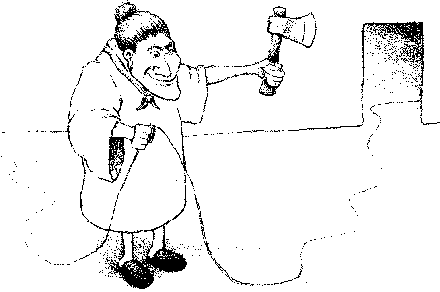
The teacher carved a statue from the softwood of a tree limb. He made it look exactly like himself, life-size. He laid it in his own bed and pulled the sheet up over it. He attached a long string to it and gave it to his pupil. He told him, “Now take this string and axe to my mother. Tell her it is time to do the killing."

Obediently the student returned to the blind old lady. He said, “Madam, my master is sleeping in his bed. If you follow this string it will lead you to him. Then kill him with this axe, if you really can do such a thing!"

She replied, “If you do not abandon me, I will do it." He said, “Why should I abandon you?"

Then she took the axe in her hands. She trembled as she stood up. Slowly she followed the string to her son’s bed. She felt the statue and thought she recognised her son. She pulled down the sheet from the head and raised the axe. Thinking to kill him with one blow she struck the neck as hard as she could with the axe. But it made a thumping sound, so she knew it had struck wood.

The teacher asked, “What are you doing, my mother?" Suddenly she realised she had been deceived and discovered. The shock was so overwhelming that she dropped dead on the spot! This time the horoscope had been correct.

The world famous teacher respectfully burned his mother’s body and offered flowers on her ashes.

Then he said to his pupil, “My son, there really is no such thing as the ‘Unhappiness Degree’. Wicked women cause unhappiness. You are fortunate to have such a good and wise mother. By sending you here to earn the Unhappiness Degree, she wanted you to learn how evil some women can be.

“You have seen with your own eyes how my mother was filled with craving and vanity. She has taught you this lesson. Now return to your wise mother, who cares so much for your well-being."

When he arrived home his mother asked, “My dear son, have you finally earned the high degree in the subject of Unhappiness?" He replied, “Yes mother."

Then she said, “I ask you again, my son, do you wish to leave the worldly life and go into the forest to worship the fire god? Or do you wish to marry and lead the family life?"

Her son replied, “I do not wish to lead the family life. I have seen with my own eyes how evil some women can be. There is no limit to their craving and vanity. Therefore I want nothing to do with family life. I will seek peace as a forest monk."

He respectfully took leave of his parents. After many years of peaceful meditation in the forest, he eventually died and was reborn in a high heaven world.

The moral is: Wickedness between women and men brings unhappiness to both.

INTERPRETER’S INTRODUCTION – BUDDHIST TALES FOR YOUNG AND OLD, VOLUME 1, STORIES 1-50

60.Two Mothers[Renunciation]

Link: https://hhdorjechangbuddhaiiiinfo.com/2023/10/31/60-two-mothersrenunciation/

#Buddhisttalesforyoungandold #Buddhiststories #storiesforkids #moralstories #Buddha #Jatakastories #PansiyaPanasJataka
59,60. Two Ways of Beating a Drum[Excess]

59,60. Two Ways of Beating a Drum[Excess]

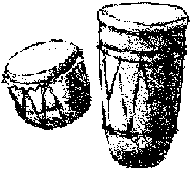
Once upon a time there was a drummer living in a small country village. He heard there was going to be a fair in the city of Benares. So he decided to go there and earn some money by playing his drums. He took his son along to accompany him when playing music written for two sets of drums.

The two drummers, father and son, went to Benares Fair. They were very successful. Everyone liked their drum playing and gave generously to them. When the fair was over they began the trip home to their little village.

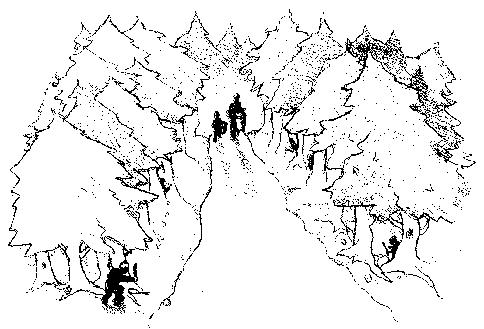
On the way they had to go through a dark forest. It was very dangerous because of muggers who robbed the travellers.

The drummer boy wanted to protect his father and himself from the muggers. So he beat his drums as loudly as he could, without stopping. “The more noise, the better!" he thought.

The drummer man took his son aside. He explained to him that when large groups passed by, especially royal processions, they were in the habit of beating drums. They did this at regular intervals, in a very dignified manner, as if they feared no one. They would beat a drum roll, remain silent, then beat again with a flourish, and so on. He told his son to do likewise, to fool the muggers into thinking there was a powerful lord passing by.

But the boy ignored his father’s advice. He thought he knew best. “The more noise, the better!" he thought.

Meanwhile, a gang of muggers heard the boy’s drumming. At first they thought it must be a powerful rich man approaching, with heavy security. But then they heard the drumming continue in a wild fashion without stopping. They realised that it sounded frantic, like a frightened little dog barking at a calm big dog.

So they went to investigate and found only the father and son. They beat them up, robbed all their hard-earned money, and escaped into the forest.

The moral is: Overdoing leads to a downfall.

59,60. Two Ways of Beating a Drum[Excess]

INTERPRETER’S INTRODUCTION – BUDDHIST TALES FOR YOUNG AND OLD, VOLUME 1, STORIES 1-50

Link:https://hhdorjechangbuddhaiiiinfo.com/2023/10/24/5960-two-ways-of-beating-a-drumexcess/

#Buddhisttalesforyoungandold #Buddhiststories #storiesforkids #moralstories #Buddha #Jatakastories #PansiyaPanasJataka
55. Prince Five-Weapons and Sticky-Hair [The Diamond Weapon]

55. Prince Five-Weapons and Sticky-Hair [The Diamond Weapon]

Once upon a time, the Enlightenment Being was born as the son of the King and Queen of Benares. On the day of his naming, 800 fortune tellers were invited to the palace. As presents, they were given whatever they desired to make them happy for the moment. Then they were asked to tell the fortune of the newborn prince. This was so they could find a good name for him.

One of the fortune tellers was an expert in reading the marks on the body. He said, “My lord, this is a being of great merit. He will be king after you."

The fortune tellers were very clever. They told the king and queen whatever they wanted to hear. They said, “Your son will be skilled in five weapons. He will become famous as the greatest master of all five weapons throughout India." Based on this, the king and queen named their son ‘Prince Five-Weapons’.

When the prince turned sixteen, the king decided to send him to college. He said, “Go, my son, to the city of Takkasila. There you will find a world famous teacher. Learn all you can from him. Give him this money as payment." He gave him a thousand gold coins and sent him on his way.

The prince went to the world famous teacher of Takkasila. He studied very hard and became his best pupil. When the teacher had taught him all he knew, he gave the prince a special graduation award. He gave him five weapons. Then he sent him back to Benares.

On his way home he came to a forest which was haunted by a monster. The local people warned Prince Five-Weapons, “Young man, don’t go through the forest. There is a monstrous demon called Sticky-Hair living there. He kills everyone he sees!"

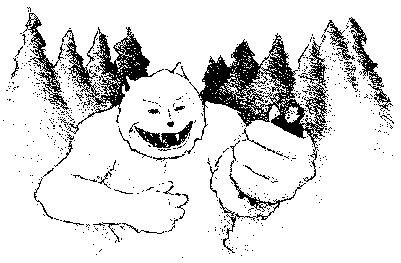
But the prince was self-confident and fearless like a young lion. So he pushed on into the forest, until he came to the dreadful monster. He was as tall as a tree, with a head as big as the roof of a house and eyes as big as dishes. He had two big yellow tusks sticking out of his gaping white mouth filled with ugly brown teeth. He had a huge belly covered with white spots, and his hands and feet were blue.

The monster roared and growled at the prince, “Where are you going in my forest, little man? You look like a tasty morsel to me. I’m going to gobble you up!"

The prince had just graduated from college and had won the highest award from his teacher. So he thought he knew just about everything, and that he could do just about anything. He replied, “Oh fierce demon, I am Prince Five-Weapons, and I have come on purpose to find you. I dare you to attack me! I will kill you easily with my first two weapons — my bow and poison-tipped arrows."

Then he put a poison arrow in his bow and shot it straight at the monster. But the arrow just stuck fast to his hair, like glue, without hurting him at all. Then the prince shot, one after another, all the rest of his 50 poison-tipped arrows. But they also stuck fast to the hair of the one called Sticky-Hair.

Then the beast shook his body, from ugly rooftop-sized head to blue coloured feet. And all the arrows fell harmlessly to the ground.

Prince Five-Weapons drew his third weapon, a 33-inch-long sword. He plunged it into his enemy. But it just stuck fast in the thick coat of sticky hair. He threw his fourth weapon, his spear, at the monster. But this too just stuck to his hair.

Next he attacked with the last of his five weapons, his club. This also stuck fast onto Sticky-Hair.

Then the prince yelled at him, “Hey you, monster — haven’t you ever heard of me, Prince Five-Weapons? I have more than just my five weapons. I have the strength of my young man’s body. I will break you in pieces!"

He hit Sticky-Hair with his right fist, just like a boxer. But his hand just stuck to the hairy coat, and he couldn’t remove it. He hit him with his left fist, but this too just stuck fast to the gooey mess of hair. He kicked him with his right foot and then his left, just like a martial arts master. But they both stuck onto him like his fists. Finally he butted him as hard as he could with his head, just like a wrestler. But, lo and behold, his head got stuck as well.

Even while sticking to the hairy monster in five places, hanging down from his coat, the prince had no fear.

Sticky-Hair thought, “This is very strange indeed. He is more like a lion than a man. Even while in the grasp of a ferocious monster like me, he does not tremble with fear. In all the time I’ve been killing people in this forest, I’ve never met anyone as great as this prince. Why isn’t he afraid of me?"

Since Prince Five-Weapons was not like ordinary men, Sticky-Hair was afraid to eat him right away. Instead he asked him, “Young man, why aren’t you afraid of death?"

The prince replied, “Why should I be afraid of death? There is no doubt that anyone who is born will definitely die!"

Then the Enlightenment Being thought, “The five weapons given to me by the world famous teacher have been useless. Even the lion-like strength of my young man’s body has been useless. I must go beyond my teacher, beyond my body, to the weapon inside my mind – the only weapon I need."

The prince continued speaking to Sticky-Hair, “There’s one small detail, oh monstrous one, I haven’t told you about yet. In my belly is my secret weapon, a diamond weapon you cannot digest. It will cut your intestines into pieces if you are foolish enough to swallow me. So if I die — you die! That’s why I’m not afraid of you."

In this way the prince used his greatest inner strength in a way Sticky-Hair could easily understand. He knew this greatest of all weapons, the one inside his mind, was the precious diamond gem of his own intelligence.

Sticky-Hair thought, “No doubt this fearless man is telling the truth. Even if I eat as much as a pea-sized tidbit of such a hero, I won’t be able to digest it. So I will let him go." Fearing his own death, he set Prince Five-Weapons free.

He said, “You are a great man. I will not eat your flesh. I let you go free, just like the moon that reappears after an eclipse, so you may shine pleasantly on all your friends and relatives."

The Enlightenment Being had learned from his battle with the monster Sticky-Hair. He had learned the only worthwhile weapon is the intelligence inside, not the weapons of the world outside. And with this diamond weapon he also knew that destroying life brings only suffering to the killer.

In gratitude, he taught the unfortunate demon. He said, “Oh Sticky-Hair, you have been born as a murderous blood sucking flesh eating demon because of unwholesome deeds in your past. If you continue killing in this way, it will lead only to suffering for you — both in this life and beyond. You can only go from darkness to darkness.

“Now that you have spared me, you won’t be able to kill so easily. Hear this — destroying life leads to misery in this world, and then rebirth in a hell world, or as an animal or a hungry ghost. Even if you were lucky enough to be reborn as a human being, you would have only a short life!"

Prince Five-Weapons continued to teach Sticky-Hair. Eventually the monster agreed to follow the Five Training Steps. In his way he transformed him from a monster into a friendly forest fairy. And when he left the forest, the prince told the local people about the change in the one-time demon. From then on they fed him regularly and lived in peace.

Prince Five-Weapons returned to Benares. Later he became king. Finally he died and was reborn as he deserved.

The moral is: The only weapon you need is hidden inside you.

55. Prince Five-Weapons and Sticky-Hair [The Diamond Weapon]

Link:https://hhdorjechangbuddhaiiiinfo.com/2023/10/17/55-prince-five-weapons-and-sticky-hair-the-diamond-weapon/

#Buddhisttalesforyoungandold #Buddhiststories #storiesforkids #moralstories #Buddha #Jatakastories #PansiyaPanasJataka
58. A Prince of Monkeys [Carefulness]

58. A Prince of Monkeys [Carefulness]

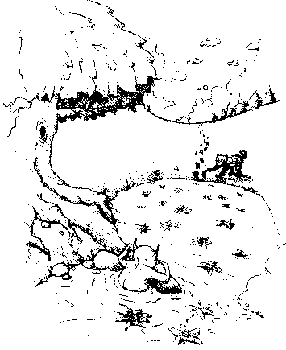
Once upon a time there was a cruel monkey king who ruled in the Himalayas. All the monkeys in his band were his own wives and children. He was afraid that one of his sons might grow up and take over as king. So it was his policy to bite each son just after he was born. This altered him so he would be too weak to ever challenge his father.

A certain wife of the monkey king was pregnant. Just in case the unborn one was a son, she wanted to protect him from the cruel policy of her husband. So she ran away to a forest at the foot of a distant mountain. There she soon gave birth to a bright little baby boy monkey.

Before long this baby grew up to be big and strong. One day he asked his mother, “Where is my father?" She told him, “He is king of a band of monkeys living at the foot of a far-off mountain. That makes you a prince!"

The prince of monkeys said, “Kindly take me to my father." His mother said, “No my son, I am afraid to do so. Your father bites all his sons in order to weaken them for life. He is afraid one of his sons will replace him as king." The prince said, “Don’t be afraid for me, mother. I can take care of myself." This gave her confidence, so she agreed and took him to his father.

When the cruel old king saw his strong young son, he thought. “I have no doubt that when this my son grows stronger he will steal my kingdom from me. Therefore I must kill him while I still can! I will hug him, pretending it is out of love for him. But really I will squeeze him to death!"

The king welcomed his son, saying, “Ah, my long lost son! Where have you been all this time? I have missed you dearly." Then he took him in his arms and hugged him. He kept squeezing harder and harder, trying to squeeze the life out of him! But the prince of monkeys was as strong as an elephant. He hugged his father right back. He squeezed him tighter and tighter, until he could feel the old king’s rib bones starting to crack!

After this terrible greeting, the monkey king was even more terrified that one day his son would kill him. He thought, “Nearby there is a pond possessed by a water demon. It would be easy to get him to eat my son. Then my problems would be over!"

The monkey king said, “Oh my dear son, now is the perfect time for you to come home. For I am old and I would like to hand over my band of monkeys to you. But I need flowers for the coronation ceremony. Go to the nearby pond and bring back two kinds of white water lilies, three kinds of blue water lilies and five types of lotuses."

The prince of monkeys said, “Yes my father, I will go and get them."

When he arrived at the pond, he saw that there were many kinds of water lilies and lotuses growing all over it. But instead of jumping right in and picking them, he investigated carefully. He walked slowly along the bank. He noticed there were footprints going into the pond, but none coming out! After considering, he realised this was a sure sign the pond was possessed by a water demon. He also realised his father must have sent him there to be killed.

He investigated further, until he found a narrow part of the pond. There, with great effort, he was able to jump from one side clear across to the other. In the midst of his leap he reached down and picked flowers, without actually getting into the water. Then he jumped back again, picking more flowers. He continued jumping back and forth, collecting lots of flowers.

Suddenly the water demon stuck his head up above the water. He exclaimed, “In all the time I’ve lived here I have never seen anyone, man or beast, as wise as this monkey! He has picked all the flowers he wanted, without ever coming within the grasp of my power, here in my kingdom of water."

Then the ferocious demon made a path for himself through the water and came up onto the bank. He said, “My lord, king of monkeys, there are three qualities that make a person unbeatable by his enemies. It appears that you have all three — skill, courage and wisdom. You must be truly invincible! Tell me, mighty one, why have you collected all those flowers?"

The prince of monkeys replied, “My father wants to make me king in his place. He sent me to gather these flowers for the coronation ceremony."

The water demon said, “You are too noble to be burdened by carrying these flowers. Let me carry them for you." He picked up all the flowers and followed him.

From a distance, the monkey king saw the water demon carrying the flowers and following the prince. He thought, “I sent him to get flowers, thinking he would be eaten by the demon. But instead he has made the water demon his servant. I am lost!"

The monkey king was afraid all his unwholesome deeds had caught up with him. He went into a sudden panic, which caused his heart to break into seven pieces. Of course this killed him on the spot!

The monkey band voted to make the strong young prince the new king.

The moral is: It pays to be careful.

A Prince of Monkeys [Carefulness]

Link:https://hhdorjechangbuddhaiiiinfo.com/2023/10/17/a-prince-of-monkeys-carefulness/

#Buddhisttalesforyoungandold #Buddhiststories #storiesforkids #moralstories #Buddha #Jatakastories #PansiyaPanasJataka
57, 224 Mr Monkey and Sir Crocodile[Good Manners]

57, 224 Mr Monkey and Sir Crocodile[Good Manners]

Once upon a time, Mr. Monkey was living by himself near a riverbank. He was very strong, and he was a great jumper.

In the middle of the river there was a beautiful island covered with mango, jackfruit and other fruit trees. There happened to be a rock sticking out of the water halfway between the bank and the island. Although it looked impossible, Mr. Monkey was used to jumping from the riverbank to the rock, and from the rock to the island. He would eat fruits all day and then return home by the same route each evening.

A high-class couple was living next to the same river — Sir Crocodile and Lady Crocodile. They were expecting their first brood of baby crocks. Because she was pregnant Lady Crocodile sometimes wished for strange things to eat. So she made unusual demands on her faithful husband.

Lady Crocodile had been amazed, just like the other animals, by the way Mr. Monkey jumped back and forth to the island. One day she developed a sudden craving to eat the heart of Mr. Monkey! She told Sir Crocodile about her desire. To please her, he promised to get Mr. Monkey’s heart for her in time for dinner.

Sir Crocodile went and laid himself down on the rock between the riverbank and the island. He waited for Mr. Monkey to return that evening, planning to catch him.

As usual, Mr. Monkey spent the rest of the day on the island. When it was time to return to his home on the riverbank, he noticed that the rock seemed to have grown. It was higher above water than he remembered it. He investigated and saw that the river level was the same as in the morning, yet the rock was definitely higher. Immediately he suspected the cunning Sir Crocodile.

To find out for sure, he called out in the direction of the rock, “Hi there, Mr. Rock! How are you?" He yelled this three times. Then he shouted, “You used to answer me when I spoke to you. But today you say nothing. What’s wrong with you, Mr. Rock?"

Sir Crocodile thought, “No doubt on other days this rock used to talk to the monkey. I can’t wait any longer for this dumb rock to speak! I will just have to speak for the rock, and trick the monkey." So he shouted, “I’m fine, Mr. Monkey. What do you want?"

Mr. Monkey asked, “Who are you?"

Without thinking, the crocodile replied, “I’m Sir Crocodile."

“Why are you lying there?" asked the monkey.

Sir Crocodile said, “I’m expecting to take your heart! There’s no escape for you, Mr. Monkey."

The clever monkey thought, “Aha! He’s right — there’s no other way back to the riverbank. So I will have to trick him."

Then he yelled, “Sir Crocodile my friend, it looks like you’ve got me. So I’ll give you my heart. Open your mouth and take it when I come your way."

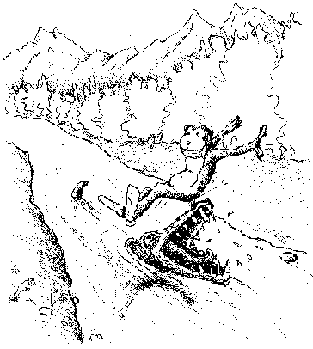
When Sir Crocodile opened his mouth, he opened it so wide that his eyes were squeezed shut. When Mr. Monkey saw this, he immediately jumped onto the top of Sir Crocodile’s head, and then instantly to the riverbank.

When Sir Crocodile realised he’d been outsmarted, he admired Mr.Monkey’s victory. Like a good sport in a contest, he praised the winner. He said, “Mr. Monkey, my intention towards you was unwholesome — I wanted to kill you and take your heart just to please my wife. But you wanted only to save yourself and harm no one. I congratulate you!"

Then Sir Crocodile returned to Lady Crocodile. At first she was displeased with him, but when the little ones came they forgot their troubles for a time.

The moral is: A good loser is a true gentleman.

57, 224 Mr Monkey and Sir Crocodile[Good Manners]

INTERPRETER’S INTRODUCTION – BUDDHIST TALES FOR YOUNG AND OLD, VOLUME 1, STORIES 1-50

Link: https://hhdorjechangbuddhaiiiinfo.com/2023/10/10/57-224-mr-monkey-and-sir-crocodilegood-manners/

#Buddhisttalesforyoungandold #Buddhiststories #storiesforkids #moralstories #Buddha #Jatakastories #PansiyaPanasJataka
56. A Huge Lump of Gold [Moderation]

56. A Huge Lump of Gold [Moderation]

Once upon a time there was a rich village. The wealthiest of the villagers decided to hide a huge lump of gold to protect it from bandits and robbers. So he buried it in a nearby rice field.

Many years later, the village was no longer rich, and the rice field was abandoned and unused. A poor farmer decided to plow the field. After some time plowing, it just so happened that his plow struck the long forgotten buried treasure.

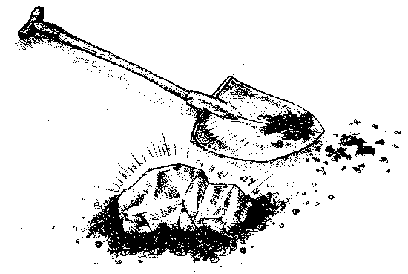
At first he thought it must be a very hard tree root. But when he uncovered it, he saw that it was beautiful shining gold. Since it was daytime he was afraid to try and take it with him. So he covered it up again and waited for nightfall.

The poor farmer returned in the middle of the night. Again he uncovered the golden treasure. He tried to lift it, but it was far too heavy. He tied ropes around it and tried to drag it. But it was so huge he couldn’t budge it an inch. He became frustrated, thinking he was lucky to find a treasure, and unlucky to not be able to take it with him. He even tried kicking the huge lump of gold. But again it wouldn’t budge an inch!

Then he sat down and began to consider the situation. He decided the only thing to do was to break the lump of gold into four smaller lumps. Then he could carry home one piece at a time.

He thought, “One lump I will use for ordinary day-to-day living. The second lump I will save for a rainy day. The third lump I will invest in my farming business. And I will gain merit with the fourth lump by giving it to the poor and needy and for other good works."

With a calm mind he divided the huge lump of gold into these four smaller lumps. Then it was easy to carry them home on four separate trips.

Afterwards he lived happily.

The moral is: “Don’t bite off more than you can chew."

56. A Huge Lump of Gold [Moderation]

Link:https://hhdorjechangbuddhaiiiinfo.com/2023/10/03/56-a-huge-lump-of-gold-moderation/

#Buddhisttalesforyoungandold #Buddhiststories #storiesforkids #moralstories #Buddha #Jatakastories #PansiyaPanasJataka
54, 85. The Whatnot Tree [Prudence]

54, 85. The Whatnot Tree [Prudence]

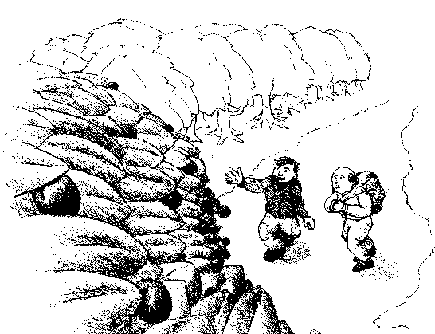
Once upon a time there was a caravan leader. He went from country to country selling various goods. His caravans usually had at least 500 bullock carts.

On one of these trips his path led through a very thick forest. Before entering it, he called together all the members of the caravan. He warned them, “My friends, when you go through this forest be careful to avoid the poisonous trees, poisonous fruits, poisonous leaves, poisonous flowers and even poisonous honeycombs.

“Therefore, whatever you have not eaten before — whether a fruit, leaf, flower or anything else — must not be eaten without asking me first." They all said respectfully, “Yes, sir."

There was a village in the forest. Just outside the village stood a tree called a ‘whatnot tree’. Its trunk, branches, leaves, flowers and fruits look very similar to a mango tree. Even the colour, shape, smell and taste are almost exactly the same as a mango tree. But unlike a mango, the whatnot fruit is a deadly poison!

Some went ahead of the caravan and came upon the whatnot tree. They were all hungry, and the whatnot fruits looked like delicious ripe mangoes. Some started eating the fruits immediately, without thinking at all. They devoured them before anyone could say a word.

Others remembered the leader’s warning, but they thought this was just a different variety of mango tree. They thought they were lucky to find ripe mangoes right next to a village. So they decided to eat some of the fruits before they were all gone.

There were also some who were wiser than the rest. They decided it would be safer to obey the warning of the caravan leader. Although they didn’t know it, he just happened to be the Enlightenment Being.

When the leader arrived at the tree, the ones who had been careful and not eaten asked, “Sir, what is this tree? Is it safe to eat these fruits?"

After investigating thoughtfully he replied, “No, no. This may look like a mango tree, but it isn’t. It is a poisonous whatnot tree. Don’t even touch it!"

The ones who had already eaten the whatnot fruit were terrified. The caravan leader told them to make themselves vomit as soon as possible. They did this, and then were given four sweet foods to eat – raisins, cane sugar paste, sweet yogurt and bee’s honey. In this way their taste buds were refreshed after throwing up the poisonous whatnot fruit.

Unfortunately, the greediest and most foolish ones could not be saved. They were the ones who had started eating the poisonous fruits immediately, without thinking at all. It was too late for them. The poison had already started doing its work, and it killed them.

In the past, when caravans had come to the whatnot tree, the people had eaten its poisonous fruits and died in their sleep during the night. The next morning the local villagers had come to the campsite. They had grabbed the dead bodies by the legs, dragged them to a secret hiding place, and buried them. Then they had taken for themselves all the merchandise and bullock carts of the caravan.

They expected to do the same thing this time. At dawn the next morning the villagers ran towards the whatnot tree. They said to each other, “The bullocks will be mine!" “I want the carts and wagons!" “I will take the loads of merchandise!"

But when they got to the whatnot tree they saw that most of the people in the caravan were alive and well. In surprise, they asked them, “How did you know this was not a mango tree?" They answered, “We did not know, but our leader had warned us ahead of time, and when he saw it he knew."

Then the villagers asked the caravan leader, “Oh wise one, how did you know this was not a mango tree?"

He replied, “I knew it for two reasons. First, this tree is easy to climb. And second, it is right next to a village. If the fruits on such a tree remain unpicked, they cannot be safe to eat!"

Everyone was amazed that such lifesaving wisdom was based on such simple common sense. The caravan continued on its way safely.

The moral is: The wise are led by common sense; fools follow only hunger.

The Whatnot Tree [Prudence]

INTERPRETER’S INTRODUCTION – BUDDHIST TALES FOR YOUNG AND OLD, VOLUME 1, STORIES 1-50

Link:https://hhdorjechangbuddhaiiiinfo.com/2023/09/26/the-whatnot-tree-prudence/

#Buddhisttalesforyoungandold #Buddhiststories #storiesforkids #moralstories #Buddha #Jatakastories #PansiyaPanasJataka
53. A Gang of Drunkards [Sobriety]

53. A Gang of Drunkards [Sobriety]

Once upon a time, when Brahmadatta was king, the Enlightenment Being was born in a wealthy family. He became the richest man in Benares.

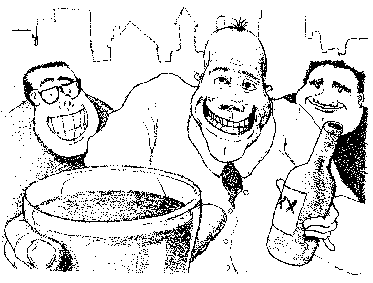
There also happened to be a gang of drunkards who roamed the streets. All they ever thought about was finding ways to get alcohol, the drug they thought they couldn’t live without.

One day, when they had run out of money as usual, they came up with a scheme to rob the richest man in Benares. But they didn’t realise that he was the reborn Bodhisatta, so he wouldn’t be so easy to fool!

They decided to make a ‘Mickey Finn’, which is a drink of liquor with a sleeping drug secretly added to it. Their plan was to get the rich man to drink the Mickey Finn. Then when he fell asleep they would rob all his money, jewellery, and even the rich clothes he wore. So they set up a temporary little roadside bar. They put their last remaining liquor into a bottle, and mixed in some strong sleeping pills.

Later the rich man came by on his way to the palace. One of the alcoholics called out to him, “Honourable sir, why not start your day right — by having a drink with us? And the first one is on the house!" Then he poured a glass of the dishonest liquor.

But the Enlightenment Being did not drink any form of alcohol. Nevertheless, he wondered why these drunkards were being so generous with their favourite drug. It just wasn’t like them.

He realised it must be some kind of trick. So he decided to teach them a lesson. He said, “It would be an insult to appear before the king in a drunken state, or with even the slightest smell of liquor on my breath. But please be so kind as to wait for me here. I’ll see you again when I return from the palace."

The drunkards were disappointed. They would not be able to drink again as soon as they wanted. But they decided to be patient and wait.

Later that day the rich man came back to the little roadside bar. The alcoholics were getting desperate for a drink. They called him over and said, “Honourable sir, why not celebrate your visit to the king? Have a drink of this fine liquor. Remember, the first one is free!"

But the rich man just kept looking at the liquor bottle and glass. He said, “I don’t trust you. That bottle and glass of liquor are exactly as they were this morning. If it were as good as you say it is, you would have tasted some yourselves by now. In fact, you couldn’t help but drink it all! I’m no fool. You must have added another drug to the alcohol."

The richest man in Benares went on his way, and the gang of drunkards went back to their plotting and scheming.

The moral is: Keep sober — and keep your common sense.

53. A Gang of Drunkards [Sobriety]

Link:https://hhdorjechangbuddhaiiiinfo.com/2023/09/19/53-a-gang-of-drunkards-sobriety/

#Buddhisttalesforyoungandold #Buddhiststories #storiesforkids #moralstories #Buddha #Jatakastories #PansiyaPanasJataka
52, 539 King fruitful and Queen sivali [Chapter 3. Giving up Power]

52, 539 King fruitful and Queen sivali [Chapter 3. Giving up Power]

This story happened very long ago, at a time when people lived much longer lives, even 10,000 years! After King Fruitful had ruled for about 7,000 years, it just so happened that the royal gardener brought him an especially wonderful collection of fruits and flowers. He liked them so much that he wanted to see the garden. So the gardener arranged and decorated the garden, and invited him to visit.

The king set out on a royal elephant, followed by the entire court and many of the ordinary people of Mithila. When he entered through the garden gate he saw two beautiful mango trees. One was full of perfectly ripe mangoes, while the other was completely without fruit. He took one of the fruits and enjoyed its delicious sweet taste. He decided to eat more of them on his return trip.

When the people saw that the king had eaten the first fruit, they knew it was all right for them to eat. In no time at all the mangoes had been eaten. When the fruits were gone, some even broke the twigs and stripped the leaves looking for more.

When King Fruitful returned he saw that the tree was stripped bare and nearly destroyed. At the same time, the fruitless tree remained as beautiful as before, its bright green leaves shining in the sunlight.

The king asked his ministers, “What has happened here?" They explained, “Since Your Majesty ate the first fruit, the people felt free to devour the rest. Searching for more fruits they even destroyed the leaves and twigs. The fruitless tree was spared and remains beautiful since it has no fruit."

This saddened the king. He thought, “This fruitful tree was destroyed, but the fruitless one was spared. My kingship is like the fruitful tree —- the more the power and possessions, the greater the fear of losing them. The holy life of a simple monk is like the fruitless tree —- giving up power and possessions leads to freedom from fear."

So the Great Being decided to give up his wealth and power, to leave the glory of kingship behind, to abandon the constant task of protecting his position. Instead he decided to put all his effort into living the pure life of a simple monk. Only then could he discover lasting deep happiness, which would spread to others as well.

He returned to the city. Standing next to the palace gate, he called for the commander of the army. He said, “From now on, no one is to see my face except a servant bringing food and a servant bringing water and toothbrush. You and the ministers will rule according to the old law. I will live as a simple monk on the top floor of the palace."

After he had lived for a while in this way, the people began to wonder about the change in him. One day a crowd gathered in the palace courtyard. They said, “Our king is not as he was before. He no longer wants to see dancing or listen to singing or watch bull fights and elephant fights or go to his pleasure garden and see the swans on the ponds. Why does he not speak to us?" They asked the servants who brought the king his food and water, “Does he tell you anything?"

They said, “He is trying to keep his mind from thinking about desirable things, so it will be peaceful and wholesome like the minds of his old friends, the Silent Buddhas. He is trying to develop the purity of the ones who own nothing but good qualities. Once we even heard him say out loud, “I can think only of the Silent Buddhas, free from chasing ordinary pleasures. Their freedom makes them truly happy — who will take me to where they live?"

King Fruitful had been living on the top floor of the palace trying to be a simple monk for only about four months. At that point he realised there were too many distractions in the beautiful kingdom of Mithila. He saw them as only an outer show keeping him from finding inner peace and Truth. So he decided, once and for all, to give up everything and become a forest monk and go live in the Himalaya Mountains.

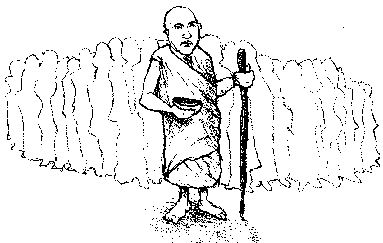
He had the yellow robes and begging bowl of a monk brought to him. He ordered the royal barber to shave his head and beard. Then early the next morning, he began walking down the royal staircase.

Meanwhile Queen Sivali had heard about his plans. She gathered together the 700 most beautiful queens of the royal harem and took them up the staircase. They passed King Fruitful coming down, but didn’t recognise him dressed as a monk. When they got to the top floor, Queen Sivali found it empty, with only the king’s shaven hair and beard still there. Instantly she realised the unknown monk must be her husband.

All 701 queens ran down the stairs to the palace courtyard. There they followed the king-turned-monk. As Queen Sivali had instructed them, they all let down their hair and tried to entice the king to stay. They cried and cried, pleading with him, “Why are you doing this?" Then all the people of the city became very upset and began following him. They were weeping as they cried out, “We have heard that our king has become a simple monk. How can we ever find such a good and fair ruler again?"

The 700 harem queens, wearing all their lovely veils and rich jewellery, crying and begging, did not change the mind of the Enlightenment Being. For he had made his decision and was determined to stick to it. He had given up the gold anointing bowl of state, which had passed the power of the royal family to him. Instead he now carried only the plain clay-begging bowl of a humble monk, a seeker of Truth.

Finally Queen Sivali stopped crying. She saw that the beautiful queens from the harem had not stopped her husband. So she went to the commander of the army. She told him to set a fire among the slum houses and abandoned buildings that were in the king’s path. She told him to set fires of brush and wet leaves in different areas of the city, to make a lot of smoke.

When this was done she fell to the ground at the king’s feet and cried, “All Mithila is burning, my lord! The beautiful buildings with their valuable art works, precious metals and jewels, and treasures are all being destroyed. Return, oh king, and save your riches before it is too late."

But the Enlightenment Being replied, “All these things belong to others. I own nothing. So I’m not afraid of losing anything. And losing things can’t make me sad. My mind is at peace."

Then he left the city through the northern gate, still followed by all 701 queens. According to Queen Sivali’s instructions, they showed him villages being robbed and destroyed. There were armed men attacking, while others seemed wounded and dead. But what looked like blood was really just red dye, and the dead were only pretending. The king knew it was a trick, since there were no actual robbers and plunderers in the kingdom in the first place.

After walking still farther, the king stopped and asked his ministers, “Whose kingdom is this?" “Yours, oh lord," they said. “Then punish any who cross this line," he ordered, as he drew a line across the road. No one, including Queen Sivali, dared to cross the line. But when she saw the king continuing on down the road, with his back to her, she was grief-stricken. Beating her breast she fell across the line. Once the line was crossed, the whole crowd lost its fear and followed her.

Queen Sivali kept the army with her as the entire crowd kept following King Fruitful. He continued for many miles, heading for the Himalayas in the north.

Meanwhile, there was a very advanced monk named Narada, who lived in a golden cave in the Himalayas. He was a very wise man. By great mental effort he had gained supernatural powers that only the highest holy men are said to have. After meditating in a wonderful trance for a full week he suddenly shouted, “What happiness! Oh what happiness!"

Then, using his special powers, he looked out over all India to see if there was anyone who was sincerely seeking that same happiness, free of all the distractions of the world. He saw only King Fruitful, the Bodhisatta who would some day become the Buddha. He saw that he had given up all his earthly power. And yet he was still blocked, still hindered by the obstacle of the crowd following him from his previous worldly life. In order to help and encourage him, he magically flew through the air and floated in front of the king.

He asked King Fruitful, “Oh monk, why is this crowd with all its noise following you?" The king replied, “I have given up the power of kingship and left the world for good. This is why my former subjects follow me, even though I leave them happily."

The holy monk said, “Don’t be too confident, oh monk. You haven’t succeeded in leaving the world quite yet. For there are still obstacles inside of you. These are the ‘Five Hindrances’ — the desire for ordinary pleasures of sight, sound and so forth; the desire to harm others; laziness; nervous worrying; and unreasonable doubts. Therefore, practice the Perfections, be patient, and don’t think either too much or too little of yourself."

He finished by saying, “I give you my blessing — may goodness, knowledge and Truth protect you on your way." Then he disappeared and reappeared back in his golden cave.

Due to this wise advice, King Fruitful became even less concerned with the crowd outside, realising that the greatest obstacles, or hindrances, are the ones inside.

Meanwhile Queen Sivali fell at his feet once again. She pleaded, “Oh king, hear the wails of your subjects. Before leaving them for good, comfort them by crowning your son to rule in your place."

He replied, “I have already left my subjects, friends, relatives and my country behind. Have no fear, the nobles of Mithila have trained Prince Longlife well, and they will protect and support you both."

She continued, “Oh king, by becoming a monk you are leaving me without a husband. What a shame! What am I to do?"

He said, “Only be careful to teach the prince no unwholesome thoughts, words or deeds. Otherwise you would bring painful results to yourself."

As the sun set, the queen made camp while the king went into the forest to sleep at the foot of a tree. The next day she continued to follow him, bringing the army with her. They approached a small city.

It just so happened that a man in the city had bought a fine piece of meat from a butcher. After cooking it he placed it on a table to cool, when a stray dog grabbed it and ran off. The man followed the dog as far as the southern gate of the city. There he gave up because he was too tired to continue.

The escaping dog crossed the path of King Fruitful and Queen Sivali. Frightened by them, he dropped the meat on the road. The king saw that it was a good piece of meat and that the real owner was unknown. So he cleaned the meat, put it in his begging bowl, and ate it.

Queen Sivali, who was used to eating the delicacies of the palace, was disgusted. She said to him, “Even at the point of death a high class person would not eat the leavings of a dog! Eating such disgusting food shows you are completely unworthy!" But he replied, “It is your own vanity that keeps you from seeing the value of this meat. If rightfully obtained, all food is pure and wholesome!"

As they continued to approach the city, King Fruitful thought, “Queen Sivali keeps following me. This is a bad thing for a monk. People say, ‘He has given up his kingdom, but he can’t get rid of his wife!’ I must find a way to teach her she must go."

Just then they came upon some playing children. Among them was a girl with one bracelet on one wrist and two on the other. Thinking she was a wise child, the king asked her, “My child, why does your one arm make noise with every movement, while the other does not?"

The little girl replied, “Oh monk, it’s because on one arm there are two bracelets, while on the other there is only one. Where there are two, it’s the second that clangs against the first and makes noise. The arm with only one bracelet remains silent. So if you would be happy, you must learn to be contented when alone."

The Bodhisatta said to the queen, “Do you hear the wisdom of this child? As a monk, I would be ashamed to let you stay with me in front of her. So you go your way and I’ll go mine. We are husband and wife no more – good-bye!"

The queen agreed and they took separate paths. But she became grief-stricken again and returned to follow the king. They entered the city together, so he could collect alms food.

They came to the house of an arrow maker. They watched him wet the red-hot arrow, and straighten it while sighting down the shaft with only one eye open. The king asked him, “Friend, to make the arrow perfectly straight, why do you view it with one eye open and the other shut?"

The arrow maker answered, “With both eyes open, the wide view of the second eye is distracting. Only by concentrating my view in one eye can I truly see the straightness of the arrow. So if you would be happy, you must learn to be contented when alone."

The king collected alms food and then they left the city. He said to the queen, “Did you hear the same wisdom again from that craftsman? As a monk, I would be ashamed to let you stay with me in front of him. So you go your way and I’ll go mine. We are husband and wife no more – good-bye!" But still she followed him.

Then the Great Being cut a stalk of tall grass. He said to Queen Sivali, “Just as the two pieces of this stalk of grass cannot be joined again, so I will not join you again in the marriage bed! We two can never be joined together again. Like a full stalk of uncut grass, live on alone, my ex-wife Sivali."

On hearing this the queen went crazy with shock and grief. She beat herself with both hands until she fell to the ground — completely unconscious. Realising this, the Bodhisatta quickly left the roadway. He erased his footsteps and disappeared into the jungle.

First he had given up the power and wealth of a king. Now he had given up the power and desire of a husband. At last he was free to follow the path of a Truth-seeking wandering monk. He made his way to the Himalayas and in only one week he was able to develop special mental powers. Never again did he return to the ordinary world.

Meanwhile the royal ministers, who had been following at a distance, reached the fainted queen. They sprinkled water on her and revived her. She asked, “Where is my husband the king?" They said, “We don’t know. Don’t you know?" In a panic she ordered, “Search for him!" They looked and looked, but of course he was gone.

When Queen Sivali recovered from her fear and grief, she realised she felt no anger, jealousy or vengeance towards the monk Fruitful. Instead she admired him more than at any time since the day they met, when she gave him her hand and led him to the throne.

She had monuments erected to honour the courageous King Fruitful on four sites: where he had spoken with the floating holy man Narada, where he had eaten the good meat left by the dog, where he had questioned the little girl, and also the arrow maker.

Beside the two mango trees in the royal garden, she had Prince Longlife crowned as the new king. Together with the army and crowds of followers, they returned to the city of Mithila.

In spite of herself, Queen Sivali had learned something by following, and finally losing, her husband King Fruitful. She too had tasted freedom!

The wise lady gave up her royal duties. She retired to meditate in the garden by the mango trees. With great effort, she gained a high mental state leading to rebirth in a heaven world.

The moral is: It’s easier to gain power than to give it up.

52, 539 King fruitful and Queen sivali [Chapter 3. Giving up Power]

Link:https://hhdorjechangbuddhaiiiinfo.com/2023/09/05/52-539-king-fruitful-and-queen-sivali-chapter-3-giving-up-power/

#Buddhisttalesforyoungandold #Buddhiststories #storiesforkids #moralstories #Buddha #Jatakastories #PansiyaPanasJataka