The Buddha told this story at Jetavana monastery about a hypocritical monk who understood how to be cunning, as in the past story of the Kuhaka-Jātaka [No. 89]
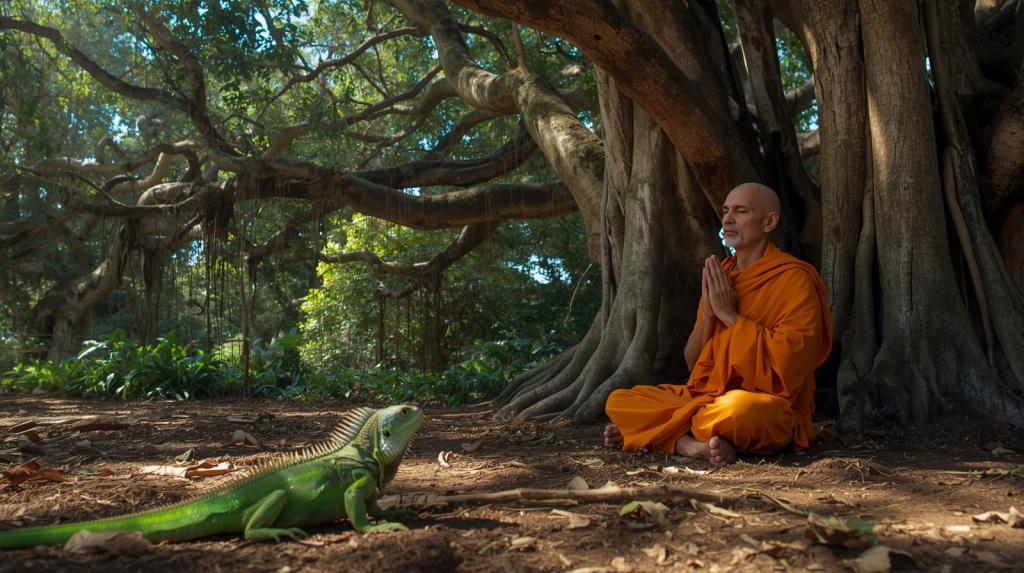
At one time, King Brahmadatta was ruling in Benares. While he was ruling, the Enlightenment Being was born as an iguana. He lived in a termite hill in a remote village.
At the same time, there lived in the same village, with the help of the villagers, a very virtuous and highly righteous ascetic. The Enlightenment Being, who had been born as an iguana, used to listen to his sweet-voiced sermons two times a day. Later, the ascetic left this place and went to the Himalayas after telling his intentions to the villagers. After that, a bogus ascetic came to that village and settled in the same temple. Living there, he accepted the offerings of the villagers.
The iguana, who was the Enlightenment Being, thought that this ascetic would also be righteous like the former ascetic. And he came to see him also two times a day. One day, there was an untimely rain and termites came out in swarms from the locality’s termite hills. Many iguanas came out from the various termite hills to eat the termites. The villagers, seeing that there were many iguanas, started to kill them. They then cooked the delicious iguana meat. Some of them gave this as an offering to the bogus ascetic. The ascetic tasted the meat and asked, “What kind of meat is this?” They responded, “It is iguana meat.” And the ascetic became intent on eating more iguana meat. He thought, “There is a big iguana that comes to me twice a day. I can kill him, and eat his meat.”
Thinking so, he requested the villagers to bring some condiments and a pot with which to cook. He hid them in the temple. Then he made a club that he could use to kill the iguana. He hid the club under his robes, and he sat at the end of the cloister path waiting for the iguana to come while taking a very righteous and virtuous pose.
When the iguana was coming from his termite hill, he sensed a difference in the ascetic. He did not go near to him as before. He first went upwind, and he smelt the smell of iguana meat coming from the robes of the ascetic. Therefore, he did not approach as he had become afraid. Instead, he went around the ascetic. As the iguana did not come near to him, the ascetic became upset. As he was anxious to kill the iguana, he thought that he would now throw the club and hit him from afar. Fortunately, the club missed the iguana, hitting only its tail. For a second time, the bogus ascetic ran to get the club and hit the iguana. The iguana, though, ran into a nearby termite hill and saved his life.
The iguana poked his head out through another hole in the termite hill and said, “Hey, ascetic. I thought that you were a righteous person, like the former ascetic. Such a person as you does not deserve to wear saffron robes and a turban, and to sit on a tiger skin.” Saying so, he went to hide.
The ascetic thought, “It is no longer good for me to stay here because the iguana can tell the villagers about me.” Thinking so, he left for the Himalayan forest on the very same day.
The Buddha, disclosing this story, said, “This bogus ascetic was the present hypocritical monk. The righteous ascetic was the Venerable Sāriputta. And I was the iguana, who has now become the fully enlightened one.”
The moral: “Righteousness can only be known through a long association with someone.”
At one time the enlightened one was living in the Jeta Grove. At that time, there was an enlightened lady called KāÏā-mātā [KāÏā’s mother]. Why was she known as KāÏā’s mother? Because she had a daughter known as KāÏā who was so known not because she was blind, but because she was so beautiful. Anyone who saw her was not able to look at another woman [as if they were blind].16
Her mother had given her in marriage to someone of a similarly matched family. She lived in that family for a long time without seeing her mother. After a long time, she came to see her mother and spent a long while with her. As she was delaying returning home, her husband sent a message that he wanted her to return home quickly so he could see her. When she heard this message, KāÏā said to her mother that she had to return home.
Hearing that, her mother, KāÏā-mātā, said to her that she should not return empty-handed, but should take with her some sweetcakes. When they were preparing these sweetcakes, a monk who was going on his alms round came.
The devout KāÏā-mātā could not say there was nothing to give as she had just prepared sweetcakes. So they gave him a bowl full of sweetcakes. When he was returning to the temple, on his way, he met another monk going on his alms round and said, “Go to KāÏā-mātā’s home. She has sweetcakes.”
Hearing that, he also went there and got a bowl full of sweetcakes. In the same way, as he was returning, he met still another monk who was going on alms round. He told the same thing to him and to a fourth monk. Now, when they had given sweetcakes to four monks, the sweetcakes were all gone.
As KāÏā now had nothing to bring for her husband, she postponed her trip. A second time her husband requested her to come home. Also the second time, the sweetcakes were given to the same monks in this way. And again, she could not return home.
As she was not coming home, her husband married another woman. This was heard by KāÏā, and she started to cry. KāÏā-mātā was also very upset. The Buddha heard this, and he visited their home, sat on the prepared chair, and asked KāÏā-mātā, “Devoted lady, why is your daughter crying?” She told the Buddha what had happened. On hearing this, Buddha preached to them in an appropriate way so as to console their grief and then returned to Jetavana monastery.
On the same day, in the evening, the monks assembled in the preaching hall were discussing what had happened because of those four monks and KāÏā’s failure to return home, and how KāÏā-mātā was upset. Meanwhile, Buddha came there in the evening to preach. He asked the monks, “Oh monks, what were you discussing before I came?” When Buddha heard from them what they had been discussing, he said, “Monks, not only today, but even before these four monks have brought sorrow to KāÏā-mātā by taking her provisions.” The monks requested the Buddha to disclose this. And he explained this story:
Long ago in ancient times there was a king called Brahmadatta in Benares. While he was ruling in Benares, the Enlightenment Being was born in a family of stone-sculptors, and he became a teacher of stone-sculptors. At that time, a millionaire in a remote village who had 40 million crores of gold hidden in a certain place passed away. Later, his wife also passed away while still having a craving for the wealth. She was reborn as a female mouse living in a nearby anthill.
At one point, the Enlightenment Being came to that village, which by that time had been abandoned. Breaking rocks that were there, he took them from that abandoned village and used them for his work. And he supported himself in this way. The female mouse saw the Enlightenment Being coming once a day, and she became enamored of him. She thought, “I have much wealth. By giving my wealth to this man, I also can live a happy life. I will bring him a gold coin each day, and he will bring me good things to eat.” Thinking so, one day she brought a gold coin in her mouth, and put it down in front of the Enlightenment Being. Seeing that, he asked, “What is this?” The female mouse said, “Take this money, and bring me some meat. The remainder can be used by your lordship.”
In this way, she gave him a gold coin daily. And the Enlightenment Being brought meat, the worth of gold equal in weight to four grains of rice, and gave the meat to the mouse. The balance of the gold he used for his own purposes. As time went on, a cat that was searching for prey saw the mouse, and caught her. The mouse said, “Please let me go.” The cat said, “I am searching for something to eat. I caught you so as to eat your flesh.” The mouse said, “If you eat me today, then you will have meat for only one day. Is it better to have meat for only one day, or forever?” The cat said, “If I have meat forever, that would be good.” When the cat said this, then the mouse said, “If that is so, then please let me go. I will provide you daily with meat.” The cat agreed, saying, “Give me meat daily. If you fail to do so, then I know what to do.” In this way, he threatened the mouse, and let her go.
Since then, the mouse divided her share of meat that the Enlightenment Being gave her each day into two parts. One part she gave to the cat, and she ate the other part. Unfortunately, on another day, another cat caught her. She promised the same thing as to the first cat, and in this way got let go. In this way, she also saved herself from a third cat and a fourth cat. Having made such promises, she used to divide the meat she obtained into five parts. She ate herself only one part. And she gave the other four parts to the four cats. As she did not have enough food day by day, she became very thin and weak.
The Enlightenment Being, seeing her like this, asked, “Why are you so thin and weak?” She told him what had happened. The Enlightenment Being said, “Why did you not tell me this up to now?” Saying this, he made a cavity in a block of clear crystal stone. He said, “When the cats come to ask you for meat, insult them while you are inside this crystal cavity.” Making her promise to do so, he went away. The mouse went into the hollow of the clear crystal. The first cat came along. He asked, “Where is the meat that you promised to give me?” Then the mouse said, “What? Am I someone who is supposed to give you meat? If you need meat, eat your kittens’ flesh.” In this way, she insulted him so as to make him angry. The cat got angry and said, “Ah, are you going back on your word in this way?” He then jumped up at the mouse, and not knowing that she was inside a piece of clear crystal, he hit it hard and thereby broke his ribs. He crept away and died lying in the forest.
In this way, the other three cats as well got angry at the female mouse’s words, and jumping up forcefully at the crystal, also ended their lives.
Since then, the female mouse became more and more enamored with the Enlightenment Being. She started to give him two gold coins daily. Doing so, she eventually gave up all her 40 million crores of gold coins.
The Buddha concluded the story, comparing the four cats eating the mouse’s meat with the four monks eating the sweetcakes of the devoted KāÏā-mātā. And the Buddha imposed a regulation on monks not to accept the giving of food by going to a home without invitation, even though a monk might know that there is good food there. If invited, only then can he accept the food.
“At that time, the four cats were these four monks. The female mouse was the devoted lady called KāÏā-mātā. The stone-sculptor was myself who became in this life the enlightened one.” In this way, the Buddha concluded the Jātaka story of the cats.
The moral: “It is not good to take advantage of generous people.”
16 KāÏā means ‘blind’, usually of one eye, occasionally of both.
While Buddha was living in Jeta grove at Sāvatthi a certain man devoted to Buddhism cultivated a garden in which he grew garlic, and he gave garlic to many monks. When people requested garlic, he used to give it to them. When the number of people became too many, he used to tell them to go into his garden and take a certain number of handfuls as he had specified. Everything was going well like this for a period of time. Even nuns used to come for garlic, and would take handfuls of cloves as he specified.15 At one time, a certain nun named Nandā came to his house with other nuns and requested garlic [for medicine?]. He said, “You may take three handfuls of garlic.” Misunderstanding him, she and each of the other nuns each took three handfuls. The watchman, seeing this, called out, “Why are you making such a mistake, and taking so much of our garlic?” Hearing of this, other nuns rebuked her.
This news went even to the Buddha. The Buddha said, “It is not good for monks and nuns to take anything which is not given.” He said further, “Through greed, much will not be gained. Be satisfied with whatever you are given, even if it is a handful.” In this way, he emphasized being satisfied with whatever one gets. “Such a one who is satisfied like that, he will gain more than one who is greedy. And what is gained will be permanently with him.” In this way, he criticized what the nuns did. Then the Buddha added, “This nun was greedy not only today. Also in the past she was greedy like this.” The monks said, “Revered sir, please disclose to us this story.” And the Buddha told the story of the past
At one time in the city of Benares, a king called Brahmadatta was ruling. At the same time, the Enlightenment Being was born in a Brahmin family and had three daughters. One was named Nandā. Another was named Nandavatī. And the third was named Sundarinandā. Unfortunately, before his daughters could be married, the father who was the Enlightenment Being died suddenly. He was born again as a golden swan that had a reminiscence of its preceding life. He understood that prior to this life, he had been born in a Brahmin family. And he learned that his wife and three daughters were living by slavery, and he decided to help them. He thought, “My feathers are golden. Therefore, they are good for making jewelry. So if I go to my wife and children, I can give them one feather, for the purpose of making jewelry, every other month.” And he went to their home, and sat on the roof. The daughters came out of the house and asked, “Who are you?” He said, “I am your father.
I came here to help you and your mother.” Saying so, he dropped a golden feather and went away. He did this several times, and each time the daughters picked up the feather. Meanwhile, the Brahmin mother thought, “This bird may change his mind at some point. If he should think in the future that he does not want to come here, then it will be a big hardship for us.” Thinking so, she summoned her daughters and said, “One day, catch your father and pluck all his feathers.”
On hearing their mother’s words, the three daughters said, “If we do so, there is no doubt that our father will feel hurt all over his body. Therefore, we do not want to do so.” When they were arguing like this one day, their father came to their home. Then the Brahmin mother said, “Please, husband, come here.” In this way, she summoned him near to her. The Enlightenment Being quickly went near to her. The woman immediately seized him and plucked all his feathers from his body.
As his golden feathers were plucked with a bad motive, they became a normal swan’s feathers. And he could not fly away as he had no feathers. He just lay in their home. As time went by, his feathers grew again, but as normal white swan’s feathers. When this happened, the family let him just fly away.
Afterwards, the Enlightenment Being never came back again to that house.
“Oh, monks. Because of her greed, she lost the chance to get golden feathers.” Concluding this story, the Buddha said, “The present nun called Nandā was the former Brahmin woman. The three daughters were this nun’s three daughters [who in this life picked garlic with her]. The golden swan was I who have become the enlightened one.” In this way, the Buddha concluded the story.
The moral: “Do not pluck fruit from your tree greedily.”
15 Garlic is not supposed to be eaten by nuns. In South Asian tradition generally, garlic and onions are considered to make one lusty, and are therefore to be avoided by women, especially widows. Also when one perspires after eating garlic, one gives off a smell that is displeasing to others. Indian law texts also note that garlic and onions are to be avoided by twice-born men.
When the Buddha was living in the Jeta Grove monastery, he delivered this Jātaka story with regard to the Venerable Sāriputta’s solving of questions at a time when the Buddha was descending from heaven near the gate of the town of SamÅkassa. This is the story:
At one time, a king called Brahmadatta ruled the city of Benares. At that time, the Enlightenment Being was the master of many ascetics in the Himalayan forest. On the day he was dying, the ascetics came to him and asked, “Revered one, what type of a mental achievement was gained by you?” He said, “The moon’s radiance, the sun’s radiance.” Saying so, he passed away.
Then the chief ascetic disciple, hearing the words of the master ascetic, said, “Our master has been born in the resplendent Brahma world [ābhassara].” The other disciples did not accept this. As they were not accepting it, the master who had been born in the Brahma world descended; and he verified that what the chief ascetic disciple had said was indeed so. He then returned to the Brahma world.
The chief disciple at that time was the Venerable Sāriputta. And I was the master ascetic who today has become the supreme being of this world.
The moral: “Truth will be certified by divine beings.”
At one time, when Buddha was living in Jetavana monastery, he disclosed this Jātaka. At that time, after the spring retreat of the monks, Buddha descended from heaven to the gate of the town of SamÅkassa. On that day, Venerable Sāriputta very intelligently solved the questions of the monks, which the monks appreciated. With regard to one of the Venerable Sāriputta’s solutions of a question, this story was told. This is the story:
Long ago when King Brahmadatta was ruling the city of Benares, the Enlightenment Being was living in the Himalayan forest as a leader of many ascetics.
At that time, the Enlightenment Being’s first disciple went to a nearby village to observe the spring retreat. In the meantime, the ascetic Enlightenment Being came to the end of his life. His other disciples came to the dying Enlightenment Being and asked, “Revered one, did you gain any kind of religious success from your practices of mental absorption?”
The Enlightenment Being said, “Nothing, it is not anything [akiñcanamÅ, natthi kiñci].” While he was saying this, his consciousness disappeared and he was born in the Brahma world.
The ascetic disciples, on hearing his words, could not understand their meaning. They thought, “Alas. He has been born in a Brahma world where people who have incorrect ideas [micchā-diææhi] are born.” Thinking so, they did not perform for him an elaborate funeral.
After this, the first chief disciple returned and asked the other ascetics, “What did our master say before his death?”
The other ascetics said what they had heard. Then the chief disciple said, “Oh, if it is so, then there is no doubt he has been born among the resplendent Brahma-s [ābhassara-s].” When he said this, the others did not believe him. Then the master who had been born in the Brahma world came down and appeared before them. He said, “My chief disciple has spoken the truth.” He then returned to the Brahma world.
The chief disciple ascetic at that time was the Venerable Sāriputta. And I was the master ascetic who was born among the resplendent Brahma-s and who have obtained full enlightenment at the present time.
The moral: “Understanding is appreciated by everyone.”
At one time, the omniscient one was living in Jetavana monastery in Sāvatthi. This story was delivered in front of a certain monk who had gone to a remote village to observe the spring retreat.
A certain monk went to observe the spring retreat, and the temple in which he was living burnt down in a fire. When the monk asked his supporters to repair it, those villagers said, “Next week we have to plough.” “Next week we have to make a fence.” Similarly, giving such various excuses, they could not repair the building for the whole three months. As there were no facilities, the monk could not develop his mind so as to obtain an aura. He wasted his days. And then at the end of the spring retreat, he went to see the Buddha. He knelt down in the presence of the Buddha, and sat by his side.
The omniscient lord had a chat with him about his life during the spring retreat at the remote village. He asked, “Oh monk, how is your progress in meditation? Were you able to do your meditation successfully?” Then the monk said that he was unable to meditate, as there were no facilities in which to do so. Then the Buddha asked, “Why did you not go to a place where facilities were available? It is necessary for you to meditate to overcome defilement. Even birds in the past went away from where they did not have proper facilities to live.” Then the Buddha was invited to disclose the past story. Buddha disclosed the past story thus:
There was a king called Brahmadatta who was ruling in the city of Benares long ago. At that time, the Enlightenment Being was a bird, and he became the leader of many birds. They lived on a tree beside a certain river.
Many birds roosted overnight on a branch of the tree that overhung the river, and they dropped their dung into the river. A certain divine cobra that was living in the river got angry because of the fouling of his water. He thought that he would burn the tree so that the birds would not live there any more. One day, when all the birds were roosting on the same branch, the divine cobra puffed out a poisonous steam that boiled the water of the river. Then, he puffed out fire. Because of this, a lot of fire and steam rose high up from the water.
On seeing this strange thing, the Enlightenment Being said to his flock of birds, “It is not good to stay here because from the water, fire has arisen. Therefore, let us go away to another place.” Some of the birds did not pay attention to that. Only a few went with him.
The fully enlightened one concluded this story saying, “I, who am now the lord Buddha, was the leader of the birds at that time.”
The moral: “One should leave a place that is inhospitable.”
When the Buddha was living in Jetavana monastery he delivered the discourse of Ajapālanigrodha [The Goatherd’s Banyan Tree]. The monks one day got together in the preaching hall and said, “Brothers, the three daughters of Māra12 were not able to tempt the Buddha when he was under the Bodhi tree.13 They came to tempt the Buddha assuming beautiful bodies, and the Buddha did not even open his eyes to see them. He exercised great self-control.” They lauded this behavior variously. While they were talking, Buddha came there and asked, “Monks, what were you talking about before I came?” The monks mentioned their discussion to the Buddha, and the Buddha said, “Monks, not only today, but even in the past I controlled my cravings for women. Therefore, there is no need to say that this is due to my enlightenment. When I, the Buddha, was not enlightened, even at such a time as the Enlightenment Being I was capable of self-control.” Then the monks requested him to disclose the story of the past. The Buddha preached to them, disclosing the past story:
At one time when King Brahmadatta was ruling in Benares, he had 500 princes. The Enlightenment Being was born the last of them. He asked a solitary Buddha [pacceka- buddha] when he might become king of the country. The Pacceka-Buddha answered, “If you can go to the city of Takkasilā, you can be the king within seven days.14” On hearing this prediction of the Pacceka-Buddha, he took five ministers to help him and set forth to go there. On his way, all five ministers were tempted by a certain demoness and eaten by her. The demoness then chased after the Enlightenment Being, who came to the city of Gandhāra. While he was spending the night in a certain inn, the king of that city passed by riding on an elephant and saw the demoness. Seeing her beauty tempted the king. The Enlightenment Being, seeing the king with her, said, “Do not take her to your palace. She is a demoness.” She said to the king, “No, no. I am his lordship’s wife. He got angry with me, and that is why he is saying this.” Believing her words, the king took her to his palace even after the Enlightenment Being had asked him not to do so. That same night, the demoness went back to her own home while the king was sleeping and came back to the palace with her attendants. They killed and ate everyone in the palace, including the king and queen, leaving behind only the bones. [This story was told previously in the Gandhāra-Jātaka (=Telapatta-Jātaka, Jātaka No. 96).]
When the demoness left, the next morning the officers who were living in the villages came back to the palace and as the doors were not opened for them, they broke down the doors and saw the bones of the king, the queen, and their retinue. They cleaned the whole palace, and decorated it as a palace in the divine world as it had been decorated before. It looked like the Sudhamma Hall of Sakka, the king of the gods. The officers summoned the ministers and discussed how to select a king. They finally came to the decision that they should invite the man who was in the inn and who warned the king not to take home the demoness. They went to him, and told him their decision. Then the Enlightenment Being said, “Does not the king have a son?” And the officers and ministers said, “No.” Then he accepted the invitation, was anointed as the king, and he came to the palace in a grand procession. After that, while he was sitting on the throne, he enjoyed the magnificence around him—his ministers, the officers, Brahmins, the commanders of the army, 16,000 dancing women, and others who were prominent in the kingdom, all dancing, playing music, beating drums, and singing. Because of these things, it was noisy like the roaring of a thunderstorm. They were playing the five-fold musical instruments, making the environment noisy.
While this was taking place, the Enlightenment Being thought, “As the Pacceka-Buddha said I should, just as he had encouraged me to do, I made an effort to come to this place. Therefore, it is my duty to do meritorious deeds.”
Thinking so, from that point on he started to do good deeds by giving alms to the needy, and thereby acquired merit from being a righteous king. Finally, he passed on as the king of Gandhāra.
He was I, who am the Buddha today.
The moral: “Yielding to temptations brings harm. Self- control brings rewards.”
12 The three daughters of Māra are TaÏhā, Arati, and Ragā.
13 See Palobhana Sutta, probably the Dhītaro Sutta of the MārasamÅyutta, SamÅyuttanikāya(C. A. F. Rhys Davids and Sūriyago¯a SumanÄgala Thera, The Book of Kindred Sayings [Saŋyutta-Nikāya] or GroupedSuttas, Part I, Kindred Sayings with Verses [Sagāthā-Vagga], [1917]: 156-59 [IV, 3, §5]). See regarding this G. P. Malalasekhara, Dictionary of Pāli Proper Names, 1937-38: 2, 166 and 1, 1160-61.
14 Takkasilā was the capital of the kingdom of Gandhāra. In the Buddha’s time, like Benares it was a center of learning.
When the Buddha was living in the Bamboo Grove monastery [VeÀuvanārāma] of Rājagaha this story was delivered one day to the monks who assembled in the preaching hall. They were talking about Devadatta’s lack of gratitude.
The Buddha entered the preaching hall and asked, “Monks, what were you talking about before I came here?” They answered, “Your lordship, we were talking about Devadatta’s ungrateful nature.” Then the Buddha said, “Oh monks, not only today, but in ancient times as well he also was ungrateful.” The monks requested the Buddha to disclose the past story. The Buddha disclosed the story as follows:
At one time there was a king called Magadha in the city of Rājagaha of the Magadha kingdom. The Enlightenment Being was born in the city to a wealthy family which had 800 million crores, and he was named SanÄkha the Millionaire.
At the same time, there was another very wealthy millionaire in Benares, known as Piliya. They were friends, and kept in contact with one another.
At one point, the millionaire Piliya of Benares went bankrupt. Being in such a situation, he thought, “It is now a good time to go to see my friend SanÄkha. I can perhaps get some wealth from him to help maintain my position.” Thinking so, he left only with his wife. Leaving Benares on foot without even a vehicle, he came to the city of Rājagaha. He came to SanÄkha’s palace, and appeared before SanÄkha. SanÄkha welcomed him and asked him the reason for his coming. Piliya said, “I have become bankrupt and there is no where for me to live now. That is why I came to see you.” The millionaire SanÄkha said, “It is very good that you have come. Do not worry.” Saying so, he divided his wealth into two equal halves and gave Piliya 400 million crores from his wealth, together with servants and other necessities such as bullocks, cows, horses, elephants, chariots, and so forth. Treating him in this fashion, SanÄkha bade him to return home.
After a long time, SanÄkha fell into the same condition.
“I am now suffering because of my downfall. There is, though, my good friend Piliya to whom I have given half of my wealth. Therefore, now it is time to go to see my friend Piliya. He will help me at this time.” Thinking so, he went with his wife to Benares. He asked his wife to stay in an inn on the outskirts of the city while he went alone to see Piliya at Piliya’s house. Piliya, hearing of SanÄkha’s coming to his home, did not receive him well. When he came, he did not treat him with respect and did not even offer him a seat or chat with him in a friendly manner. He only asked the reason for his coming.
SanÄkha said, “I came to see you.” Piliya then asked, “Where are you staying?” SanÄkha said, “I have no place to stay.” On that very same day, there had arrived at Piliya’s home a thousand cartfuls of red rice. Not knowing the nature of gratitude, Piliya summoned a slave boy and said, “It is not good to send this man away empty handed. Therefore, measure him one measure of unhusked red rice and give it to this man.” He said to the millionaire SanÄkha, “Take this, cook it, and eat it anywhere you like. Do not come back to see me again.”
Hearing these words of Piliya, SanÄkha thought, “Do I take this or not?” Again he thought, “As I came here, it is not good to violate our friendship. Let whatever happens be. I will take it.” And he took the measure of unhusked red rice and went back to where his wife was. On seeing this, his wife said, “You have given him 400 million crores. Why did you take this measure of rice?” He said, “If I did not take this, there is no doubt I would have violated our friendship. Therefore, I brought it so as not to violate our friendship. Do not worry.” But SanÄkha’s wife started to cry. Meanwhile, one of SanÄkha’s former servants was passing nearby. He recognized the voices of the millionaire SanÄkha and of his wife who was crying. Recognizing them, he entered the inn and asked why SanÄkha’s wife was crying. She said, “We have given Piliya 400 million crores of wealth together with retinue. But when we are having a hard time, this man has given us a measure of unhusked red rice.” Then the former servant said, “Do not worry, your lordships. Come with me to my home.” He took them to his home. And after giving them baths, he gave them food and entertained them very well. Introducing them to his friends, he requested them to honor SanÄkha and his wife. He went together with all of them to the royal palace, and made a clamor on account of this matter. Then the king of Benares, on hearing this noise, inquired as to its cause. He summoned both the millionaires of Rājagaha and of Benares and questioned them. Listening to them both, first he asked SanÄkha, “What did you give Piliya in his hard time?” SanÄkha said, “400 million crores of wealth.” Then he asked Piliya, “Is it true?” Piliya said, “Yes.” Then he asked, “When he came to you, what did you give?” Piliya remained silent. Then the king said, “I heard that you have given one measure of unhusked rice. Is it true?” Again, Piliya remained silent.
Then the king and his ministers censured Piliya. The king said to the millionaire SanÄkha, “You can take all of his wealth.” The millionaire SanÄkha said, “Your majesty, I do not wish to take another’s wealth. The 400 million crores that I have given him before is enough for me. I do not need another’s wealth.” So he took his wealth, and the people whom he had given to Piliya, and went to the city of Rājagaha. There in Rājagaha he put his affairs in order, and he did many meritorious deeds such as charity and so forth for the benefit of others. At the end of his life, he passed on happily.
At that time, Devadatta was Piliya. And I who have attained Buddhahood was the millionaire SanÄkha.
When the Buddha was living in the monastery of Jeta Grove, one Brahmin who had become a follower of the Buddha had very pious feelings toward the Buddha, the law [dhamma] and the community of monks [sanÄgha]. At that time, he had a wife who was living in his home, but as an adulterous woman. She would get up in the middle of the night and go out. During the daytime, without doing any work at home, she would recline on the bed and sleep.
The Brahmin would come home and ask, “Why are you sleeping?” The Brahmin woman would say, “I am sick.” He asked, “What is the sickness?” She would say, “I have an upset stomach.” The Brahmin asked, “What can I do for that?” She said, “I need sweet, delicious food.” Because of that, the Brahmin daily would go out and beg alms for her. But, the sickness remained, without her recovering, for days on end. Therefore, the Brahmin thought of going to the Buddha to ask for a treatment for her. As he had not gone to see the Buddha for several days, he took some fragrances, flowers and lights in both hands, and went to the monastery. Paying his respects to the Buddha, he sat by his side.
Lord Buddha saw the Brahmin and asked, “You have not come to see me for so long. Why so?” The Brahmin said, “Your lordship, my wife was suffering with pain, and I was searching for treatment for her and so could not come. That is why I was away.” And he continued his explanation, “Sir, even though she is sick for days, she is not weak, not lean or thin, and not of bad complexion. I have been giving her nourishing food as much as I can. Yet she does not seem to get well. Now I do not know what to do.”
Then the Buddha said, “Because it is covered by re- births in the ocean of existence, you cannot understand it. Even in the past, I was the person who prescribed medicine for this sickness of hers.” Then the Brahmin requested the Buddha to disclose the past.
The Buddha said the past story thus:
At one time when King Brahmadatta was reigning in Benares, the Enlightenment Being was born as the head teacher of the princes of a hundred and one cities. He taught both princes and Brahmin youths. One Brahmin learned completely the three Veda-s, writing, mathematics, logic, grammar, and the eighteen such subjects from the Enlightenment Being. This Brahmin would visit the teacher to serve him three times each day, and at the same time would clarify any doubts he had in his mind about the teachings. At the same time, the Brahmin’s wife was unrighteous as mentioned in the above story. The disclosure of that situation was also similar to that mentioned in the above story.
The teacher said, “It is not necessary to give her nourishment and delicious foods. Instead of that, take cow’s urine and boil in it five kinds of medicinal leaves, making a decoction. In that, place the three kinds of condiments and the three kinds of nuts [which are hard to swallow], making a decoction out of this. Put it in a copper pot and ferment it for several days so that it takes on the flavor of the copper. Then the smell becomes like cheese. Take that decoction to her, and taking with you a rope, creeper and bundle of sticks, tell her to drink this medicine to get rid of her sickness. Warn her, if she does not do so you will seize her by her hair and beat her with the rope, the creeper or the bundle of sticks. When you do so, she will recover from her sickness.
The Brahmin went home and did as the head teacher instructed. Then the woman asked, “Who prescribed this?” The Brahmin said, “This was told me by my master who has educated me.” Then she understood there was no doubt that the teacher knew her behavior. She thought, “Why should I suffer drinking this distasteful decoction and undergoing other punishments?” She repented and determined to give up her bad behavior. She got up from her bed, and began to clean the house and do her other wifely duties.
Since then, she maintained her chastity and lived happily.
In the story of the present also, the pious Brahmin’s wife heard that the Buddha asked about her sickness and she thought, “There is no doubt that the Buddha knows the unrighteousness that I have done.” And she gave up her bad behavior as well.
“At that time, the Brahmin husband and wife were the same as today.” And the Buddha said further, “I who am the Buddha today was born as the head teacher then.”
The moral: “Truth will never be defeated by hypocrisy.”


 頂禮 H.H. 第三世多杰羌佛- 眾善奉行