102 The Story of the Greengrocer [PaÏÏika-Jātaka]



Link:
#Buddhisttalesforyoungandold #Buddhiststories #storiesforkids #moralstories #Buddha #Jatakastories #PansiyaPanasJataka
Link:
#Buddhisttalesforyoungandold #Buddhiststories #storiesforkids #moralstories #Buddha #Jatakastories #PansiyaPanasJataka
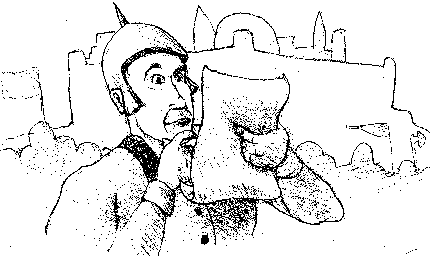
Once upon a time, the son of Brahmadatta was ruling righteously in Benares, in northern India. It came to pass that the King of Kosala made war, killed the King of Benares, and made the queen become his own wife.
Meanwhile, the queen’s son escaped by sneaking away through the sewers. In the countryside he eventually raised a large army and surrounded the city. He sent a message to the king, the murderer of his father and the husband of his mother. He told him to surrender the kingdom or fight a battle.
The prince’s mother, the Queen of Benares, heard of this threat from her son. She was a gentle and kind woman who wanted to prevent violence and suffering and killing. So she sent a message to her son — “There is no need for the risks of battle. It would be wiser to close every entrance to the city. Eventually the lack of food, water and firewood will wear down the citizens. Then they will give the city to you without any fighting."
The prince decided to follow his mother’s wise advice. His army blockaded the city for seven days and nights. Then the citizens captured their unlawful king, cut off his head, and delivered it to the prince. He entered the city triumphantly and became the new King of Benares.
The moral is: Kind advice is wise advice.
100. A Mother’s Wise Advice [Non-violence]
Link: https://hhdorjechangbuddhaiiiinfo.com/2024/10/22/100-a-mothers-wise-advice-non-violence/
#Buddhisttalesforyoungandold #Buddhiststories #storiesforkids #moralstories #Buddha #Jatakastories #PansiyaPanasJataka
Once upon a time, the Enlightenment Being was born in a merchant’s family in Benares, in northern India. He was given the name Wise. When he grew up, he began doing business with a man whose name just happened to be Verywise.
It came to pass that Wise and Verywise took a caravan of 500 bullock carts into the countryside. After selling all their goods they returned to Benares with their handsome profits.
When it came time to split their gains between them, Verywise said, “I should get twice as much profit as you." “How come?" asked Wise. “Because you are Wise and I am Verywise. It is obvious that Wise should get only half as much as Verywise."
Then Wise asked, “Didn’t we both invest equal amounts in this caravan trip? Why do you deserve twice as much profit as I?" Verywise replied, “Because of my quality of being Verywise." In this way their quarrel went on with no end in sight.
Then Verywise thought, “I have a plan to win this argument." So he went to his father and asked him to hide inside a huge hollow tree. He said, “When my partner and I come by and ask how to share our profits, then you should say, ‘Verywise deserves a double share."‘
Verywise returned to Wise and said, ‘My friend, neither of us wants this quarrel. Let’s go to the old sacred tree and ask the tree spirit to settle it."
When they went to the tree Verywise said solemnly, “My lord tree spirit, we have a problem. Kindly solve it for us." Then his father, hidden inside the hollow tree, disguised his voice and asked, “What is your question?" The man’s cheating son said, “My lord tree spirit, this man is Wise and I am Verywise. We have done business together. Tell us how to share the profits." Again disguising his voice, his father responded, “Wise deserves a single share and Verywise deserves a double share."
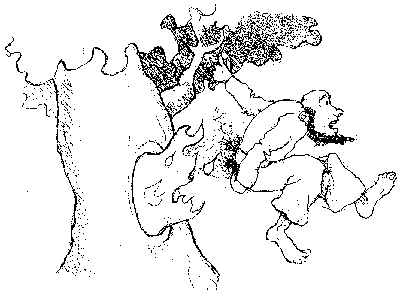
Hearing this solution, Wise decided to find out if it really was a tree spirit speaking from inside the tree. So he threw some hay into it and set it on fire. Immediately Verywise’s father grabbed onto a branch, jumped out of the flames and fell on the ground. He said in his own voice, “Although his name is Verywise, my son is just a clever cheater. I’m lucky that the one named Wise really is so, and I’ve escaped only half toasted!"
Then Wise and Verywise shared their profits equally. Eventually they both died and were reborn as they deserved.
The moral is: A cheater may be clever but not wise.
98. A Man Named Wise [Cheating]
Link: https://hhdorjechangbuddhaiiiinfo.com/2024/10/08/98-a-man-named-wise-cheating/
#Buddhisttalesforyoungandold #Buddhiststories #storiesforkids #moralstories #Buddha #Jatakastories #PansiyaPanasJataka

Once upon a time there was a world famous teacher in Takkasila, in north-western India. He had 500 high class students who learned sacred teachings from him.
It just so happened that one of these high class students had been named ‘Bad’ by his parents. One day he thought, “When I am told, ‘Come Bad’, ‘Go Bad’, ‘Do this Bad’, it is not nice for me or others. It even sounds disgraceful and unlucky."
So he went to the teacher and asked him to give him a more pleasant name, one that would bring good fortune rather than bad. The teacher said, “Go my son, go wherever you like and find a more fortunate name. When you return, I will officially give you your new name."
The young man named Bad left the city, and traveled from village to village until he came to a big city. A man had just died and Bad asked what his name was. People said. “His name was Alive." “Alive also died?" asked Bad. The people answered, “Whether his name be Alive or whether it be Dead, in either case he must die. A name is merely a word used to recognize a person. Only a fool would not know this!" After hearing this, Bad no longer felt badly about his own name — but he didn’t feel good about it either.
As he continued on his way into the city, a debt-slave girl was being beaten by her masters in the street. He asked, “Why is she being beaten?" He was told, “Because she is a slave until she pays a loan debt to her masters. She has come home from working, with no wages to pay as interest on her debt." “And what is her name?" he asked. “Her name is Rich." they said. “By her name she is Rich but she has no money even to pay interest?" asked Bad. They said, ‘Whether her name be Rich or whether it be Poor, in either case she has no money. A name is merely a word used to recognize a person. Only a fool would not know this!" After hearing this, Bad became even less interested in changing his name.
After leaving the city, along the roadside he met a man who had lost his way. He asked him, “What is your name? " He replied, ‘My name is Tourguide." “You mean to say that even a Tourguide has gotten lost?" asked Bad. Then the man said, “Whether my name be Tourguide or whether it be Tourist, in either case I have lost my way. A name is merely a word used to recognize a person. Only a fool would not know this!"
Now completely satisfied with his own name, Bad returned to his teacher.
The world famous teacher of Takkasila asked him, “How are you, my son? Have you found a good name?" He answered, “Sir, those named Alive and Dead both die, Rich and Poor may be penniless, Tourguide and Tourist can get lost. Now I know that a name is merely a word used to recognize a person. The name does not make things happen, only deeds do. So I’m satisfied with my name. There’s no point in changing it."
The teacher summarized the lesson his pupil had learned this way — “By seeing Alive as dead, Rich as poor, Tourguide as lost, Bad has accepted himself."
The moral is: “A rose by any other name would smell as sweet."
97. A Man Named Bad [Self Acceptance]
Link: https://hhdorjechangbuddhaiiiinfo.com/2024/10/01/97-a-man-named-bad-self-acceptance/
#Buddhisttalesforyoungandold #Buddhiststories #storiesforkids #moralstories #Buddha #Jatakastories #PansiyaPanasJataka
Once upon a time King Brahmadatta was ruling in Benares, in northern India. The Enlightenment Being was born as the last of his 100 sons and grew up to be a wise young man.
In those days there were Silent Buddhas who came to the palace to receive alms food. They were called Buddhas because they were enlightened — they knew the Truth and experienced life as it really is, in every present moment. They were called Silent because they did not preach the Truth. This was because they knew it was a time when no one would be able to understand it. However, being filled with sympathy for the unhappiness of all beings, the Silent Buddhas wished to help anyone who asked them.
One day the young prince was thinking about his 99 older brothers and wondering if he had any chance to become King of Benares. He decided to ask the Silent Buddhas about it.
The next day the Silent Buddhas came as usual to collect alms food in the palace. The prince brought purified water and washed their feet. When they had sat down he gave them appetizers to eat. Before giving the next course he said to them, “I am 100th in line to the throne. What are the odds that I will become King of Benares?"
They replied, “Oh prince, with so many older brothers there is almost no chance you will ever be king here. However, you might become King of Takkasila. If you can get there in seven days you can become king. But on your way there is a dangerous forest. You must take the road passing through it, since it would take twice as long to go around it.
“That forest is known as ‘Devils Woods’, because it is filled with all kinds of devils — he-devils, she-devils, and even little children-devils! The she-devils spend most of their time by the roadside. They use magic to make buildings and entire cities appear along the way.
“The buildings have ceilings decorated with stars, and gorgeous rich couches surrounded by silk curtains of many colors. Sitting on these couches, the she-devils make themselves look like the sweetest, most pleasant of goddesses. With words dripping with honey they attract travelers saying, ‘You look tired. Come in, sit down, have something to drink and then be on your way.’
“Those who are persuaded to come in are invited to sit down. Then the she-devils use their beautiful physical appearance to trap their visitors with their own burning desires. After giving in to their desires, the strangers are killed by the she-devils and eaten while their blood is still hot!
“In this way those who are attracted by sight are trapped by the physical forms of women. Those who are attracted by sound are trapped by their singing voices and music. Those attracted by smell are trapped by the divine perfumes they wear. Those attracted by taste are trapped by the heavenly tasting delicacies they offer. Those attracted by touch are trapped by their soft luxurious beds and velvet couches.
“But if you, fair prince, can control all five senses, and force yourself to avoid looking at those beautiful enticing she-devils, only then can you become King of Takkasila in seven days."
The grateful Bodhisatta replied, “Thank you venerable ones, I will follow your advice. After hearing such warnings, how could I take the chance of looking at them?"
Then he asked the Silent Buddhas to give him special charms to protect him on his dangerous journey through Devils Woods. So they chanted protective blessings onto a string and some sand. He accepted the charms and paid his farewell respects to them, and then to his royal parents.
Returning to his own home he announced to his household servants, “I am going to Takkasila to win the kingship. You are to remain here." But five of them said, “We also wish to go with you." “No," said he, “you can’t come with me. I have been warned that on the way there are beautiful she-devils who trap people who can’t resist the desires coming from their own five senses. Then they kill their victims and eat them while their blood is still hot. It is far too dangerous for you. I will rely only on myself and travel alone."
But the five would not listen. They said, “If we go with you, oh prince, we will force ourselves to keep from looking at those beautiful she-devils. We will accompany you to Takkasila." “If you insist, then so be it," said the prince, ‘but keep your determination strong."
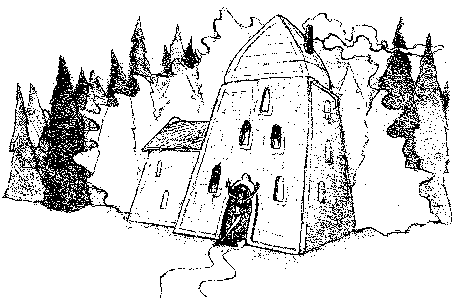
The she-devils were waiting for them in Devils Woods. They had already magically formed beautiful villages and cities with lovely houses and palaces along the way.
It just so happened that one of the prince’s five servants was easily enchanted by the sight of the curves and figures of the bodies of women. So he began to fall behind in order to admire them. The worried prince asked. ‘Why do you delay, my friend?" “My feet ache," said the man, “let me sit and rest a while in one of these mansions. Then I will catch up with you." “My good friend," said the prince, “those are she-devils. Don’t chase after them!"
Nevertheless, blinded by the temptation of the sense of sight, the man replied, “My lord, I can’t turn away. Whatever will happen, let it happen!" Giving him one last warning, the prince continued on with the other four.
The one who remained behind went closer to the beautiful looking forms he was so attracted to. After pleasing themselves fully with the man, the she-devils killed him and ate him on the spot!
Then they went farther into Devils Woods and created another mirage of a beautiful mansion. They sat inside and began singing the sweetest melodies, accompanied by the lovely sounds of all kinds of musical instruments. One of the prince’s followers was enchanted by the sound of beautiful music. So he too fell behind and was gobbled up by the still hungry she-devils.
Farther down the road they created another magic mansion filled with the scents of all kinds of divine perfumes. This time the man who loved sweet smells fell behind and was eaten as well.
Next the she-devils created a fabulous restaurant filled with foods having the most heavenly flavors. Here the lover of the tastes of the finest delicacies wandered in and was devoured in turn.
Then the she-devils went still farther down the road, created soft luxurious beds and velvet couches, and sat on them. The last of the prince’s followers was one who loved the touch of the softest fabrics and the most luxurious comfort. So he too fell behind and met his death, and was quickly eaten by the ravenous she-devils.
These events left the Enlightenment Being all alone in Devils Woods. A certain she-devil thought, “Aha! This one is very strong-minded indeed. But I am even more determined. I will not stop until I have tasted his flesh!" So she alone stubbornly followed him, even though the other devils gave up the chase.
As she got closer to the edge of Devils Woods, some woodsmen saw her and asked. “Lovely lady, who is it that walks on ahead of you?" ‘We are newlyweds," replied the lying demon, “he is my too pure husband, who ran away from me on our wedding night. That’s why I’m chasing after him."
The woodsmen caught up to the prince and asked, “Noble sir, this delicate flower-like golden-skinned young maiden has left her family to live with you. Why don’t you walk with her, instead of making her chase after you?"
The prince replied, “Good people, she is not my wife. She is a devil. She killed the five men who followed me and ate them while their blood was still hot!"
Whereupon the lovely looking devil said, “See how it is, gentlemen, anger can make husbands call their own wives devils and hungry ghosts! Such is the way of the world."
Continuing to follow the prince, the determined she-devil magically made herself look pregnant. Then she seemed to be a first-time mother carrying her make-believe baby on her hip. Whoever saw the pair questioned them just as the woodsmen had. Each time the Bodhisatta repeated, “She is not my wife. She is a devil. She killed the five men who followed me and ate them while their blood was still hot!"
96,132. The Prince and the She-devils [Chapter 1. Five Meals in the Forest]
#Buddhisttalesforyoungandold #Buddhiststories #storiesforkids #moralstories #Buddha #Jatakastories #PansiyaPanasJataka
It is said that there are two ways to practice religion. One is to live apart from the ordinary everyday world as a monk, a nun or a holy one. Those who are sincere in this way have as their highest goal the direct experience of complete Truth — full Enlightenment.
The other way to practice religion is within the ordinary world. Those who are sincere in this way have as their highest goal the harmony of an undivided world, living peacefully under a perfectly wholesome ruler — a ‘King of the World’.
Once upon a time the Enlightenment Being was born and given the name ‘Clear-sighted’. As he grew up he developed ten rules of good government: absence of hidden ill will, absence of open hostility, harmlessness, self-control, patience, gentleness, charity, generosity, straightforwardness and goodness.
The people of the world began to notice the wholesomeness and fairness of Clear-sighted, who lived strictly according to these rules. Gradually those in his vicinity volunteered to live under his authority as king, rather than under the dishonest politicians of the time.
As his reputation spread, every king in the world came to Clear-sighted and said, “Come, oh lord, you are welcome, my kingdom is your kingdom, advise me how to rule in your name."
Then Clear-sighted said, “Do not destroy life. Do not take what is not given. Do not behave wrongly in sexual desires. Do not speak falsely. Do not take alcohol that clouds the mind. My commands to the world are only these five. As long as these five are obeyed, my sixth rule is freedom for all to follow local customs and religions."
After all the people on earth had come to live under his peaceful rule, he became known as Clear-sighted the Great, King of the World. His royal city, the capital of the whole world, was called Kusavati. It was a beautiful and prosperous city with four magnificent gates — one golden, one silver, one jade and one crystal.
Outside the gates, Kusavati was surrounded by seven rows of palm trees — a row with golden trunks and silver leaves and fruits; a row with silver trunks and golden leaves and fruits; a row with cat’s-eye trunks and crystal leaves and fruits; a row with crystal trunks and cat’s-eye leaves and fruits; a row with agate trunks and coral leaves and fruits; a row with coral trunks and agate leaves and fruits; and finally a row with trunks and leaves and fruits of every kind of jewel found in the world!
When breezes blew through these marvelous palms the sweet sounds of gentle music were heard throughout the city. This music was so enticing and pleasant that some of the citizens were enchanted into stopping their work and dancing for joy!
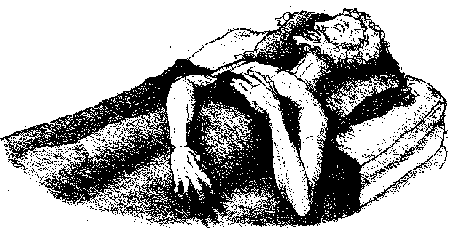
Clear-sighted the Great, King of the World, had a couch encrusted with jewels from the wonderful palms. After a long, righteous and peaceful reign, he lay on the rich couch for the last time. He knew that his end was near.
Of all his 84,000 queens, the one who loved him most was called, ‘Most-pleasant’. Sensing the state of his mind she said, “You rule over all the cities of the world, including this beautiful Kusavati with its four magnificent gates and seven rows of marvelous palms. Think about this and be happy!"
The King of the World said, “No, my dear queen don’t say that. Instead you should advise me to give up attachment to the cities of the world and all they contain." Surprised she asked, “Why do you say this, my lord?" “Because today I will die," he said.
Then Queen Most-pleasant started to cry, wiping away the tears as they flowed. And all the other 84,000 queens also broke into tears. And the king’s ministers and his whole court, both men and women, could not keep from weeping and sobbing. All eyes overflowed with tears.
But King Clear-sighted the Great said, “Your tears are useless. Be at peace." Hearing this the wailing subsided and his subjects became silent. Then he said to Queen Most-pleasant, “Oh my queen, do not cry, do not lament. Anything that comes into being, whether it be a kingdom including the whole world, or just a tiny sesame seed — it cannot last forever. Anyone who comes into being, whether it be the King of the World, or the poorest petty thief — all must decay and die. Whatever is built up, falls apart. Whatever becomes, decays. The only true happiness is in the moment when becoming and decaying are not."
In this way the Enlightenment Being got them to think about what most people don’t want to think about — that all things come to an end. He advised them to be generous and wholesome. Then the King of the World, like everyone else, died. He was reborn as a god in a heaven world, where in time, like everyone else, he died.
The moral is: “All good things come to an end."
95. Clear-sighted the Great, King of the World [Impermanence]
#Buddhisttalesforyoungandold #Buddhiststories #storiesforkids #moralstories #Buddha #Jatakastories #PansiyaPanasJataka
It is said that there are two ways to practice religion. One is to live apart from the ordinary everyday world as a monk, a nun or a holy one. Those who are sincere in this way have as their highest goal the direct experience of complete Truth — full Enlightenment.
The other way to practice religion is within the ordinary world. Those who are sincere in this way have as their highest goal the harmony of an undivided world, living peacefully under a perfectly wholesome ruler — a ‘King of the World’.
Once upon a time the Enlightenment Being was born and given the name ‘Clear-sighted’. As he grew up he developed ten rules of good government: absence of hidden ill will, absence of open hostility, harmlessness, self-control, patience, gentleness, charity, generosity, straightforwardness and goodness.
The people of the world began to notice the wholesomeness and fairness of Clear-sighted, who lived strictly according to these rules. Gradually those in his vicinity volunteered to live under his authority as king, rather than under the dishonest politicians of the time.
As his reputation spread, every king in the world came to Clear-sighted and said, “Come, oh lord, you are welcome, my kingdom is your kingdom, advise me how to rule in your name."
Then Clear-sighted said, “Do not destroy life. Do not take what is not given. Do not behave wrongly in sexual desires. Do not speak falsely. Do not take alcohol that clouds the mind. My commands to the world are only these five. As long as these five are obeyed, my sixth rule is freedom for all to follow local customs and religions."
After all the people on earth had come to live under his peaceful rule, he became known as Clear-sighted the Great, King of the World. His royal city, the capital of the whole world, was called Kusavati. It was a beautiful and prosperous city with four magnificent gates — one golden, one silver, one jade and one crystal.
Outside the gates, Kusavati was surrounded by seven rows of palm trees — a row with golden trunks and silver leaves and fruits; a row with silver trunks and golden leaves and fruits; a row with cat’s-eye trunks and crystal leaves and fruits; a row with crystal trunks and cat’s-eye leaves and fruits; a row with agate trunks and coral leaves and fruits; a row with coral trunks and agate leaves and fruits; and finally a row with trunks and leaves and fruits of every kind of jewel found in the world!
When breezes blew through these marvelous palms the sweet sounds of gentle music were heard throughout the city. This music was so enticing and pleasant that some of the citizens were enchanted into stopping their work and dancing for joy!
Clear-sighted the Great, King of the World, had a couch encrusted with jewels from the wonderful palms. After a long, righteous and peaceful reign, he lay on the rich couch for the last time. He knew that his end was near.
Of all his 84,000 queens, the one who loved him most was called, ‘Most-pleasant’. Sensing the state of his mind she said, “You rule over all the cities of the world, including this beautiful Kusavati with its four magnificent gates and seven rows of marvelous palms. Think about this and be happy!"
The King of the World said, “No, my dear queen don’t say that. Instead you should advise me to give up attachment to the cities of the world and all they contain." Surprised she asked, “Why do you say this, my lord?" “Because today I will die," he said.
Then Queen Most-pleasant started to cry, wiping away the tears as they flowed. And all the other 84,000 queens also broke into tears. And the king’s ministers and his whole court, both men and women, could not keep from weeping and sobbing. All eyes overflowed with tears.
But King Clear-sighted the Great said, “Your tears are useless. Be at peace." Hearing this the wailing subsided and his subjects became silent. Then he said to Queen Most-pleasant, “Oh my queen, do not cry, do not lament. Anything that comes into being, whether it be a kingdom including the whole world, or just a tiny sesame seed — it cannot last forever. Anyone who comes into being, whether it be the King of the World, or the poorest petty thief — all must decay and die. Whatever is built up, falls apart. Whatever becomes, decays. The only true happiness is in the moment when becoming and decaying are not."
In this way the Enlightenment Being got them to think about what most people don’t want to think about — that all things come to an end. He advised them to be generous and wholesome. Then the King of the World, like everyone else, died. He was reborn as a god in a heaven world, where in time, like everyone else, he died.
The moral is: “All good things come to an end."
95. Clear-sighted the Great, King of the World [Impermanence]
#Buddhisttalesforyoungandold #Buddhiststories #storiesforkids #moralstories #Buddha #Jatakastories #PansiyaPanasJataka
Once upon a time, the Enlightenment Being lived in a world where most religions were very similar. They taught that the way to remove suffering from the mind was to make the body suffer instead. As strange as it seems, most people thought that the holiest of the holy were the ones who tortured their bodies the most! Since everyone seemed to agree with this, the Bodhisatta decided to find out for himself if it was true.
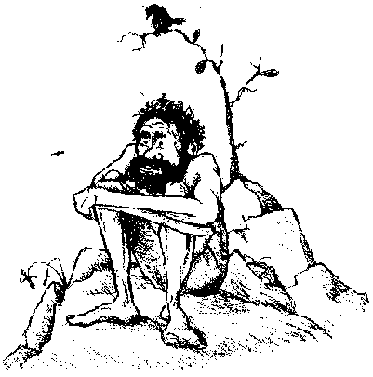
He stopped living as an ordinary everyday person and became a holy man according to the custom of the times. This meant that he gave up everything, even his clothes. He went naked, with his body covered only by dust and dirt.
So he wouldn’t be spoiled by the taste of good food, he forced himself to eat only filthy things — dirt, ashes, urine and cow dung.
So he could concentrate without being interrupted by anyone, he went to live in the most dangerous part of the forest. If he did see a human being, he ran away like a timid deer.
In the wintertime he spent his days under the trees and his nights out in the open. So in the daytime he was soaked by the cold water dripping from the icicles hanging from the tree branches. And at night he was covered by the falling snow. In this way, in winter, he made his body suffer the most extreme cold in both day and night.
In the summertime he spent his days out in the open and his nights under the trees. So in the daytime he was burned by the most severe rays of the sun. And at night he was blocked from the few cooling breezes of the open air. In this way, in summer, he made his body suffer the most extreme heat in both day and night.
This was how he struggled, trying to bring peace to his mind. He was so determined that he lived his entire life in this way.
Then, just as he was about to die, he saw a vision of himself reborn in a hell world. The vision struck him like lightning, and instantly he knew that all the ways he had tortured his body were completely useless! They had not brought him peace of mind. Lo and behold, as he gave up his false beliefs and held on to the truth, he died and was reborn in a heaven world!
The moral is: Even at the very last moment, “The truth shall make you free."
94. The Holy Man Who Tried To Be Too Holy [Extremism]
Link: https://hhdorjechangbuddhaiiiinfo.com/2024/09/03/94-the-holy-man-who-tried-to-be-too-holy-extremism/
#Buddhisttalesforyoungandold #Buddhiststories #storiesforkids #moralstories #Buddha #Jatakastories #PansiyaPanasJataka
Once upon a time, the Five Training Steps were not yet known in the world. There was a very wealthy man living in Benares who owned a large herd of cattle. He hired a man to look after them.
During the time of year when the rice paddies were filled with the green growing rice plants, the herdsman took the cattle to the forest to graze. From there he brought the milk and butter and cheese to the rich man in Benares.
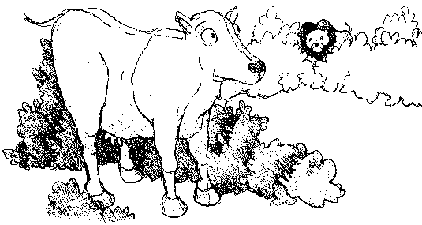
It just so happened that being in the forest put the cattle in a very frightening situation. There was a meat eating lion living nearby. Sensing the presence of the lion kept the cattle in constant fear. This made the cows tense and high-strung, leaving them too weak to give more than a little milk.
One day the owner of the cattle asked the herdsman why he was bringing such a small amount of milk and butter and cheese. He replied, “Sir, cows need to be calm and contented to give much milk. Due to a nearby lion, your cows are always afraid and tense. So they give hardly any milk."
“I see", said the rich man. Thinking like an animal trapper, he asked, “Is the lion closely connected to any other animal?" The herdsman answered, “Sir, there happens to be a variety of deer living in the forest. They are called ‘minideer’ because they are so small. Even the adults only grow to be about one foot tall. The lion has become very friendly with a certain minideer doe."
The rich man of Benares said, “So that my cows will be at peace and able to give their usual milk, this is what you are to do. Capture the lion’s friend and rub poison all over her body. Then wait a couple days before releasing her. She will be like bait in a trap for the lion. When he dies, bring his body to me. Then my cows will be safe and happy again."
The herdsman followed his boss’s orders exactly. When the lion saw his favorite minideer doe he was so overjoyed that he threw all caution to the wind. Without even sniffing the air around her, he immediately began licking her excitedly all over. Because of too much joy and not enough caution, he fell into the poisonous trap. The poor lion died on the spot.
The moral is: Too much of a good thing can be dangerous.
93. The Careless Lion [Circumspection]
Link: https://hhdorjechangbuddhaiiiinfo.com/2024/08/27/93-the-careless-lion-circumspection/
#Buddhisttalesforyoungandold #Buddhiststories #storiesforkids #moralstories #Buddha #Jatakastories #PansiyaPanasJataka
 頂禮 H.H. 第三世多杰羌佛- 眾善奉行