84. A Question From a Seven-year-old [Six Worthy Ways]

84. A Question From a Seven-year-old [Six Worthy Ways]

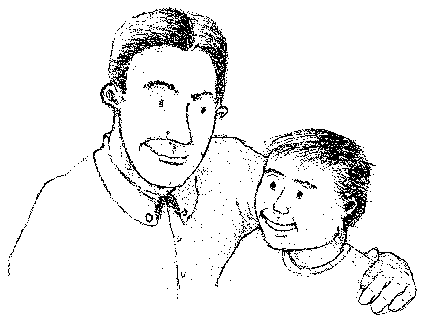
Once upon a time there was a rich man living in Bane’s, in northern India. He had a son who was intelligent, curious and eager to learn. Even though he was only seven years old, he was determined to find out what is really valuable.

One day the little boy asked his father, “What are the ways to gain the most valuable things in life?"

His father said, “Only worthy ways lead to worthwhile goals. These are the six worthy ways:

  • Keep yourself healthy and fit;
  • Be wholesome in every way;
  • Listen to those with more experience;
  • Learn from those with more knowledge;
  • Live according to Truth;
  • Act with sincerity, not just energy."

The boy paid close attention to his father’s words. He tried hard to practice these ways from then on. As he grew up and became wise, he realized that the six worthy ways, and the most valuable things in life, could not be separated.

The moral is: “A serious question deserves a serious answer."

84. A Question From a Seven-year-old [Six Worthy Ways]

Link: https://hhdorjechangbuddhaiiiinfo.com/2024/06/11/84-a-question-from-a-seven-year-old-six-worthy-ways/

#Buddhisttalesforyoungandold #Buddhiststories #storiesforkids #moralstories #Buddha #Jatakastories #PansiyaPanasJataka

83. A Hero Named Jinx [Friendship]

83. A Hero Named Jinx [Friendship]

Once upon a time, there was a very rich man who was well known for wholesomeness. He had a good friend who had the somewhat strange name, Jinx. They had been the best of friends ever since they were little children making mud-pies together. They had gone to the same schools and helped each other always.

After graduating, Jinx fell on hard times. He couldn’t find a job and earn a living. So he went to see his lifelong friend, the prosperous and successful rich man. He was kind and comforting to his friend Jinx, and was happy to hire him to manage his property and business.

After he went to work in the rich man’s mansion, pretty soon his strange name became a household word. People said, “Wait a minute, Jinx," “Hurry up, Jinx," “Do this, Jinx," ‘Do that, Jinx."

After a while some of the rich man’s neighbors went to him and said, ‘Dear friend and neighbor, we are concerned that misfortune may strike. Your mansion manager has a very strange and unlucky name. You should not let him live with you any longer. His name fills your house, with people saying, ‘Wait a minute, Jinx,’

‘Hurry up, Jinx,’ ‘Do this, Jinx,’ ‘Do that, Jinx.’ People only use the word ‘jinx’ when they want to cause bad luck or misfortune. Even house spirits and fairies would be frightened by hearing it constantly and would run away. This can only bring disaster to your household. The man named Jinx is inferior to you — he is miserable and ugly. What advantage can you possibly get by keeping such a fellow around?"

The rich man replied, “Jinx is my best friend! We have supported and cared for each other ever since we were little tots making mud-pies together. A lifelong trustworthy friend is of great value indeed! I could not reject him and lose our friendship just because of his name. After all, a name is only for recognition.

“The wise don’t give a name a I second thought. Only fools are superstitious about sounds and words and names. They don’t make good luck or bad luck!" So saying, the rich man refused to follow the advice of his busybody neighbors.

One day he went on a journey to his home village. While he was away, he left his friend Jinx in charge of his mansion home.

It just so happened that a gang of robbers heard about this. They decided it would be a perfect time to rob the mansion. So they armed themselves with various weapons and surrounded the rich man’s home during the night.

Meanwhile, the faithful Jinx suspected that robbers might attack. So he stayed up all night to guard his friend’s possessions. When he caught sight of the gang surrounding the house, he woke up everybody inside. Then he got them to blow shell horns and beat drums and make as much noise as possible.

Hearing all this, the bandits thought, “We must have been given bad information. There must be many people inside and the rich man must still be at home." So they threw down their clubs and other weapons, and ran away.

The next morning the people from the mansion were surprised to see the discarded weapons. They said to each other. “If we didn’t have such a wise house protector, all the wealth in the mansion would certainly have been stolen. Jinx has turned out to be a hero! Rather than bringing bad luck, such a strong friend has been a blessing to the rich man."

When the master of the house returned home his neighbors met him and told him what had happened. He said, “You all advised against letting my friend stay with me. If I had done as you said, I’d be penniless today!

“Walking together for just seven steps is enough to start a friendship. Continuing for twelve steps forms a bond of loyalty. Remaining together for a month brings the closeness of relatives. And for longer still, the friend becomes like a second self. So my friend Jinx is no jinx — but a great blessing!"

The moral is: The longer the friendship, the greater its rewards.

83. A Hero Named Jinx [Friendship]

Link: https://hhdorjechangbuddhaiiiinfo.com/2024/05/28/83-a-hero-named-jinx-friendship/

#Buddhisttalesforyoungandold #Buddhiststories #storiesforkids #moralstories #Buddha #Jatakastories #PansiyaPanasJataka
82, 41, 104, 369, 439. The Curse of Mittavinda [Chapter 3. Pleasure]

82, 41, 104, 369, 439. The Curse of Mittavinda [Chapter 3. Pleasure]

After seven days on the Indian Ocean, all the winds and currents stopped completely. The ship was stuck! After being dead in the water for seven days, all on board were terrified they would die.

So they drew straws to find out who was the cause of their bad luck and frightening misfortune. Seven times the short straw was drawn by Mittavinda!

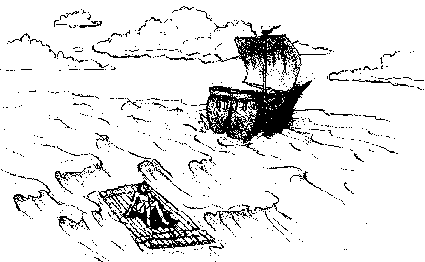
They forced him onto a tiny bamboo raft, and set him adrift on the open seas. They shouted, “Be gone forever! You are nothing but a curse!" And suddenly a strong wind sent the ship on its way.

But once again Mittavinda’s life was spared. This was a result of his wholesome actions as a monk, so many births ago. No matter how long it takes, actions cause results.

Sometimes an action causes more than one result, some pleasant and some unpleasant. It is said there are Asuras who live through such mixed results in an unusual way.

Asuras are unfortunate ugly gods. Some of them are lucky enough to change their form into beautiful young dancing girl goddesses. These are called Apsaras.

They enjoy the greatest pleasures for seven days. But then they must go to a hell world and suffer torments as hungry ghosts for seven days. Again they become Apsara goddesses — back and forth, back and forth — until both kinds of results are finished.

While floating on the tiny bamboo raft, it just so happened that Mittavinda came to a lovely Glass Palace. There he met four very pretty Apsaras. They enjoyed their time together, filled with heavenly pleasures, for seven days.

Then when it was time for the goddesses to become hungry ghosts, they said to Mittavinda, “Wait for us just seven short days, and we will return and continue our pleasure."

The Glass Palace and the four Apsaras disappeared. But still Mittavinda had not regained the peace of mind thrown away by the village monk, so very long ago. Seven days of pleasure had not satisfied him. He could not wait for the lovely goddesses to return. He wanted more and more. So he continued on in the little bamboo raft.

Lo and behold, he came to a shining Silver Palace, with eight Apsara goddesses living there. Again he enjoyed seven days of the greatest pleasure. These Apsaras also asked him to wait the next seven days, and disappeared into a hell world.

Amazing as it may seem, the greedy Mittavinda went on to seven days of pleasure in a sparkling Jewel Palace with 16 Apsaras. But they too disappeared. Then he spent seven days in a glowing Golden Palace with 32 of the most beautiful Apsaras of all.

But still he was not satisfied! When all 32 asked him to wait seven days, again he departed on the raft.

Before long he came to the entrance of a hell world filled with suffering tortured beings. They were living through the results of their own actions. But his desire for more pleasure was so strong that Mittavinda thought he saw a beautiful city surrounded by a wall with four fabulous gates. He thought, “I will go inside and make myself king!"

After he entered, he saw one of the victims of this hell world. He had a collar around his neck that spun like a wheel, with five sharp blades cutting into his face, head, chest and back. But Mittavinda was still so greedy for pleasure that he could not see the pain right before his eyes. Instead he saw the spinning collar of cutting blades as if it were a lovely lotus blossom. He saw the dripping blood as if it were the red powder of perfumed sandal wood. And the screams of pain from the poor victim sounded like the sweetest of songs!

He said to the poor man, “You’ve had that lovely lotus crown long enough! Give it to me, for I deserve to wear it now." The condemned man warned him, “This is a cutting collar, a wheel of blades." But Mittavinda said, “You only say that because you don’t want to give it up."

The victim thought, “At last the results of my past unwholesome deeds must be completed. Like me, this poor fool must be here for striking his mother. I will give him the wheel of pain." So he said, “Since you want it so badly, take the lotus crown!"

With these words the wheel of blades spun off the former victim’s neck and began spinning around the head of Mittavinda. And suddenly all his illusions disappeared — he knew this was no beautiful city, but a terrible hell world; he knew this was no lotus crown, but a cutting wheel of blades; and he knew he was not king, but prisoner. Groaning in pain he cried out desperately, “Take back your wheel! Take back your wheel!" But the other one had disappeared.

Just then the king of the gods arrived for a teaching visit to the hell world. Mittavinda asked him. “Oh king of gods, what have I done to deserve this torment?" The god replied, “Refusing to listen to the words of monks, you obtained no wisdom, but only money. A thousand gold coins did not satisfy you, nor even 120,000. Blinded by greed, you struck your mother on your way to grabbing greater wealth still.

“Then the pleasure of four Apsaras in their Glass Palace did not satisfy you. Neither eight Apsaras in a Silver Palace, nor 16 in a Jewel Palace. Not even the pleasure of 32 lovely goddesses in a Golden Palace was enough for you! Blinded by greed for pleasure you wished to be king. Now, at last, you see your crown is only a wheel of torture, and your kingdom is a hell world.

“Learn this, Mittavinda – all who follow their greed wherever it leads are left unsatisfied. For it is in the nature of greed to be dissatisfied with what one has, whether a little or a lot. The more obtained, the more desired – until the circle of greed becomes the circle of pain."

Having said this, the god returned to his heaven world home. At the same time the wheel crashed down on Mittavinda. With his head spinning in pain, he found himself adrift on the tiny bamboo raft.

Soon he came to an island inhabited by a powerful she-devil. She happened to be disguised as a goat. Being hungry, Mittavinda thought nothing of grabbing the goat by a hind leg. And the she-devil hiding inside kicked him way up into the air. He finally landed in a thorn bush on the outskirts of Benares!

After he untangled himself from the thorns, he saw some goats grazing nearby. He wanted very badly to return to the palaces and the dancing girl Apsaras. Remembering that a goat had kicked him here, he grabbed the leg of one of these goats. He hoped it would kick him back to the island.

Instead, this goat only cried out. The shepherds came, and captured Mittavinda for trying to steal one of the king’s goats.

As he was being taken as a prisoner to the king, they passed by the world famous teacher of Benares. Immediately he recognized his student. He asked the shepherds, “Where are you taking this man?"

They said, “He is a goat thief! We are taking him to the king for punishment!" The teacher said, “Please don’t do so. He is one of my students. Release him to me, so he can be a servant in my school." They agreed and left him there.

The teacher asked Mittavinda, “What has happened to you since you left me?"

He told the story of being first respected and then cursed, by the people of the remote village. He told of getting married and having two children, only to see them killed and eaten by demons in the haunted forest. He told of slapping his generous mother when he was crazy with the greed for money. He told of being cursed by his shipmates and being cast adrift on a bamboo raft. He told of the four palaces with their beautiful goddesses, and how each time his pleasure ended he was left unsatisfied. He told of the cutting wheel of torture, the reward for the greedy in hell. And he told of his hunger for goat meat that only got him kicked back to Benares without even a bite to eat!

The world famous teacher said, “It is clear that your past actions have caused both unpleasant and pleasant results, and that both are eventually completed. But you cannot understand that pleasures always come to an end. Instead, you let them feed your greed for more and more. You are left exhausted and unsatisfied, madly grasping at goat legs! Calm down, my friend. And know that trying to hold water in a tight fist, will always leave you thirsty!"

Hearing this, Mittavinda bowed respectfully to the great teacher. He begged to be allowed to follow him as a student. The Enlightenment Being welcomed him with open arms.

The moral is: In peace of mind, there is neither loss nor gain.

82, 41, 104, 369, 439. The Curse of Mittavinda [Chapter 3. Pleasure]

Link: https://hhdorjechangbuddhaiiiinfo.com/2024/05/21/82-41-104-369-439-the-curse-of-mittavinda-chapter-3-pleasure/

#Buddhisttalesforyoungandold #Buddhiststories #storiesforkids #moralstories #Buddha #Jatakastories #PansiyaPanasJataka
82, 41, 104, 369, 439. The Curse of Mittavinda [Chapter 2. Greed]

82, 41, 104, 369, 439. The Curse of Mittavinda [Chapter 2. Greed]

Little did poor Mittavinda know that his lives of constant hunger were about to come to an end. After wandering about, he eventually ended up in Benares.

At that time the Enlightenment Being was living the life of a world famous teacher in Benares. He had 500 students. As an act of charity, the people of the city supported these poor students with food. They also paid the teacher’s fees for teaching them.

Mittavinda was permitted to join them. He began studying under the great teacher. And at last, he began eating regularly.

But he paid no attention to the teachings of the wise master. He was disobedient and violent. During 500 lives as a hungry dog, quarrelling had become a habit. So he constantly got into fist fights with the other students.

It became so bad that many of the students quit. The income of the world famous teacher dwindled down to almost nothing. Because of all his fighting, Mittavinda was finally forced to run away from Benares.

He found his way to a small remote village. He lived there as a hard working laborer, married a very poor woman and had two children.

It became known that he had studied under the world famous teacher of Benares. So the poor villagers selected him to give advice when questions arose. They provided a place for him to live near the entrance to the village. And they began following his advice.

But things did not go well. The village was fined seven times by the king. Seven times their houses were burned. And seven times the town pond dried up.

They realized that all their troubles began when they started taking Mittavinda’s advice. So they chased him and his family out of the village. They shouted, ‘Be gone forever! You are nothing but a curse!"

While they were fleeing, they went through a haunted forest. Demons came out of the shadows and killed and ate his wife and children. But Mittavinda escaped.

‘He made his way to a seaport city. He was lonely, miserable and penniless. It just so happened that there was a kind generous rich merchant living in the city. He heard the story of Mittavinda’s misfortunes. Since they had no children of their own, he and his wife adopted Mittavinda. For better or worse they treated him exactly as their own son.

His new mother and father were very religious. They always tried to do wholesome things. But Mittavinda still had not learned his lesson. He did not accept any religion, so he often did unwholesome things.

Some time after his father’s death, his mother decided to try and help him enter the religious life. She said, “There is this world and there is the one to come. If you do bad things, you will suffer painful results in both worlds."

But foolish Mittavinda replied, “I will do whatever I enjoy doing and become happier and happier. There is no point considering whether what I do is wholesome or unwholesome. I don’t care about such things!"

On the next full moon holy day, Mittavinda’s mother advised him to go to the temple and listen all night long to the wise words of the monks. He said. “I wouldn’t waste my time!" So she said, “When you return I will give you a thousand gold coins."

Mittavinda thought that with enough money he could enjoy himself constantly and be happy all the time. So he went to the temple. But he sat in a. corner, paid no attention and fell asleep for the night. Early the next morning he went home to collect his reward.

Meanwhile his mother thought he would appreciate wise teachings. Then he would bring the oldest monk home with him. So she prepared delicious food for the expected guest. When she saw him returning alone, she said, “Oh my son, why didn’t you ask the senior monk to come home with you for breakfast?"

He said, “I did not go to the temple to listen to a monk or to bring him home with me. I went only to get your thousand gold coins!" His disappointed mother said, Never mind the money. Since there is so much delicious food prepared – only eat and sleep!" He replied, “Until you give me the money I refuse to eat!" So she gave him the thousand gold coins. Only then did he gobble up the food until all he could do was fall asleep.

Mittavinda did not think a thousand gold coins were enough for him to constantly enjoy himself. So he used the money to start a business, and before long he became very rich. One day he came home and said, “Mother, I now have 120,000 gold coins. But I am not yet satisfied. Therefore I will go abroad on the next ship and make even more money!"

She replied, “Oh my son, why do you want to go abroad? The ocean is dangerous and it is very risky doing business in a strange land. I have 80,000 gold coins right here in the house. That is enough for you. Please don’t go, my only son!"

Then she held him to keep him from leaving. But Mittavinda was crazy with greed. So he pushed his mother’s hand away and slapped her face. She fell to the floor. She was so hurt and shocked that she yelled at him, “Be gone forever! You are nothing but a curse!"

Without looking back, Mittavinda rushed to the harbor and set sail on the first departing ship.

82, 41, 104, 369, 439. The Curse of Mittavinda [Chapter 2. Greed]

Link: https://hhdorjechangbuddhaiiiinfo.com/2024/05/14/82-41-104-369-439-the-curse-of-mittavinda-chapter-2-greed/

#Buddhisttalesforyoungandold #Buddhiststories #storiesforkids #moralstories #Buddha #Jatakastories #PansiyaPanasJataka

82, 41, 104, 369, 439, The Curse of Mittavinda [Chapter 1. Jealousy]

82, 41, 104, 369, 439, The Curse of Mittavinda [Chapter 1. Jealousy]

Once upon a time, there was a monk who lived in a tiny monastery in a little village. He was very fortunate that the village rich man supported him in the monastery. He never had to worry about the cares of the world. His alms food was always provided automatically by the rich man.

So the monk was calm and peaceful in his mind. There was no fear of losing his comfort and his daily food. There was no desire for greater comforts and pleasures of the world. Instead, he was free to practice the correct conduct of a monk, always trying to eliminate his faults and do only wholesome deeds. But he didn’t know just how lucky he was!

One day an elder monk arrived in the little village. He had followed the path of Truth until he had become perfect and faultless.

When the village rich man saw this unknown monk, he was very pleased by his gentle manner and his calm attitude. So he invited him into his home. He gave him food to eat, and he thought himself very fortunate to hear a short teaching from him. He then invited him to take shelter at the village monastery. He said, “I will visit you there this evening, to make sure all is well."

When the perfect monk arrived at the monastery, he met the village monk. They greeted each other pleasantly. Then the village monk asked, “Have you had your lunch today?" The other replied, “Yes, I was given lunch by the supporter of this monastery. He also invited me to take shelter here."

The village monk took him to a room and left him there. The perfect monk passed his time in meditation.

Later that evening, the village rich man came. He brought fruit drinks, flowers and lamp oil, in honor of the visiting holy man. He asked the village monk, “Where is our guest?" He told him what room he had given him.

The man went to the room, bowed respectfully, and greeted the perfect monk. Again he appreciated hearing the way of Truth as taught by the rare faultless one.

Afterwards, as evening approached, he lit the lamps and offered the flowers at the monastery’s lovely temple shrine. He invited both monks to lunch at his home the next day. Then he left and returned home.

In the evening, a terrible thing happened. The village monk, who had been so contented, allowed the poison of jealousy to creep into his mind. He thought, “The village rich man has made it easy for me here. He provides shelter each night and fills my belly once a day.

“But I’m afraid this will change because he respects this new monk so highly. If he remains in this monastery, my supporter may stop caring for me. Therefore, I must make sure the new monk does not stay."

Thinking in this way, he lost his former mental calm. His mind became disturbed due to his jealousy – the fear of losing his comfort and his daily food. This led to the added mental pain of resentment against the perfect monk. He began plotting and scheming to get rid of him.

Late that night, as was the custom, the monks met together to end the day. The perfect monk spoke in his usual friendly way, but the village monk would not speak to him at all.

So the wise monk understood that he was jealous and resentful. He thought, ‘This monk does not understand my freedom from attachment to families, people and comforts. I am free of any desire to remain here. I am also free of any desire to leave here. It makes no difference. It is sad this other one cannot understand non-attachment. I pity him for the price he must pay for his ignorance."

He returned to his room, closed the door and meditated in a high mental state throughout the night.

The next day, when it was time to go collect alms food from the supporter of the monastery, the village monk rang the temple gong. But he rang it by tapping it lightly with his finger nail. Even the birds in the temple courtyard could not hear the tiny sound.

Then he went to the visiting monk’s room and knocked on the door. But again he only tapped lightly with his finger nail. Even the little mice inside the walls could not hear the silent tapping.

Having done his courteous duty in such a tricky way, he went to the rich man’s home. The man bowed respectfully to the monk, took his alms bowl and asked, “Where is the new monk, our visitor?"

The village monk replied, “I have not seen him. I rang the gong, I knocked at his door, but he did not appear. Perhaps he was not used to such rich food as you gave him yesterday. Perhaps he is still asleep, busily digesting it, dreaming of his next feast! Perhaps this is the kind of monk who pleases you so much!"

Meanwhile, back at the monastery, the perfect monk awoke. He cleaned himself and put on his robe. Then he calmly departed to collect alms food wherever he happened to find it.

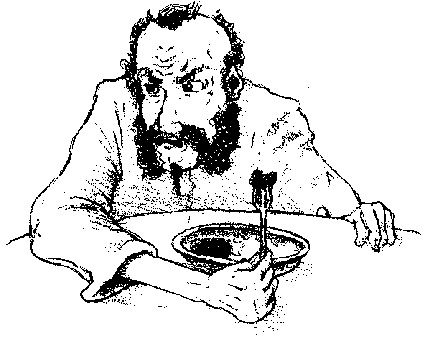
The rich man fed the village monk the richest of food. It was delicious and sweet, made from rice, milk, butter, sugar and honey. When the monk had eaten his fill, the man took his bowl, scrubbed it clean, and sweetened it with perfumed water. He filled it up again with the same wonderful food. He gave it back to the monk, saying, “Honorable monk, our holy visitor must be worn out from travelling. Please take my humble alms food to him." Saying nothing, he accepted the generous gift for the other.

By now the village monk’s mind was trapped by its own jealous scheming. He thought, “If that other monk eats this fantastic meal, even if I grabbed him by the throat and kicked him out, he still would never leave! I must secretly get rid of this alms food. But if I give it to a stranger, it will become known and talked about. If I throw it away in a pond, the butter will float on the surface and be discovered. If I throw it away on the ground, crows will come from miles around to feast on it, and that too would be noticed. So how can I get rid of it?"

Then he saw a field that had just been burned by farmers to enrich the soil. It was covered with hot glowing coals. So he threw the rich man’s generous gift on the coals. The alms food burned up without a trace. And with it went his peace of mind!

For, when he got back to the monastery, he found the visitor gone. He thought, “This must have been a perfectly wise monk. He must have known I was jealous afraid of losing my favored position. He must have known I resented him and tried to trick him into leaving. I wasted alms food meant for him. And all for the sake of keeping my own belly full! I’m afraid something terrible will happen to me! What have I done?" So, afraid of losing his easy daily food, he had thrown away his peace of mind.

For the rest of his life the rich man continued to support him. But his mind was filled with torment and suffering. He felt doomed like a walking starving zombie, or a living hungry ghost.

When he died, his torment continued. For he was reborn in a hell world, where he suffered for hundreds of thousands of years.

Finally, there too he died, as all beings must. But the results of his past actions were only partly completed. So he was reborn as a demon, 500 times! In those 500 lives, there was only one day when he got enough to eat, and that was a meal of afterbirth dropped by a deer in the forest!

Then he was reborn as a starving stray dog another 500 times! For the sake of a full monk’s belly in a past life, all these 500 lives were also filled with hunger, and quarrelling over food. Only a single time did he get enough to eat, and that was a meal of vomit he found in a gutter!

Finally most of the results of his actions were finished. Only then was he so very fortunate enough to be reborn as a human being. He was born into the poorest of the poor beggar families of the city of Kasi, in northern India. He was given the name, Mittavinda.

From the moment of his birth, this poor family became even more poor and miserable. After a few years, the pain of hunger became so great, that his parents beat him and chased Mittavinda away for good. They shouted, “Be gone forever! You are nothing but a curse!"

Poor Mittavinda! So very long ago he had not known how lucky he was. He was contented as a humble village monk. But he allowed the poison of jealousy to enter his mind – the fear of losing his easy daily food. This led to the self-torture of resentment against a perfect monk, and to trickery in denying him one wholesome gift of alms food. And it took a thousand and one lives for the loss of his comfort and daily food to be completed. What he had feared, his own actions had brought to pass!

82, 41, 104, 369, 439, The Curse of Mittavinda [Chapter 1. Jealousy]

Link: https://hhdorjechangbuddhaiiiinfo.com/2024/05/07/82-41-104-369-439-the-curse-of-mittavinda-chapter-1-jealousy/

#Buddhisttalesforyoungandold #Buddhiststories #storiesforkids #moralstories #Buddha #Jatakastories #PansiyaPanasJataka

81. Forest Monks in a King’s Pleasure Garden [Pupils Without a Teacher]

81. Forest Monks in a King’s Pleasure Garden [Pupils Without a Teacher]

Once upon a time, there was a high class rich man who gave up his wealth and his easy life in the ordinary world. He went to the Himalayan forests and lived as a homeless holy man. By practicing meditation, he developed his mind and gained the highest knowledge. Dwelling in high mental states, he enjoyed great inner happiness and peace of mind. Before long, he had 500 pupils.

In a certain year, when the rainy season was beginning, the pupils said to their teacher, “Oh wise master, we would like to go to the places where most people live. We would like to get some salt and other seasonings and bring them back here."

The teacher said, “You have my permission. It would be healthy for you to do so, and return when the rainy season is over. But I will stay here and meditate by myself." They knelt down and paid their farewell respects.

The 500 pupils went to Benares and began living in the royal pleasure garden. The next day they collected alms in the villages outside the city gates. They received generous gifts of food. On the following day they went inside the city. People gladly gave them food.

After a few days, people told the king, “Oh lord king, 500 forest monks have come from the Himalayas to live in your pleasure garden. They live in a simple way, without luxuries. They control their senses and are known to be very good indeed."

Hearing such good reports, the king went to visit them. He knelt down and paid his respects. He invited them to stay in the garden during the whole four months of the rainy season. They accepted, and from then on were given their food in the king’s palace.

Before long a certain holiday took place. It was celebrated by drinking alcohol, which the people thought would bring good luck. The King of Benares thought, “Good wine is not usually available to monks who live simply in the forests. I will treat them to some as a special gift." So he gave the 500 forest monks a large quantity of the very best tasting wine.

The monks were not at all accustomed to alcohol. They drank the king’s wine and walked back to the garden. By the time they got there, they were completely drunk. Some of them began dancing, while others sang songs. Usually they put away their bowls and other things neatly. But this time they just left everything lying around, here and there. Soon they all passed out into a drunken sleep.

When they had slept off their drunkenness, they awoke and saw the messy condition they’d left everything in. They became sad and said to each other, ‘We have done a bad thing, which is not proper for holy men like us." Their embarrassment and shame made them weep with regret. They said, ‘We have done these unwholesome things only because we are away from our holy teacher."

At that very moment the 500 forest monks left the pleasure garden and returned to the Himalayas. When they arrived they put away their bowls and other belongings neatly, as was their custom. Then they went to their beloved master and greeted him respectfully.

He asked them, Mow are you, my children? Did you find enough food and lodgings in the city? Were you happy and united?"

They replied. “Venerable master, we were happy and united. But we drank what we were not supposed to drink. We lost all our common sense and self-control. We danced and sang like silly monkeys. It’s fortunate we didn’t turn into monkeys! We drank wine, we danced, we sang, and in the end we cried from shame."

The kind teacher said, “It is easy for things like this to happen to pupils who have no teacher to guide them. Learn from this: do not do such things in the future."

From then on they lived happily and grew in goodness.

The moral is: A pupil without a teacher is easily embarrassed.

81. Forest Monks in a King’s Pleasure Garden [Pupils Without a Teacher]

Link: https://hhdorjechangbuddhaiiiinfo.com/2024/04/30/81-forest-monks-in-a-kings-pleasure-garden-pupils-without-a-teacher/

#Buddhisttalesforyoungandold #Buddhiststories #storiesforkids #moralstories #Buddha #Jatakastories #PansiyaPanasJataka
80. Fear Maker and Little Archer [Self-deception]

80. Fear Maker and Little Archer [Self-deception]

Some say that the world comes into being, disappears, and comes into being … over and over, throughout time. In one of these previous worlds, countless years ago, Truth was unknown and the Five Training Steps were practiced by only a few. Even the Enlightenment Being — the Bodhisatta — did not know Truth, and had not yet discovered the Five Training Steps.

Once upon a time in that long ago world, there was a king named Brahmadatta. Like many other kings of that name, he ruled in the place known today as Benares.

The Bodhisatta was born in a rich high class family in a market town, also in northern India. He happened to be a dwarf, bent over and partly hunchbacked. When he became a young man he remained short and stooped. Many people found him unpleasant to look at.

He studied under a very outstanding teacher. He learned all there was to know at that time, about the two great branches of knowledge — religion and science. He also learned how to use a bow and arrow better than anyone else in India. For this reason his teacher called him ‘Little Archer’.

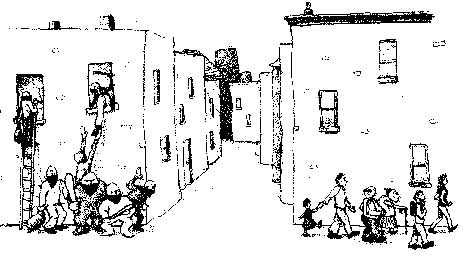
Like most new graduates he was quite clever. He thought, “Many people judge by appearance alone. If I go to a king and ask for a job, he’ll probably ask, ‘Having such a short body, what can you possibly do for me?’ Therefore it would be better if I can team up with a front man — someone who is handsome in appearance, tall and well-grown in body, and strong in personality. I will provide the brains, but remain out of sight behind his shadow. In this way we can earn a good living together."

One day he was walking in the district where the weavers live and work. He happened to see a big, strong looking man. He greeted him and asked his name. The weaver said, “Because of my appearance, people call me Fear Maker."

“With such an impressive name." said Little Archer, “and being so big and strong looking, why do you have such a low paying job?" “Because life is hard," he replied.

“I have an idea." Said the dwarf “In all India there is no one as skilled with a bow and arrow as I am. But I don’t look the part! If I asked a king for work he would either laugh or get angry at me. He would not believe that a hunchbacked little dwarf could be the greatest archer in India!

‘But you look perfect. And your name helps too. Therefore, let us go together to the king. You will be the front man and do all the talking. The king will hire you immediately. Meanwhile I will remain as if hidden underneath your shadow. I will be the real archer and we will prosper and be happy. You just have to do whatever I tell you."

Thinking he had nothing to lose, Fear Maker agreed, saying, “It’s a deal, my friend!"

The two partners went off to Benares to see the king. When they entered the throne room, they bowed respectfully to the king. He asked them, “Why have you come here?"

Fear Maker stood in front and did all the talking. He answered, “I am the great archer known as Fear Maker. There is no one in all India who understands the science of archery as well as I do. I wish to be in your service, your majesty."

The king was quite impressed. He asked, “What shall I pay you?" “I will serve you for 500 pieces of money per week your majesty," he replied.

Nodding, the king noticed the silent dwarf stooping behind him, almost out of sight. “Who is this little man?" he asked. “What does he do for you?" “He’s my little assistant," said Fear Maker. ‘Very well," said King Brahmadatta, “the job is yours."

In this way Fear Maker was accepted into the king’s service, but it was Little Archer who did all the work.

Before long, news came to the palace that there was a ferocious tiger living in the jungle next to the king’s highway. He ambushed travellers, and then killed and ate them. Many began to avoid the king’s highway out of fear of the man-eater.

The king summoned Fear Maker and asked, “Can you capture this rampaging tiger, young man?" “Your majesty," he answered, “I am known as your best archer. Why wouldn’t I be able to capture a tiger?" Hearing this, the king gave him an extra sum of money and sent him out to catch the tiger.

Fear Maker went home and told all this to his partner. “All right," said Little Archer, “be on your way!" “Aren’t you coming too?" asked the surprised Fear Maker. “No, I won’t go," he replied, “but I will give you a perfect plan. You must do exactly as I say." “I will, my little friend. Please tell me," said the big front man.

The clever little dwarf said to his friend, “Go to the district of the tiger, but don’t rush straight to his home by yourself. Instead, gather together a thousand local villagers and give them all bows and arrows. Take them directly to the tiger’s home. But then you must let them go on ahead while you hide in the underbrush.

‘The local villagers will be very afraid of the tiger. When they see him they will surround him and beat him. Being so terrified, they won’t stop beating him until he’s dead!

“Meanwhile you must cut a piece of vine with your teeth. Then come out of hiding and approach the dead tiger, holding the vine in your hand. When you see the tiger’s body, shout at the people, ‘Hey! Who has killed the tiger? I was going to capture him with this vine and lead him like a bull to the king. That’s why I’ve been searching in the jungle. Now tell me who has killed the tiger before I could get here with my vine.’

“The villagers will be easily frightened by this. They will say, ‘Lord Fear Maker, please don’t tell the king! Then they will give you a big bribe to be quiet. Thinking you have killed the dangerous tiger, King Brahmadatta will also reward you greatly." This was the tricky plan of the clever Little Archer.

Fear Maker did exactly as he had been instructed. The man-eating tiger was killed, and fear was removed from that part of the king’s highway. Followed by a big crowd he returned to the king and said, “Your majesty, I have killed the tiger and made the jungle safe for people again." The king was pleased and gave him a huge reward.

Before long there were similar complaints about a buffalo who threatened another royal road. Again the king sent Fear Maker. Following Little Archer’s strategy he did exactly as before. He took credit for killing the buffalo and was greatly rewarded again by the grateful king.

By this time Fear Maker had become a very rich and powerful nobleman. All the wealth and praise, which he didn’t really deserve, soon went to his head. He became intoxicated with his own conceit and began thinking he was a ‘big man’ in his own right. He even looked down on Little Archer and ignored his advice. He said to him, “You think this is all because of you. But I don’t need you. I can do all this without you!" He had come to believe the appearance created by Little Archer’s plan.

Then it happened that an enemy king attacked. He surrounded the city of Benares with his army. He sent a message to King Brahmadatta that he must either surrender his kingdom or wage war. The King of Benares ordered his greatest hero, Fear Maker, to go out and fight the enemy.

Fear Maker was dressed in full military armour. He mounted the mightiest armoured war elephant. Little Archer knew that the ungrateful conceited braggart, called Fear Maker was really scared to death underneath. So he too mounted the elephant and sat behind Fear Maker. The mighty elephant walked through the city gates towards the battlefield, followed by a big crowd.

When Fear Maker heard the huge noise made by the war drums, he began trembling with fear. To keep him from falling off the elephant and being killed, Little Archer tied a rope around him and held him with it.

When Fear Maker saw the field of battle he was overwhelmed by the terrible fear of death. So much so, that he couldn’t help but release his bowels and urinate at the same time — all over the back of the poor brave war elephant!

The Enlightenment Being said, “Before you bragged and spoke roughly like a big man. But now, the only big thing you do is make a filthy mess all over this elephant’s back! Your present actions prove your past appearance was false."

Fear Maker had embarrassed himself. Little Archer had humbled him by speaking the truth. But he couldn’t help feeling sympathy for him. He said, “Don’t be afraid anymore, my friend. With me to protect you, your life is safe. Climb down from the elephant and go home and take a bath."

Alone atop the great elephant, the Enlightenment Being thought, “Now is the time to show what is in the heart of this hunchbacked little dwarf!" Shouting mightily as he rode he charged into the field of battle. Without killing any men or animals, he crashed through the enemy’s defences. He broke into the king’s camp, captured him, and took him back as prisoner to the King of Benares.

King Brahmadatta was delighted with Little Archer’s great victory. He rewarded him with wealth and fame. He became known throughout all India as ‘Little Archer the Wise’. He sent his friend Fear Maker back to his home village and supported him with monthly payments.

Little Archer the Wise practiced generosity and other meritorious deeds. When he died he was reborn as he deserved.

The moral is: “Appearances can be deceiving."

80. Fear Maker and Little Archer [Self-deception]

Link: https://hhdorjechangbuddhaiiiinfo.com/2024/04/16/80-fear-maker-and-little-archer-self-deception/

#Buddhisttalesforyoungandold #Buddhiststories #storiesforkids #moralstories #Buddha #Jatakastories #PansiyaPanasJataka
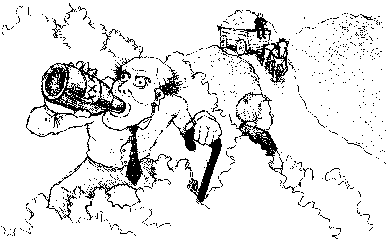
79. A Motherless Son [Betrayal]

79. A Motherless Son [Betrayal]

Once upon a time, King Brahmadatta was ruling in Benares in northern India. He had a clever minister who pleased him very much. To show his appreciation he appointed him headman of a remote border village. His duty was to represent the king and collect the king’s taxes from the villagers.

Before long the headman was completely accepted by the villagers. Since he had been sent by the just King Brahmadatta, they respected him highly. They came to trust him as much as if he had been born among them.

In addition to being clever, the headman was also very greedy. Collecting the king’s taxes was not enough reward for him. After becoming friendly with a gang of bandits, he thought up a plan to make himself rich.

The headman said to his friends, the robbers, “I will find excuses and reasons to lead all the villagers into the jungle. This will be easy for me, since they trust me as one of their own. I will keep them busy in the jungle, while you invade the village and rob everything of value. Carry everything away before I bring the people home. In return for my help, you must give me half of all the loot!" The bandits agreed, and a date was set.

When the day arrived, the headman assembled all the villagers and led them into the jungle. According to the plan, the bandits entered the unprotected village. They stole everything of value they could find. They also killed all the defenseless village cows, and cooked and ate the meat. At the end of the day the gang collected all their stolen goods and escaped.

It just so happened that on that very same day a travelling merchant came to the village to trade his goods. When he saw the bandits he stayed out of sight.

The headman brought all the villagers home in the evening. He ordered them to make a lot of noise by beating drums as they marched towards the village. If the bandits had still been there, they would have heard the villagers coming for sure.

The village people saw that they had been robbed and all their cows were dead and partly eaten. This made them very sad. The travelling merchant appeared and said to them, ‘This treacherous village headman has betrayed your trust in him. He must be a partner of the gang of bandits. Only after they left with all your valuables did he lead you home. beating drums as loudly as possible!

“This man pretends to know nothing about what has happened —- as innocent as a newborn lamb! In truth, it’s as if a son did something so shameful that his mother would say: “I am not his mother, he is not my son. My son is dead!"‘

Before long, news of the crime reached the king. He recalled the treacherous headman and punished him according to the law.

The moral is: No one defends a betrayer of trust.

79. A Motherless Son [Betrayal]

Link: https://hhdorjechangbuddhaiiiinfo.com/2024/04/09/79-a-motherless-son-betrayal/

#Buddhisttalesforyoungandold #Buddhiststories #storiesforkids #moralstories #Buddha #Jatakastories #PansiyaPanasJataka

78. Illisa the Cheap [Miserliness]

78. Illisa the Cheap [Miserliness]

Once upon a time, there was a billionaire in northern India. He was an adviser to a king. Although he was very rich, he was not at all good looking. He was lame due to crooked feet, and his hands were also deformed into crooked positions. His eyes were crooked too, that is to say, he was cross-eyed. And some would say he had a crooked mind as well, for he was without any religion whatsoever! You might think people would call him, ‘Illisa the Crooked’, but that was not the case.

Illisa also happened to be a miser, one who will not give anything to anybody. He would not even spend any of his wealth on his own enjoyment. Therefore, it was said that his home was like a pond possessed by demons, where no one could quench his thirst.

However, Illisa’s ancestors, going back seven generations, were the most generous of gift givers. They gave away the very best of their possessions. But when Illisa inherited the family fortune, he abandoned that great family tradition.

The family had always maintained a charity dining hall, where anyone could come for a free hot meal. Illisa burned this free food kitchen to the ground since he wanted to be rid of the expense. Then he pushed the poor and hungry from his door, hitting them as they went. He quickly earned a reputation for hoarding all his wealth and possessions. Soon people began calling him, ‘Illisa the Cheap’.

One day when he was returning home from advising the king, Illisa saw a tired worn-out villager by the side of the road. He had obviously walked a great distance. He was sitting on the ground pouring cheap wine into a cup. He was drinking it, along with some smelly dried fish.

Seeing this made Illisa thirsty for a drink of liquor. Then he thought, “I would love to have a drink! But if I do, others may want to drink with me, and that could cost me money!" For that reason alone, he suppressed his craving for alcohol.

As time passed, his craving did not disappear. Instead, fighting it and worrying constantly made him look sick. His skin turned yellow, and he became thinner and thinner until the veins stuck out from his flesh. He fought a constant battle against his thirst for liquor. He slept face down, holding onto the bed tightly while he slept.

His wife began to notice the changes in him. One day, while massaging his back to comfort him, she asked, “Are you sick, my husband?" “No," said Illisa. Did the king get angry at you?" she asked. “No," said he. “Have our children or the servants done anything to upset you?" asked his wife. Again he said “No." “Do you have a strong craving for something?" she continued.

Illisa the Cheap kept silent. He was afraid that if he told her it might end up costing him money! But his wife began pleading, “Tell me, please tell me." Finally, swallowing hard and clearing his throat, he answered, “Yes, I do have a strong craving." “A craving for what?" she asked. “For a drink of alcoholic liquor," he admitted at last.

“Oh, is that all!" said his wife. “Why didn’t you tell me this at first? You are not poor. You can easily afford to buy a drink for yourself and the whole city as well! Shall I brew a big batch of liquor for us all?"

Of course this was not what Illisa the Cheap wanted to hear. He blurted out. ‘Why should we give liquor to others? Let them earn their own!" Then his wife asked. “Well then, what about just for us and our neighbors?" “I didn’t know you had become so rich all of a sudden!" he shot back at her. How about just our household?" she asked. How generous you are with my money!" he replied. “All right then," she said, “I will brew just enough liquor for you and me, my husband." “Why should you be included? Women should not drink liquor!"

“Now I understand you perfectly well!" said Illisa’s wife. “I will make only enough liquor for you alone." But Illisa the Cheap always thought of even the slightest chance of spending money. He said, “If you prepare liquor here, people will notice and come ask for some. Even if I buy some in a liquor store and bring it here to drink, others will find out and want some. There will be no liquor given away in this house!"

So Illisa decided to give the smallest coin he had to a servant boy, and sent him to the liquor store. When he returned, Illisa took him down to the riverside. He took the small bottle of liquor from the boy, and set him to stand watch nearby. Then Illisa the Cheap hid in the underbrush, poured some liquor into a cup, and secretly began drinking.

It just so happened that when Illisa’s father had died, he had been reborn as Sakka, King of the Heaven of 33. This was because of his lifelong generosity.

At this particular moment, Sakka was curious about whether his free food kitchen was still giving out food to all who wished it. He discovered that it no longer existed, that his son had given up the family tradition and had even kicked the hungry out onto the street! He saw his miserly son drinking by himself, hiding in the bushes, afraid he might have to share with others.

Sakka decided to change Illisa’s mind and teach him a lesson about the results of both good and bad actions. He decided to make him become generous, rather than cheap, so that he too might be reborn in a heaven world.

The King of the Heaven of 33 disguised himself so that he looked exactly like Illisa the Cheap. He too had crooked feet, crooked hands and crooked eyes. He entered the city, went to the palace, and asked for an audience with the king. The king said, “Let my adviser Illisa come in."

He asked, “Why have you come at this untimely moment?" “My lord," said Sakka, “I have come to give my billionaire’s wealth to you to fill up the treasury." The king replied, “No, no. I have enough, much more than that." The disguised Sakka said, “Then if you do not want it my lord kindly permit me to give it away as I wish." “Do as you say," said the king.

Sakka went to Illisa’s house. The servants greeted him as if he were indeed their master. He entered the house and sat down. He summoned the gate keeper and said, “If anybody comes here who looks like me and says, ‘This house is mine’, don’t let him in. Instead beat him on the back and kick him out!" Then he went upstairs and called for Illisa’s wife. Smiling at her he said, “My love, let us be generous!"

At first, Illisa’s wife, children and servants were surprised. They said to each other, “It was never in his mind to give anything to anybody before today. This must be because he’s been drinking alcohol and has gotten a little soft in the head!"

Illisa’s wife said, “As you wish, my lord, give away as much as you like." Tall for the drummer," said Sakka, “and order him to go and beat his drum in the city. Have him announce that all who desire gold, silver, pearls, jewels, lapis lazuli, diamonds and coral, are to come to the home of Illisa the billionaire." She did as he said.

Soon a big crowd began to arrive, carrying baskets, buckets and bags. Sakka opened up the store rooms of Illisa’s wealth. He said, “I give you all these riches. Take as much as you want and go." The people took it all outside and piled it up. They filled up their containers and carried them away.

One clever man from the countryside harnessed Illisa the Cheap’s bullocks to Illisa the Cheap’s bullock cart. Then he filled it to the brim with Illisa the Cheap’s seven treasures, and rode out of the city by the main road.

Without knowing it, he passed by the bushes where the real Illisa was still drinking liquor. He was so happy to be suddenly rich, that he shouted out as he went, “May Lord Illisa the billionaire live a hundred years! Because of you I have struck the jackpot. I won’t have to work another day in my life! These were your bullocks, your cart and your seven treasures. They were not given to me by my father and mother — but by you, Illisa the generous!"

The hidden Illisa was shocked to hear this. He thought, “This man is talking about me! Has the king taken my wealth and given it away?" Then: he jumped out from the bushes and shouted, “Hey you, what are you doing with my bullock cart?" He grabbed the reins and stopped the cart.

The villager got down and said, “What’s wrong with you? The billionaire Lord Illisa is giving his wealth to all the people of the city. What do you think you’re doing?"

As he said this, he struck Illisa on the head as hard as a thunderclap and rode away on the cart filled with treasure.

Illisa the Cheap bounced to his feet and chased after the cart. He grabbed the reins again. This time the villager held onto Illisa by the hair, pulled his head down, and struck it hard with his elbow. He grabbed him by the neck, threw him to the ground, and then continued on his way.

All this rough treatment sobered up Illisa. He ran home as fast as he could. He saw the crowds of people carrying off his precious riches. He grabbed hold of them to stop them, but they just pushed him out of the way and knocked him down. Nearly fainting from his bruises, he tried to get into his home. But the gate keeper said, “Where do you think you’re going?" Beating him with a cane, he grabbed him by the neck and threw him out.

Illisa thought, “Now no one can help me but the king." So he ran to the palace and went straight inside. He said, “My lord, why do you want my house to be looted?" The king said, “This is not my doing. I myself heard you say that if I would not accept your wealth, you would give it to all the citizens. I applaud your generosity! And did you not send a drummer into the streets to announce you were giving your wealth to any and all?"

“My lord king must be joking!" said Illisa. “I didn’t do any such thing. People don’t call me ‘Illisa the Cheap’ for nothing! I don’t give anything to anybody if I can help it! Please, lord king, summon whoever is giving my treasures away, and clear up this matter."

After being summoned by the king, Sakka came to the palace. Illisa asked, “Who is the real billionaire, my lord king?" Neither the king nor his ministers could tell the difference between them.

The king said, “We cannot recognize which one it is. Do you know someone who can recognize you for sure?" “Yes, my lord, my wife can recognize me," said Illisa. But when she was called for and asked to decide, she stood next to Sakka and said, “This is my husband." When Illisa’s children and servants were summoned, they too picked Sakka.

Illisa thought, “I have a wart on my head, covered up by my hair. Only my barber knows this." So he said to the king, “Please summon my barber. He knows me very well."

The barber was called for and the king asked him, “Can you tell us which of these two men is Illisa the billionaire?" “I must examine their heads," he said, “then I will determine who the real Illisa is." “Do so," said the king.

Immediately Sakka, King of the Heaven of 33, made a wart appear on his head. When the barber examined them he found warts on both their heads. He said, “Oh lord king, I cannot recognize which of these is Illisa. Both have crooked feet, both have crooked hands, both have crooked eyes, and both have warts on the same spots on their heads. I can’t tell the difference!"

Hearing these words, Illisa began trembling. His mind became so unbalanced from losing his last hope of regaining his wealth, that he fainted on the spot.

At that very moment, Sakka said, “I am not Illisa. I am Sakka, King of the Gods of the Heaven of 33." As he said this, he used his super powers to rise into the air and remain suspended there.

Attendants splashed cold water on Illisa’s face and woke him from his fainting spell. He knelt down in respect before Sakka, King of Gods.

Then Sakka spoke: “This wealth came from me, Illisa, not from you. I myself, when I was your father, did many meritorious deeds. I was glad to give to the poor and needy. That is why, when I died, I was reborn as Sakka, King of Gods.

“However, you have violated our family tradition. Being a non-giver, living the life of a miser, burning my charity dining hall to the ground, and chasing the homeless beggars from your door — you have kept all the family wealth to yourself. You are so cheap that you cannot even use the wealth for your own enjoyment! It is utterly wasted and useless. The family fortune has become like a pond possessed by demons, where no one can quench his thirst. It would be better if you were dead!

“Illisa, my former son, if you change your ways, you will be the one to benefit most. If you rebuild my free food kitchen and give hot meals to all who ask, you will earn both merit and peace of mind. But if you refuse to be generous, I will make all your riches disappear. And I will split your crooked skull with my divine diamond dagger!"

In fear of his own death, Illisa the Cheap promised, “I will give generously from now on, oh King of Gods."

Sakka accepted his promise. Still floating in the air, he preached on the true value of giving. He also convinced him to practice the Five Training Steps, for the benefit of himself and others. These are to give up entirely: destroying life, taking what is not given, sexual wrongdoing, speaking falsely, and losing one’s mind from alcohol.

Then Sakka disappeared and returned to his heavenly home.

Illisa did indeed change his ways. He gave alms generously, did many other good deeds, and became much happier. When he died, he was reborn in a heaven world.

The moral is: Poor indeed is the rich man who won’t part with a penny.

78. Illisa the Cheap [Miserliness]

Link: https://hhdorjechangbuddhaiiiinfo.com/2024/04/02/78-illisa-the-cheap-miserliness/

#Buddhisttalesforyoungandold #Buddhiststories #storiesforkids #moralstories #Buddha #Jatakastories #PansiyaPanasJataka