56. A Huge Lump of Gold [Moderation]

56. A Huge Lump of Gold [Moderation]

Once upon a time there was a rich village. The wealthiest of the villagers decided to hide a huge lump of gold to protect it from bandits and robbers. So he buried it in a nearby rice field.

Many years later, the village was no longer rich, and the rice field was abandoned and unused. A poor farmer decided to plow the field. After some time plowing, it just so happened that his plow struck the long forgotten buried treasure.

At first he thought it must be a very hard tree root. But when he uncovered it, he saw that it was beautiful shining gold. Since it was daytime he was afraid to try and take it with him. So he covered it up again and waited for nightfall.

The poor farmer returned in the middle of the night. Again he uncovered the golden treasure. He tried to lift it, but it was far too heavy. He tied ropes around it and tried to drag it. But it was so huge he couldn’t budge it an inch. He became frustrated, thinking he was lucky to find a treasure, and unlucky to not be able to take it with him. He even tried kicking the huge lump of gold. But again it wouldn’t budge an inch!

Then he sat down and began to consider the situation. He decided the only thing to do was to break the lump of gold into four smaller lumps. Then he could carry home one piece at a time.

He thought, “One lump I will use for ordinary day-to-day living. The second lump I will save for a rainy day. The third lump I will invest in my farming business. And I will gain merit with the fourth lump by giving it to the poor and needy and for other good works."

With a calm mind he divided the huge lump of gold into these four smaller lumps. Then it was easy to carry them home on four separate trips.

Afterwards he lived happily.

The moral is: “Don’t bite off more than you can chew."

56. A Huge Lump of Gold [Moderation]

Link:https://hhdorjechangbuddhaiiiinfo.com/2023/10/03/56-a-huge-lump-of-gold-moderation/

#Buddhisttalesforyoungandold #Buddhiststories #storiesforkids #moralstories #Buddha #Jatakastories #PansiyaPanasJataka

54, 85. The Whatnot Tree [Prudence]

54, 85. The Whatnot Tree [Prudence]

Once upon a time there was a caravan leader. He went from country to country selling various goods. His caravans usually had at least 500 bullock carts.

On one of these trips his path led through a very thick forest. Before entering it, he called together all the members of the caravan. He warned them, “My friends, when you go through this forest be careful to avoid the poisonous trees, poisonous fruits, poisonous leaves, poisonous flowers and even poisonous honeycombs.

“Therefore, whatever you have not eaten before — whether a fruit, leaf, flower or anything else — must not be eaten without asking me first." They all said respectfully, “Yes, sir."

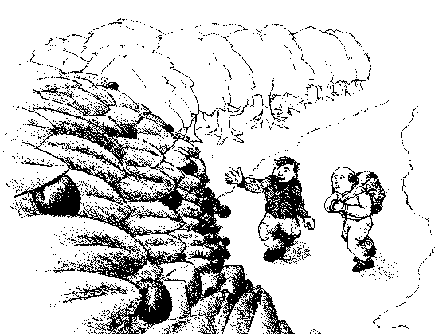
There was a village in the forest. Just outside the village stood a tree called a ‘whatnot tree’. Its trunk, branches, leaves, flowers and fruits look very similar to a mango tree. Even the colour, shape, smell and taste are almost exactly the same as a mango tree. But unlike a mango, the whatnot fruit is a deadly poison!

Some went ahead of the caravan and came upon the whatnot tree. They were all hungry, and the whatnot fruits looked like delicious ripe mangoes. Some started eating the fruits immediately, without thinking at all. They devoured them before anyone could say a word.

Others remembered the leader’s warning, but they thought this was just a different variety of mango tree. They thought they were lucky to find ripe mangoes right next to a village. So they decided to eat some of the fruits before they were all gone.

There were also some who were wiser than the rest. They decided it would be safer to obey the warning of the caravan leader. Although they didn’t know it, he just happened to be the Enlightenment Being.

When the leader arrived at the tree, the ones who had been careful and not eaten asked, “Sir, what is this tree? Is it safe to eat these fruits?"

After investigating thoughtfully he replied, “No, no. This may look like a mango tree, but it isn’t. It is a poisonous whatnot tree. Don’t even touch it!"

The ones who had already eaten the whatnot fruit were terrified. The caravan leader told them to make themselves vomit as soon as possible. They did this, and then were given four sweet foods to eat – raisins, cane sugar paste, sweet yogurt and bee’s honey. In this way their taste buds were refreshed after throwing up the poisonous whatnot fruit.

Unfortunately, the greediest and most foolish ones could not be saved. They were the ones who had started eating the poisonous fruits immediately, without thinking at all. It was too late for them. The poison had already started doing its work, and it killed them.

In the past, when caravans had come to the whatnot tree, the people had eaten its poisonous fruits and died in their sleep during the night. The next morning the local villagers had come to the campsite. They had grabbed the dead bodies by the legs, dragged them to a secret hiding place, and buried them. Then they had taken for themselves all the merchandise and bullock carts of the caravan.

They expected to do the same thing this time. At dawn the next morning the villagers ran towards the whatnot tree. They said to each other, “The bullocks will be mine!" “I want the carts and wagons!" “I will take the loads of merchandise!"

But when they got to the whatnot tree they saw that most of the people in the caravan were alive and well. In surprise, they asked them, “How did you know this was not a mango tree?" They answered, “We did not know, but our leader had warned us ahead of time, and when he saw it he knew."

Then the villagers asked the caravan leader, “Oh wise one, how did you know this was not a mango tree?"

He replied, “I knew it for two reasons. First, this tree is easy to climb. And second, it is right next to a village. If the fruits on such a tree remain unpicked, they cannot be safe to eat!"

Everyone was amazed that such lifesaving wisdom was based on such simple common sense. The caravan continued on its way safely.

The moral is: The wise are led by common sense; fools follow only hunger.

The Whatnot Tree [Prudence]

INTERPRETER’S INTRODUCTION – BUDDHIST TALES FOR YOUNG AND OLD, VOLUME 1, STORIES 1-50

Link:https://hhdorjechangbuddhaiiiinfo.com/2023/09/26/the-whatnot-tree-prudence/

#Buddhisttalesforyoungandold #Buddhiststories #storiesforkids #moralstories #Buddha #Jatakastories #PansiyaPanasJataka
53. A Gang of Drunkards [Sobriety]

53. A Gang of Drunkards [Sobriety]

Once upon a time, when Brahmadatta was king, the Enlightenment Being was born in a wealthy family. He became the richest man in Benares.

There also happened to be a gang of drunkards who roamed the streets. All they ever thought about was finding ways to get alcohol, the drug they thought they couldn’t live without.

One day, when they had run out of money as usual, they came up with a scheme to rob the richest man in Benares. But they didn’t realise that he was the reborn Bodhisatta, so he wouldn’t be so easy to fool!

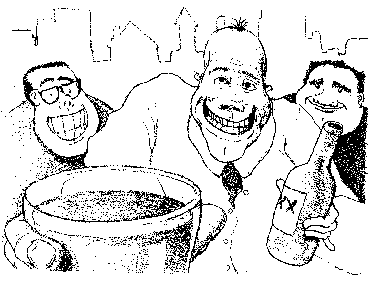
They decided to make a ‘Mickey Finn’, which is a drink of liquor with a sleeping drug secretly added to it. Their plan was to get the rich man to drink the Mickey Finn. Then when he fell asleep they would rob all his money, jewellery, and even the rich clothes he wore. So they set up a temporary little roadside bar. They put their last remaining liquor into a bottle, and mixed in some strong sleeping pills.

Later the rich man came by on his way to the palace. One of the alcoholics called out to him, “Honourable sir, why not start your day right — by having a drink with us? And the first one is on the house!" Then he poured a glass of the dishonest liquor.

But the Enlightenment Being did not drink any form of alcohol. Nevertheless, he wondered why these drunkards were being so generous with their favourite drug. It just wasn’t like them.

He realised it must be some kind of trick. So he decided to teach them a lesson. He said, “It would be an insult to appear before the king in a drunken state, or with even the slightest smell of liquor on my breath. But please be so kind as to wait for me here. I’ll see you again when I return from the palace."

The drunkards were disappointed. They would not be able to drink again as soon as they wanted. But they decided to be patient and wait.

Later that day the rich man came back to the little roadside bar. The alcoholics were getting desperate for a drink. They called him over and said, “Honourable sir, why not celebrate your visit to the king? Have a drink of this fine liquor. Remember, the first one is free!"

But the rich man just kept looking at the liquor bottle and glass. He said, “I don’t trust you. That bottle and glass of liquor are exactly as they were this morning. If it were as good as you say it is, you would have tasted some yourselves by now. In fact, you couldn’t help but drink it all! I’m no fool. You must have added another drug to the alcohol."

The richest man in Benares went on his way, and the gang of drunkards went back to their plotting and scheming.

The moral is: Keep sober — and keep your common sense.

53. A Gang of Drunkards [Sobriety]

Link:https://hhdorjechangbuddhaiiiinfo.com/2023/09/19/53-a-gang-of-drunkards-sobriety/

#Buddhisttalesforyoungandold #Buddhiststories #storiesforkids #moralstories #Buddha #Jatakastories #PansiyaPanasJataka
52, 539 King fruitful and Queen sivali [Chapter 3. Giving up Power]

52, 539 King fruitful and Queen sivali [Chapter 3. Giving up Power]

This story happened very long ago, at a time when people lived much longer lives, even 10,000 years! After King Fruitful had ruled for about 7,000 years, it just so happened that the royal gardener brought him an especially wonderful collection of fruits and flowers. He liked them so much that he wanted to see the garden. So the gardener arranged and decorated the garden, and invited him to visit.

The king set out on a royal elephant, followed by the entire court and many of the ordinary people of Mithila. When he entered through the garden gate he saw two beautiful mango trees. One was full of perfectly ripe mangoes, while the other was completely without fruit. He took one of the fruits and enjoyed its delicious sweet taste. He decided to eat more of them on his return trip.

When the people saw that the king had eaten the first fruit, they knew it was all right for them to eat. In no time at all the mangoes had been eaten. When the fruits were gone, some even broke the twigs and stripped the leaves looking for more.

When King Fruitful returned he saw that the tree was stripped bare and nearly destroyed. At the same time, the fruitless tree remained as beautiful as before, its bright green leaves shining in the sunlight.

The king asked his ministers, “What has happened here?" They explained, “Since Your Majesty ate the first fruit, the people felt free to devour the rest. Searching for more fruits they even destroyed the leaves and twigs. The fruitless tree was spared and remains beautiful since it has no fruit."

This saddened the king. He thought, “This fruitful tree was destroyed, but the fruitless one was spared. My kingship is like the fruitful tree —- the more the power and possessions, the greater the fear of losing them. The holy life of a simple monk is like the fruitless tree —- giving up power and possessions leads to freedom from fear."

So the Great Being decided to give up his wealth and power, to leave the glory of kingship behind, to abandon the constant task of protecting his position. Instead he decided to put all his effort into living the pure life of a simple monk. Only then could he discover lasting deep happiness, which would spread to others as well.

He returned to the city. Standing next to the palace gate, he called for the commander of the army. He said, “From now on, no one is to see my face except a servant bringing food and a servant bringing water and toothbrush. You and the ministers will rule according to the old law. I will live as a simple monk on the top floor of the palace."

After he had lived for a while in this way, the people began to wonder about the change in him. One day a crowd gathered in the palace courtyard. They said, “Our king is not as he was before. He no longer wants to see dancing or listen to singing or watch bull fights and elephant fights or go to his pleasure garden and see the swans on the ponds. Why does he not speak to us?" They asked the servants who brought the king his food and water, “Does he tell you anything?"

They said, “He is trying to keep his mind from thinking about desirable things, so it will be peaceful and wholesome like the minds of his old friends, the Silent Buddhas. He is trying to develop the purity of the ones who own nothing but good qualities. Once we even heard him say out loud, “I can think only of the Silent Buddhas, free from chasing ordinary pleasures. Their freedom makes them truly happy — who will take me to where they live?"

King Fruitful had been living on the top floor of the palace trying to be a simple monk for only about four months. At that point he realised there were too many distractions in the beautiful kingdom of Mithila. He saw them as only an outer show keeping him from finding inner peace and Truth. So he decided, once and for all, to give up everything and become a forest monk and go live in the Himalaya Mountains.

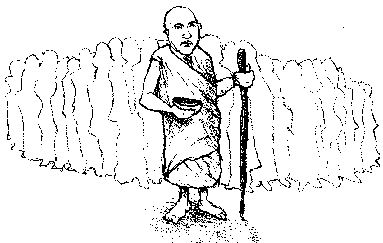
He had the yellow robes and begging bowl of a monk brought to him. He ordered the royal barber to shave his head and beard. Then early the next morning, he began walking down the royal staircase.

Meanwhile Queen Sivali had heard about his plans. She gathered together the 700 most beautiful queens of the royal harem and took them up the staircase. They passed King Fruitful coming down, but didn’t recognise him dressed as a monk. When they got to the top floor, Queen Sivali found it empty, with only the king’s shaven hair and beard still there. Instantly she realised the unknown monk must be her husband.

All 701 queens ran down the stairs to the palace courtyard. There they followed the king-turned-monk. As Queen Sivali had instructed them, they all let down their hair and tried to entice the king to stay. They cried and cried, pleading with him, “Why are you doing this?" Then all the people of the city became very upset and began following him. They were weeping as they cried out, “We have heard that our king has become a simple monk. How can we ever find such a good and fair ruler again?"

The 700 harem queens, wearing all their lovely veils and rich jewellery, crying and begging, did not change the mind of the Enlightenment Being. For he had made his decision and was determined to stick to it. He had given up the gold anointing bowl of state, which had passed the power of the royal family to him. Instead he now carried only the plain clay-begging bowl of a humble monk, a seeker of Truth.

Finally Queen Sivali stopped crying. She saw that the beautiful queens from the harem had not stopped her husband. So she went to the commander of the army. She told him to set a fire among the slum houses and abandoned buildings that were in the king’s path. She told him to set fires of brush and wet leaves in different areas of the city, to make a lot of smoke.

When this was done she fell to the ground at the king’s feet and cried, “All Mithila is burning, my lord! The beautiful buildings with their valuable art works, precious metals and jewels, and treasures are all being destroyed. Return, oh king, and save your riches before it is too late."

But the Enlightenment Being replied, “All these things belong to others. I own nothing. So I’m not afraid of losing anything. And losing things can’t make me sad. My mind is at peace."

Then he left the city through the northern gate, still followed by all 701 queens. According to Queen Sivali’s instructions, they showed him villages being robbed and destroyed. There were armed men attacking, while others seemed wounded and dead. But what looked like blood was really just red dye, and the dead were only pretending. The king knew it was a trick, since there were no actual robbers and plunderers in the kingdom in the first place.

After walking still farther, the king stopped and asked his ministers, “Whose kingdom is this?" “Yours, oh lord," they said. “Then punish any who cross this line," he ordered, as he drew a line across the road. No one, including Queen Sivali, dared to cross the line. But when she saw the king continuing on down the road, with his back to her, she was grief-stricken. Beating her breast she fell across the line. Once the line was crossed, the whole crowd lost its fear and followed her.

Queen Sivali kept the army with her as the entire crowd kept following King Fruitful. He continued for many miles, heading for the Himalayas in the north.

Meanwhile, there was a very advanced monk named Narada, who lived in a golden cave in the Himalayas. He was a very wise man. By great mental effort he had gained supernatural powers that only the highest holy men are said to have. After meditating in a wonderful trance for a full week he suddenly shouted, “What happiness! Oh what happiness!"

Then, using his special powers, he looked out over all India to see if there was anyone who was sincerely seeking that same happiness, free of all the distractions of the world. He saw only King Fruitful, the Bodhisatta who would some day become the Buddha. He saw that he had given up all his earthly power. And yet he was still blocked, still hindered by the obstacle of the crowd following him from his previous worldly life. In order to help and encourage him, he magically flew through the air and floated in front of the king.

He asked King Fruitful, “Oh monk, why is this crowd with all its noise following you?" The king replied, “I have given up the power of kingship and left the world for good. This is why my former subjects follow me, even though I leave them happily."

The holy monk said, “Don’t be too confident, oh monk. You haven’t succeeded in leaving the world quite yet. For there are still obstacles inside of you. These are the ‘Five Hindrances’ — the desire for ordinary pleasures of sight, sound and so forth; the desire to harm others; laziness; nervous worrying; and unreasonable doubts. Therefore, practice the Perfections, be patient, and don’t think either too much or too little of yourself."

He finished by saying, “I give you my blessing — may goodness, knowledge and Truth protect you on your way." Then he disappeared and reappeared back in his golden cave.

Due to this wise advice, King Fruitful became even less concerned with the crowd outside, realising that the greatest obstacles, or hindrances, are the ones inside.

Meanwhile Queen Sivali fell at his feet once again. She pleaded, “Oh king, hear the wails of your subjects. Before leaving them for good, comfort them by crowning your son to rule in your place."

He replied, “I have already left my subjects, friends, relatives and my country behind. Have no fear, the nobles of Mithila have trained Prince Longlife well, and they will protect and support you both."

She continued, “Oh king, by becoming a monk you are leaving me without a husband. What a shame! What am I to do?"

He said, “Only be careful to teach the prince no unwholesome thoughts, words or deeds. Otherwise you would bring painful results to yourself."

As the sun set, the queen made camp while the king went into the forest to sleep at the foot of a tree. The next day she continued to follow him, bringing the army with her. They approached a small city.

It just so happened that a man in the city had bought a fine piece of meat from a butcher. After cooking it he placed it on a table to cool, when a stray dog grabbed it and ran off. The man followed the dog as far as the southern gate of the city. There he gave up because he was too tired to continue.

The escaping dog crossed the path of King Fruitful and Queen Sivali. Frightened by them, he dropped the meat on the road. The king saw that it was a good piece of meat and that the real owner was unknown. So he cleaned the meat, put it in his begging bowl, and ate it.

Queen Sivali, who was used to eating the delicacies of the palace, was disgusted. She said to him, “Even at the point of death a high class person would not eat the leavings of a dog! Eating such disgusting food shows you are completely unworthy!" But he replied, “It is your own vanity that keeps you from seeing the value of this meat. If rightfully obtained, all food is pure and wholesome!"

As they continued to approach the city, King Fruitful thought, “Queen Sivali keeps following me. This is a bad thing for a monk. People say, ‘He has given up his kingdom, but he can’t get rid of his wife!’ I must find a way to teach her she must go."

Just then they came upon some playing children. Among them was a girl with one bracelet on one wrist and two on the other. Thinking she was a wise child, the king asked her, “My child, why does your one arm make noise with every movement, while the other does not?"

The little girl replied, “Oh monk, it’s because on one arm there are two bracelets, while on the other there is only one. Where there are two, it’s the second that clangs against the first and makes noise. The arm with only one bracelet remains silent. So if you would be happy, you must learn to be contented when alone."

The Bodhisatta said to the queen, “Do you hear the wisdom of this child? As a monk, I would be ashamed to let you stay with me in front of her. So you go your way and I’ll go mine. We are husband and wife no more – good-bye!"

The queen agreed and they took separate paths. But she became grief-stricken again and returned to follow the king. They entered the city together, so he could collect alms food.

They came to the house of an arrow maker. They watched him wet the red-hot arrow, and straighten it while sighting down the shaft with only one eye open. The king asked him, “Friend, to make the arrow perfectly straight, why do you view it with one eye open and the other shut?"

The arrow maker answered, “With both eyes open, the wide view of the second eye is distracting. Only by concentrating my view in one eye can I truly see the straightness of the arrow. So if you would be happy, you must learn to be contented when alone."

The king collected alms food and then they left the city. He said to the queen, “Did you hear the same wisdom again from that craftsman? As a monk, I would be ashamed to let you stay with me in front of him. So you go your way and I’ll go mine. We are husband and wife no more – good-bye!" But still she followed him.

Then the Great Being cut a stalk of tall grass. He said to Queen Sivali, “Just as the two pieces of this stalk of grass cannot be joined again, so I will not join you again in the marriage bed! We two can never be joined together again. Like a full stalk of uncut grass, live on alone, my ex-wife Sivali."

On hearing this the queen went crazy with shock and grief. She beat herself with both hands until she fell to the ground — completely unconscious. Realising this, the Bodhisatta quickly left the roadway. He erased his footsteps and disappeared into the jungle.

First he had given up the power and wealth of a king. Now he had given up the power and desire of a husband. At last he was free to follow the path of a Truth-seeking wandering monk. He made his way to the Himalayas and in only one week he was able to develop special mental powers. Never again did he return to the ordinary world.

Meanwhile the royal ministers, who had been following at a distance, reached the fainted queen. They sprinkled water on her and revived her. She asked, “Where is my husband the king?" They said, “We don’t know. Don’t you know?" In a panic she ordered, “Search for him!" They looked and looked, but of course he was gone.

When Queen Sivali recovered from her fear and grief, she realised she felt no anger, jealousy or vengeance towards the monk Fruitful. Instead she admired him more than at any time since the day they met, when she gave him her hand and led him to the throne.

She had monuments erected to honour the courageous King Fruitful on four sites: where he had spoken with the floating holy man Narada, where he had eaten the good meat left by the dog, where he had questioned the little girl, and also the arrow maker.

Beside the two mango trees in the royal garden, she had Prince Longlife crowned as the new king. Together with the army and crowds of followers, they returned to the city of Mithila.

In spite of herself, Queen Sivali had learned something by following, and finally losing, her husband King Fruitful. She too had tasted freedom!

The wise lady gave up her royal duties. She retired to meditate in the garden by the mango trees. With great effort, she gained a high mental state leading to rebirth in a heaven world.

The moral is: It’s easier to gain power than to give it up.

52, 539 King fruitful and Queen sivali [Chapter 3. Giving up Power]

Link:https://hhdorjechangbuddhaiiiinfo.com/2023/09/05/52-539-king-fruitful-and-queen-sivali-chapter-3-giving-up-power/

#Buddhisttalesforyoungandold #Buddhiststories #storiesforkids #moralstories #Buddha #Jatakastories #PansiyaPanasJataka
52, 539 King Fruitful and Queen Sivali, [Chapter 1. Rebirth of the Bodhisattva]

52, 539 King Fruitful and Queen Sivali, [Chapter 1. Rebirth of the Bodhisattva]

Once upon a time in the city of Mithila, there was a king who had two sons. The older one was named Badfruit, and his younger brother was called Poorfruit.

While they were still fairly young, the king made his older son the crown prince. He was second in command and next in line to the throne. Prince Poorfruit became commander of the army.

Eventually the old king died and Prince Badfruit became the new king. Then his brother became crown prince.

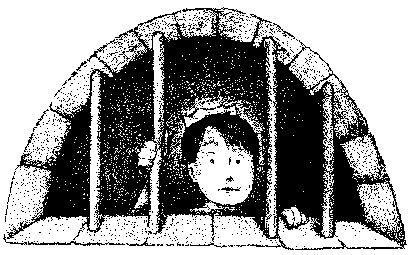
Before long, a certain servant took a disliking to Crown Prince Poorfruit. He went to King Badfruit and told a lie — that his brother was planning to kill him. At first the king did not believe him. But after the servant kept repeating the lie, the king became frightened. So he had Prince Poorfruit put in chains and locked up in the palace dungeon.

The prince thought, “I am a righteous man who does not deserve these chains. I never wanted to kill my brother. I wasn’t even angry at him. So now I call on the power of Truth. If what I say is true, may these chains fall off and the dungeon doors be opened!" Miraculously the chains broke in pieces, the door opened, and the prince fled to an outlying village. The people there recognised him. Since they respected him they helped him, and the king was unable to capture him.

Even though he lived in hiding, the crown prince became the master of the entire remote region. In time he raised a large army. He thought, “Although I was not an enemy to my brother at first, I must be an enemy to him now." So he took his army and surrounded the city of Mithila.

He sent a message to King Badfruit — “I was not your enemy, but you have made me so. Therefore I have come to wage war against you. I give you a choice — either give me your crown and kingdom or come out and fight." Hearing of this, most of the city people went out and joined the prince.

King Badfruit decided to wage war. He would do anything to keep his power. Before going out with his army, he went to say good-bye to his number one queen. She was expecting a baby very soon. He said to her “My love, no one knows who will win this war. Therefore, if I die you must protect the child inside you." Then he bravely went off to war and was quickly killed by the soldiers of his enemy brother.

The news of the king’s death spread through the city. The queen disguised herself as a poor dirty homeless person. She put on old rags for clothes and smeared dirt on herself. She put some of the king’s gold and her own most precious jewellery into a basket. She covered these with dirty rice that no one would want to steal. Then she left the city by the northern gate. Since she had always lived inside the city, the queen had no idea where to go from there. She had heard of a city called Campa. She sat down at the side of the road and began asking if anyone was going to Campa.

It just so happened that the one who was about to be born was no ordinary baby. This was not his first life or his first birth. Millions of years before, he had been a follower of a long-forgotten teaching “Buddha" — a fully “Enlightened One". He had wished with all his heart to become a Buddha just like his beloved master.

He was reborn in many lives — sometimes as poor animals, sometimes as long-living gods and sometimes as human beings. He always tried to learn from his mistakes and develop the “Ten Perfections". This was so he could purify his mind and remove the three root causes of unwholesomeness — the poisons of craving, anger, and the delusion of a separate self. By using the perfections, he would someday be able to replace the poisons with the three purities — non-attachment, loving-kindness, and wisdom.

This “Great Being" had been a humble follower of the forgotten Buddha. His goal was to gain the same enlightenment of a Buddha — the experience of complete Truth. So people call him “Bodhisatta", which means “Enlightenment Being". No one really knows about the millions of lives lived by this great hero. But many stories have been told — including this one about a pregnant queen who was about to give birth to him. After many more rebirths, he became the Buddha who is remembered and loved in the entire world today.

At the time of our story, the Enlightenment Being had already achieved the Ten Perfections. So the glory of his coming birth caused a trembling in all the heaven worlds, including the Heaven of 33 ruled by King Sakka. When he felt the trembling, being a god he knew it was caused by the unborn babe inside the disguised Queen of Mithila. And he knew this must be a being of great merit, so he decided to go and help out.

King Sakka made a covered carriage with a bed in it and appeared at the roadside in front of the pregnant queen. He looked just like an ordinary old man. He called out, “Does anyone need a ride to Campa?" The homeless queen answered, “I wish to go there, kind sir." “Come with me then", the old man said.

Since the birth was not far off, the pregnant queen was quite large. She said, “I cannot climb up into your carriage. Simply carry my basket and I will walk behind." The old man, the king of the gods, replied, “Never mind! Never Mind! I am the cleverest driver around. So don’t worry. Just step into my cart!"

Lo and behold, as she lifted her foot, King Sakka magically caused the ground under her to rise up! So she easily stepped down into the carriage. Immediately she knew this must be a god, and fell fast asleep.

Sakka drove the cart until he came to a river. Then he awakened the lady and said, “Wake up, daughter, and bathe in this river. Dress yourself in this fine clothing I have brought you. Then eat a packet of rice." She obeyed him, and then lay down and slept some more.

In the evening she awoke and saw tall houses and walls. She asked, “What is this city, Father?" He said, “This is Campa." King Sakka replied, “I took a shortcut. Now that we are at the southern gate of the city, you may safely enter. I must go on to my own far-off village." So they parted and Sakka disappeared in the distance, returning to his heaven world.

The queen entered the city and sat down at an inn. There happened to be a wise man living in Campa. He recited spells and gave advice to help people who were sick or unfortunate. While on his way to bathe in the river with 500 followers, he saw the beautiful queen from a distance. The great goodness of the unborn one within gave her a soft warm glow, which only the wise man noticed. At once he felt a kind and gentle liking for her, just as if where were his own youngest sister. So he left his followers outside and went into the inn.

He asked her, “Sister, what village are you from?" She replied, “I am the number one queen of King Badfruit of Mithila."

He asked, “Then why did you come here?" “My husband was killed by the army of his brother, Prince Poorfruit," she said. “I was afraid, so I ran away to protect the unborn one within me." The wise man asked, “Do you have any relatives in this city?" She said, “No sir." Then he said, “Don’t worry at all. I was born in a rich family and I myself am rich. I will care for you just as I would for my own young sister. Now you must call me brother and grab hold of my feet and cry out."

When she did this, the followers came inside. The wise man explained to them that she was his long lost youngest sister. He told his closest followers to take her to his home in a covered cart. He told them to tell his wife that this was his sister, who was to be cared for.

They did exactly as he had said. The wife welcomed her, gave her a hot bath, and made her rest in bed.

After bathing in the river the wise man returned home. At dinnertime, he asked his sister to join them. After dinner, he invited her to stay in his home.

In only a few days the queen gave birth to a wonderful little baby boy. She named him fruitful. She told the wise man this was the name of the boy’s grandfather, who had once been King of Mithila.

52, 539 King Fruitful and Queen Sivali, [Chapter 1. Rebirth of the Bodhisattva]

Link:https://hhdorjechangbuddhaiiiinfo.com/2023/08/22/52-539-king-fruitful-and-queen-sivali-chapter-1-rebirth-of-the-bodhisattva/

#Buddhisttalesforyoungandold #Buddhiststories #storiesforkids #moralstories #Buddha #Jatakastories #PansiyaPanasJataka
51. King Goodness the Great [Perseverance]

51. King Goodness the Great [Perseverance]

Once upon a time, in Benares in northern India, the Enlightenment Being was born into the royal family. When he became king he was called Goodness the Great. He had earned this title by trying to do good all the time, even when the results might not benefit him. For example, he spent much of the royal treasury on the building and running of six houses of charity. In these houses good and aid were given freely to all the poor and needy who came along, even to unknown travellers. Soon King Goodness the Great became famous for his patience, loving-kindness and compassion. It was said that he loved all beings just like a father loves his young children.

Of course King Goodness observed the holy days by not eating. And naturally he practiced the ‘Five Training Steps’, giving up the five unwholesome actions. These are: destroying life, taking what is not given, doing wrong in sexual ways, speaking falsely, and losing one’s mind from alcohol. So his gentle kindness became more and more pure.

Since he wished to harm no one, King Goodness the Great even refused to imprison or injure wrongdoers. Knowing this, one of his highest ministers tried to take advantage of him. He cooked up a scheme to cheat some of the women in the royal harem. Afterwards it became known by all and was reported to the king.

He called the bad minister before him and said, ‘I have investigated and found that you have done a criminal act. Word of it has spread and you have dishonoured yourself here in Benares. So it would be better for you to go and live somewhere else. You may take all your wealth and your family. Go wherever you like and live happily there. Learn from this lesson.’

Then the minister took his family and al his belongings to the city of Kosala. Since he was very clever indeed, he worked his way up and became a minister of the king. In time he became the most trusted adviser to the King of Kosala. One day he said, ‘My lord, I came here from Benares. The city of Benares is like a beehive where the bees have no stingers! The ruling king is very tender and weak. With only a very small army you can easily conquer the city and make it yours.’

The king doubted this, so he said, “You are my minister, but you talk like a spy who is leading me into a trap!’ He replied “No my lord. If you don’t believe me, send your best spies to examine what I say. I am not lying. When robbers are brought to the King of Benares, he gives them money, advises them not to take what is not given, and then lets them go free,"

The king decided to find out if this was true. So he sent some robbers to raid a remote border village belonging to Benares. The villagers caught the looters and brought them to King Goodness the Great. He asked them, “Why do you want to do this type of crime?"

The robbers answered, “Your worship, we are poor people. There is no way to live without money. As your kingdom has plenty of workers, there is no work for us to do. So we had to loot the country in order to survive." Hearing this, the king gave them gifts of money, advised them to change their ways, and let them go free.

When the King of Kosala was told of this, he sent another gang of bandits to the streets of Benares itself. They too looted the shops and even killed some of the people. When they were captured and brought to king Goodness, he treated them just the same as the first robbers.

Learning of this, the King of Kosala began marching his troops and elephants towards Benares.

In those days the King of Benares had a mighty army which included very brave elephants. There were many ordinary soldiers, and also some that were as big as giants. It was known that they were capable of conquering all India.

The giant soldiers told King Goodness about the small invading army from Kosala. They asked permission to attack and kill them all.

But King Goodness the Great would not send them into battle. He said, “My children, do not fight just so I may remain king. If we destroy the lives of others we also destroy our own peace of mind. Why should we kill others? Let them have the kingdom if they want it so badly. I do not wish to fight."

The royal ministers said, “Our Lord, we will fight them ourselves. Don’t worry yourself. Only give us the order." But again he prevented them.

Meanwhile the King of Kosala sent him a warning, telling him to give up the kingdom or fight. King Goodness the Great sent this reply: “I do not want you to fight with me, and you do not want me to fight with you. If you want the country, you can have it. Why should we kill people just to decide the name of the king? What does it matter even the name of the country itself?"

Hearing this, the ministers came forward and pleaded, “Our Lord, let us go out with our mighty army. We will beat them with our weapons and capture them all. We are much stronger than they are. We would not have to kill any of them. And besides, if we surrender the city, the enemy army would surely kill us all!"

But King Goodness would not be moved. He refused to cause harm to anyone. He replied, “Even if you do not wish to kill, by fighting many will be injured. By accident some may die. No one knows the future – whether our attackers will kill us or not. But we do know whether our present actions are right or wrong. Therefore I will not harm, or cause others to harm, any living being!"

Then King Goodness ordered the city gates be opened up for the invaders. He took his ministers to the top floor of the palace and advised them, “Say nothing and try to remain calm."

The King of Kosala entered the city of Benares and saw that no one was against him. So he and his soldiers entered and went up to the top floor. They capture the innocent King Goodness the Great. The soldiers tied the hands of the defeated king and all of his ministers.

Then they were taken to the cemetery outside the city. They were buried up to their necks, standing straight up, with only their heads above ground. But even while the dirt was being trampled down around his neck, the Great Being remained without anger in his mind and said nothing.

Their discipline and obedience to King Goodness were so great that not a single minister spoke a word against anyone. But the King of Kosala had no mercy. He said roughly, “Come night time, let the jackals do as they please!"

And so it came to pass that, at midnight, a large band of jackals wandered into the cemetery. They could smell a feast of human flesh waiting for them.

Seeing them coming, King Goodness and his ministers shouted all at once and scared the jackals away. Twice more this happened. Then the clever jackals realised, “These men must have been put here for us to kill and eat." No longer afraid, they ignored the shouts. The jackal king walked right up to the face of King Goodness.

The king offered his throat to the beast. But before he could bite into him, the king grabbed the jackal’s chin with his teeth. No harming him, King Goodness gripped him tightly so the jackal king howled in fear. This frightened his followers and they all ran away.

Meanwhile the jackal king thrashed back and forth, trying madly to free himself from the might jaws of the human king. In so doing, he loosened the dirt packed around the king’s neck and shoulders. Then King Goodness released the screaming jackal. He was able to wiggle himself free from the loosened earth and pull himself up onto the ground. Then he freed all his frightened ministers.

Nearby there was a dead body. It just so happened that it was lying on the border of the territories claimed by two rival demons. They were arguing over the division of the body, insulting each other in ways that only demons can.

Then one demon said to the other, “Why should we continue quarrelling instead of eating? Right over there is King Goodness the Great of Benares. He is famous in all worlds for his righteousness. He will divide the dead body for us.

They dragged the body to the king and asked him to divide it between them fairly. He said, ‘My friends, I would be glad to divide this for you. But I am filthy and dirty, I must clean myself first."

The two demons used their magic powers to bring scented water, perfume, clothing, ornaments and flowers from the king’s own palace in Benares. He bathed, perfumed himself, dressed, and covered himself with ornaments and flower garlands.

The demons asked King Goodness if there was anything else they could do. He replied that he was hungry. So, again by their magic powers, the demons brought the most delicious flavoured rice in a golden bowl and perfumed drinking water in a golden cup — also from the royal palace in Benders.

When he was satisfied, king Goodness asked them to bring him the sword of state from the pillow of the King of Kosala, who was sleeping in the palace in Benares. With magic that too was easily done. Then the king used the sword to cut the dead boy into two halves, right down the spine. He washed the sword of state and strapped it to his side.

The hungry demons happily gobbled up the fairly divided dead body. Then they gratefully said to King Goodness, “Now that our bellies are full, is there anything else we can do to please you?"

He replied, “By your magic, set me in my own bedroom in the palace next to the King of Kosala. In addition, put all these my ministers back in their homes." Without a word, the demons did exactly as the king had asked.

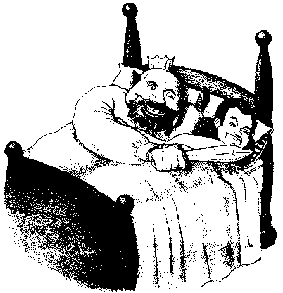
At that moment the King of Kosala was fast asleep in the royal bedchamber. King Goodness the Great gently touched the belly of the sleeping king with the sword of state. The king awoke in great surprise. In the dim lamplight he was frightened to see King Goodness leaning over him with sword in hand. He had to rub his eyes to make sure he was not having a nightmare!"

Then he asked the great king, “My lord how did you come here in spite of all my guards? You were buried up to your neck in the cemetery — how is it you are spotlessly clean, sweet smelling, dressed in your own royal robes, and decorated with fine jewellery and the loveliest flowers?"

King Goodness told him the story of his escape from the band of jackals. He told of the two demons that came to him to settle their quarrel. And he told how they gratefully helped him with their magic powers.

On hearing this, the King of Kosala was overcome by his own shame. He bowed his head to King Goodness the Great and cried, “Oh great king, the stupid ferocious demons, who live by eating the flesh and drinking the blood of dead bodies — they recognised your supreme goodness. But I, who was lucky enough to be born as an intelligent and civilised human being — I have been too foolish to see how wonderful your pure goodness is.

“I promise never again to plot against you, my lord —- you who have gained such perfect harmlessness. And I promise to serve you forever as the truest of friends. Please forgive me, great king." Then, as if he were a servant, the King of Kosala laid King Goodness the Great down on the royal bed, while he himself lay on a small couch.

The next day the King of Kosala called all his soldiers into the palace courtyard. There he publicly praised the king of Benares and asked his forgiveness once again. He gave back the kingdom and promised that he would always protect King Goodness. Then he punished his adviser, the criminal minister, and returned to Kosala with all his troops and elephants.

King Goodness the Great was sitting majestically on his golden throne, with its legs like those of a gazelle. He was shaded from the sun by the pure white royal umbrella. He taught his loyal subjects saying, “People of Benares wholesomeness begins with giving up the five unwholesome actions once and for all. The highest qualities of the good person, whether ruler or subject, are loving-kindness and compassion. Filled with these qualities, one cannot harm another —- no matter what the reason or the cost. No matter how dangerous the threat, one must persevere until the greatness of the good heart wins in the end."

Throughout the rest of his reign, the people of Benares lived peacefully and happily. King Goodness the Great continued performing wholesome works. Eventually he died and was reborn as he deserved.

The moral is: Refusing to harm others, the good heart wins over all.

51. King Goodness the Great [Perseverance]

Link:https://hhdorjechangbuddhaiiiinfo.com/2023/08/15/king-goodness-the-great-perseverance/

#Buddhisttalesforyoungandold #Buddhiststories #storiesforkids #moralstories #Buddha #Jatakastories #PansiyaPanasJataka
49. The Groom Who Lost His Bride to the Stars [Astrology]

49. The Groom Who Lost His Bride to the Stars [Astrology]

Buddhist Tales for Young and Old, volume 1, Prince Goodspeaker, Stories 1-50

Once upon a time, there was a rich family living in Benares, in northern India. They arranged for their son to marry a good and honest girl from a nearby village. Being very pretty as well, they were sure they could not find a better wife for their son.

The groom’s family decided on a date for the wedding. The bride’s family agreed to meet them in the village on the wedding day.

Meanwhile, the rich family also had their own special astrological priest. When he found out they had picked the wedding day, without paying him to consult the stars, he became angry. He decided to get even with them.

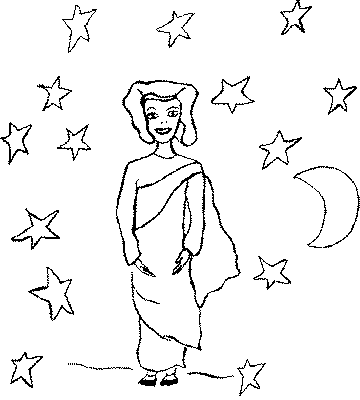
When the wedding day arrived, the astrological priest dressed up in his finest robes, and called the family together. He bowed to them all, and then looked at his star charts very seriously. He told them that this star was too close to the horizon, and that planet was in the middle of an unlucky constellation, and the moon was in a very dangerous phase for having a wedding. He told them that, not seeking his advice, they had picked the worst day of the year for a wedding. This could only lead to a terrible marriage.

The frightened family forgot all about the wonderful qualities of the intended bride, and remained home in Benares.

Meanwhile the bride’s family had arranged everything for the village wedding ceremony. When the agreed upon hour arrived, they waited and waited for the future husband and his family. Finally they realized they were not coming. So they thought, “Those city people picked the date and time, and now they didn’t show up. This is insulting! Why should we wait any longer? Let our daughter marry an honourable and hard working village man." So they quickly arranged a new marriage and celebrated the wedding.

The next day, the astrological priest said that, suddenly, the stars and planets and moon were in perfect positions for a wedding! So the Benares family went to the village and asked for the wedding to take place. But the village people said, “You picked the date and time. Then you disgraced us by not showing up!"

The city people replied, “Our family priest told us that yesterday the stars and planets and moon were in terrible positions. It was a very unlucky day for a wedding. But he has assured us that today is a most lucky day. So please send us the bride at once!"

The village family said, “You have no honour. You have made the choice of the day more important than the choice of the bride. It’s too late now! Our daughter has married another." Then the two families began to quarrel heatedly.

A wise man happened to come along. Seeing the two families quarrelling he tried to settle the dispute.

The city people told him that they had respected the warnings of their astrological priest. It was because of the unlucky positions of the stars and planets and moon, that they had not come to the wedding.

The wise man said, “The good fortune was in the bride, not in the stars. You fools have followed the stars and lost the bride. Without your foolishness, those far off stars can do nothing!"

The moral is: Luck comes from actions, not from stars.

49. The Groom Who Lost His Bride to the Stars [Astrology]

Link: https://hhdorjechangbuddhaiiiinfo.com/2023/02/07/49-the-groom-who-lost-his-bride-to-the-stars-astrology/

INTERPRETER’S INTRODUCTION – BUDDHIST TALES FOR YOUNG AND OLD, VOLUME 1, STORIES 1-50

#Buddhisttalesforyoungandold #Buddhiststories #storiesforkids #moralstories #Buddha #Jatakastories #PansiyaPanasJataka
48. The Magic Priest and the Kidnapper Gang [Power and Greed]

48. The Magic Priest and the Kidnapper Gang [Power and Greed]

Buddhist Tales for Young and Old, volume 1, Prince Goodspeaker, Stories 1-50

Once upon a time in Bane’s, there was a king named Brahmadatta. In one of the kingdom’s remote villages, there was a priest who had magical power. He knew a special magic spell which was a secret given to him by his teacher.

This spell could be used only once a year, when the planets were lined up in a certain way. Only then, the priest could say the secret magic words into his open palms. Then he looked up into the sky, clapped his hands, and a shower of precious jewels came down on him.

The magic priest was also a teacher. He had a very good student, who was intelligent and able to understand the most difficult ideas. He was obedient and faithful, always wishing to honour and protect his master.

One day, the priest had to go on a trip to a faraway village, in order to perform an animal sacrifice. Since he had to take a dangerous road, the good student went with him.

Along this road there happened to be a gang of 500 bandits. They were known as the ‘Kidnapper Gang’. They captured people and demanded ransom money in return for letting them live.

Lo and behold, the magic priest and his good student were captured by the Kidnapper Gang. They set the ransom at 5,000 gold coins, and sent the student to go get it, in order to save his master’s life.

Before leaving, the student knelt before his teacher and bowed respectfully. He said to him quietly, so the bandits could not hear, “Oh master, tonight is the one night of the year when the planets will be lined up perfectly. Only then can your magic spell be used to shower you with jewels from the sky. However, I must warn you, my beloved and respected teacher, that to use such a power to save yourself from such greedy men as these would be extremely dangerous. Obtaining great wealth so easily must lead to disaster for men like them. And if you think only of your own safety, bringing such harm to them will cause danger to you as well.

“Therefore, I warn you, do not give in to the desire to make the spell of jewels. Let the lucky night pass by for this year. Even if these bandits harm you, trust your faithful student to save you, without adding to your danger." So saying, he took his leave.

That evening, the kidnappers tied up the magic priest tightly, and left him outside their cave for the night. They gave him nothing to eat or drink.

After the moon came out, the priest saw the planets lining up so his spell could work. He thought, “Why should I suffer like this? I can magically pay my own ransom. Why should I care if harm comes to these 500 kidnappers? I am a magic priest. My life is worth much more than theirs. I care only for my own life. And besides, this lucky night only comes but once a year. I cannot waste the chance to use my great power!"

Having decided to ignore the advice of the good student, he called the kidnappers and said, “Oh brave and mighty ones, why do you want to tie me up and make me suffer?"

They replied, “Oh holy priest, we need money. We have many mouths to feed. We must have money, and lots of it!"

The magic priest said, “Ah, you did this for money? Is that all there is to it? In that case, I will make you rich beyond your wildest dreams! For I am great and powerful. As a holy priest, you can trust me. You must untie me, wash my head and face, dress me in new clothes, and cover me with flowers. Then, after so honouring me properly, leave me alone to do my magic."

The kidnappers followed his instructions. But, not trusting him completely, they hid in the bushes and secretly watched him.

This is what they saw. The washed and flower-covered priest looked up into the sky. Seeing that the planets were lined up in the special lucky pattern, he lowered his head and muttered the magic spell into his hands. They were sounds that no one could understand, something like this: “Nah Wah Shed-nath. Eel Neeah Med-rak. Goh Bah Mil-neeay."

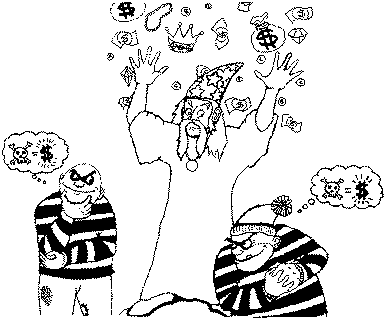
Then he gazed into the sky and clapped his hands. Suddenly he was showered with the most beautiful jewels!

The Kidnapper Gang came out from hiding and grabbed all the precious stones. They wrapped them up in bundles and went off down the road, with the magic priest following behind.

On the way, they were stopped by another gang of 500 robbers. They asked them, “Why are you stopping us?" “Give us all your wealth!" the others demanded.

The kidnappers said, “Leave us alone. You can get all the riches you want from this magic priest, just as we have done. He says magic words, looks up into the sky, claps his hands, and the most fabulous jewels come down!"

So they let the Kidnapper Gang go, and surrounded the priest. They demanded that he make a shower of precious stones for them as well.

He said, “Of course I can give you all the jewels you want. But you must be patient and wait for one year. The lucky time, when the planets are lined up properly, has already come this year. It will not happen again until next year. Come see me then, and I will be happy to make you rich!"

Robbers are not exactly known for their patience. They became angry at once. They shouted at him, “Ah, you tricky lying priest! You made the Kidnapper Gang wealthy, but now you refuse to do the same for us. We’ll teach you to take us so lightly!" Then they cut him in two with a sharp sword, and left both halves of his body in the middle of the road.

The robbers chased after the Kidnapper Gang. There was a terrible bloody battle. After hours of fighting, they killed all 500 kidnappers and stole the wonderful jewels.

As soon as they left the battleground, the 500 robbers began quarrelling over the wealth. They divided into two rival groups of 250 each. These fought another bloody battle, until only two were left alive one from each side.

These two collected all the valuable jewels and hid them in the forest. They were very hungry. So one guarded the treasure, while the other started cooking rice.

The one doing the guarding thought, “When the other is finished cooking, I will kill him and keep all this loot for myself?"

Meanwhile, the one doing the cooking thought, “If we divide these jewels in two, I will get less. Therefore, I will add poison to this rice, kill the other, and keep all the jewels for myself. Why share, when I can have it all!"

So he ate some of the rice, since he was so hungry, and poisoned the rest. He took the rice pot to the other and offered it to him. But he immediately swung his sword and chopped off the cook’s head!

Then the hungry killer began gobbling up the poisoned rice. Within minutes, he dropped dead on the spot!

A few days later, the good student returned with the ransom money. He could not find his teacher or the Kidnapper Gang. Instead, he found only the worthless possessions they had left behind after getting the jewels.

Continuing down the road, he came to the two halves of his teacher’s dead body. Realizing that the magic priest must have ignored his warning, he mourned his cruel death. Then he built a funeral pyre, covered it with wildflowers, and burned the body of his respected teacher.

A little further down the road, the good student came upon the 500 dead bodies of the Kidnapper Gang. Further still, he started seeing the dead robbers, until he counted 498.

Then he saw the footprints of the last two going into the forest. He realized that they too must fight over the treasure, so he followed them. Finally, he came to the dead body slumped over the rice pot, the other one with his head chopped off, and the bundles of valuable jewels. He could tell immediately what had happened.

He thought, “It is so sad. My teacher had great knowledge, but not enough common sense. He could not resist using his magical power, regardless of the results. By causing the deaths of the one-thousand greedy gangsters, he doomed himself as well."

The good student took the treasure back to the village, and used it generously for the benefit of many.

The moral is: When power has no conscience, and greed has no limit – the killing has no end.

Link: https://hhdorjechangbuddhaiiiinfo.com/2023/01/31/48-the-magic-priest-and-the-kidnapper-gang-power-and-greed/

INTERPRETER’S INTRODUCTION – BUDDHIST TALES FOR YOUNG AND OLD, VOLUME 1, STORIES 1-50

#Buddhisttalesforyoungandold #Buddhiststories #storiesforkids #moralstories #Buddha #Jatakastories #PansiyaPanasJataka
46, 268 Watering the Garden [Foolishness]

46, 268 Watering the Garden [Foolishness]

Buddhist Tales for Young and Old, volume 1, Prince Goodspeaker, Stories 1-50

It was just before New Year’s in Benares, in northern India. Everyone in the city was getting ready for the three day celebration, including the gardener of the king’s pleasure garden.

There was a large troop of monkeys living in this pleasure garden. So they wouldn’t have to think too much, they always followed the advice of their leader, the monkey king.

The royal gardener wanted to celebrate the New Year’s holiday, just like everybody else. So he decided to hand over his duties to the monkeys.

He went to the monkey king and said, “Oh king of monkeys, my honourable friend, would you do a little favour for me? New Years is coming. I too wish to celebrate. So I must be away for three full days. Here in this lovely garden, there are plenty of fruits and berries and nuts to eat. You and your subjects may be my guests, and eat as much as you wish. In return, please water the young trees and plants while I’m gone."

The monkey king replied, “Don’t worry about a thing, my friend! We will do a terrific job! Have a good time!"

The gardener showed the monkeys where the watering buckets were kept. Feeling confident, he left to celebrate the holiday. The monkeys called after him, “Happy New Year!"

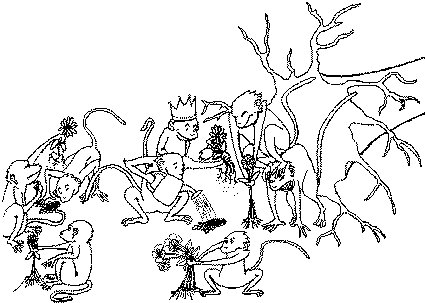
The next day, the monkeys filled up the buckets, and began watering the young trees and plants. Then the king of the monkeys addressed them: “My subjects, it is not good to waste water. Therefore, pull up each young tree or plant before watering. Inspect it to see how long the roots are. Then give more water to the ones with long roots, and less water to the ones with short roots. That way we will not waste water, and the gardener will be pleased!"

Without giving it any further thought, the obedient subjects followed their king’s orders.

Meanwhile, a wise man was walking by outside the entrance to the garden. He saw the monkeys uprooting all the lovely young trees and plants, measuring their roots, and carefully pouring water into the holes in the ground. He asked, “Oh foolish monkeys, what do you think you’re doing to the king’s beautiful garden?"

They answered, “We are watering the trees and plants, without wasting water! We were commanded to do so by our lord king."

The man said, “If this is the wisdom of the wisest among you – the king – what are the rest of you like? Intending to do a worthwhile deed, your foolishness turns it into disaster!"

The moral is: Only fools can make good deeds into bad ones.

46, 268 Watering the Garden [Foolishness]

Link: https://hhdorjechangbuddhaiiiinfo.com/2022/12/21/46-268-watering-the-garden-foolishness/

INTERPRETER’S INTRODUCTION – BUDDHIST TALES FOR YOUNG AND OLD, VOLUME 1, STORIES 1-50

#Buddhisttalesforyoungandold #Buddhiststories #storiesforkids #moralstories #Buddha #Jatakastories #PansiyaPanasJataka