22. The Dog King Silver [Justice]

22. The Dog King Silver [Justice]

Buddhist Tales for Young and Old, volume 1, Prince Goodspeaker, Stories 1-50
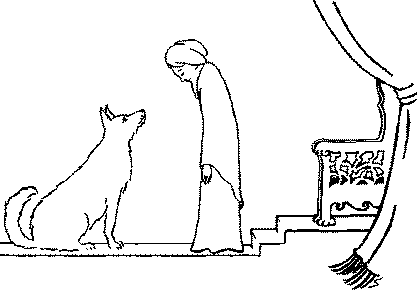
Once upon time, the King of Benares went to his pleasure garden in his fancy decorated chariot. He loved this chariot, mostly because of the rich hand-worked leather belts and straps.

On this occasion, he stayed in his pleasure garden all day long and into the evening. It was late when he finally got back to the palace. So the chariot was left outside in the compound all night, instead of being locked up properly.

During the night it rained heavily, and the leather got wet, swelled up, became soft, and gave off an odour. The pampered palace dogs smelled the delicious leather scent and came down into the compound. They chewed off and devoured the soft wet chariot straps. Before daybreak, they returned unseen to their places in the palace.

When the king woke up and came down, he saw that the leather had been chewed off and eaten by dogs. He called the servants and demanded to know how this happened.

Since they were supposed to watch the palace dogs, the servants were afraid to blame them. Instead, they made up a story that stray dogs, the mutts and mongrels of the city, had come into the grounds through sewers and storm drains. They were the ones who had eaten the fancy leather.

The king flew into a terrible rage. He was so overcome by anger that he decided to take vengeance against all dogs. So he decreed that whenever anyone in the city saw a dog, he was to kill him or her at once!

The people began killing dogs. The dogs could not understand why suddenly they were being killed. Later that day, they learned of the king’s decree. They became very frightened and retreated to the cemetery just outside the city. This was where their leader lived, the Dog King Silver.

Silver was king not because he was the biggest or strongest or toughest. He was average in size, with sleek silver fur, sparkling black eyes and alert pointed ears. He walked with great dignity, that brought admiration and respect from men as well as dogs. In his long life he had learned much, and was able to concentrate his mind on what is most important. So he became the wisest of all the dogs, as well as the one who cared most for the others. Those were the reasons he was king of the dogs.

In the cemetery, the dogs were in a panic. They were frightened to death. The Dog King Silver asked them why this was. They told him all about the chariot straps and the king’s decree, and the people killing them whenever they saw them.

King Silver knew there was no way to get into the well-guarded palace grounds. So he understood that the leather must have been eaten by the dogs living inside the palace.

He thought, “We dogs know that, no matter how different we may appear, somehow we are all related. So now I must make my greatest effort to save the lives of all these poor dogs, my relatives. There is no one to save them but me."

He comforted them by saying, “Do not be afraid. I will save you all. Stay here in the cemetery and don’t go into the city. I will tell the King of Benares who are the thieves and who are the innocent. The truth will save us all."

Before setting out, he went to a different part of the cemetery to be alone. Having practiced goodness all his life, and trained his mind, he now concentrated very hard and filled his mind with feelings of loving-kindness. He thought, “May all dogs be well and happy, and may all dogs be safe. I go to the palace for the sake of dogs and men alike. No one shall attack or harm me."

Then the Dog King Silver began walking slowly through the streets of Benares. Because his mind was focused, he had no fear. Because of his long life of goodness, he walked with a calm dignity that demanded respect. And because of the warm glow of loving-kindness that all the people sensed, no one felt the rising of anger or any intention to harm him. Instead, they marvelled as the Great Being passed, and wondered how it could be so!

It was as if the whole city were entranced. With no obstruction, the Dog King Silver walked right past the palace guards, into the royal hall of justice, and sat down calmly underneath the king’s throne itself! The King of Benares was impressed by such courage and dignity. So when servants came to remove the dog, he ordered them to let him remain.

Then the Dog King Silver came out from under the throne and faced the mighty King of Benares. He bowed respectfully and asked, “Your majesty, was it you who ordered that all the dogs of the city should be killed?" “It was I," replied the king. “What crime did the dogs commit?" asked the dog king. “Dogs ate my rich beautiful chariot leather and straps." “Do you know which dogs did this?" asked King Silver. “No one knows," said the King of Benares.

“My lord," said the dog, “for a king such as you, who wishes to be righteous, is it right to have all dogs killed in the place of the few guilty ones? Does this do justice to the innocent ones?" The king replied, as if it made perfect sense to him, “Since I do not know which dogs destroyed my leather, only by ordering the killing of all dogs can I be sure of punishing the guilty. The king must have justice!"

The Dog King Silver paused for a moment, before challenging the king with the crucial question – “My lord king, is it a fact that you have ordered all dogs to be killed, or are there some who are not to be killed?" The king suddenly became a little uneasy as he was forced to admit, before his whole court, “It is true that most dogs are to be killed, but not all. The fine pure-breeds of my palace are to be spared."

Then the dog king said, “My lord, before you said that all dogs were to be killed, in order to insure that the guilty would be punished. Now you say that your own palace dogs are to be spared. This shows that you have gone wrong in the way of prejudice. For a king who wishes to be righteous, it is wrong to favor some over others. The king’s justice must be unbiased, like an honest scale. Although you have decreed an impartial death to all dogs, in fact this is only the slaughter of poor dogs. Your rich palace dogs are unjustly saved, while the poor are wrongly killed!"

Recognizing the truth of the dog king’s words, the King of Benares asked, “Are you wise enough to know which dogs ate my leather straps and belts?" “Yes my lord, I do know," said he, “it could only be your own favorite palace dogs, and I can prove it." “Do so," said the king.

The dog king asked to have the palace pets brought into the hall of justice. He asked for a mixture of buttermilk and grass, and for the dogs to be made to eat it. Lo and behold, when this was done they vomited up partly digested pieces of the king’s leather straps!

Then the Dog King Silver said, “My lord, no poor dogs from the city can enter the well-guarded palace compound. You were blinded by prejudice. It is your dogs who are the guilty ones. Nevertheless, to kill any living being is an unwholesome thing to do. This is because of what we dogs know, but men do not seem to know – that somehow all life is related, so all living beings deserve the same respect as relatives."

The whole court was amazed by what had just taken place. The King of Benares was suddenly overcome by a rare feeling of humility. He bowed before the dog king and said, “Oh great king of dogs, I have never seen anyone such as you, one who combines perfect wisdom with great compassion. Truly, your justice is supreme. I offer my throne and the kingdom of Benares to you!"

The Enlightenment Being replied, “Arise my lord, I have no desire for a human crown. If you wish to show your respect for me, you should be a just and merciful ruler. It would help if you begin to purify your mind by practising the ‘Five Training Steps’. These are to give up entirely the five unwholesome actions: destroying life, taking what is not given, sexual wrong-doing, speaking falsely, and drunkenness."

The king followed the teachings of the wise dog king. He ruled with great respect for all living beings. He ordered that whenever he ate, all dogs, those of the palace and those of the city, were to be fed as well. This was the beginning of the faithfulness between dogs and men that has lasted to this day.

The moral is: Prejudice leads to injustice, wisdom leads to justice.

22. The Dog King Silver [Justice]

Link: https://hhdorjechangbuddhaiiiinfo.com/2022/04/26/22-the-dog-king-silver-justice/

INTERPRETER’S INTRODUCTION – BUDDHIST TALES FOR YOUNG AND OLD, VOLUME 1, STORIES 1-50

#Buddhisttalesforyoungandold #Buddhiststories #storiesforkids #moralstories #Buddha #Jatakastories #PansiyaPanasJataka

21. The Tree that Acted Like a Hunter [Impatience]

21. The Tree that Acted Like a Hunter [Impatience]

Buddhist Tales for Young and Old, volume 1, Prince Goodspeaker, Stories 1-50

Once upon a time, there was an antelope who lived in the deep forest. He ate the fruits that fell from the trees. There was one tree that had become his favorite.

In the same area there was a hunter who captured and killed antelopes and deer. He put down fruit as bait under a tree. Then he waited, hiding in the branches above. He held a rope noose hanging down to the ground around the fruits. When an animal ate the fruit, the hunter tightened the noose and caught him.

Early one morning the antelope came to his favorite tree in search of fruits to eat. He did not see that the hunter was hiding in it, with his noose-trap ready. Even though he was hungry, the antelope was very careful. He was on the lookout for any possible danger. He saw the delicious looking ripe fruits at the foot of his favorite tree. He wondered why no animal had yet eaten any, and so he was afraid something was wrong.

The hiding hunter saw the antelope approaching from a distance. Seeing him stop and take great care, he was afraid he would not be able to trap him. He was so anxious that he began throwing fruits in the direction of the antelope, trying to lure him into coming closer.

But this was a pretty smart antelope. He knew that fruits only fall straight down when they fall from trees. Since these fruits were flying towards him, he knew there was danger. So he examined the tree itself very carefully, and saw the hunter in the branches. However, he pretended not to see him.

He spoke in the direction of the tree. “Oh my dear fruit tree, you used to give me your fruits by letting them fall straight down to the ground. Now, throwing them towards me, you do not act at all like a tree! Since you have changed your habits, I too will change mine. I will get my fruits from a different tree from now on, one that still acts like a tree!"

The hunter realized his mistake and saw that the antelope had outsmarted him. This angered him and he yelled out, “You may escape me this time, you clever antelope, but I’ll get you next time for sure!"

The antelope realized that, by getting so angry, the hunter had given himself away a second time. So he spoke in the direction of the tree again. “Not only don’t you act like a tree, but you act like a hunter! You foolish humans, who live by killing animals. You do not understand that killing the innocent brings harm also to you, both in this life and by rebirth in a hell world. It is clear that we antelopes are far wiser than you. We eat fruits, we remain innocent of killing others, and we avoid the harmful results."

So saying, the careful antelope leaped into the thick forest and was gone.

The moral is: The wise remain innocent.

21. The Tree that Acted Like a Hunter [Impatience]

Link: https://hhdorjechangbuddhaiiiinfo.com/2022/04/19/21-the-tree-that-acted-like-a-hunter-impatience/

INTERPRETER’S INTRODUCTION – BUDDHIST TALES FOR YOUNG AND OLD, VOLUME 1, STORIES 1-50

#Buddhisttalesforyoungandold #Buddhiststories #storiesforkids #moralstories #Buddha #Jatakastories #PansiyaPanasJataka

20. The Monkey King and the Water Demon [Attentiveness]

20. The Monkey King and the Water Demon [Attentiveness]

Buddhist Tales for Young and Old, volume 1, Prince Goodspeaker, Stories 1-50

Once upon a time, far away in a deep forest, there was a nation of 80,000 monkeys. They had a king who was unusually large, as big as a fawn. He was not only big in body, he was also ‘large in mind’. After all, he was the Bodhisatta — the Enlightenment Being.

One day, he advised his monkey nation by saying, “My subjects, there are poisonous fruits in this deep forest, and ponds possessed by demons. So if you see any unusual fruit or unknown pond, do not eat or drink until you ask me first." Paying close attention to their wise king, all the monkeys agreed to follow his advice.

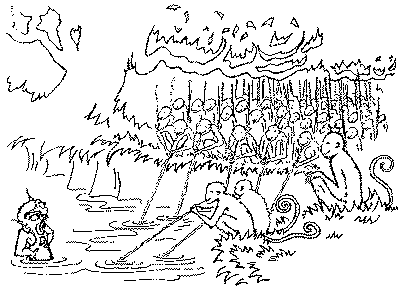
Later on, they came to an unknown pond. Even though they were all tired out and thirsty from searching for food, no one would drink without first asking the monkey king. So they sat in the trees and on the ground around the pond.

When he arrived, the monkey king asked them, “Did anyone drink the water?" They replied, “No, your majesty, we followed your instructions." He said, “Well done."

Then he walked along the bank, around the pond. He examined the footprints of the animals that had gone into the water, and saw that none came out again! So he realized this pond must be possessed by a water demon. He said to the 80,000 monkeys, “This pond is possessed by a water demon. Do not anybody go into it."

After a little while, the water demon saw that none of the monkeys went into the water to drink. So he rose out of the middle of the pond, taking the shape of a frightening monster. He had a big blue belly, a white face with bulging green eyes, and red claws and feet. He said, “Why are you just sitting around? Come into the pond and drink at once!"

The monkey king said to the horrible monster, “Are you the water demon who owns this pond?" “Yes, I am," said he. “Do you eat whoever goes into the water?" asked the king. “Yes, I do," he answered, “including even birds. I eat them all. And when you are forced by your thirst to come into the pond and drink, I will enjoy eating you, the biggest monkey, most of all!" He grinned, and saliva dripped down his hairy chin.

But the monkey king with the well-trained mind remained calm. He said, “I will not let you eat me or a single one of my followers. And yet, we will drink all the water we want!" The water demon grunted, “Impossible! How will you do that?" The monkey king replied, “Each one of the 80,000 of us will drink using bamboo shoots as straws. And you will not be able to touch us!"

Of course, anyone who has seen bamboo knows there is a difficulty. Bamboo grows in sections, one after another, with a knot between each one. Any one section is too small, so the demon could grab the monkey, pull him under and gobble him up. But the knots make it impossible to sip through more than one section.

The monkey king was very special, and that is why so many followed him. In the past, he had practiced goodness and trained his mind with such effort and attention, that he had developed very fine qualities of mind. This is why he was said to be ‘large in mind’, not because he simply had a ‘big brain’.

The Enlightenment Being was able to keep these fine qualities in his mind, and produce a very unlikely event – a miracle. First, he took a young bamboo shoot, blew through it to make the knots disappear, and used it to sip water from the pond. Then, amazing as it may sound, he waved his hand and all the bamboo growing around that one pond lost their knots. They became a new kind of bamboo.

Then, all his 80,000 followers picked bamboo shoots and easily drank their fill from the pond. The water demon could not believe his green eyes. Grumbling to himself, he slid back under the surface, leaving only gurgling bubbles behind.

The moral is: “Test the water before jumping in."

20. The Monkey King and the Water Demon [Attentiveness]

Link: https://hhdorjechangbuddhaiiiinfo.com/2022/03/28/20-the-monkey-king-and-the-water-demon-attentiveness/

INTERPRETER’S INTRODUCTION – BUDDHIST TALES FOR YOUNG AND OLD, VOLUME 1, STORIES 1-50

#Buddhisttalesforyoungandold #Buddhiststories #storiesforkids #moralstories #Buddha #Jatakastories #PansiyaPanasJataka

19. The God in the Banyan Tree [A Bad Promise]

19. The God in the Banyan Tree [A Bad Promise]

Buddhist Tales for Young and Old, volume 1, Prince Goodspeaker, Stories 1-50

In the past, and even in some places today, people have had superstitions. One such is that a large or unusual tree is inhabited by a tree god, or some kind of spirit. People think that they can make a promise to this tree god, so he will help them in some way. When they think the god has helped them, then they must keep their promise.

Once upon a time, in the city of Kasi in northern India, a man came upon a large banyan tree. He immediately thought there must be a go

d living there. So he made a promise to this tree god that he would perform an animal sacrifice, in return for a wish being granted.

It just so happened that his wish was fulfilled, but whether by a god or a demon or by some other means — no one knows. The man was sure the tree god had answered his prayer, so he wanted to keep his promise.

Since it was a big wish, it called for a big sacrifice. He brought many goats, mules, chickens and sheep. He collected firewood and prepared to burn the helpless animals as a sacrifice.

The spirit living in the banyan tree appeared and said, “Oh friend, you made a promise. You are now bound by that promise. You think you must keep the promise in order to be released from the bondage to it. But if you commit such terrible unwholesome acts, even though promised, the unpleasant results will put you in much greater bondage. For you will be forced to suffer those results in this life, and even by rebirths in hell worlds! The way to release yourself into future deliverance is to give up unwholesome actions, no matter what!

“And furthermore, since you think I’m a true god, what makes you think I eat meat? Haven’t you heard that we gods eat better things, like ‘ambrosia’ or stardust or sunbeams? I have no need of meat or any other food offerings." Then he disappeared.

The foolish man understood the mistake he had made. Instead of doing unwholesome deeds that would force unhappy results on him in the future, he began to do only wholesome deeds that would benefit himself and others.

The moral is: Keeping a bad promise is worse than making it.

19. The God in the Banyan Tree [A Bad Promise]

Link: https://hhdorjechangbuddhaiiiinfo.com/2022/03/15/19-the-god-in-the-banyan-tree-a-bad-promise/

INTERPRETER’S INTRODUCTION – BUDDHIST TALES FOR YOUNG AND OLD, VOLUME 1, STORIES 1-50

#Buddhisttalesforyoungandold #Buddhiststories #storiesforkids #moralstories #Buddha #Jatakastories #PansiyaPanasJataka
18. The Goat Who Saved the Priest [Ignorance]

18. The Goat Who Saved the Priest [Ignorance]

Buddhist Tales for Young and Old, volume 1, Prince Goodspeaker, Stories 1-50

Once upon a time, there was a very famous priest in a very old religion. He decided it was the right day to perform the ritual sacrificing of a goat. In his ignorance, he thought this was an offering demanded by his god.

He obtained an appropriate goat for the sacrifice. He ordered his servants to take the goat to the holy river and wash him and decorate him with flower garlands. Then they were to wash themselves, as part of the purification practice.

Down at the riverbank, the goat suddenly understood that today he would definitely be killed. He also became aware of his past births and deaths and rebirths. He realized that the results of his past unwholesome deeds were about to finally be completed. So he laughed an uproarious goat-laugh, like the clanging of cymbals.

In the midst of his laughter, he realized another truth that the priest, by sacrificing him, would suffer the same terrible results, due to his ignorance. So he began to cry as loudly as he had just been laughing!

The servants, who were bathing in the holy river, heard first the laughing and then the crying. They were amazed. So they asked the goat, “Why did you loudly laugh and then just as loudly cry? What is the reason for this?" He replied, “I will tell you the reason. But it must be in the presence of your master, the priest."

Since they were very curious, they immediately took the sacrificial goat to the priest. They explained all that had happened. The priest, too, became very curious. He respectfully asked the goat, “Sir, why did you laugh so loudly, and then just as loudly cry?"

The goat, remembering his past lives, said, “A long time ago, I too was a priest who, like you, was well educated in the sacred religious rites. I thought that to sacrifice a goat was a necessary offering to my god, which would benefit others, as well as myself in future rebirths. However, the true result of my actions was that in my next 499 lives I myself have been beheaded!

“While being prepared for the sacrifice, I realized that today I will definitely lose my head for the 500th time. Then I will finally be free of all the results of my unwholesome deeds of so long ago. The joy of this made me laugh uncontrollably.

“Then I suddenly realized that you, the priest, were about to repeat the same unwholesome action, and would be doomed to the same result of having your head chopped off in your next 500 lives! So, out of compassion and sympathy, my laughter turned to tears."

The priest was afraid this goat might be right, so he said, “Well, sir goat, I will not kill you." The goat replied, “Reverend priest, even if you do not kill me, I know that today I will lose my head and finally be released from the results of my past unwholesome action."

The priest said, “Don’t be afraid, my fine goat. I will provide the very best protection and personally guarantee that no harm will come to you." But the goat said, “Oh priest, your protection is very weak, compared to the power of my unwholesome deed to cause its necessary results."

So the priest cancelled the sacrifice, and began to have doubts about killing innocent animals. He released the goat and, along with his servants, followed him in order to protect him from any danger.

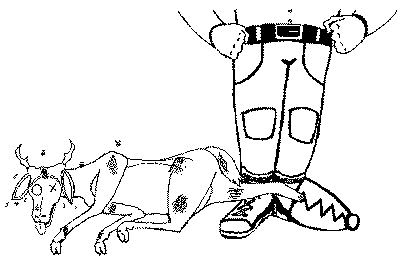
The goat wandered into a rocky place. He saw some tender leaves on a branch and stretched out his neck to reach them. All of a sudden a thunderstorm appeared out of nowhere. A lightning bolt struck an over-hanging rock, and cut off a sharp slab, which fell and chopped off the goat’s head! He died instantly, and the thunderstorm disappeared.

Hearing of this very strange event, hundreds of local people came to the place. No one could understand how it had happened.

There was also a fairy who lived in a nearby tree. He had seen all that had occurred. He appeared, gently fluttering in the air overhead. He began to teach the curious people, saying, “Look at what happened to this poor goat. This was the result of killing animals! All beings are born, and suffer through sickness, old age and death. But all wish to live, and not to die. Not seeing that all have this in common, some kill other living beings. This causes suffering also to those who kill, both now and in countless future rebirths.

“Being ignorant that all deeds must cause results to the doer, some continue to kill and heap up more suffering on themselves in the future. Each time they kill, a part of themselves must also die in this present life. And the suffering continues even by rebirth in hell worlds!"

Those who heard the fairy speak felt that they were very lucky indeed. They gave up their ignorant killing, and were far better off, both in this life, and in pleasant rebirths.

The moral is: Even religion can be a source of ignorance.

18. The Goat Who Saved the Priest [Ignorance]

Link: https://hhdorjechangbuddhaiiiinfo.com/2022/03/07/18-the-goat-who-saved-the-priest-ignorance/

INTERPRETER’S INTRODUCTION – BUDDHIST TALES FOR YOUNG AND OLD, VOLUME 1, STORIES 1-50

#Buddhisttalesforyoungandold #Buddhiststories #storiesforkids #moralstories #Buddha #Jatakastories #PansiyaPanasJataka
16. The Fawn Who Played Dead [Attendance]

16. The Fawn Who Played Dead [Attendance]

Buddhist Tales for Young and Old, volume 1, Prince Goodspeaker, Stories 1-50

Once upon a time, there was a herd of forest deer. In this herd was a wise and respected teacher, cunning in the ways of deer. He taught the tricks and strategies of survival to the young fawns.

One day, his younger sister brought her son to him, to be taught what is so important for deer. She said, “Oh brother teacher, this is my son. Please teach him the tricks and strategies of deer." The teacher said to the fawn, “Very well, you can come at this time tomorrow for your first lesson."

The young deer came to the lessons as he was supposed to. When others cut classes to spend all day playing, he remained and paid attention to the good teacher. He was well-liked by the other young bucks and does, but he only played when his class work was complete. Being curious to learn, he was always on time for the lessons. He was also patient with the other students, knowing that some learn more quickly than others. He respected the teacher deer for his knowledge, and was grateful for his willingness to share it.

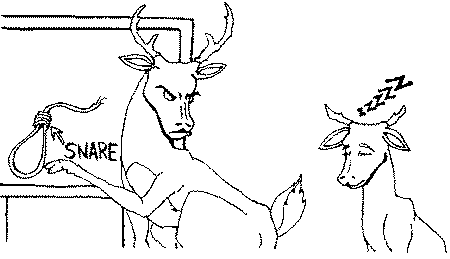
One day, the fawn stepped in a trap in the forest and was captured. He cried out in great pain. This frightened the other fawns, who ran back to the herd and told his mother. She was terrified, and ran to her brother the teacher. Trembling with fear, crying big tears, she said to him, “Oh my dear brother, have you heard the news that my son has been trapped by a hunter’s snare? How can I save my little child’s life? Did he study well in your presence?"

Her brother said, “My sister, don’t be afraid. I have no doubt he will be safe. He studied hard and always did his very best. He never missed a class and always paid attention. Therefore, there is no need to have doubt or pain in your heart. He will not be hurt by any human being. Don’t worry. I am confident he will return to you and make you happy again. He has learned all the tricks and strategies used by deer to cheat the hunters. So be patient. He will return!"

Meanwhile, the trapped fawn was thinking, “All my friends were afraid and ran away. There is no one to help me get out of this deadly trap. Now I must use the tricks and strategies I learned from the wise teacher who taught so well."

The deer strategy he decided to use was the one called, “playing dead." First, he used his hoofs to dig up the dirt and grass, to make it look like he had tried very hard to escape. Then he relieved his bowels and released his urine, because this is what happens when a deer is caught in a trap and dies in very great fear. Next, he covered his body with his own saliva.

Lying stretched out on his side, he held his body rigidly and stiffened his legs out straight. He turned up his eyes, and let his tongue hang out of the side of his mouth. He filled his lungs with air and puffed out his belly. Finally, with his head leaning on one side, he breathed through the nostril next to the ground, not through the upper one.

Lying motionless, he looked so much like a stiff corpse that flies flew around him, attracted by the awful smells. Crows stood nearby waiting to eat his flesh.

Before long it was early morning and the hunter came to inspect his traps. Finding the fawn who was playing dead, he slapped the puffed up belly and found it stiff. Seeing the flies and the mess he thought, “Ah, it has already started to stiffen. He must have been trapped much earlier this morning. No doubt the tender meat is already starting to spoil. I will skin and butcher the carcass right here, and carry the meat home."

Since he completely believed the deer was dead, he removed and cleaned the trap, and began spreading leaves to make a place to do the butchering. Realizing he was free, the fawn suddenly sprang to his feet. He ran like a little cloud blown by a swift wind, back to the comfort and safety of his mother. The whole herd celebrated his survival, thanks to learning so well from the wise teacher.

The moral is: Well-learned lessons bring great rewards.

16. The Fawn Who Played Dead [Attendance]

Link: https://hhdorjechangbuddhaiiiinfo.com/2022/02/15/16-the-fawn-who-played-dead-attendance/

INTERPRETER’S INTRODUCTION – BUDDHIST TALES FOR YOUNG AND OLD, VOLUME 1, STORIES 1-50

#Buddhisttalesforyoungandold #Buddhiststories #storiesforkids #moralstories #Buddha #Jatakastories #PansiyaPanasJataka

15. The Fawn Who Played Hooky [Truancy]

15. The Fawn Who Played Hooky [Truancy]

Buddhist Tales for Young and Old, volume 1, Prince Goodspeaker, Stories 1-50

Once upon a time, there was a herd of forest deer. In this herd was a wise and respected teacher, cunning in the ways of deer. He taught the tricks and strategies of survival to the young fawns.

One day, his younger sister brought her son to him, to be taught what is so important for deer. She said, “Oh brother teacher, this is my son. Please teach him the tricks and strategies of deer." The teacher said to the fawn, “Very well, you can come at this time tomorrow for your first lesson."

At first, the young deer came to the lessons as he was supposed to. But soon, he became more interested in playing with the other young bucks and does. He didn’t realize how dangerous it could be for a deer who learned nothing but deer games. So he started cutting classes. Soon he was playing hooky all the time.

Unfortunately, one day the fawn who played hooky stepped in a snare and was trapped. Since he was missing, his mother worried. She went to her brother the teacher, and asked him, “My dear brother, how is my son? Have you taught your nephew the tricks and strategies of deer?"

The teacher replied, “My dear sister, your son was disobedient and unteachable. Out of respect for you, I tried my best to teach him. But he did not want to learn the tricks and strategies of deer. He played hooky! How could I possibly teach him? You are obedient and faithful, but he is not. It is useless to try to teach him."

Later they heard the sad news. The stubborn fawn who played hooky had been trapped and killed by a hunter. He skinned him and took the meat home to his family.

The moral is: Nothing can be learned from a teacher, by one who misses the class.

15. The Fawn Who Played Hooky [Truancy]

Link: https://hhdorjechangbuddhaiiiinfo.com/2022/01/27/15-the-fawn-who-played-hooky-truancy/

INTERPRETER’S INTRODUCTION – BUDDHIST TALES FOR YOUNG AND OLD, VOLUME 1, STORIES 1-50

#Buddhisttalesforyoungandold #Buddhiststories #storiesforkids #moralstories #Buddha #Jatakastories #PansiyaPanasJataka