Once while the Buddha was living in Jetavana monastery, this story was delivered about Venerable KāÀudāyi. He used to go to preach to gatherings. As he often could not understand the purpose of the gatherings, sometimes he would preach sad things to a happy community and happy things to a grieving community. As he could not preach appropriately to communities, he obtained a bad name. The community of monks knew this. One time, the monks who were assembled in the hall of law for the evening preaching were talking about this matter.
When the Buddha came there, he asked, “Oh monks, what were you talking about before I arrived?” The monks said, “Your lordship, we were talking about the lack of understanding of Venerable KāÀudāyi in preaching.” Then the Buddha said, “Monks, KāÀudāyi not only acts like this today. Even in the past, he has acted in the same way.” And Buddha was invited to disclose the story of the past that had been hidden by the course of time. Buddha preached the story of the past.
This is how it was:
Long ago in the past, there was a king called Brahmadatta in Benares. At that time, the Enlightenment Being was a prominent teacher in the city. He lived by giving instruction to students. People who were rich enough to afford it gave a thousand gold coins to the teacher. Some, who had not much money, got their education by working as servants to the master. And in this way, they were able to study.
Once there came a poor foolish man to get an education from the Enlightenment Being. He was paying for his education by working. One day he was massaging his master’s feet, and the master requested that he raise up his feet. The student agreed, and under one side of the foot of the bed he placed folded cloth. As he had nothing for the other side, he placed his thigh under the bed. All that night, until the next morning, he kept his thigh under the bed forgoing his rest. In the morning, when the master awoke, he saw that the student was sitting at his foot, and he became very sad. He thought, “This poor foolish man works here as a slave, and cannot learn anything. Therefore, it would be good to somehow teach this man something.” Thinking so, he said to the foolish student, “Whatever you see daily, you must tell me. And also relate to me a comparable thing [upamā].” The Enlightenment Being thought that by the student making a comparison, he would be able to develop his thinking.
The next day, the teacher asked the student to bring some firewood. When the student returned, the master requested, “Tell me whatever you have seen.” The student said, “I have seen a snake in the forest.” The master asked,
“What did the snake resemble?” The student responded, “The snake was like a plough handle.” The master thought, “A snake is long, and a plough handle is also long. Therefore his example is correct.” Thinking so, he was satisfied.
The following day, he also went to the forest to bring firewood. And on that day, he saw an elephant. On returning, he said to his master that he had seen an elephant. The master asked him for a comparison. The student said, “It is like a plough handle.” The teacher thought, “The end of an elephant’s trunk is similar to a snake’s head. Therefore it is a good comparison.” And he was satisfied.
On still the next day, he went again into the forest. There he saw sugarcane. When he returned, he told his master, “I have seen sugarcane.” The master again asked for a comparison. He said, “It is like a plough handle.” The master thought, “Sugarcane is long, and the trunk of an elephant is also long. Therefore the comparison is correct.” And he was satisfied.
The next day, when he went to the place where lunch was to be given, he ate curd and rice. After eating the curd and rice, he returned. He told his master, “I have eaten curd and rice.” His master asked for a similar thing to curd and rice. He said, “It is like a plough handle.”
The teacher had been satisfied with the previous three answers. But in this case he thought, “What a foolish man this is. No matter how hard I try, I will not be able to make him a wise man.” And he gave up his efforts to make the student a person with understanding.
The foolish student at that time is today KāÀudāyi. I who am the Buddha was his master at that time.
Saying so, he completed the discourse of the Jātaka story.
The moral: “Even if good luck is in an unwise man’s pocket, he will lose it.”
When the Buddha was living in the Bamboo Grove temple, once those monks who were assembled in the preaching hall were talking about the monk Devadatta. They said to each other, “Brothers, monk Devadatta even when seeing the Buddha’s physical beauties, such as the thirty-two great marks of a great person [mahāpurisa] and the eighty additional attributes, a fathom wide halo, and physical beauties of the like, does not respect the Buddha and affords him no loving kindness. He has become jealous by thinking, ‘I do not have such physical beauty.’ And he wants to kill the Buddha.”
Then the Buddha came there and sat on his seat. He asked, “Oh monks, what were you discussing before I came?” The monks replied, “Your reverence, we were talking about the monk Devadatta’s jealousy of the Buddha.” The Buddha said, “Monks, it is not only now, but even in the past he was jealous of me.” The monks said, “Please, sir, disclose that story to us.” The Buddha, after that invitation, stated the following story:
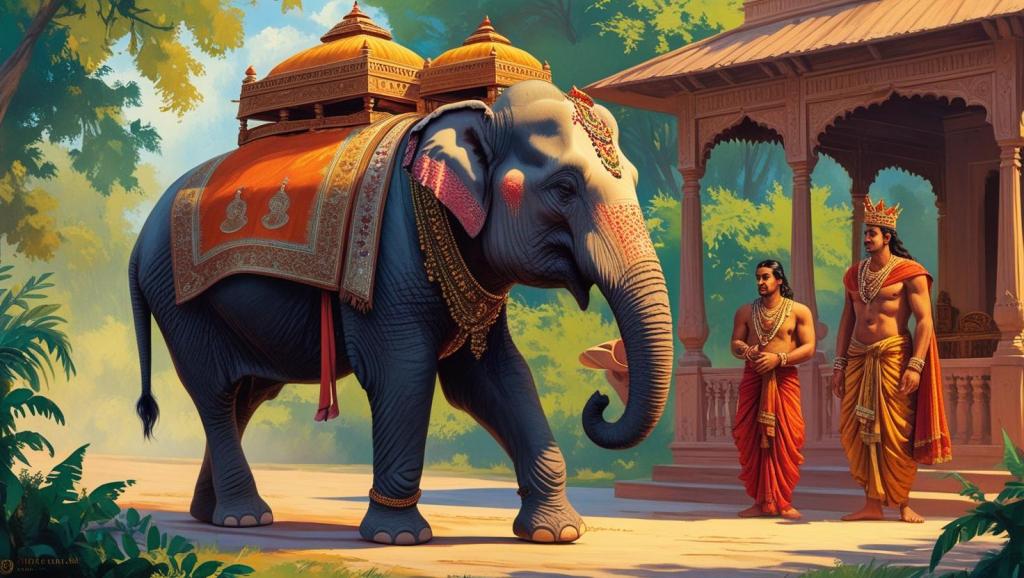
Long ago in ancient days, there was a king called Magadha in the city of Rājagaha. The Enlightenment Being was born among elephants, was white, and was very beautiful. He was in service to King Magadha.
Once, King Magadha got onto this white elephant that was well caparisoned and left in a grand procession to go to the city. The citizens, on seeing this elephant’s beautiful body that was well shaped and large, said, “Oh, what a nice elephant. Such a big elephant is good for a universal monarch, and not for a king like this.” Talking so, the people appreciated only the elephant, and not the king. On hearing such appreciation of the elephant, the king got angry, thinking, “These people did not appreciate me, who is their king.” He became in this way jealous of the elephant, and thought of killing him. Thinking so, he summoned the mahout and said, “I want to know whether you trained this royal elephant to be obedient. If so, I want to examine it. Climb with him to the top of Vephulla Mountain.” The mahout did so. And the king followed him with his ministers. He ordered the mahout to lead the elephant to a precipice. The mahout did so. The king then asked the mahout to have the elephant stand on three feet. He did so. Then the king ordered to have the elephant hold up its front two feet. He did so. Then the king asked him to have the elephant raise up its hind legs. He did so. Then he asked the mahout to have the elephant stand on one foot. He did so. And the elephant still did not fall. Then the king said, “Ask the elephant to go forward toward the precipice raising all four legs into the air.”
The mahout thought, “This king wants to kill the elephant. This is just a stratagem.” He said secretly to his elephant, “Your lordship, he is trying to kill you. If you can, get up into the sky and flee away to the city of Benares.” At that very same moment, there arose a certain miraculous power on account of the virtue from previous merit, and miraculously the elephant jumped up into the sky. Then the mahout said to the king, “Your lordship, this elephant is not appropriate for such a person as you who has so little merit. Therefore, this elephant is not fit for such a foolish king as you. You stay there by yourself.” And he had the elephant go through the sky to Benares to the king’s palace grounds. People saw this, and they were surprised and became very happy. They ran to the king and informed him about this. The king came to that place and saw the elephant. And he said with great pleasure, “If this elephant will allow me to mount it, I request you to come down to the ground.” And the elephant came down to the ground.
The mahout got down from the elephant and gave respect to the king. The king asked, “Why, son, did you come with this elephant?” The mahout told him everything. The king thanked him, saying, “You have done a good deed.” Being satisfied, the king took the elephant into his possession. He divided Benares into three parts. He gave one part to the elephant, the second part to the mahout, and the third part he kept for himself. And he ruled righteously. Finally, he passed away according to his Kamma.
The Buddha, finalizing the story, said, “The king of Benares at that time was the Venerable Sāriputta. The mahout was the Venerable Ānanda. And King Magadha was the monk Devadatta. I, who am now the Buddha, was the elephant.” Saying so, the Buddha ended this Jātaka story of an unwise person.
The moral: “While lack of wisdom brings death, wisdom brings happiness.”
The Buddha delivered this story about Anāthapiϯika’s true friend when he was in the Jetavanārāma of Anāthapiϯika in Sāvatthi. The millionaire Anāthapiϯika had a friend and he helped him as stated earlier in the Kālaka::i-Jātaka [No. 83].
At one time there was a king called Brahmadatta in Benares. At that time the Enlightenment Being lived in the pleasure garden of the king and was a friend of the deity who possessed that park and who lived in the most prominent Sāla tree in the park. The Enlightenment Being lived in a clump of Kusa grass.
The king of Benares lived in a palace that had only one pillar supporting it. One day this pillar was shaken by the wind. The king decided to further support it. He summoned his carpenter and asked him to cut down any good tree with a core from the pleasure garden. The chief carpenter went to the pleasure garden, looked for an appropriate tree to cut down, and not seeing one decided finally with his assistant to cut down the prominent Sāla tree in the garden. He went back to the palace and reported about the problem, and about the prominent tree to the king.
The king said, “Even if it is the prominent tree, you cut it and repair the palace.” Then the carpenter went with his assistant to cut down the tree. They made an appropriate reverence [pūjā], asking the deity who possessed the tree to move away from the tree. Hearing this request, the deity thought, “I do not have any other tree this large in the pleasure garden in which to stay.” He began to cry, and his children also began to cry while they all embraced one another. All the other deities who were visiting there also started to cry. The deity who resided in the clump of Kusa grass also came upon hearing all this crying. He asked the reason for the crying. On hearing the reason, he said, “Please, do not be afraid. I know a way to save the tree.” The next day, when the carpenters came to cut the tree, he made himself into a chameleon. He went through the roots of the tree, came up the tree on the far side so that people could not see him, and went to a top branch of the tree.
On seeing the chameleon on the top branches of the tree, the carpenter and his assistant thought, “This tree is hollow inside.” They gave up the idea of cutting down the tree because it had no core inside.
Then the tree deity summoned the other deities and said, “Even though I was the highest deity in the pleasure garden, I did not know how to save my tree and palace. The deity who lived in a clump of Kusa grass understood how to protect it with his wisdom. Therefore, we must always associate with wise people, and not with the unwise.” In this way, he preached to his fellow deities, and he became friendlier with the deity who possessed the clump of Kusa grass. Later, he passed away.
The pleasure garden deity was the Venerable Ānanda at that time. And I was born as the deity of the clump of Kusa grass.
And in this way, the Buddha finalized the KusanāÀi story.
The moral: “Associate with the wise no matter what their station, not the unwise.”
When the Buddha was living in the Jeta Grove, the Buddha related this story regarding the Brahmin girl Ciñcā. Its present story is explained in the Mahāpaduma-Jātaka in the twelfth book [No. 472].
[After the Buddha’s attainment of enlightenment, the Jains and other ascetics found that their gains had fallen. Therefore, the Jain recluses became upset and angry, and they hatched a conspiracy to defame the Buddha. Ciñcā, the Brahmin girl, became their instrument. In accord with the conspiracy, she came from home toward the Jetavana monastery every evening wearing a red cloth. Then she slept at a recluse’s home, and returned to her home each morning as if she were a person coming from Jetavana monastery. People asked, “Where did you go?” She answered, “Do not care about where I go. Do not think about me.” And she behaved so as to create doubts in people’s minds about her.
She continued in this fashion for four months. By doing this, she led people to believe that she was no doubt coming from the Buddha’s chamber. She used to say, “Now I am one month pregnant.” “Now I am two months pregnant.” “Now I am three months pregnant.” And so forth. When ten months had passed like this, she pretended to be a woman who was about to deliver a baby.7 Then she went to the Buddha having stuffed something around her belly, and when Buddha was preaching, in the middle of the congregation she accused the Buddha, saying, “Ah, you are preaching here as if a person who is innocent. I am now ten months pregnant and I have to deliver my baby. I have no home in which to deliver. Why do you not prepare the food and other items that I need for my delivery of the baby? Mention it to King Kosala or to millionaire Anāthapiϯika and arrange someplace for me to stay.”
The Buddha said, “Oh sister, the truth of this incident is known by both of us. Except for the two of us, who will know the truth?” At the same moment, there came four deities as rats. They scurried up her body, and cut the strings holding what was tied around her belly. The cloths that were tightened there fell down to the ground.
Everyone started to censure her. People attacked her because she had falsely accused the Buddha. And they kicked her out of the hall. Suddenly there came a big fire from hell (Avici), and the ground opened and took her.]
Regarding this, there was then discussion in the preaching hall. The Buddha revealed the story of the past thus:
Once the Enlightenment Being was born as a Brahmin advisor to King Brahmadatta, who ruled in Benares. He had a very beautiful queen who loved him very much. Because the king loved her so much, he once said to her, “For whatever you desire, you may ask.” The queen responded, “I have everything I want. I have nothing to ask. And so, I ask you not to look at any other woman with passion. That is my boon.” The king said, “Since there are 16,000 beautiful women in my possession, I may not be able to give that boon.” She then pleaded, again and again. Very ardently, she continued to so plead. Finally, the king was unable to say “no” to her, and agreed.
While they were living in such a manner, deeply in love with one another, there was a riot in a remote village. His minister could not settle it. Finally, the king went there with his fourfold army. Before he left, he summoned his queen and said, “War is doubtful. It is difficult to bring women to the battlefield. One cannot retreat quickly with women beside you. Therefore, I cannot take you to the battlefield. Stay at home.” The queen said, “No. Let me come with you.” But the king was steadfast.
Then the queen said, “If such be so, please inform me of all news every Yojana.8” The king and queen both agreed to this. And the king left, asking his ministers to look after the queen. The chief Brahmin advisor undertook her protection within the confines of the city. Every Yojana the king sent a messenger to inform her of his affairs, and to inquire about her well being.
When each messenger came, the queen asked, “Why did you come?” Each messenger replied, “I came to inquire about your safety and happiness.” Thereupon the queen summoned each to her chamber, was intimate with each of them, and then sent each back. Meanwhile, on the battlefield, the king won. During his thirty-two Yojana long trip, the queen was intimate with thirty-two messengers. Coming back, he also sent thirty-two messengers, and each of these was also intimate with the queen. The queen in this way was intimate with sixty-four messengers.
Finally, the king came near the city and camped overnight. He informed the chief Brahmin advisor the news of his arrival. The chief advisor decorated the city to welcome the king and his army. And he went to the palace to inform the queen of the king’s arrival. The queen, seeing the beauty of his body, said, “Come and sit on the bed.” The advisor, who was the Enlightenment Being, said, “Your majesty, the king who is your husband is handsome. I am both afraid of him, and of what might befall me in my next birth.” When she heard this, she said, “Were not those sixty- four messengers who came to me also afraid of the king the same as you are? And were they also not afraid of their next birth?” Then the advisor said, “Even though I have reached my present age, I have never seen a woman with such a lustful mind. Therefore, please do not speak to me in this way.” She said, “If you say ‘no’ to me, then I will ask the king to behead you complaining that you have asked me to be intimate with you.” The advisor, who was the Enlightenment Being, said, “Not only in one life, but also in a thousand lives, even if you have me beheaded, I will not agree to your desires.” Saying so, he left.
The queen got angry. She scratched her body everywhere, and applied oil to the wounds. Wearing a dirty garment, she lay in her bedroom. She told her servant girls that when the king comes and asks about her, to tell him that she was sick and was lying in her bed.
The Enlightenment Being went forward to welcome the king and his army, who returned to the city triumphantly with a very big procession. The king came into the palace after circumambulating the city and not seeing the queen in the palace, he asked the servant girls about her. They said she was sick. Then the king went into her sleeping room and saw that she was lying in bed. Touching her back, he asked how she was feeling. After asking her two or three times, she turned around toward him and replied, “Ah, your lordship also has come. Now I am with my husband.” Hearing these words, the king asked, “Why do you speak so?” Then she complained about the advisor, saying, “He did what no husband would ask him to do.” And she showed her bruises to the king. The king got very angry, and ordered his security people to handcuff the Brahmin advisor and to kill him.
The security people, hearing these words, took the Brahmin advisor and brought him to the place of execution beating the death drums. Then the Enlightenment Being thought, “This happened because of the queen. But I must use my common sense here.” Thinking so, he said to the executioners, “I know many places where wealth is hidden. Please do not kill me until I show them to the king.” Then they asked, “What can you show the king?” The advisor said, “Because of me, the king has much wealth hidden. If you kill me, he will lose all this wealth not knowing where it is. Therefore, my death will be a big loss for him.” The executioners heard this, and thought, “He says the truth.” So they took him back to the king.
On seeing him, the king asked, “You, Brahmin, without having fear or shame did such a bad deed. Why did you do it?” The Enlightenment Being said, “Your lordship, I never did such a thing. From the earliest time I can remember, I have never even killed a louse. I have never even taken so much as a piece of grass that was not given. I have never looked at another’s woman with lustful thoughts, and have never looked at another’s woman with head raised.9 Even in jest, I have never said falsehoods. I have never tasted alcohol, even as little as would be on a blade of grass. The sixty-four messengers are the people who misbehaved with the queen. Even though she trapped me in the same way, I did not get involved. That is why she complained about me.”
On hearing this, the king summoned all the sixty-four messengers and also the queen. He questioned them as to whether or not this was true. They all admitted to their wrongdoing. The king ordered all of them to be killed. But the Enlightenment Being said, “Your lordship, these people did what the queen requested. Therefore, it is not right to punish them.” And they were saved from punishment, and were retained in their positions. And he said further, “This is the nature of women. Therefore, it would be correct to excuse the queen as well.” He in this way saved her also.
Finally he thought, “All this happened to me as I was in the life of a householder. Therefore, it would be good to renounce lay life.” Thinking so, while his relatives cried, giving up all his wealth behind him, he went to the Himalayan forest and became ordained as an ascetic. After meditating there, he generated the fivefold higher knowledge and the eightfold high achievements of concentration. After his death, he was born in the Brahma world.
Buddha said, “The queen at that time was Ciñcā. The king was the Venerable Ānanda. And the advisor Brahmin was myself, the Buddha.” And in this way he ended the story of release from bondage [bandhanamokkha].
Once when the Buddha was living in Jetavana monastery, there were two monks who did not do their monastic duties at the proper times. They would go to bed late at night, and they did not wake up at the proper time. When they woke up, they made a lot of noise. Because of this, the monks who slept normal hours nearby could not get sound sleep.
This story was spread among the monks who assembled for the evening Dhamma sermon of the Buddha in the preaching hall. The Buddha went in the evening to preach and asked, “Oh monks, what was your discussion before I came here?” The monks said, “Venerable sir, such-and-such monks shout and make noise at improper times during the night. We were discussing that.” Buddha said, “Oh monks, it is not only today but also in the past that these two monks have been noisy at improper times.” Buddha was then invited to disclose the story of the past. He delivered this story to disclose the previous life:
When Brahmadatta was ruling in Benares in the past, the Enlightenment Being was born in a notable Brahmin family. He was well educated, became the chief instructor in the area, and taught 500 students.
The students had a certain rooster who crowed at the proper times. They woke up at the proper time each day, and studied every morning learning their lessons by heart.
Then the rooster died.
After that, one student went to the forest to collect firewood. There he caught a wild rooster. He put it in a cage, and fed it regularly.
That rooster did not crow at the proper times. Sometimes, he would crow at midnight. Hearing the noise of the rooster, the students would get up at midnight and read their lessons so as to learn them by heart. But as it was too early to wake up, they became very upset. Sometimes, this rooster would crow in the middle of the morning. When they got up at that time, they did not have enough time to do their studies during the morning hours. So the rooster became very unpopular among the students. They killed it and complained to the teacher.
The teacher said, “Without teachers and parents, and without proper instruction, this fowl came to such a fate. Therefore, students must follow the guidance of teachers.”
Buddha then compared these two incidents, and finished this story disclosing, “The fowl that crowed at the improper time was one of these monks who has no set time for his work. The students were you who are assembled here. The teacher was I, the Buddha, who attained Nibbāna.”
When the enlightened one was living in Jetavana monastery, this Jātaka story was delivered regarding the millionaire called Uttara.
While the millionaire Uttara was living in the city of Sāvatthi, a certain very highly meritorious prince was conceived in his wife’s womb, and after ten months he was delivered. He grew up and became a youth.
At one time, there was a Kattikā festival. Many millionaires’ children came out with their wives onto the streets and celebrated in the streets for seven days. Uttara also, thinking his son should celebrate with them, went to him and told him of his intentions, saying, “You also go, along with the young women of the household, and celebrate the Kattikā festival.”
As the son of Uttara came from the Brahma world, he did not do as his father wished. Thereupon, without his consent, his friends got together and summoned a certain prostitute from the village. She, decorated with ornaments and fancy clothes, tried to entice him. But, on seeing her, he did not want to have anything to do with her. His friends tried to persuade him, letting her show him her feminine wiles, but he only smiled.
The millionaire Uttara’s son, looking at her with a distracted mind, saw her as bones only. Seeing her as impurities, he was averse to her. But he thought, “Why should I send her back empty-handed?” So, he gave her all that she needed. She left, and while she was walking in the street, a certain rich official saw her. He led her to his home.
When the Kattikā celebration was over, the prostitute’s mother did not see her daughter. She went to the millionaires’ sons and accused them of taking her daughter. She asked, “Where is she now? Show me.” Hearing her accusation, the youths said, “We sent her, on the very same day she was summoned, to the millionaire Uttara’s son. Go and ask him.” Then she went to him and asked about her daughter. He said, “I sent her away, on the very same day. I do not know where she went.” The woman took him to court, and cried before the king. The king examined the case and said, “If she was in your house, you will have to produce her.” The young millionaire’s son said, “Sir, I do not know where she is.”
The king then said, “If it is so, I will order you to be punished.” And he did so.
The ministers, hearing the king’s order, put cuffs around the millionaire Uttara’s son’s hands and led him away as punishment drums were beating. On hearing this noise, many people came and surrounded him crying and weeping. They said, “Such a punishment has fallen on such a virtuous person as you!”
The millionaire’s son, who was the victim, thought, “If I get rid of this punishment, I will be ordained as a monk in the monastic order of the Buddha.”
Meanwhile, the prostitute heard the news that he was sentenced to death because of her. Knowing this, she came from the official’s mansion where she had been staying and appeared before the executioners. Some people in the crowd, who saw her, handed her over to her mother. Then, the millionaire Uttara’s son was released.
The millionaire’s son after being freed from death went to the lake and washed his hair, taking a bath. He then ate rice. After that, he paid respect to his parents, and obtained permission from them to become ordained as a monk. And he went to the forest. He became a monk, and received his higher ordination [upasampadā]. Within a few days, gaining insight from meditation, he obtained the status of Arahant.
On the very same day, the elders assembled in the preaching hall were talking about him. When the Buddha entered, he asked the monks, “Oh monks, what were you talking about before I came here?” When they mentioned that the story of the millionaire’s son and his attainment of the status of Arahant was being discussed by them, the Buddha said, “Oh monks, not only today but even in the past wise people have been released from death’s grip as was this monk today.” The Buddha was invited to disclose the story of the past. The Buddha then disclosed this story:
Long ago a king called Brahmadatta was ruling in Benares. At that time, the Enlightenment Being was born among quails. A certain quail hunter in Benares at one point went to the forest and came back having caught a lot of quails. Keeping them at home and feeding them, he sold them to people.
One day, the quail that was the Enlightenment Being got trapped in the net placed down by the quail hunter. He also was brought to the hunter’s home. The quail hunter gave the quails that he had caught food to eat to make them fat. But the Enlightenment Being did not eat the food, thinking, “If I eat, I will be fat, and I will not be able to escape through the small holes of the net which is confining me.” The quail hunter, seeing that this quail was not eating over a few days, took him into his hand and examined him in the palm of his hand so as to ascertain why this quail was not eating. Meanwhile, this quail saw a moment’s inattention on the part of the quail hunter, and he flew away to the forest.
When he went home, his relatives surrounded him and asked, “What happened to you? Why were you away for such a long time?” He said that he had been captured by a hunter, and related how he had obtained his release. Buddha said, comparing the two stories, “Wise people are released from death as this quail. The quail at that time was I who have attained Buddhahood, the master who became the teacher of the three worlds.”
The moral: “Parents love children.”
Further,
“The practice of common sense is essential for a safe life.”
When Buddha was living in Jetavana monastery, the Venerable Devadatta’s right hand disciple Kokālika caused a disruption among the monks. Because of that, the Buddha related this Jātaka story. The story of its cause is detailed in the thirteenth book in the Takkāriya-Jātaka [No. 481].
[During a certain spring retreat the two chief disciples of the Buddha, Sāriputta and Moggallāna, went to the monk called Kokālika and said, “With your help to us, and with our help to you, we can live together happily in this temple for this rainy season period of three months.” The two chief disciples said this so as to try to avoid being bothered by the public. Kokālika asked, “What is the happiness that you can gain because of me?” The two chief disciples said, “If you do not disclose to anyone that we are here, then we can live happily. That is the help you can give us. During these three months, we will teach you the discourses (sutta-s) and the philosophical and psychological analyses (abhidhamma) of the Buddha. This is how we can help you.”
Then the Venerable Kokālika prepared shelter for them. This was not known to anyone. At the end of the rainy season retreat, they requested Kokālika to visit the Buddha with them. On the way to seeing the Buddha, they came to a certain village. After the two chief disciples left the village, the Venerable Kokālika came back and said to the villagers, “You devotees are ignorant like animals. Our chief disciples were with me nearby for the last three months. And now, these two have left to go back to Sāvatthi.”
Hearing this, the villagers became very upset and taking many offerings chased after the two chief disciples. Meeting them, they begged pardon and said, “Bhante, we could not recognize you. Please pardon us and accept these offerings.” Then the chief disciples refused to accept the gifts and instructed the villagers even not to give them to Kokālika. The villagers invited the two chief disciples to come back again to the village. Kokālika thought, “The chief disciples did not accept these gifts, and they did not even allow me to accept them.” And he became angry with them.
The two chief disciples, in Sāvatthi with the Buddha for a short time, again left this time with their 500 disciples to go to the village where Kokālika lived. The villagers treated them with the four requisites of monks (food, clothing, shelter, and medicine). Those monks who went with the two chief disciples shared all the gifts given by the villagers with each other, and did not give any to Kokālika.
Because of this, Kokālika got angry and said, “Both Sāriputta and Moggallāna have bad motives. They did not accept the gifts given before by the villagers when they were here alone. Now they are accepting them when they are together with a retinue of 500 monks.” And he accused the two chief disciples in this way, with an evil mind.
However, hearing this the two chief disciples thought, “Kokālika acquires a great amount of demerit because of us. Therefore it is not good to stay here. So, let us go.” And they left the place along with their retinue.
Seeing this, the villagers started to cry and plead with them to stay. But they were firm in their decision. Meanwhile, a young monk spoke to the villagers and said, “Oh villagers, how can the two chief disciples stay here without the consent of Kokālika?”
The villagers got angry and went to Kokālika and requested, “Go, please, and invite the venerable two chief disciples to stay here and beg their pardon. If not, you must leave this village.” Then he became afraid of the villagers and requested the two chief disciples to stay. The two chief disciples said, “You, monk, do not go. You stay here. But we will not come back.”
Kokālika returned, but he could not stay in the village without the help of the villagers. He became very melancholy and taking his robes and books, left to see the Buddha who was in Jetavanārāma. He complained, “Your lordship, Sāriputta and Moggallāna have bad motives. They have gone over to earning gifts.” The Buddha said, “Kokālika, do not say so. They both are very highly virtuous and are endowed with good qualities.”
Then Kokālika said, “Sir, your chief disciples’ words are unwholesome. I know it. And they are not virtuous.” In this way, while Buddha was objecting to his saying so, he left.
Kokālika returned, but he could not stay in the village without the help of the villagers. He became very melancholy and taking his robes and books, left to see the Buddha who was in Jetavanārāma. He complained, “Your lordship, Sāriputta and Moggallāna have bad motives. They have gone over to earning gifts.” The Buddha said, “Kokālika, do not say so. They both are very highly virtuous and are endowed with good qualities.” Then Kokālika said, “Sir, your chief disciples’ words are unwholesome. I know it. And they are not virtuous.” In this way, while Buddha was objecting to his saying so, he left.
Within a short time, everywhere on his body there developed big boils which started to bleed and fester. He could not bear the pain, and screaming lay down near the gate of Jetavanārāma. His bad reputation spread everywhere, even up to the Brahmaloka.
This was seen by a certain higher deity (brahma) named Tudu who thought, “It is my duty now to go and advise Kokālika to beg pardon for his fault.” Staying in the sky, he said, “Kokālika, you have done a very bad deed. Go hurry up and beg pardon.” Then Kokālika asked, “Who are you, sir?” And Tudu said, “I am Tudu, your former master.” “What? You are a non-returner to this world? If so, how can you come from the Brahmaloka to this human world? No doubt, you are like a hungry ghost who comes to a heap of garbage.” Then the deity went back to his place saying, “If you speak so, then you look out for yourself.” And he left. And Kokālika died because of the same disease, and was born in a woeful state called the Hell of Paduma. The Sahāmpati Brahma deity saw this and informed the Buddha. On this occasion, Buddha said, “Kokālika not only in this life, but also in the past, faced difficulties because of his words.”]
Buddha stated that the monk Mahā-Kokālika, by speaking too much, faced death even in the past. The monks requested him to disclose the story. The Buddha explained it thus:
At one time, when a king called Brahmadatta reigned in Benares, the Enlightenment Being was born in a well-known Brahmin family of Benares. After growing up, he became ordained as a Rsi. He became the head of many ascetics and lived in a Himalayan forest.
Then, a certain ascetic who was malnourished, taking an axe, went into the forest to cut firewood so as to warm the hermitage.
Another ascetic came to where he was, and told him, “Cut this, cut this, and cut that.” In this way, he was ordering the first ascetic how to cut the wood. The first ascetic got angry and said, “Are you my teacher, that you are teaching me to cut firewood?” He picked up his sharp axe and he slashed him, killing him.
The Enlightenment Being, hearing the news, made all necessary rites and rituals for the dead ascetic. Meanwhile, near the hermitage where the Enlightenment Being was living, there was a certain partridge that was crying loudly on a fruit tree. A partridge hunter, hearing its cries, caught him and killed him. The Enlightenment Being, not hearing its cries for a few days, asked, “What happened to that partridge that cried up until a few days ago?” The other ascetics told him what happened. On hearing this, the Enlightenment Being compared the stories of the dead ascetic and the partridge. Both clamored uselessly. And he advised his fellow ascetics to meditate. He himself meditated on the fourfold sublime statuses of the mind, and gained rapturous ecstasies [jhāna-s]. Without failing to maintain those achievements, he was born among the Brahma beings.
Buddha finished this story saying, “At that time, the ascetic who got slashed in the head by the axe was the elder Kokālika. The Rsi who became the head of the group of ascetics was myself, the Buddha.”
Once the omniscient one was living in Jetavana monastery. He disclosed this Jātaka story regarding a certain monk who disregarded counsel. This Jātaka story comes in detail in the Gijjha-Jātaka in the ninth book [No. 427].
[A monk was ordained, and after his ordination he became disregardful of his teacher’s advice. He did not follow the precepts and religious practices properly. The elderly monks advised him on many things. He thought, “Why should I be obedient to these elders? I know what to do and what to say.” And he became more and more disrespectful to the elder monks. This was heard by the Buddha, and the Buddha summoned him and said, “Oh monk, you even in the past became disobedient and destroyed your life.”]
Addressing the monks, the omniscient one said, “Oh monks, this monk not only disregarded counsel in this life, but also did so in the past.” And then the monks in the audience requested the Buddha to express the hidden past. The Buddha then spoke this story:
At one time when King Brahmadatta ruled Benares, the Enlightenment Being was born in a family of gymnasts. When he became old enough, he learned how to do somersaults. With his master, he went from village to village displaying gymnastics. Once they came to a certain village and prepared to display their skills. While they were preparing the show, the master set up five javelins instead of four as usual. The pupil asked, “Master, why did you set up five javelins instead of four. It is dangerous to have five. Take one javelin out.” Then the master, as he was intoxicated, said, “Do you not understand my skills?” Saying so, he did somersaults over the javelins. Over the first four javelins, he jumped safely. But he was not skilled enough to clear the fifth javelin, and impaled himself on it, and died.
The student became very sad, and said, “My master died without listening to my advice.” He removed him from the javelin, and cremated him. Buddha disclosed this story, comparing the past story to the present.
“The gymnast who disregarded advice was the monk in the present. And I who am the Buddha today was born his student at that time.”
The moral: “Good advice deserves everyone’s attention.”
At one time the all-knower was living in Sāvatthi. This story was spoken about a certain housewife who was ordained among the sisters and who was too fond of food. Once she went collecting alms on a certain street, and there she was well entertained by the devoted people who offered her the daintiest food. She thought, “Let no other nun come to collect alms in this street. If such were to happen, I might miss these well prepared entertainments.” Therefore she thought further, “I must prevent other nuns from coming to this street.” Thinking so, she returned to the nunnery and told the other nuns, “On such-and-such a street there are elephants, horses, biting dogs, and other harmful animals. It is not good for anyone to go there.” The other nuns who heard this believed what she said as the truth. They completely kept away from going to that street. They even did not want to look at that place.
Then, only that nun went to that street for alms. One day she went there to a house for alms. While she was going toward the house, a certain ram ran after her and attacked her. Her thighbone was broken. The people who were in the vicinity came about her and set her thighbone with a bandage. They put her on a stretcher and took her to the nunnery.
This news was spread among the monks and nuns in the temple. On that occasion, when the Buddha came to the preaching hall in the evening and sat on the prepared platform, he asked the monks, “Oh monks, what were you talking about before I came here?” They said, “Venerable sir, we were discussing about the nun who broke her thighbone in the street.” And they related the story. The Buddha said, “Not only in this life by warning others falsely did she have to face the problem of a broken bone, but also in the past she faced death.” And then the disciples invited him to disclose the past story.
Buddha said:
Long ago in Benares when a king called Brahmadatta ruled, the Enlightenment Being was born as a king of birds. In his flock of birds, one female bird got plenty of food. And while she was eating this food, one day she thought, “If other birds come to this location, I will lose this plentiful fare. It is better not to let them come.” Thinking this way, she went back to the flock and said, “That road is packed with lots of bullocks which pull chariots, and with many other troublesome animals. It is not good to go there as it is dangerous.”
Hearing this, other birds never wanted to go there.
As she was wandering as was her wont in that location by herself, a fast chariot came up behind her. She turned her neck and saw the chariot coming up behind, but neglected to get out of the way as she was greedily eating food and thought the chariot was far off. Unfortunately, when the chariot came near her, she could not fly off. She was cut into two pieces and died. The Enlightenment Being while flying overhead in the sky, asked the other birds, “Where is that female bird who was warning others?” And they saw her dead on the road. The Enlightenment Being said, “Look at her. She died being enslaved to her own craving. Because of that, she is dead in vain.” They went away, leaving her body behind.
The female bird at that time that was warning others was the present nun. And the king of the birds at that time was I who became the enlightened one.
The moral: “It is not good to be greedy.”
Further,
“False admonitions to others have a way of befalling oneself.”






 頂禮 H.H. 第三世多杰羌佛- 眾善奉行