39. Buried Treasure [The Arrogance of Power]

39. Buried Treasure [The Arrogance of Power]

Buddhist Tales for Young and Old, volume 1, Prince Goodspeaker, Stories 1-50

Once upon a time, there was an old man who lived in Benares. He had a very good friend, who was known to be wise. Luckily, or perhaps unluckily, he also had a beautiful young wife.

The old man and his young wife had a son. The man came to love his son very much. One day he thought, “I have learned that my beautiful young wife cannot always be trusted. When I die, I am sure she will marry another man, and together they will waste the wealth I have worked so hard for. Later on, there will be nothing left for my son to inherit from his mother. So I will do something to guarantee an inheritance for my deserving son. I will bury my wealth to protect it for him."

Then he called for his most faithful servant, Nanda. Together they took all the old man’s wealth deep into the forest and buried it. He said, “My dear Nanda, I know you are obedient and faithful. After I die, you must give this treasure to my son. Keep it a secret until then. When you give the treasure to him, advise him to use it wisely and generously."

Before long, the old man died. Several years later, his son completed his education. He returned home to take his place as the head of the family. His mother said, “My son, being a suspicious man, your father has hidden his wealth. I am sure that his faithful servant, Nanda, knows where it is. You should ask him to show you. Then you can get married and support the whole family."

So the son went to Nanda and asked him if he knew where his father had hidden his wealth. Nanda told him that the treasure was buried in the forest, and that he knew the exact spot.

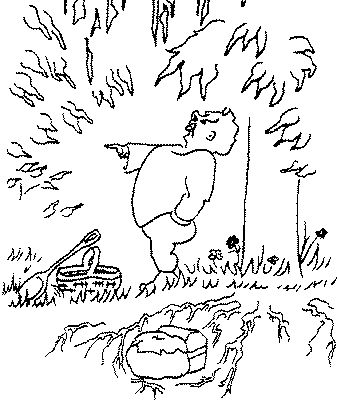
Then the two of them took a basket and a shovel into the forest. When they arrived at the place the treasure was buried, all of a sudden Nanda became puffed up with how important he was. Although he was only a servant, he had the power of being the only one to know the secret. So he became conceited and thought he was better than the son. He said, “You son of a servant girl! Where would you inherit a treasure from?"

The patient son did not talk back to his father’s servant. He suffered his abuse, even though it puzzled him. After a short time, they returned home empty-handed.

This strange behavior was repeated two more times. The son thought, “At home, Nanda appears willing to reveal the secret of the treasure. But when we go into the forest carrying the basket and shovel, he is no longer willing. I wonder why he changes his mind each time."

He decided to take this puzzle to his father’s wise old friend. He went to him and described what had happened.

The wise old man said, “Go again with Nanda into the forest. Watch where he stands when he abuses you, which he surely will do. Then send him away saying. “You have no right to speak to me that way. Leave me."

“Dig up the ground on that very spot and you will find your inheritance. Nanda is a weak man. Therefore, when he comes closest to his little bit of power, he turns it into abuse."

The son followed this advice exactly. Sure enough, he found the buried treasure. As his father had hoped, he generously used the wealth for the benefit of many.

The moral is: A little power soon goes to the head of one not used to it.

39. Buried Treasure [The Arrogance of Power]

Link: https://hhdorjechangbuddhaiiiinfo.com/2022/10/11/39-buried-treasure-the-arrogance-of-power/

INTERPRETER’S INTRODUCTION – BUDDHIST TALES FOR YOUNG AND OLD, VOLUME 1, STORIES 1-50

#Buddhisttalesforyoungandold #Buddhiststories #storiesforkids #moralstories #Buddha #Jatakastories #PansiyaPanasJataka
38. The Crane and the Crab [Trickery]

38. The Crane and the Crab [Trickery]

Buddhist Tales for Young and Old, volume 1, Prince Goodspeaker, Stories 1-50

Once upon a time, there was a crane who lived near a small pond. Right next to the pond was a big tree with a fairy living in it. He learned by observing the various animals.

There were also many small fish living in the small pond. The crane was in the habit of picking up fish with his beak and eating them. Since there happened to be a drought in the area, the water level in the pond was becoming lower and lower. This made it easier for the crane to catch fish. In fact, he was even getting to be a little fat!

However, the crane discovered that no matter how easy it was to catch fish, and no matter how many he ate, he was never completely satisfied. But he did not learn from this. Instead, he decided that if he ate all the fish in the pond, then he would find true happiness. “The more the merrier!" he said to himself.

In order to catch all the fish in the pond, the crane thought up a clever plan. He would trick the fish, and deceive them into trusting him. Then when they trusted him the most, he would gobble them up. He was very pleased with himself for thinking up such a trick.

To begin with, the crane sat down on the shore. He remained quietly in one position, just like a holy man in the forest. This was intended to get the fish to trust him.

The fish came to him and asked. “Sir crane, what are you thinking?" The holy-looking crane answered, “Oh my dear fish, it makes me sad to think of your future. I am thinking about the coming miserable disaster."

They said, “My lord, what disaster is coming to us?" To which the crane replied, “Look around you! There is very little water left in this pond. You are also running out of food to eat. This severe drought is very dangerous for you poor little ones."

Then the fish asked, “Dear uncle crane, what can we do to save ourselves?" “My poor little children," said the crane, “you must trust me and do as I say. If you allow me to pick you up in my beak, I will take you, one at a time to another pond. That pond is much bigger than this one. It is filled with water and covered with lovely lotuses. It will be like a paradise for you!"

When they heard the part about the beak, the fish became a little suspicious. They said, “Mr. Crane, how can we believe you? Since the beginning of the world, there has never been a crane who wanted to help fish. Cranes have put fish in their beaks only to eat them. This must be a trick. Or else you must be joking!"

The crane then raised his head and made himself look as dignified as possible. He said, “Please don’t think such a thing. Can’t you see that I am a very special crane? You should trust me. But if you don’t believe me, send one fish with me and I will show him the beautiful pond. Then when I bring him back here, you will know I can be trusted."

The fish said to each other, “This crane looks so dignified. He sounds like an honest crane. But just in case it’s a trick, let us send with him a useless little troublemaker fish. This will be a test." Then they found a young fish who was known for playing hooky from school. They pushed him towards the shore.

The crane bent his head and picked up the little one in his beak. Then he spread his wings and flew to a big tree on the shore of a beautiful big pond. Just as he had said, it was covered with lovely lotuses. The fish was amazed to see such a wonderful place. Then the crane carried him back to his poor old pond, just as he had promised.

Arriving home, the little fish described the wonders of the beautiful big pond. Hearing this, all the other fish became very excited and rushed to be the first to go.

The first lucky passenger was that same useless little troublemaker. Again the crane picked him up in his beak and flew to the big tree on the shore of the beautiful new pond. The little one was sure the helpful crane was about to drop him into the wonderful pond. But instead, the crane suddenly killed him, gobbled up his flesh, and let the bones fall to the ground.

The crane returned to the old pond, brought the next little fish to the same tree, and ate him in the same way. Likewise, one by one, he gobbled up every last fish!

He became so stuffed with fish meat that he had trouble flying back to the little pond. He saw that there were no more fish left for him to trick and eat. Then he noticed a lonely crab crawling along the muddy shore. And he realized that he was still not completely satisfied!

So he walked over to the crab and said, “My dear crab, I have kindly carried all the fish to a wonderful big pond not far from here. Why do you wish to remain here alone? If you simply do as the fish have done, and let me pick you up in my beak, I will gladly take you there. For your own good, please trust me."

But the crab thought, “There is no doubt this over-stuffed crane has eaten all those fish. His belly is so full he can hardly stand up straight. He definitely cannot be trusted! If I can get him to carry me to a new pond and put me in it, so much the better. But if he tries to eat me, I will have to cut off his head with my sharp claws."

Then the crab said, “My friend crane, I am afraid I am much too heavy for you to carry in your beak. You would surely drop me along the way. Instead, I will grab onto your neck with my eight legs, and then you can safely carry me to my new home."

The crane was so used to playing tricks on others, that he did not imagine he would be in any danger — even though the crab would be grasping him by the throat. Instead he thought, “Excellent! This will give me a chance to eat the sweet meat of this foolish trusting crab."

So the crane permitted the crab to grab onto his neck with all eight legs. In addition, he grasped the crane’s neck with his sharp claws. He said, “Now kindly take me to the new pond."

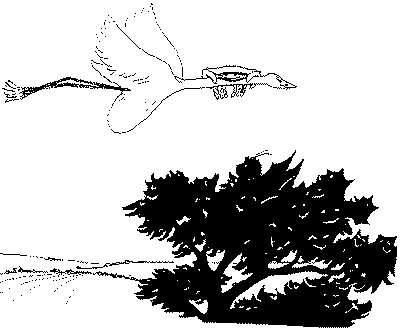
The foolish crane, with his neck in the clutches of the crab, flew to the same big tree next to the new pond.

Then the crab said, “Hey you stupid crane, have you lost your way? You have not taken me to the pond. Why don’t you take me to the shore and put me in?"

The crane said, “Who are you calling stupid? I don’t have to take that from you. You’re not my relative. I suppose you thought you tricked me into giving you a free ride. But I’m the clever one. Just look at all those fish bones under this tree. I’ve eaten all the fish, and now I’m going to eat you too, you stupid crab!"

The crab replied, “Those fish were eaten because they were foolish enough to trust you. But no one would trust you now. Because you tricked the fish, you have become so conceited you think you can trick anyone. But you can’t fool me. I have you by the throat. So if one dies, we both die!"

Then the crane realized the danger he was in. He begged the crab, “Oh my lord crab, please release me. I have learned my lesson. You can trust me. I have no desire to eat such a handsome crab as you."

Then he flew down to the shore and continued, “Now please release me. For your own good, please trust me."

But this old crab had been around. He realized the crane could not be trusted no matter what he said. He knew that if he let go of the crane, he would be eaten for sure. So he cut through his neck with his claws, just like a knife through butter! And the crane’s head fell on the ground. Then the crab crawled safely into the wonderful pond.

Meanwhile, the inquisitive fairy had also come to the new pond and seen all that had happened. Sitting on the very top of the big tree, he said for all the gods to hear:

“The one who lived by tricks and lies,
No longer trusted now he dies."

The moral is: The trickster who can’t be trusted, has played his last trick.

38. The Crane and the Crab [Trickery]

Link: https://hhdorjechangbuddhaiiiinfo.com/2022/10/04/the-crane-and-the-crab-trickery/

INTERPRETER’S INTRODUCTION – BUDDHIST TALES FOR YOUNG AND OLD, VOLUME 1, STORIES 1-50

#Buddhisttalesforyoungandold #Buddhiststories #storiesforkids #moralstories #Buddha #Jatakastories #PansiyaPanasJataka
37. The Birth of a Banyan Tree [Respect for Elders]

37. The Birth of a Banyan Tree [Respect for Elders]

Buddhist Tales for Young and Old, volume 1, Prince Goodspeaker, Stories 1-50

Once upon a time, there was a big banyan tree in the forest beneath the mighty Himalayas. Living near this banyan tree were three very good friends. They were a quail, a monkey and an elephant. Each of them was quite smart.

Occasionally the three friends got into a disagreement. When this happened, they did not consider the opinion of any one of them to be more valuable. No matter how much experience each one had, his opinion was treated the same as the others. So it took them a long time to reach an agreement. Every time this happened, they had to start from the beginning to reach a solution.

After a while they realized that it would save time, and help their friendship, if they could shorten their disagreements. They decided that it would certainly help if they considered the most valuable opinion first. Then, if they could agree on that one, they would not have to waste time, and possibly even become less friendly, by arguing about the other two.

Fortunately, they all thought the most valuable opinion was the one based on the most experience. Therefore, they could live together even more peacefully if they gave higher respect to the oldest among them. Only if his opinion were clearly wrong, would they need to consider others.

Unfortunately, the elephant and the monkey and the quail had no idea which one was the oldest. Since this was a time before old age was respected, they had no reason to remember their birthdays or their ages.

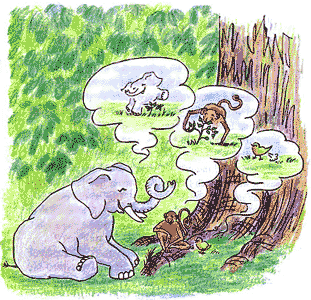
Then one day, while they were relaxing in the shade of the big banyan tree, the quail and the monkey asked the elephant, “As far back as you can remember, what was the size of this banyan tree?"

The elephant replied, “I remember this tree for a very long time. When I was just a little baby, I used to scratch my belly by rubbing it over the tender shoots on top of this banyan tree."

Then the monkey said, “When I was a curious baby monkey, I used to sit and examine the little seedling banyan tree. Sometimes I used to bend over and nibble its top tender leaves."

The monkey and the elephant asked the quail, “As far back as you can remember, what was the size of this banyan tree?"

The quail said, “When I was young, I was looking for food in a nearby forest. In that forest, there was a big old banyan tree, which was full of ripe berries. I ate some of those berries, and the next day I was standing right here. This was where I let my droppings fall, and the seeds they contained grew up to be this very tree!"

The monkey and the elephant said, “Aha! Sir quail, you must be the oldest. You deserve our respect and honor. From now on we will pay close attention to your words. Based on your wisdom and experience, advise us when we make mistakes. When there are disagreements, we will give the highest place to your opinion. We ask only that you be honest and just."

The quail replied, “I thank you for your respect, and I promise to always do my best to deserve it." It just so happened that this wise little quail was the Bodhisatta the Enlightenment Being.

The moral is: Respect for the wisdom of elders leads to harmony.

Link: https://hhdorjechangbuddhaiiiinfo.com/2022/09/27/the-birth-of-a-banyan-tree-respect-for-elders/

37. The Birth of a Banyan Tree [Respect for Elders]

INTERPRETER’S INTRODUCTION – BUDDHIST TALES FOR YOUNG AND OLD, VOLUME 1, STORIES 1-50

#Buddhisttalesforyoungandold #Buddhiststories #storiesforkids #moralstories #Buddha #Jatakastories #PansiyaPanasJataka
36. Wise Birds and Foolish Birds [Good Advice]

36. Wise Birds and Foolish Birds [Good Advice]

Buddhist Tales for Young and Old, volume 1, Prince Goodspeaker, Stories 1-50

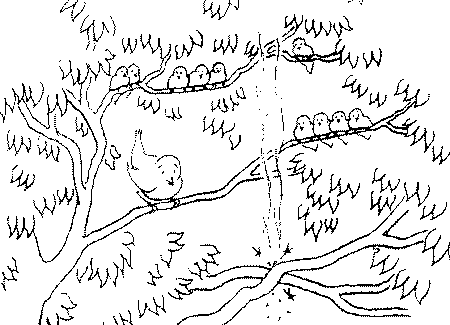
Once upon a time, there was a giant tree in the forest. Many many birds lived in this tree. And the wisest of them was their leader.

One day the leader bird saw two branches rubbing against each other. They were making wood powder come falling down. Then he noticed a tiny wisp of smoke rising from the rubbing branches. He thought, “There is no doubt a fire is starting that may burn down the whole forest."

Lo and behold, in a little while the wise leader’s warning came true. The rubbing branches made sparks that fell in the dry leaves under the tree. Those sparks became flames that grew and grew. Soon the giant tree itself caught fire. The foolish birds who still lived there were blinded and choked by the smoke. Many, who could not escape, were trapped and burned to death.

So the wise old leader called a meeting of all the birds living in the great tree. He told them, “My dear friends, the tree we are living in is beginning to make a fire. This fire may destroy the whole forest. Therefore it is dangerous to stay here. Let us leave this forest at once!"

The wise birds agreed to follow his advice. So they flew away to another forest in a different land. But the birds who were not so wise said, “That old leader panics so easily. He imagines crocodiles in a drop of water! Why should we leave our comfortable homes that have always been safe? Let the scared ones go. We will be brave and trust in our trees!"

The moral is: Those who ignore the advice of the wise, do so at their own risk.

Wise Birds and Foolish Birds [Good Advice]

Link: https://hhdorjechangbuddhaiiiinfo.com/2022/09/20/wise-birds-and-foolish-birds-good-advice/

INTERPRETER’S INTRODUCTION – BUDDHIST TALES FOR YOUNG AND OLD, VOLUME 1, STORIES 1-50

#Buddhisttalesforyoungandold #Buddhiststories #storiesforkids #moralstories #Buddha #Jatakastories #PansiyaPanasJataka
35. The Baby Quail Who Could Not Fly Away [The Power of Truth, Wholesomeness and Compassion]

35. The Baby Quail Who Could Not Fly Away

 [The Power of Truth, Wholesomeness and Compassion]

Buddhist Tales for Young and Old, volume 1, Prince Goodspeaker, Stories 1-50

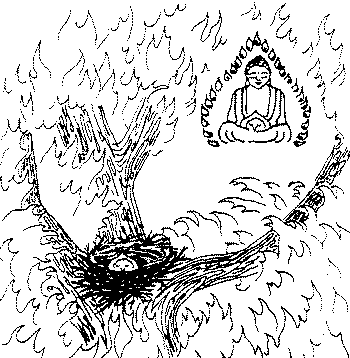
Once upon a time, the Enlightenment Being was born as a tiny quail. Although he had little feet and wings, he could not yet walk or fly. His parents worked hard bringing food to the nest, feeding him from their beaks.

In that part of the world, there were usually forest fires every year. So it happened that a fire began in that particular year. All the birds who were able, flew away at the first sign of smoke. As the fire spread, and got closer and closer to the nest of the baby quail, his parents remained with him. Finally the fire got so close, that they too had to fly away to save their lives.

All the trees, big and small, were burning and crackling with a loud noise. The little one saw that everything was being destroyed by the fire that raged out of control. He could do nothing to save himself. At that moment, his mind was overwhelmed by a feeling of helplessness.

Then it occurred to him, “My parents loved me very much. Unselfishly they built a nest for me, and then fed me without greed. When the fire came, they remained with me until the last moment. All the other birds who could, had flown away a long time before.

“So great was the loving-kindness of my parents, that they stayed and risked their lives, but still they were helpless to save me. Since they could not carry me, they were forced to fly away alone. I thank them, wherever they are, for loving me so. I hope with all my heart they will be safe and well and happy.

“Now I am all alone. There is no one I can go to for help. I have wings, but I cannot fly away. I have feet, but I cannot run away. But I can still think. All I have left to use is my mind – a mind that remains pure. The only beings I have known in my short life were my parents, and my mind has been filled with loving-kindness towards them. I have done nothing unwholesome to anyone. I am filled with new-born innocent truthfulness."

Then an amazing miracle took place. This innocent truthfulness grew and grew until it became larger than the little baby bird. The knowledge of truth spread beyond that one lifetime, and many previous births became known. One such previous birth had led to knowing a Buddha, a fully enlightened knower of Truth – one who had the power of Truth, the purity of wholesomeness, and the purpose of compassion.

Then the Great Being within the tiny baby quail thought, “May this very young innocent truthfulness be united with that ancient purity of wholesomeness and power of Truth. May all birds and other beings, who are still trapped by the fire, be saved. And may this spot be safe from fire for a million years!"

And so it was.

The moral is: Truth, wholesomeness and compassion can save the world.

35. The Baby Quail Who Could Not Fly Away

Link: https://hhdorjechangbuddhaiiiinfo.com/2022/09/13/35-the-baby-quail-who-could-not-fly-away-the-power-of-truth-wholesomeness-and-compassion/

INTERPRETER’S INTRODUCTION – BUDDHIST TALES FOR YOUNG AND OLD, VOLUME 1, STORIES 1-50

#Buddhisttalesforyoungandold #Buddhiststories #storiesforkids #moralstories #Buddha #Jatakastories #PansiyaPanasJataka
33. The Quail King and the Hunter [Unity]

33. The Quail King and the Hunter [Unity]

Buddhist Tales for Young and Old, volume 1, Prince Goodspeaker, Stories 1-50

Once upon a time, there was a Quail King who reigned over a flock of a thousand quails.

There was also a very clever quail hunter. He knew how to make a quail call. Because this sounded just like a real quail crying for help, it never failed to attract other quails. Then the hunter covered them with a net, stuffed them in baskets, and sold them to make a living.

Because he always put the safety of his flock first, Quail King was highly respected by all. While on the lookout for danger, one day he came across the hunter and saw what he did. He thought, “This quail hunter has a good plan for destroying our relatives. I must make a better plan to save us."

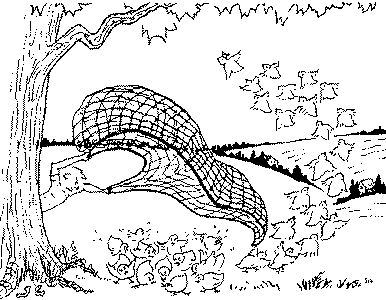
Then he called together his whole nation of a thousand quails. He also invited other quails to attend the meeting. He said, “Greetings to our quail nation and welcome to our visitors. We are faced with great danger. Many of our relatives are being trapped and sold by a clever hunter. Then they are being killed and eaten. I have come up with a plan to save us all. When the hunter covers us with his net, every single one of us must raise his neck at the same time. Then, all together, we should fly away with the net and drop it on a thorn bush. That will keep him busy, and we will be able to escape with our lives." All agreed to follow this smart strategy.

The next day the hunter lured the quails with his quail call as usual. But when he threw his net over them, they all raised up their necks at once, flew away with the net, and dropped it on a thorn bush. He could catch no quails at all! In addition, it took him the rest of the day to loosen his net from the thorns – so he had no time left to try again!

The same thing happened on the following day. So he spent a second day unhooking his net from sharp thorns. He arrived home only to be greeted by his wife’s sharp tongue! She complained, “You used to bring home quail to eat, and money from selling quails. Now you return empty-handed. What do you do all day? You must have another wife somewhere, who is feasting on quail meat at this very moment!"

The hunter replied, “Don’t think such a thing, my darling. These days the quails have become very unified. They act as one, and raise up their necks and carry my net to a thorn bush. But thanks to you, my one and only wife, I know just what to do! Just as you argue with me, one day they too will argue, as relatives usually do. While they are occupied in conflict and bickering, I will trap them and bring them back to you. Then you will be pleased with me again. Until then, I must be patient."

The hunter had to put up with his wife’s complaints for several more days. Then one morning after being lured by the quail call, it just so happened that one quail accidentally stepped on the head of another. He immediately got angry and squawked at her. She removed her foot from his head and said, “Please don’t be angry with me. Please excuse my mistake." But he would not listen. Soon both of them were squawking and squawking, and the conflict got worse and worse!

Hearing this bickering getting louder and louder, Quail King said, “There is no advantage in conflict. Continuing it will lead to danger!" But they just wouldn’t listen.

Then Quail King thought, “I’m afraid this silly conflict will keep them from cooperating to raise the net." So he commanded that all should escape. His own flock flew away at once.

And it was just in time too! Suddenly the quail hunter threw his net over the remaining quails. The two arguing quails said to each other, “I won’t hold the net for you." Hearing this, even some of the other quails said, “Why should I hold the net for anyone else?"

So the conflict spread like wildfire. The hunter grabbed all the quails, stuffed them in his baskets, and took them home to his wife. Of course she was overjoyed, and they invited all their friends over for a big quail feast.

The moral is: There is safety in unity, and danger in conflict.

The Quail King and the Hunter [Unity]

Link: https://hhdorjechangbuddhaiiiinfo.com/2022/08/30/the-quail-king-and-the-hunter-unity/

INTERPRETER’S INTRODUCTION – BUDDHIST TALES FOR YOUNG AND OLD, VOLUME 1, STORIES 1-50

#Buddhisttalesforyoungandold #Buddhiststories #storiesforkids #moralstories #Buddha #Jatakastories #PansiyaPanasJataka
31. The Heaven of 33 [Chapter 3. Merit]

31. The Heaven of 33 [Chapter 3. Merit]

Buddhist Tales for Young and Old, volume 1, Prince Goodspeaker, Stories 1-50

King Sakka returned victoriously to his palace in the Heaven of 33. Next to it stood the mansion of his first wife, the reborn Good-doer. Outside the mansion was the garden of his second wife, the reborn Beauty. And there was the heavenly pond of his third wife, the reborn Happy.

However, Well-born had died and been reborn as a slender crane in the forest. Since he missed her, Sakka found her and brought her up to the Heaven of 33 for a visit. He showed her the mansion and the garden and the pond of his three wives. He told her that, by doing good work, the other three had gained merit. This merit had brought them happiness, both in their previous lives and in their rebirths.

He said. “You, my dear crane, in your previous life as Well-born, did no such good work. So you did not gain either merit or happiness, and were reborn as a forest crane. I advise you to begin on the path of purity by following the Five Training Steps." After being taught the five steps, the lovely crane decided to follow them. Then she returned to the forest.

Not long afterwards, King Sakka was curious about how the crane was doing. So he took the shape of a fish and lay down in front of her. The crane picked him up by the head. She was just about to swallow the King of the Heaven of 33, when the fish wiggled his tail.

Immediately the crane thought, “This fish must be alive!" Remembering the first training step, she released the living fish back into the stream. Rising from the water, King Sakka returned to his godly form and said, “It is very good, my dear crane, that you are able to follow the Five Training Steps." Then he returned to the second heaven world.

In the fullness of time, the crane died. Following the Five Training Steps had brought her both merit and a peaceful mind. So she was reborn in the wonderful state of mankind, into a potter’s family in Benares, in northern India.

Again King Sakka was interested in finding out where the one who had been Well-born, and then the crane, was now reborn. He found her in the potter’s family, and wanted to help her in gaining merit and finding happiness.

So he disguised himself as an old man and created a cart full of golden cucumbers. He went into Benares and shouted, “Cucumbers! Cucumbers! I have cucumbers!"

When people came to buy these amazing cucumbers, he said, “These golden cucumbers are not for sale. I will give them away, but only to one who is wholesome, that is, one who follows the Five Training Steps."

The people said, “We never heard of the Five Training Steps. But we will buy your golden cucumbers. Name your price!" He repeated, “My cucumbers are not for sale. I have brought them to give to any person who practices the Five Training Steps." The people said, “This man has come here only to play tricks on us." So they left him alone.

Soon Well-born heard about this unusual man. Even though she had been reborn, she still had the habit of following the Five Training Steps. So she thought, “This man must have come to find me."

She went to him and asked for the golden cucumbers. He said, “Do you follow the Five Training Steps? Have you given up destroying life, taking what is not given, doing wrong in sexual ways, speaking falsely, and losing your mind from alcohol?" She answered, “Yes sir, I do follow these steps, and I am peaceful and happy."

Then the old man said, “I brought these cucumbers especially for you, to encourage you to gain more merit and future happiness." So he left the cart of golden cucumbers with her, and returned to the Heaven of 33.

Throughout the rest of her life, the woman was very generous with all this gold. Spreading her happiness to others, she gained merit. After she died, she was reborn as the daughter of the King of the Asuras. She grew up to be a goddess of great beauty. To the Asuras this seemed like a miracle, since the rest of them were the ugliest of all the gods.

The Asura king was pleased with his daughter’s goodness, as well as her famous beauty. He gathered all the Asuras together and gave her the freedom to choose a husband.

Sakka, King of the Heaven of 33, knew of the latest rebirth of the one who had been his wife Well-born, then a crane, and then a potter’s daughter. So he came down to the lower heaven world and took the shape of an ordinary ugly Asura. He thought, “If Well-born chooses a husband whose inner qualities of wholesomeness are the same as hers, we will be reunited at last!"

Because of her past associations with Magha the Good, reborn as King Sakka, now disguised as an ordinary Asura, the beautiful princess was drawn to him. So she picked him from among all the Asuras.

King Sakka took her to the Heaven of 33, made her his fourth wife, and they lived happily ever after.

The moral is: The Five Training Steps are the beginning of wholesomeness. Wholesomeness is the beginning of peace and happiness.

The Heaven of 33 [Chapter 3. Merit]

Link: https://hhdorjechangbuddhaiiiinfo.com/2022/08/16/the-heaven-of-33-chapter-3-merit/

31. The Heaven of 33 [Chapter 2. Compassion]

31.The Heaven of 33 [Chapter 2. Compassion]

Buddhist Tales for Young and Old, volume 1, Prince Goodspeaker, Stories 1-50

At that time, so very long ago, there were some unfortunate ugly gods called ‘Asuras’. They had taken to living in the second heaven world.

The one who had been Magha the Good in his previous life, was now Sakka, King of the Heaven of 33. He thought, “Why should we, who are the 33, live in our Heaven of 33 with these unfortunate ugly Asuras? Since this is our world, let us live happily by ourselves."

So he invited them to a party and got them drunk on very strong liquor. It seems that, in being reborn, King Sakka had forgotten some of his own teachings as Magha the Good. After getting the Asuras drunk, he got them to go to a lower world, just as big as the Heaven of 33.

When they sobered up and realized they had been tricked into going to a lower heaven world, the Asuras became angry. They rose up and made war against King Sakka. Soon they were victorious, and Sakka was forced to run away.

While retreating in his mighty war chariot, he came to the vast forest where the Garudas have their nests. These are gods who, unfortunately, have no super powers. Instead they are forced to get around by flapping huge heavy wings.

When King Sakka’s chariot drove through their forest, it upset their nests and made the baby Garudas fall down. They cried in fear and agony. Hearing this, Sakka asked his charioteer where these sad cries were coming from. He answered, “These are the shrieks of terror coming from the baby Garudas, whose nests and trees are being destroyed by your powerful war chariot."

Hearing this suffering, King Sakka realized that all lives, including his own, are only temporary. Hearing this suffering, the compassion of the Great Being, which passes from life to life, arose within him and said, “Let the little ones have no more fear. The first training step must not be broken. There can be no exception. I will not destroy even one life for the sake of a heavenly kingdom that must some day end. Instead I will offer my life to the victorious Asuras. Turn back the chariot!"

So the chariot returned in the direction of the Heaven of 33. The Asuras saw King Sakka turn around, and thought he must have reinforcements from other worlds. So they ran, without looking back, down to their lower heaven world.

31.The Heaven of 33 [Chapter 2. Compassion]

Link: https://hhdorjechangbuddhaiiiinfo.com/2022/07/26/the-heaven-of-33-chapter-2-compassion/

INTERPRETER’S INTRODUCTION – BUDDHIST TALES FOR YOUNG AND OLD, VOLUME 1, STORIES 1-50

#Buddhisttalesforyoungandold #Buddhiststories #storiesforkids #moralstories #Buddha #Jatakastories #PansiyaPanasJataka
31. The Heaven of 33 [Chapter 1. Co-operation]

Buddhist Tales for Young and Old, volume 1, Prince Goodspeaker, Stories 1-50

31. The Heaven of 33 [Chapter 1. Co-operation]

Once upon a time, when King Magadha was ruling in the land, there was a young noble called, ‘Magha the Good’. He lived in a remote village of just 30 families. When he was young, his parents married him to a girl who had qualities of character similar to his own. They were very happy together, and she gave birth to several children.

The villagers came to respect Magha the Good because he always tried to help improve the village, for the good of all. Because they respected him, he was able to teach the five steps of training, to purify their thoughts, words and deeds.

Magha’s way of teaching was by doing. An example of this happened one day when the villagers gathered to do handicraft work. Magha the Good cleaned a place for himself to sit. Before he could sit down though, someone else sat there. So he patiently cleaned another place. Again a neighbor sat in his place. This happened over and over again, until he had patiently cleaned sitting places for all those present. Only then could he himself sit in the last place.

By using such examples of patience, Magha the Good taught his fellow villagers how to cooperate with each other, without quarrelling. Working together in this way, they constructed several buildings and made other improvements that benefitted the whole village.

Seeing the worthwhile results of patience and cooperation, based on following the gentle ways of the Five Training Steps, all in the village became calmer and more peaceful. A natural side effect was that former crimes and wrongdoing completely disappeared!

You would think this would make everybody happier. However, there was one man who did not like the new situation at all. He was the head of the village, the politician who cared only about his own position.

Formerly, when there were murders and thefts, he handed out punishments. This increased his position of authority, and caused the villagers to fear him. When husbands or wives had affairs with others, the head man collected fines. In the same way, when reputations were damaged by lies, or contracts were not lived up to, he also collected fines. He even got tax money from the profits of selling strong liquor. He did not mind that drunkenness led to many of the crimes.

It is easy to see why the head man was upset to lose so much respect and power and money, due to the people living peacefully together. So he went to the king and said, “My lord, some of the remote villages are being robbed and looted by bandits. We need your help."

The king said, “Bring all these criminals to me."

The dishonest politician rounded up the heads of all 30 families and brought them as prisoners to the king. Without questioning them, the king ordered that they all be trampled to death by elephants.

All 30 were ordered to lie down in the palace courtyard and the elephants were brought in. They realized they were about to be trampled to death. Magha the Good said to them, “Remember and concentrate on the peacefulness and purity that come from following the Five Training Steps, so you may feel loving-kindness towards all. In this way, do not get angry at the unjust king, the lying head man, or the unfortunate elephants."

The first elephant was brought in by his mahout. But when he tried to force him to trample the innocent villagers, the elephant refused. He trumpeted as he went away. Amazingly, this was repeated with each of the king’s elephants. None would step on them.

The mahouts complained to the king that this was not their fault. “It must be," they said, “that these men have some drug that is confusing the elephants."

The king had the villagers searched, but they found nothing. Then his advisers said, “These men must be magicians who have cast an evil spell on your mighty elephants!"

The villagers were asked, “Do you have such a spell?" Magha the Good said, “Yes we do." This made the king very curious. So he himself asked Magha, “What is this spell and how does it work?"

Magha the Good replied, “My lord king, we do not cast the same kinds of spells that others cast. We cast the spell of loving-kindness with minds made pure by following the Five Training Steps."

“What are these Five Training Steps?" asked the king. Magha the Good said, “All of us have given up the five unwholesome actions, which are: destroying life, taking what is not given, doing wrong in sexual ways, speaking falsely, and losing one’s mind from alcohol."

“In this way we have become harmless, so that we can give the gift of fearlessness to all. Therefore, the elephants lost their fear of the mahouts, and did not wish to harm us. They departed, trumpeting triumphantly. This was our protection, which you have called a ‘spell’."

Finally seeing the wholesomeness and wisdom of these people, the king questioned them and learned the truth. He decided to confiscate all the property of the dishonest village head man and divide it among them.

The villagers were then free to do even more good works for the benefit of the whole village. Soon they began to build a big roadside inn, right next to the highway crossroads.

This was the biggest project they had yet undertaken. The men were confident because they had learned so well how to cooperate with each other for a common goal. But they had not yet learned how to cooperate in this work with the women of the village. They seemed to think it was ‘man’s work’.

By this time Magha the Good had four wives. Their names were Good-doer, Beauty, Happy and Well-born. Of these, the first wife, Good-doer, was the wisest. She wanted to pave the way for the women to benefit from cooperating in doing good work. So she gradually became friendly with the boss in charge of the roadside inn project.

Because she wanted to contribute by helping in a big way, she gave a present to the boss. She asked him, “Can you think of a way that I may become the most important contributor to this good work?"

The boss replied, “I know just such a way!" Then he secretly constructed the most important part of the building, the roof beam that would hold the roof together. He wrapped it up and hid it with Good-doer, so it could dry for the time necessary to become rigid and strong.

Meanwhile, the men of the village continued happily in the building project. At last they got to the point of installing the roof beam. They began to make one, but the boss interrupted them. He said, “My friends, we cannot use fresh green wood to make the roof beam. It will bend and sag. We must have an aged dry roof beam. Go find one!"

When they searched in the village, they found that Good-doer just happened to have a perfect roof beam. It was even the right size! When they asked if they could buy it from her, she said, “It is not for sale at any price. I wish to contribute the roof beam for free, but only if you let me participate in building the inn."

The men were afraid to change their successful ways. So they said, “Women have never been part of this project. This is impossible."

Then they returned to the construction boss and told him what had happened. He said, “Why do you keep the women away? Women are part of everything in this world. Let us be generous and share the harmony and wholesomeness of this work with the women. Then the project and our village will be even more successful."

So they accepted the roof beam from Good-doer, and she helped to finish the building of the inn. Then Beauty had a wonderful garden built next to the inn, which she donated. It had all kinds of flowers and fruit trees. So, too, Happy had a lovely pond dug, and planted beautiful lotuses in it. But Well-born, being the youngest and a little spoiled, did nothing for the inn.

In the evenings, Magha the Good held meetings in the roadside inn. He taught the people to assist their parents and elders, and to give up harsh words, accusing others behind their backs, and being stingy.

It is said that the lowest heaven world contains the gods of the four directions, North, East, South and West. Because he followed his own teachings, Magha the Good died with happiness in his heart. He was reborn as Sakka, king of the second lowest heaven world.

In time, the heads of all the other families of the village, as well as Good-doer, Beauty and Happy, also died. They were reborn as gods under King Sakka. This was known as the “Heaven of 33″.

The Heaven of 33 [Chapter 1. Co-operation]

Link: https://hhdorjechangbuddhaiiiinfo.com/2022/07/05/the-heaven-of-33-chapter-1-co-operation/

INTERPRETER’S INTRODUCTION – BUDDHIST TALES FOR YOUNG AND OLD, VOLUME 1, STORIES 1-50

#Buddhisttalesforyoungandold #Buddhiststories #storiesforkids #moralstories #Buddha #Jatakastories #PansiyaPanasJataka