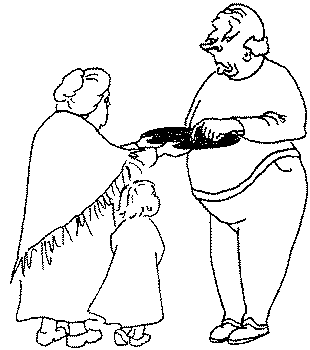
12. King Banyan Deer [Chapter 1. Compassion]

12. King Banyan Deer [Chapter 1. Compassion]

Buddhist Tales for Young and Old, volume 1, Prince Goodspeaker, Stories 1-50
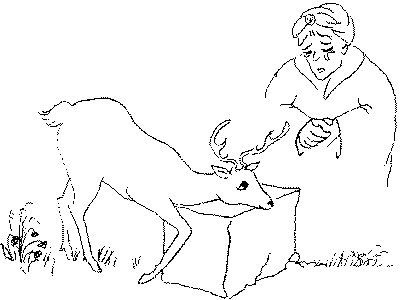
Once upon a time, an unusual and beautiful deer was born in the forests near Benares, in northern India. Although he was as big as a young colt, it was easy for his mother to give birth to him. When he opened his eyes, they were as bright as sparkling jewels. His mouth was as red as the reddest forest berries. His hoofs were as black as polished coal. His little horns glistened like silver. And his color was golden, like a perfect summer’s dawn. As he grew up, a herd of 500 deer gathered around him, and he became known as King Banyan Deer.

Meanwhile, not far away, another beautiful buck deer was born, just as splendidly golden in color. In time, a separate herd of 500 deer came to follow him, and he was known as Branch Deer.

The King of Benares, at that time, was very fond of eating venison. So he regularly hunted and killed deer. Each time he hunted, he went to a different village and ordered the people to serve him. They had to stop what they were doing, whether plowing or harvesting or whatever, and work in the king’s hunting party.

The people’s lives were upset by these interruptions. They grew fewer crops, and other businesses also had less income. So they came together and decided to build a large deer park for the king, at Benares. There he could hunt by himself, with no need to command the services of the villagers.

So the people built a deer park. They made ponds where the deer could drink, and added trees and grasses for them to eat from. When it was ready, they opened the gate and went out into the nearby forests. They surrounded the entire herds of Banyan and Branch deer. Then, with sticks and weapons and noise makers, they drove them all into the deer park trap, and locked the gate behind them.

After the deer had settled down, the people went to the king and said, “Our crops and income have suffered because of your hunting requirements. Now we have made you a pleasant safe deer park, where you can hunt by yourself as you like. With no need of our aid, you can enjoy both the hunting and the eating of deer."

The king went to the new deer park. There he was pleased to see the vast herds. While watching them, his eye was caught by the two magnificent golden deer, with large fully grown antlers. Because he admired their unusual beauty, the king granted immunity to these two alone. He ordered that they should be completely safe. No one could harm or kill them.

Once a day the king would come and kill a deer for his dinner table. Sometimes, when he was too busy, the royal cook would do this. The body would then be brought to the chopping block to be butchered for the oven.

Whenever the deer saw the bow and arrows, they went into a panic, trembling for their lives. They ran around wildly, some being injured and some wounded, many suffering great pain.

One day, King Banyan Deer’s herd gathered around him. He called Branch Deer, and the two herds joined for a meeting. King Banyan Deer addressed them. “Although in the end, there is no escape from death, this needless suffering due to injuries and wounds can be prevented. Since the king only wishes the meat of one deer per day, let one be chosen by us each day to submit himself to the chopping block. One day from my herd, and the next day from Branch Deer’s herd, the victim’s lot will fall to one deer at a time."

Branch Deer agreed. From then on, the one whose turn it was, meekly surrendered himself and laid his neck on the block. The cook came each day, simply killed the waiting victim, and prepared the king’s venison.

One day, the turn fell by chance to a pregnant doe in Branch Deer’s herd. Caring for the others as well as herself and the unborn one, she went to Branch Deer and said, “My lord, I am pregnant. Grant that I may live until I have delivered my fawn. Then we will fill two turns rather than just one. This will save a turn, and thereby a single life for one long day."

Branch Deer replied, “No, no, I cannot change the rules in midstream and put your turn upon another. The pregnancy is yours, the babe is your responsibility. Now leave me."

Having failed with Branch Deer, the poor mother doe went to King Banyan Deer and explained her plight. He replied gently, “Go in peace. I will change the rules in midstream and put your turn upon another."

And the deer king went to the executioner’s block, and laid down his own golden neck upon it.

A silence fell in the deer park. And some who tell this story even say that silence also fell in other worlds not seen from here.

Soon the royal cook came to kill the willing victim on the block. But when he saw it was one of the two golden deer the king had ordered spared, he was afraid to kill him. So he went and told the King of Benares.

The king was surprised, so he went to the park. He said to the golden deer, still lying on the block, “Oh king of deer, did I not promise to spare your life? What is the reason you come here like the others?"

King Banyan Deer replied, “Oh king of men, this time a pregnant doe was unlucky enough to be the one to die. She pleaded for me to spare her, for the sake of others as well as her unborn baby and herself. I could not help but feel myself in her place, and feel her suffering. I could not help but weep, to think the little one would never see the dawn, would never taste the dew. And yet, I could not force the pain of death on another, relieved to think it was not his turn today. So, mighty king, I offer my life for the sake of the doe and her unborn fawn. Be assured there is no other reason."

The King of Benares was overwhelmed. Powerful as he was, a tear rolled down his cheek. Then he said, “Oh great lord, the golden king of deer, even among human beings, I have not seen any such as you! Such great compassion, to share in the suffering of others! Such great generosity, to give your life for others! Such great kindness and tender love for all your fellow deer! Arise."

“I decree that you will never be killed by me or anyone else in my kingdom. And, so too, the doe and her babe."

Without yet raising his head, the golden one said, “Are only we to be saved? What of the other deer in the park, our friends and kin?" The king said, “My lord, I cannot refuse you, I grant safety and freedom to all the deer in the park." “And what of the deer outside the park, will they be killed?" asked Banyan. “No my lord, I spare all the deer in my whole kingdom."

Still the golden deer did not raise up his head. He pleaded, “So the deer will be safe, but what will the other four-footed animals do?" “My lord, from now on they too are safe in my land." “And what of the birds? They too want to live." “Yes, my lord, the birds too will be safe from death at the hands of men." “And what of the fish, who live in the water?" “Even the fish will be free to live, my lord." So saying, the King of Benares granted immunity from hunting and killing to all the animals in his land.

Having pleaded for the lives of all creatures, the Great Being arose.

12. King Banyan Deer [Chapter 1. Compassion]

Link: https://hhdorjechangbuddhaiiiinfo.com/2022/01/03/12-king-banyan-deer-chapter-1-compassion/

INTERPRETER’S INTRODUCTION – BUDDHIST TALES FOR YOUNG AND OLD, VOLUME 1, STORIES 1-50

#Buddhisttalesforyoungandold #Buddhiststories #storiesforkids #moralstories #Buddha #Jatakastories #PansiyaPanasJataka
11. Beauty and Grey [A Wise Leader]

11. Beauty and Grey [A Wise Leader]

Buddhist Tales for Young and Old, volume 1, Prince Goodspeaker, Stories 1-50

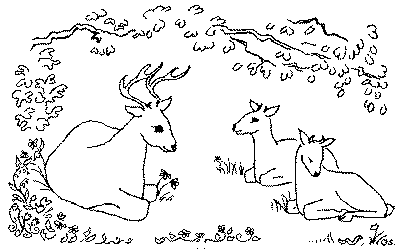
Once upon a time, there was a deer who was the leader of a herd of a thousand. He had two sons. One was very slim and tall, with bright alert eyes, and smooth reddish fur. He was called Beauty. The other was Grey in color, also slim and tall, and was called Grey.

One day, after they were fully grown, their father called Beauty and Grey to him. He said, “I am now very old, so I cannot do all that is necessary to look after this big herd of deer. I want you, my two grown-up children, to be the leaders, while I retire from looking after them all the time. We will divide the herd, and each of you will lead 500 deer." So it was done.

In India, when the harvest time comes, the deer are always in danger. The rice is at its tallest, and the deer cannot help but go into the paddies and eat it. To avoid the destruction of their crops, the human beings dig pits, set sharp stakes in the ground, and build stone traps — all to capture and kill the deer.

Knowing this was the season, the wise old deer called the two new leaders to him. He advised them to take the herds up into the mountain forest, far from the dangerous farm lands. This was how he had always saved the deer from being wounded or killed. Then he would bring them back to the low lands after the harvest was over.

Since he was too old and weak for the trip, he would remain behind in hiding. He warned them to be careful and have a safe journey. Beauty set out with his herd for the mountain forest, and so did Grey with his.

The villagers all along the way knew that this was the time the deer moved from the low lying farm lands to the high countryside. So they hid along the way and killed the deer as they passed by.

Grey did not pay attention to his father’s wise advice. Instead of being careful and traveling safely, he was in a hurry to get to the lush mountain forest. So he moved his herd constantly, during the night, at dawn and dusk, and even in broad daylight. This made it easy for the people to shoot the deer in Grey’s herd with bows and arrows. Many were killed, and many were wounded, only to die in pain later on. Grey reached the forest with only a few deer remaining alive.

The tall sleek red-furred Beauty was wise enough to understand the danger to his moving herd. So he was very careful. He knew it was safer to stay away from the villages, and from all humans. He knew it was not safe in the daytime, or even at dawn or dusk. So he led his herd wide around the villages, and moved only in the middle of the night. Beauty’s herd arrived in the mountain forest safe and sound, with no one killed or injured.

The two herds found each other, and remained in the mountains until well after the harvest season was over. Then they began the return to the farmland country.

Grey had learned nothing from the first trip. As it was getting cold in the mountains, he was in a hurry to get to the warmer low lands. So he was just as careless as before. Again the people hid along the way and attacked and killed the deer. All Grey’s herd were killed, later to be eaten or sold by the villagers. Grey himself was the only one who survived the journey.

Beauty led his herd in the same careful way as before. He brought back all 500 deer, completely safe. While the deer were still in the distance, the old chief said to his doe, “Look at the deer coming back to us. Beauty has all his followers with him. Grey comes limping back alone, without his whole herd of 500. Those who follow a wise leader, with good qualities, will always be safe. Those who follow a foolish leader, who is careless and thinks only of himself, will fall into troubles and be destroyed."

After some time, the old deer died and was reborn as he deserved. Beauty became chief of the herd and lived a long life, loved and admired by all.

The moral is: A wise leader puts the safety of his followers first.

11. Beauty and Grey [A Wise Leader]

Link:https://hhdorjechangbuddhaiiiinfo.com/2021/12/25/11-beauty-and-grey-a-wise-leader/

INTERPRETER’S INTRODUCTION – BUDDHIST TALES FOR YOUNG AND OLD, VOLUME 1, STORIES 1-50

#Buddhisttalesforyoungandold #Buddhiststories #storiesforkids #moralstories #Buddha #Jatakastories #PansiyaPanasJataka

5. The Price Maker [Foolishness]

Story 5

5. The Price Maker [Foolishness]

Buddhist Tales for Young and Old, volume 1, Prince Goodspeaker, Stories 1-50

5. The Price Maker [Foolishness]

Long ago and far away, there was a king who ruled in Benares, in northern India. One of his ministers was called the Royal Price Maker, and he was a very honest man. His job was to set a fair price for anything the king wanted to buy or sell.

On some occasions, the king did not like his price making. He did not get as big a profit as he wanted. He did not want to pay so much when he bought, or sell for what he thought was not enough. So he decided to change the price maker.

One day he saw a nice looking young man and he thought, “This fellow will be good for my price making position." So he dismissed his former honest price maker, and appointed this man to be the new one. The man thought, “I must make the king happy by buying at very low prices and selling at very high prices." So he made the prices ridiculous, without caring at all what anything was worth. This gained the greedy king a lot of money, and made him very happy. Meanwhile, all the others who dealt with the new price maker, including the king’s other ministers and ordinary people, became very unhappy.

Then one day a horse merchant arrived in Benares with 500 horses to sell. There were stallions, mares and colts. The king invited the merchant to the palace, and called upon his Royal Price Maker to set a price for all 500 horses. Thinking only of pleasing the king, he said, “The entire herd of horses is worth one cup of rice." So the king ordered that one cup of rice be paid to the horse dealer, and all the horses were taken to the royal stables.

Of course the merchant was very upset, but he could do nothing at the moment. Later he heard about the former price maker, who had a reputation for being very fair and honest. So he approached him and told him what had happened. He wanted to hear his opinion, in order to get a proper price from the king. The former price maker said, “If you do as I say, the king will be convinced of the true value of the horses. Go back to the price maker and satisfy him with a valuable gift. Ask him to tell the value of one cup of rice, in the presence of the king. If he agrees, come and tell me. I will go with you to the king."

Following this advice, the merchant went to the price maker and gave him a valuable gift. The gift made him very happy, so that he saw the value of pleasing the horse dealer. Then the merchant said to him, “I was very happy with your previous evaluation. Can you please convince the king of the value of one cup of rice?" The foolish price maker said, ‘Why not? I will explain the worth of one cup of rice, even in the presence of the king."

So the price maker thought the horse dealer was satisfied with his cup of rice. He arranged for another meeting with the king, as the merchant was departing for his own country. The merchant reported back to the old price maker, and they went together to see the king.

All the king’s ministers and his full court were in the royal meeting hall. The horse merchant said to the king, “My lord, I understand that in this your country, my whole herd of 500 horses is worth one cup of rice. Before I leave for home, I want to know the value of one cup of rice in your country." The king turned to his loyal price maker and said, “What is the value of one cup of rice?"

The foolish price maker, in order to please the king, had previously priced the herd of horses at one cup of rice. Now, after receiving a bribe from the horse dealer, he wanted to please him too. So he replied to the king, in his most dignified manner, “Your worship, one cup of rice is worth the city of Benares, including even your own harem, as well as all the suburbs of the city. In other words, it is worth the whole kingdom of Benares!"

On hearing this, the royal ministers and wise men in the assembly hall started to roar with laughter, slapping their sides with their hands. When they calmed down a little, they said, “Earlier we heard that the kingdom was priceless. Now we hear that all Benares, with its palaces and mansions, is worth only a cup of rice! The decision of the Royal Price Maker is so strange! Where did your highness find such a man? He is good only for pleasing a king such as you, not for making fair prices for a merchant who sells his horses from country to country."

Hearing the laughter of his whole court, and the words of his ministers and advisers, the king was ashamed. So he brought back his former price maker to his official position. He agreed to a new fair price for the herd of horses, as set by the honest price maker. Having learned a lesson, the king and his kingdom lived justly and prospered.

The moral is: A fool in high office can bring shame even to a king.

5. The Price Maker [Foolishness]

Link: https://hhdorjechangbuddhaiiiinfo.com/2021/10/17/5-the-price-maker-foolishness/

INTERPRETER’S INTRODUCTION – BUDDHIST TALES FOR YOUNG AND OLD, VOLUME 1, STORIES 1-50

#Buddhisttalesforyoungandold #Buddhiststories #storiesforkids #moralstories #Buddha #Jatakastories #PansiyaPanasJataka #foolishness #Banares #India

3. The Golden Plate

Story 3

The Golden Plate

 [Greed and Honesty]

Buddhist Tales for Young and Old, volume 1, Prince Goodspeaker, Stories 1-50

Once upon a time in a place called Seri, there were two salesmen of pots and pans and handmade trinkets. They agreed to divide the town between them. They also said that after one had gone through his area, it was all right for the other to try and sell where the first had already been.

One day, while one of them was coming down a street, a poor little girl saw him and asked her grandmother to buy her a bracelet. The old grandmother replied, “How can we poor people buy bracelets?" The little girl said, “Since we don’t have any money, we can give our black sooty old plate." The old woman agreed to give it a try, so she invited the dealer inside.

The salesman saw that these people were very poor and innocent, so he didn’t want to waste his time with them. Even though the old woman pleaded with him, he said he had no bracelet that she could afford to buy. Then she asked, “We have an old plate that is useless to us, can we trade it for a bracelet?" The man took it and, while examining it, happened to scratch the bottom of it. To his surprise, he saw that underneath the black soot, it was a golden plate! But he didn’t let on that he had noticed it. Instead he decided to deceive these poor people so he could get the plate for next to nothing. He said, “This is not worth even one bracelet. There’s no value in this. I don’t want it!" He left, thinking he would return later when they would accept even less for the plate.

Meanwhile the other salesman, after finishing in his part of town, followed after the first as they had agreed. He ended up at the same house. Again the poor little girl begged her grandmother to trade the old plate for a bracelet. The woman saw that this was a nice tender looking merchant and thought, “He’s a good man, not like the rough-talking first salesman." So she invited him in and offered to trade the same black sooty old plate for one bracelet. When he examined it, he too saw that it was pure gold under the grime. He said to the old woman, “All my goods and all my money together are not worth as much as this rich golden plate!"

Of course the woman was shocked at this discovery, but now she knew that he was indeed a good and honest fellow. So she said she would be glad to accept whatever he could trade for it. The salesman said, “I’ll give you all my pots and pans and trinkets, plus all my money, if you will let me keep just eight coins and my balancing scale, with its cover to put the golden plate in." They made the trade. He went down to the river, where he paid the eight coins to the ferry man to take him across.

By then the greedy salesman had returned, already adding up huge imaginary profits in his head. When he met the little girl and her grandmother again, he said he had changed his mind and was willing to offer a few cents, but not one of his bracelets, for the useless black sooty old plate. The old woman then calmly told him of the trade she had just made with the honest salesman, and said, “Sir, you lied to us."

The greedy salesman was not ashamed of his lies, but he was saddened as he thought, “I’ve lost the golden plate that must be worth a hundred thousand." So he asked the woman, “Which way did he go?" She told him the direction. He left all his things right there at her door and ran down to the river, thinking, “He robbed me! He robbed me! He won’t make a fool out of me!"

From the riverside he saw the honest salesman still crossing over on the ferry boat. He shouted to the ferry man, “Come back!" But the good merchant told him to keep on going to the other side, and that’s what he did.

Seeing that he could do nothing, the greedy salesman exploded with rage. He jumped up and down, beating his chest. He became so filled with hatred towards the honest man, who had won the golden plate, that he made himself cough up blood. He had a heart attack and died on the spot!

The moral is: “Honesty is the best policy."

The Golden Plate  [Greed and Honesty]

Link: https://hhdorjechangbuddhaiiiinfo.com/2021/10/01/3-the-golden-plate/

INTERPRETER’S INTRODUCTION – BUDDHIST TALES FOR YOUNG AND OLD, VOLUME 1, STORIES 1-50

#Buddhisttalesforyoungandold #Buddhiststories #storiesforkids #moralstories #Buddha #Jatakastories #PansiyaPanasJataka #greedandhonesty

1. Demons in the Desert [The Correct Way of Thinking]

Story 1

Demons in the Desert 

[The Correct Way of Thinking]

Buddhist Tales for Young and Old, volume 1, Prince Goodspeaker, Stories 1-50

Once upon a time there were two merchants, who were friends. Both of them were getting ready for business trips to sell their merchandise, so they had to decide whether to travel together. They agreed that, since each had about 500 carts, and that they were both going to the same place along the same road, it would be too crowded to go at the same time.

One decided that it would be much better to go first. He thought, “The road will not be rutted by the carts, the bullocks will be able to choose the best of all the grass, we will find the best fruits and vegetables to eat, my people will appreciate my leadership and, in the end, I will be able to bargain for the best prices."

The other merchant considered carefully and realized there were advantages to going second. He thought, “My friend’s carts will level the ground so we won’t have to do any road work, his bullocks will eat the old rough grass and new tender shoots will spring up for mine to eat. In the same way, they will pick the old fruits and vegetables and fresh ones will grow for us to enjoy. I won’t have to waste my time bargaining when I can take the price already set and make my profit." So he agreed to let his friend go first. This friend was sure he’d fooled him and gotten the best of him – so he set out first on the journey.

The merchant who went first had a troublesome time of it. They came to a wilderness called the ‘Waterless Desert’, which the local people said was haunted by demons. When the caravan reached the middle of it, they met a large group coming from the opposite direction. They had carts that were mud smeared and dripping with water. They had lotuses and water lilies in their hands and in the carts. The head man, who had a know-it-all attitude, said to the merchant, “Why are you carrying these heavy loads of water? In a short time you will reach that oasis on the horizon with plenty of water to drink and dates to eat. Your bullocks are tired from pulling those heavy carts filled with extra water – so throw away the water and be kind to your overworked animals!"

Even though the local people had warned them, the merchant did not realize that these were not real people, but demons in disguise. They were even in danger of being eaten by them. Being confident that they were helpful people, he followed their advice and had all his water emptied onto the ground.

As they continued on their way they found no oasis or any water at all. Some realized they’d been fooled by beings that might have been demons, and started to grumble and accuse the merchant. At the end of the day, all the people were tired out. The bullocks were too weak from lack of water to pull their heavy carts. All the people and animals lay down in a haphazard manner and fell into a deep sleep. Lo and behold, during the night the demons came in their true frightening forms and gobbled up all the weak defenseless beings. When they were done there were only bones lying scattered around — not one human or animal was left alive.

After several months, the second merchant began his journey along the same way. When he arrived at the wilderness, he assembled all his people and advised them — “This is called the ‘Waterless Desert’ and I have heard that it is haunted by demons and ghosts. Therefore we should be careful. Since there may be poison plants and foul water, don’t drink any local water without asking me." In this way they started into the desert.

After getting about halfway through, in the same way as with the first caravan, they were met by the water soaked demons in disguise. They told them the oasis was near and they should throw away their water. But the wise merchant saw through them right away. He knew it didn’t make sense to have an oasis in a place called ‘Waterless Desert’. And besides, these people had bulging red eyes and an aggressive and pushy attitude, so he suspected they might be demons. He told them to leave them alone saying, “We are business men who don’t throw away good water before we know where the next is coming from."

Then seeing that his own people had doubts, the merchant said to them, “Don’t believe these people, who may be demons, until we actually find water. The oasis they point to may be just an illusion or a mirage. Have you ever heard of water in this ‘Waterless Desert’? Do you feel any rain-wind or see any storm clouds?" They all said, “No", and he continued, “If we believe these strangers and throw away our water, then later we may not have any to drink or cook with – then we will be weak and thirsty and it would be easy for demons to come and rob us, or even eat us up! Therefore, until we really find water, do not waste even a drop!"

The caravan continued on its way. That evening it reached the place where the first caravan’s people and bullocks had been killed and eaten by the demons. They found the carts and human and animal bones lying all around. They recognized that the fully loaded carts and the scattered bones belonged to the former caravan. The wise merchant told certain people to stand watch around the camp during the night.

The next morning the people ate breakfast, and fed their bullocks well. They added to their goods the most valuable things left from the first caravan. So they finished their journey very successfully, and returned home safely so that they and their families could enjoy their profits.

The moral is: One must always be wise enough not to be fooled by tricky talk and false appearances.

1. Demons in the Desert [The Correct Way of Thinking]

Link: https://hhdorjechangbuddhaiiiinfo.com/2021/09/12/1-demons-in-the-desert-the-correct-way-of-thinking/

INTERPRETER’S INTRODUCTION – BUDDHIST TALES FOR YOUNG AND OLD, VOLUME 1, STORIES 1-5

#Buddhisttalesforyoungandold #Buddhiststories #storiesforkids #moralstories #Buddha #Jatakastories #PansiyaPanasJataka #thecorrectwayofthinking

From the Storyteller to the Listeners

from the storyteller to the listeners

Buddhist Tales for Young and Old, volume 1, Prince Goodspeaker, Stories 1-50

When you read or listen to these very old stories, if you wonder how much is really true, the Buddha gave some advice that might help. He said that when you listen to what a monk says you should test the meaning, weigh or consider it, and depend on your own insights to know the truth of it. Then follow and practice what you know to be true.

Let us praise

the Exalted, Worthy, Fully Self-Enlightened One

 and follow the Truth.

from the storyteller to the listeners

Link:https://hhdorjechangbuddhaiiiinfo.com/2021/09/12/from-the-storyteller-to-the-listeners/

#Buddhisttalesforyoungandold #Buddhiststories #storiesforkids #moralstories #Buddha #Jatakastories #PansiyaPanasJataka

Interpreter’s Introduction – Buddhist Tales for Young and Old, volume 1, Stories 1-50

Interpreter’s Introduction

Buddhist Tales for Young and Old, volume 1, Stories 1-50

PRINCE GOODSPEAKER

This image has an empty alt attribute; its file name is picture17.jpg

It is a pleasure to rewrite the Jataka stories in modern English understandable by western readers. To achieve this goal, the stories are being retold in order to convey the spirit and meaning. They are not scholarly word-for-word translations as have been done by others. The Pali Text Society published the whole text in English translation a hundred years ago. In Sri Lanka they were translated into Sinhalese in the 14th century, where they were known as Pansiya Panas Jataka.

In all Buddhist countries the Jataka tales were the major sources for developing the character of the people. They were used widely in preaching by monks and lay preachers. King Dutugemunu (2nd century B.C.), in Anuradhapura, paid for the support of preachers to teach Dharma, the teachings of the Buddha. They usually used these stories in their sermons. Even the Venerable Arahant Maha Mahinda, who introduced Dharma into Sri Lanka, used these stories to illustrate the truth of the teachings. Some were even used by the Lord Buddha in his teachings, and from him his followers learned them and passed them into popular use in society. Even earlier, the same types of stories were present in Vedic literature.

Greek myths, as well as the fables of Aesop, inherited them from the Vedas and Buddhism; Persia also took them from India. They later migrated into the stories of Chaucer in England and Boccaccio in Italy. The stories were used for a variety of purposes. In Sanskrit, the Pancatantra used them to teach Law and Economics, and the Katha Sarit Sagara used them for the development of knowledge, as well as just for enjoyment. In the past, people have been satisfied and fulfilled in many ways by hearing them in forms ranging from lessons to fairy tales.

By reading these stories, children and adults can develop their knowledge and learn how to face the difficult experiences of modern life. They can easily develop human values and good qualities like patience, forbearance, tolerance and the four sublime states of mind – loving-kindness, compassion, sympathetic joy and equanimity. The major purpose of these stories is to develop the moral and ethical values of the readers. Without them, people cannot be peaceful and happy in their hearts and minds. And the reader will find that these values are very different from those of the wider, violently acquisitive, ego-based society.

In this interpretation, changes are being made to the style of the old Jataka stories, and explanations are added, as is appropriate for children in the modern world. The lovely artwork is also sometimes in a modern setting, to attract young and old to the truths contained in the tales.

The sources used have been as follows:

1. Jataka Pali (Colombo: Buddha Jayanti Tripitaka Series Publication Board, 1983) – original Pali stanzas.
2. Jataka Pali (Colombo: Simon Hewavitarane Bequest, 1926) – original Pali Jataka stories in Sinhalese characters.
3. Sinhala Jataka Pot Vahanse (Colombo: Jinalankara Press, 1928) – Sinhalese translation of Pali Jataka stories.
4. Sinhala Jalaka Pot Vahanse (Colombo: Ratnakara Bookshop, 1961) – Sinhalese translation of Pali Jataka stories.
5. Jataka Pota, ed. Lionel Lokuliyana (Colombo: M. D. Gunasena & Co., 1960) – Sinhalese translation of first fifty Pali Jataka stories.
6. The Jataka or Stories of the Buddha’s Former Lives, ed. E. B. Cowell (London: Pali Text Society, 1981), 6 vols., index
English translation of Pali Jataka stories.
7. Pansiyapanas Jataka Pot Vahanse (Bandaragama: H. W. N. Prematilaka, 1987) – Sinhalese summaries of Pali Jataka stories.

In addition, “From the Storyteller to the Listeners" (below), contains a paraphrase taken from “Discourse With Canki," Middle Length Sayings (Majjhima-Nikaya), trans. I. B. Horner (London: Pali Text Society, 1975), 11, 95, pp. 362-3. The title of the fourth story, “The Mouse Merchant", was originally in Somadeva, The Ocean of Story (Katha Sarit Sagara), trans. C. H. Tawney (London: C. J. Sawyer, 1924).

The sequence numbers used for the stories are in the same order as in the Jataka Pali and The Jataka or Stories of the Buddha’s Former Lives (above). Multiple sequence numbers indicate that identical, similar or partial stories are told in one version. The most complex example is “The Curse of Mittavinda" which requires explanation. Here the Losaka (41), the three Mittavinda (82, 104, 369) and the Catu-Dvara (439) Jatakas are combined. This is because the stanzas of 82, 104 and 369 all refer directly to the palaces described in 41 and 439, as well as to the wheel of torture described in 439. The latter retells the four palaces portion of 41, and then leads directly into the wheel of torture (Ussada hell) portion. To allow continuity, the ending of the wheel of torture portion is taken from 369, since in it Mittavinda does not die.

Since the stories include legends which are not actually canonical, the character traditionally said to be the Bodhisatta (the Buddha in a past life) is not necessarily identified in each rewritten story.

It is hoped that these stories will be picked up by teachers and used to teach children. They can serve as examples in guiding children to use the morals in their daily activities. By drawing their minds into thinking properly, their thinking power will be developed. This will prove invaluable in facing difficulties, unexpected circumstances and disasters, without being confused.

The stories teach valuable lessons to correct our current life style. For instance, the second story, “Finding a New Spring", teaches the value of perseverance. Today people who are enslaved to the Modern development of science and technology, are lazy due to the easy availability of things they need (and things they don’t need). They become used to giving up their efforts to achieve goals when there are even minor difficulties. They give up, change their minds, and try something else. Having become lazy, their thinking power declines, as does their effort to overcome difficulties. Consequently, they also do not understand how to solve the problems of living with others, and their human values decline as well.

Mankind has achieved the present level of civilization over a long period of time, by using vast human energy to control his weaknesses. Deep and immeasurable dedication and effort have been required to develop human physical and intellectual skills. We need to preserve these qualities for the future peace and happiness of the world. Our highest efforts are needed to preserve declining human qualities and values. If not, the future will be in turmoil with quarrels and conflict.

Mature and compassionate people of diverse cultures are realising the danger. The cause is the discouragement of the teaching of an internal moral code. Modern educators and psychologists have neglected the function of the moral development of children. This is the major cause of the world-wide increasing crime rate. Fifty years ago children were taught moral values, but there is no such subject in modern schools, while churches and temples are poorly attended. Without such teaching, where will a young child learn what is good and bad, from cartoons, commercials and movies? Why has the subject been neglected in the field of education and in the society at large?

In “Finding a New Spring", when the caravan lost its way, the leader did not blame others or grumble, he was determined to overcome the unexpected circumstances. In the midst of the weakened thinking of the others, he was the only one who could be depended on to lead the search for water. Even after tiring digging led to the great rock obstacle, he was not to give up. His perseverance broke through the slab and reached the goal. How joyful they all were! Why do we not teach our children to follow such examples in their unexpected encounters? The adults who read these stories to children must point out morals like these and help them to develop their tender minds.

May all beings be well and happy!

Kurunegoda Piyatissa

November 30, 1994

Buddhist Literature Society
New York Buddhist Vihara
84-32 124th Street, Kew Gardens
New York, N.Y. 11415 USA

Interpreter’s Introduction

Buddhist Tales for Young and Old, volume 1, Stories 1-50

Link: https://hhdorjechangbuddhaiiiinfo.com/2021/08/14/interpreters-introduction-buddhist-tales-for-young-and-old-volume-1-stories-1-50/

#Buddhisttalesforyoungandold #Buddhiststories #storiesforkids #moralstories #Buddha #Jatakastories #PansiyaPanasJataka