105. The Story of Weak Timber

105. The Story of Weak Timber

At one time, the fully enlightened one who was the teacher to the whole three worlds with an immense courage was living in Jetavana monastery. He delivered this story about a monk who was very much afraid of death.

A certain young householder who lived in Sāvatthi once listened to the sermon of the Buddha and became very afraid of death. Everywhere he went night and day, whenever he heard a bad noise or the sounds of birds and bees, he fled away while crying loudly with the fear of death, never having reflected on death. If he had reflected on death, he would not have been afraid of death. As he had not practiced mindfulness on death, he was afraid of death. His nature of fearing death spread even among the other monks.

Then the monks, assembled in the hall of the turning of the wheel, brought up a discussion about that monk’s fearfulness of death. Buddha, the master, after coming to the preaching hall said, “Oh, monks. What were you talking about before I came to this place?” The monks told him about what they were talking. Then the Lord summoned the fearful monk and asked him, “Oh, Bhikkhu. Is it true that you have become afraid of death?” And the monk answered, “Yes, sir.” And the Buddha said:

Oh, monks. Do not look down on this Bhikkhu because he has been afraid of death even before this life.

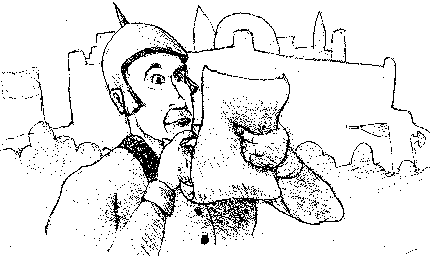
Long ago in the past, a king called Brahmadatta was ruling in Benares. At that time, the Enlightenment Being who had finished completing his perfections was born in the Himalayan forest as a tree deity. The king of Benares at that time, wanting to train his royal elephant in war, gave the elephant to elephant trainers. The elephant could not bear the pain of the training. Breaking the rope that was tying him, he ran to the Himalayan forest. People chased after him. They could not catch him, and returned with empty hands.

Since then, the elephant became one who feared death. Even when hearing the sound of the wind blowing, he would become afraid and would run fast while trembling, shaking his trunk. He felt that his four legs were tightened with ropes and that he was being pricked with an elephant goad. Such was the fear he suffered. He used to wander while trembling without having any physical or mental enjoyments.

The tree deities sitting on branches saw him, and one of them said, “Branches of trees that are weak can be blown down easily by the east and west winds. In this forest, such weak branches are everywhere. If you are afraid of those branches falling down from the wind, it is not good. Eat grass, and drink water, and live happily in this forest.”

And when this tree deity addressed him like this, the elephant became brave from that point on.

The master, the fully enlightened one, disclosed this sermon on the law. He preached the four noble truths and spoke this Jātaka story of weak timber. At the end of the sermon, the monk who was afraid of death attained the stream entrance state of mind. He became a Sotāpanna. This monk at that former time was the elephant. And the tree deity was the Buddha who has attained full enlightenment today.

The moral: “Fear is mere hallucination.”

105. The Story of Weak Timber

Link: https://hhdorjechangbuddhaiiiinfo.com/2025/01/07/105-the-story-of-weak-timber/

#Buddhisttalesforyoungandold #Buddhiststories #storiesforkids #moralstories #Buddha #Jatakastories #PansiyaPanasJataka #thefullyenlightenedone

104 The Story of Mittavindaka [One Who Enjoys His Friends]

104 The Story of Mittavindaka [One Who Enjoys His Friends]

At one time, the fully enlightened one who is always turning his mind to altruism was in Jetavana monastery. This story was delivered about a certain monk who was disobedient.

The present story is similar to the Mittavindaka-Jātaka that was previously spoken [No. 82; and see Nos. 41, 369, and 439]. This Jātaka story was in the time of the Buddha Kassapa. At that time one who was burning in hell and wearing an iron wheel put on his chest as an instrument of torture asked the Enlightenment Being, “Sir. What sort of an unwholesome deed was done by me to suffer like this?” Then the Enlightenment Being explained to him:

You did the following type of unwholesome deed. At one time you saw four divine damsels who were a grouping of temporary hungry ghosts [vemānika-petī-s]. Unsatisfied you thought, “Is this enough for happiness or not?” You wondered in such a fashion. You then wondered further, and looked until you saw another eight divine damsels. Without being satisfied by them even, you looked further and saw another twelve divine damsels. And even having seen such a number, you were not satisfied and looked until you saw another sixteen. You were not satisfied even then, and looked further until you saw another thirty-two. And even then you were not satisfied, and being very greedy and dissatisfied you looked even further and then came upon this iron wheel. In this way, without being satisfied with your own luck you kept expecting more and more. Now you have fallen into the trap of an iron wheel. You became enslaved to your cravings, and because of that you are now suffering the torture of the iron wheel cutting your head and giving you terrible pain.

So saying, the Enlightenment Being explained Mittavindaka’s pain due to his former deeds. The Enlightenment Being then went back to his own divine world, and the suffering Mittavindaka had to experience pain in hell for a long time until his previous deeds’ power had ended.

Buddha, the master, disclosing this particular story, explained the tale of Mittavindaka. “Mittavindaka was the disobedient monk of today at that time. The Enlightenment Being, who was born as a god at that time, is today myself.”

The moral: “Be satisfied even with small achievements. It is not good to be too greedy.” Also, “Be a gourmet, not a gourmand.”

104 The Story of Mittavindaka [One Who Enjoys His Friends]

Link: https://hhdorjechangbuddhaiiiinfo.com/2024/12/24/104-one-who-enjoys-his-friends/

#Buddhisttalesforyoungandold #Buddhiststories #storiesforkids #moralstories #Buddha #Jatakastories #PansiyaPanasJataka

103. The Story of Hostile Action

103. The Story of Hostile Action

At one time, the teacher of the three worlds who became the top jewel of the crown of the Sākya clan uttered this story about the millionaire, Anāthapiϯika:

The millionaire Anāthapiϯika once went to his village where people cultivate for him. On his way back he decided not to stop on the road, having a doubt as to whether there would be robbers on the way, and instead went directly to Sāvatthi. He hurried to Sāvatthi and the next day went to the Buddha and mentioned about his decision to come directly back without stopping.

The omnipresent one said, “Oh, millionaire. Even in the past wise people, seeing robbers on the way, without delaying came directly to the place where they intended to go. “In an ancient time when King Brahmadatta was ruling in Benares, our Enlightenment Being who fulfilled perfections was born in a certain village as a millionaire’s son. He was invited by the villagers to stay and take lunch with them, and was delayed because they talked and chatted until evening. When he was returning, he saw some robbers on his way. Seeing them, he hurried on without stopping in the middle of his trip.

He ate his dinner at home with the most sumptuous food, lay on his bed and enjoyed himself, saying: “‘What a joy I have achieved. One must come to realize that it is not good to live with a hostile-minded person, wherever he may be, even for a day. If a person lives with such a one even a day, he’ll come to live with confusion and unhappiness.’ “Thus the Enlightenment Being enjoying his wisdom performed many meritorious deeds such as the practice of generosity.”

Buddha, the master, completed this preaching and ended the story of hostile action. In those days, the millionaire of Benares was the Buddha.

The moral: “If you expect danger, it is best to avoid it.”

Link:#Buddhisttalesforyoungandold #Buddhiststories #storiesforkids #moralstories #Buddha #Jatakastories #PansiyaPanasJataka

100. A Mother’s Wise Advice [Non-violence]

100. A Mother’s Wise Advice [Non-violence]

Once upon a time, the son of Brahmadatta was ruling righteously in Benares, in northern India. It came to pass that the King of Kosala made war, killed the King of Benares, and made the queen become his own wife.

Meanwhile, the queen’s son escaped by sneaking away through the sewers. In the countryside he eventually raised a large army and surrounded the city. He sent a message to the king, the murderer of his father and the husband of his mother. He told him to surrender the kingdom or fight a battle.

The prince’s mother, the Queen of Benares, heard of this threat from her son. She was a gentle and kind woman who wanted to prevent violence and suffering and killing. So she sent a message to her son — “There is no need for the risks of battle. It would be wiser to close every entrance to the city. Eventually the lack of food, water and firewood will wear down the citizens. Then they will give the city to you without any fighting."

The prince decided to follow his mother’s wise advice. His army blockaded the city for seven days and nights. Then the citizens captured their unlawful king, cut off his head, and delivered it to the prince. He entered the city triumphantly and became the new King of Benares.

The moral is: Kind advice is wise advice.

100. A Mother’s Wise Advice [Non-violence]

Link: https://hhdorjechangbuddhaiiiinfo.com/2024/10/22/100-a-mothers-wise-advice-non-violence/

#Buddhisttalesforyoungandold #Buddhiststories #storiesforkids #moralstories #Buddha #Jatakastories #PansiyaPanasJataka

99, 101. Achieving Nothing [No Thing]

99, 101. Achieving Nothing [No Thing]

Once upon a time the Bodhisatta — the Enlightenment Being — was born into a high class family in northern India. When he grew up he gave up the ordinary desires of the everyday world and became a holy man. He went to the Himalayan Mountains where 500 other holy men became his followers.

He meditated throughout his long life. He gained supernatural powers — like flying through the air and understanding people’s thoughts without their speaking. These special powers impressed his 500 followers greatly.

One rainy season, the chief follower took 250 of the holy men into the hill country villages to collect salt and other necessities. It just so happened that this was the time when the master was about to die. The 250 who were still by his side realized this. So they asked him, “Oh most holy one, in your long life practicing goodness and meditation, what was your greatest achievement?"

Having difficulty speaking as he was dying, the last words of the Enlightenment Being were, “No Thing." Then he was reborn in a heaven world.

Expecting to hear about some fantastic magical power, the 250 followers were disappointed. They said to each other. “After a long life practicing goodness and meditation, our poor master has achieved ‘nothing’." Since they considered him a failure, they burned his body with no special ceremony, honors, or even respect.

When the chief follower returned, he asked, “Where is the holy one?" “He has died," they told him. “Did you ask him about his greatest achievement?" “Of course we did," they answered. “And what did he say?" asked the chief follower. “He said he achieved ‘nothing’," they replied, “so we didn’t celebrate his funeral with any special honors."

Then the chief follower said, “You brothers did not understand the meaning of the teacher’s words. He achieved the great knowledge of ‘No Thing’. He realized that the names of things are not what they are. There is what there is, without being called ‘this thing’ or ‘that thing’. There is no ‘Thing’." In this way the chief follower explained the wonderful achievement of their great master, but they still did not understand.

Meanwhile, from his heaven world, the reborn Enlightenment Being saw that his former chief follower’s words were not accepted. So he left the heaven world and appeared floating in the air above his former followers’ monastery. In praise of the chief follower’s wisdom he said, “The one who hears the Truth and understands automatically, is far better off than a hundred fools who spend a hundred years thinking and thinking and thinking."

By preaching in this way, the Great Being encouraged the 500 holy men to continue seeking Truth. After lives spent in serious meditation, all 500 died and were reborn in the same heaven world with their former master.

The moral is: When the wise speak, listen!

99, 101. Achieving Nothing [No Thing]

Link: https://hhdorjechangbuddhaiiiinfo.com/2024/10/15/99-101-achieving-nothing-no-thing/

#Buddhisttalesforyoungandold #Buddhiststories #storiesforkids #moralstories #Buddha #Jatakastories #PansiyaPanasJataka
98. A Man Named Wise [Cheating]

98. A Man Named Wise [Cheating]

Once upon a time, the Enlightenment Being was born in a merchant’s family in Benares, in northern India. He was given the name Wise. When he grew up, he began doing business with a man whose name just happened to be Verywise.

It came to pass that Wise and Verywise took a caravan of 500 bullock carts into the countryside. After selling all their goods they returned to Benares with their handsome profits.

When it came time to split their gains between them, Verywise said, “I should get twice as much profit as you." “How come?" asked Wise. “Because you are Wise and I am Verywise. It is obvious that Wise should get only half as much as Verywise."

Then Wise asked, “Didn’t we both invest equal amounts in this caravan trip? Why do you deserve twice as much profit as I?" Verywise replied, “Because of my quality of being Verywise." In this way their quarrel went on with no end in sight.

Then Verywise thought, “I have a plan to win this argument." So he went to his father and asked him to hide inside a huge hollow tree. He said, “When my partner and I come by and ask how to share our profits, then you should say, ‘Verywise deserves a double share."‘

Verywise returned to Wise and said, ‘My friend, neither of us wants this quarrel. Let’s go to the old sacred tree and ask the tree spirit to settle it."

When they went to the tree Verywise said solemnly, “My lord tree spirit, we have a problem. Kindly solve it for us." Then his father, hidden inside the hollow tree, disguised his voice and asked, “What is your question?" The man’s cheating son said, “My lord tree spirit, this man is Wise and I am Verywise. We have done business together. Tell us how to share the profits." Again disguising his voice, his father responded, “Wise deserves a single share and Verywise deserves a double share."

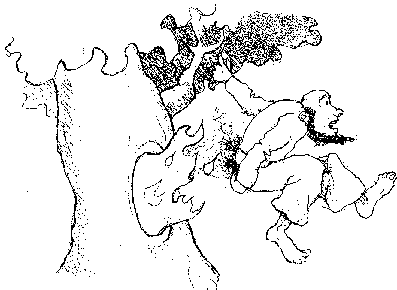
Hearing this solution, Wise decided to find out if it really was a tree spirit speaking from inside the tree. So he threw some hay into it and set it on fire. Immediately Verywise’s father grabbed onto a branch, jumped out of the flames and fell on the ground. He said in his own voice, “Although his name is Verywise, my son is just a clever cheater. I’m lucky that the one named Wise really is so, and I’ve escaped only half toasted!"

Then Wise and Verywise shared their profits equally. Eventually they both died and were reborn as they deserved.

The moral is: A cheater may be clever but not wise.

98. A Man Named Wise [Cheating]

Link: https://hhdorjechangbuddhaiiiinfo.com/2024/10/08/98-a-man-named-wise-cheating/

#Buddhisttalesforyoungandold #Buddhiststories #storiesforkids #moralstories #Buddha #Jatakastories #PansiyaPanasJataka

97. A Man Named Bad [Self Acceptance]

97. A Man Named Bad [Self Acceptance]

Once upon a time there was a world famous teacher in Takkasila, in north-western India. He had 500 high class students who learned sacred teachings from him.

It just so happened that one of these high class students had been named ‘Bad’ by his parents. One day he thought, “When I am told, ‘Come Bad’, ‘Go Bad’, ‘Do this Bad’, it is not nice for me or others. It even sounds disgraceful and unlucky."

So he went to the teacher and asked him to give him a more pleasant name, one that would bring good fortune rather than bad. The teacher said, “Go my son, go wherever you like and find a more fortunate name. When you return, I will officially give you your new name."

The young man named Bad left the city, and traveled from village to village until he came to a big city. A man had just died and Bad asked what his name was. People said. “His name was Alive." “Alive also died?" asked Bad. The people answered, “Whether his name be Alive or whether it be Dead, in either case he must die. A name is merely a word used to recognize a person. Only a fool would not know this!" After hearing this, Bad no longer felt badly about his own name — but he didn’t feel good about it either.

As he continued on his way into the city, a debt-slave girl was being beaten by her masters in the street. He asked, “Why is she being beaten?" He was told, “Because she is a slave until she pays a loan debt to her masters. She has come home from working, with no wages to pay as interest on her debt." “And what is her name?" he asked. “Her name is Rich." they said. “By her name she is Rich but she has no money even to pay interest?" asked Bad. They said, ‘Whether her name be Rich or whether it be Poor, in either case she has no money. A name is merely a word used to recognize a person. Only a fool would not know this!" After hearing this, Bad became even less interested in changing his name.

After leaving the city, along the roadside he met a man who had lost his way. He asked him, “What is your name? " He replied, ‘My name is Tourguide." “You mean to say that even a Tourguide has gotten lost?" asked Bad. Then the man said, “Whether my name be Tourguide or whether it be Tourist, in either case I have lost my way. A name is merely a word used to recognize a person. Only a fool would not know this!"

Now completely satisfied with his own name, Bad returned to his teacher.

The world famous teacher of Takkasila asked him, “How are you, my son? Have you found a good name?" He answered, “Sir, those named Alive and Dead both die, Rich and Poor may be penniless, Tourguide and Tourist can get lost. Now I know that a name is merely a word used to recognize a person. The name does not make things happen, only deeds do. So I’m satisfied with my name. There’s no point in changing it."

The teacher summarized the lesson his pupil had learned this way — “By seeing Alive as dead, Rich as poor, Tourguide as lost, Bad has accepted himself."

The moral is: “A rose by any other name would smell as sweet."

97. A Man Named Bad [Self Acceptance]

Link: https://hhdorjechangbuddhaiiiinfo.com/2024/10/01/97-a-man-named-bad-self-acceptance/

#Buddhisttalesforyoungandold #Buddhiststories #storiesforkids #moralstories #Buddha #Jatakastories #PansiyaPanasJataka

96,132. The Prince and the She-devils [Chapter 1. Five Meals in the Forest]

96,132. The Prince and the She-devils [Chapter 1. Five Meals in the Forest]

Once upon a time King Brahmadatta was ruling in Benares, in northern India. The Enlightenment Being was born as the last of his 100 sons and grew up to be a wise young man.

In those days there were Silent Buddhas who came to the palace to receive alms food. They were called Buddhas because they were enlightened — they knew the Truth and experienced life as it really is, in every present moment. They were called Silent because they did not preach the Truth. This was because they knew it was a time when no one would be able to understand it. However, being filled with sympathy for the unhappiness of all beings, the Silent Buddhas wished to help anyone who asked them.

One day the young prince was thinking about his 99 older brothers and wondering if he had any chance to become King of Benares. He decided to ask the Silent Buddhas about it.

The next day the Silent Buddhas came as usual to collect alms food in the palace. The prince brought purified water and washed their feet. When they had sat down he gave them appetizers to eat. Before giving the next course he said to them, “I am 100th in line to the throne. What are the odds that I will become King of Benares?"

They replied, “Oh prince, with so many older brothers there is almost no chance you will ever be king here. However, you might become King of Takkasila. If you can get there in seven days you can become king. But on your way there is a dangerous forest. You must take the road passing through it, since it would take twice as long to go around it.

“That forest is known as ‘Devils Woods’, because it is filled with all kinds of devils — he-devils, she-devils, and even little children-devils! The she-devils spend most of their time by the roadside. They use magic to make buildings and entire cities appear along the way.

“The buildings have ceilings decorated with stars, and gorgeous rich couches surrounded by silk curtains of many colors. Sitting on these couches, the she-devils make themselves look like the sweetest, most pleasant of goddesses. With words dripping with honey they attract travelers saying, ‘You look tired. Come in, sit down, have something to drink and then be on your way.’

“Those who are persuaded to come in are invited to sit down. Then the she-devils use their beautiful physical appearance to trap their visitors with their own burning desires. After giving in to their desires, the strangers are killed by the she-devils and eaten while their blood is still hot!

“In this way those who are attracted by sight are trapped by the physical forms of women. Those who are attracted by sound are trapped by their singing voices and music. Those attracted by smell are trapped by the divine perfumes they wear. Those attracted by taste are trapped by the heavenly tasting delicacies they offer. Those attracted by touch are trapped by their soft luxurious beds and velvet couches.

“But if you, fair prince, can control all five senses, and force yourself to avoid looking at those beautiful enticing she-devils, only then can you become King of Takkasila in seven days."

The grateful Bodhisatta replied, “Thank you venerable ones, I will follow your advice. After hearing such warnings, how could I take the chance of looking at them?"

Then he asked the Silent Buddhas to give him special charms to protect him on his dangerous journey through Devils Woods. So they chanted protective blessings onto a string and some sand. He accepted the charms and paid his farewell respects to them, and then to his royal parents.

Returning to his own home he announced to his household servants, “I am going to Takkasila to win the kingship. You are to remain here." But five of them said, “We also wish to go with you." “No," said he, “you can’t come with me. I have been warned that on the way there are beautiful she-devils who trap people who can’t resist the desires coming from their own five senses. Then they kill their victims and eat them while their blood is still hot. It is far too dangerous for you. I will rely only on myself and travel alone."

But the five would not listen. They said, “If we go with you, oh prince, we will force ourselves to keep from looking at those beautiful she-devils. We will accompany you to Takkasila." “If you insist, then so be it," said the prince, ‘but keep your determination strong."

The she-devils were waiting for them in Devils Woods. They had already magically formed beautiful villages and cities with lovely houses and palaces along the way.

It just so happened that one of the prince’s five servants was easily enchanted by the sight of the curves and figures of the bodies of women. So he began to fall behind in order to admire them. The worried prince asked. ‘Why do you delay, my friend?" “My feet ache," said the man, “let me sit and rest a while in one of these mansions. Then I will catch up with you." “My good friend," said the prince, “those are she-devils. Don’t chase after them!"

Nevertheless, blinded by the temptation of the sense of sight, the man replied, “My lord, I can’t turn away. Whatever will happen, let it happen!" Giving him one last warning, the prince continued on with the other four.

The one who remained behind went closer to the beautiful looking forms he was so attracted to. After pleasing themselves fully with the man, the she-devils killed him and ate him on the spot!

Then they went farther into Devils Woods and created another mirage of a beautiful mansion. They sat inside and began singing the sweetest melodies, accompanied by the lovely sounds of all kinds of musical instruments. One of the prince’s followers was enchanted by the sound of beautiful music. So he too fell behind and was gobbled up by the still hungry she-devils.

Farther down the road they created another magic mansion filled with the scents of all kinds of divine perfumes. This time the man who loved sweet smells fell behind and was eaten as well.

Next the she-devils created a fabulous restaurant filled with foods having the most heavenly flavors. Here the lover of the tastes of the finest delicacies wandered in and was devoured in turn.

Then the she-devils went still farther down the road, created soft luxurious beds and velvet couches, and sat on them. The last of the prince’s followers was one who loved the touch of the softest fabrics and the most luxurious comfort. So he too fell behind and met his death, and was quickly eaten by the ravenous she-devils.

These events left the Enlightenment Being all alone in Devils Woods. A certain she-devil thought, “Aha! This one is very strong-minded indeed. But I am even more determined. I will not stop until I have tasted his flesh!" So she alone stubbornly followed him, even though the other devils gave up the chase.

As she got closer to the edge of Devils Woods, some woodsmen saw her and asked. “Lovely lady, who is it that walks on ahead of you?" ‘We are newlyweds," replied the lying demon, “he is my too pure husband, who ran away from me on our wedding night. That’s why I’m chasing after him."

The woodsmen caught up to the prince and asked, “Noble sir, this delicate flower-like golden-skinned young maiden has left her family to live with you. Why don’t you walk with her, instead of making her chase after you?"

The prince replied, “Good people, she is not my wife. She is a devil. She killed the five men who followed me and ate them while their blood was still hot!"

Whereupon the lovely looking devil said, “See how it is, gentlemen, anger can make husbands call their own wives devils and hungry ghosts! Such is the way of the world."

Continuing to follow the prince, the determined she-devil magically made herself look pregnant. Then she seemed to be a first-time mother carrying her make-believe baby on her hip. Whoever saw the pair questioned them just as the woodsmen had. Each time the Bodhisatta repeated, “She is not my wife. She is a devil. She killed the five men who followed me and ate them while their blood was still hot!"

96,132. The Prince and the She-devils [Chapter 1. Five Meals in the Forest]

Link: https://hhdorjechangbuddhaiiiinfo.com/2024/09/24/96132-the-prince-and-the-she-devils-chapter-1-five-meals-in-the-forest/

#Buddhisttalesforyoungandold #Buddhiststories #storiesforkids #moralstories #Buddha #Jatakastories #PansiyaPanasJataka