117. The Story of the Partridge

117. The Story of the Partridge

When Buddha was living in Jetavana monastery, the Venerable Devadatta’s right hand disciple Kokālika caused a disruption among the monks. Because of that, the Buddha related this Jātaka story. The story of its cause is detailed in the thirteenth book in the Takkāriya-Jātaka [No. 481].

[During a certain spring retreat the two chief disciples of the Buddha, Sāriputta and Moggallāna, went to the monk called Kokālika and said, “With your help to us, and with our help to you, we can live together happily in this temple for this rainy season period of three months.” The two chief disciples said this so as to try to avoid being bothered by the public. Kokālika asked, “What is the happiness that you can gain because of me?” The two chief disciples said, “If you do not disclose to anyone that we are here, then we can live happily. That is the help you can give us. During these three months, we will teach you the discourses (sutta-s) and the philosophical and psychological analyses (abhidhamma) of the Buddha. This is how we can help you.”

Then the Venerable Kokālika prepared shelter for them. This was not known to anyone. At the end of the rainy season retreat, they requested Kokālika to visit the Buddha with them. On the way to seeing the Buddha, they came to a certain village. After the two chief disciples left the village, the Venerable Kokālika came back and said to the villagers, “You devotees are ignorant like animals. Our chief disciples were with me nearby for the last three months. And now, these two have left to go back to Sāvatthi.”

Hearing this, the villagers became very upset and taking many offerings chased after the two chief disciples. Meeting them, they begged pardon and said, “Bhante, we could not recognize you. Please pardon us and accept these offerings.” Then the chief disciples refused to accept the gifts and instructed the villagers even not to give them to Kokālika. The villagers invited the two chief disciples to come back again to the village. Kokālika thought, “The chief disciples did not accept these gifts, and they did not even allow me to accept them.” And he became angry with them.

The two chief disciples, in Sāvatthi with the Buddha for a short time, again left this time with their 500 disciples to go to the village where Kokālika lived. The villagers treated them with the four requisites of monks (food, clothing, shelter, and medicine). Those monks who went with the two chief disciples shared all the gifts given by the villagers with each other, and did not give any to Kokālika.

Because of this, Kokālika got angry and said, “Both Sāriputta and Moggallāna have bad motives. They did not accept the gifts given before by the villagers when they were here alone. Now they are accepting them when they are together with a retinue of 500 monks.” And he accused the two chief disciples in this way, with an evil mind.

However, hearing this the two chief disciples thought, “Kokālika acquires a great amount of demerit because of us. Therefore it is not good to stay here. So, let us go.” And they left the place along with their retinue.

Seeing this, the villagers started to cry and plead with them to stay. But they were firm in their decision. Meanwhile, a young monk spoke to the villagers and said, “Oh villagers, how can the two chief disciples stay here without the consent of Kokālika?”

The villagers got angry and went to Kokālika and requested, “Go, please, and invite the venerable two chief disciples to stay here and beg their pardon. If not, you must leave this village.” Then he became afraid of the villagers and requested the two chief disciples to stay. The two chief disciples said, “You, monk, do not go. You stay here. But we will not come back.”

Kokālika returned, but he could not stay in the village without the help of the villagers. He became very melancholy and taking his robes and books, left to see the Buddha who was in Jetavanārāma. He complained, “Your lordship, Sāriputta and Moggallāna have bad motives. They have gone over to earning gifts.” The Buddha said, “Kokālika, do not say so. They both are very highly virtuous and are endowed with good qualities.”

Then Kokālika said, “Sir, your chief disciples’ words are unwholesome. I know it. And they are not virtuous.” In this way, while Buddha was objecting to his saying so, he left.

Kokālika returned, but he could not stay in the village without the help of the villagers. He became very melancholy and taking his robes and books, left to see the Buddha who was in Jetavanārāma. He complained, “Your lordship, Sāriputta and Moggallāna have bad motives. They have gone over to earning gifts.” The Buddha said, “Kokālika, do not say so. They both are very highly virtuous and are endowed with good qualities.” Then Kokālika said, “Sir, your chief disciples’ words are unwholesome. I know it. And they are not virtuous.” In this way, while Buddha was objecting to his saying so, he left.

Within a short time, everywhere on his body there developed big boils which started to bleed and fester. He could not bear the pain, and screaming lay down near the gate of Jetavanārāma. His bad reputation spread everywhere, even up to the Brahmaloka.

This was seen by a certain higher deity (brahma) named Tudu who thought, “It is my duty now to go and advise Kokālika to beg pardon for his fault.” Staying in the sky, he said, “Kokālika, you have done a very bad deed. Go hurry up and beg pardon.” Then Kokālika asked, “Who are you, sir?” And Tudu said, “I am Tudu, your former master.” “What? You are a non-returner to this world? If so, how can you come from the Brahmaloka to this human world? No doubt, you are like a hungry ghost who comes to a heap of garbage.” Then the deity went back to his place saying, “If you speak so, then you look out for yourself.” And he left. And Kokālika died because of the same disease, and was born in a woeful state called the Hell of Paduma. The Sahāmpati Brahma deity saw this and informed the Buddha. On this occasion, Buddha said, “Kokālika not only in this life, but also in the past, faced difficulties because of his words.”]

Buddha stated that the monk Mahā-Kokālika, by speaking too much, faced death even in the past. The monks requested him to disclose the story. The Buddha explained it thus:

At one time, when a king called Brahmadatta reigned in Benares, the Enlightenment Being was born in a well-known Brahmin family of Benares. After growing up, he became ordained as a Rsi. He became the head of many ascetics and lived in a Himalayan forest.

Then, a certain ascetic who was malnourished, taking an axe, went into the forest to cut firewood so as to warm the hermitage.

Another ascetic came to where he was, and told him, “Cut this, cut this, and cut that.” In this way, he was ordering the first ascetic how to cut the wood. The first ascetic got angry and said, “Are you my teacher, that you are teaching me to cut firewood?” He picked up his sharp axe and he slashed him, killing him.

The Enlightenment Being, hearing the news, made all necessary rites and rituals for the dead ascetic. Meanwhile, near the hermitage where the Enlightenment Being was living, there was a certain partridge that was crying loudly on a fruit tree. A partridge hunter, hearing its cries, caught him and killed him. The Enlightenment Being, not hearing its cries for a few days, asked, “What happened to that partridge that cried up until a few days ago?” The other ascetics told him what happened. On hearing this, the Enlightenment Being compared the stories of the dead ascetic and the partridge. Both clamored uselessly. And he advised his fellow ascetics to meditate. He himself meditated on the fourfold sublime statuses of the mind, and gained rapturous ecstasies [jhāna-s]. Without failing to maintain those achievements, he was born among the Brahma beings.

Buddha finished this story saying, “At that time, the ascetic who got slashed in the head by the axe was the elder Kokālika. The Rsi who became the head of the group of ascetics was myself, the Buddha.”

The moral: “Useless speech brings danger.”

Link:

#Buddhisttalesforyoungandold #Buddhiststories #storiesforkids #moralstories #Buddha #Jatakastories #PansiyaPanasJataka #JatakaTalesofSakyamuniBuddha #JatakaTales

116. The Story of Disregarded Advice

116. The Story of Disregarded Advice

Once the omniscient one was living in Jetavana monastery. He disclosed this Jātaka story regarding a certain monk who disregarded counsel. This Jātaka story comes in detail in the Gijjha-Jātaka in the ninth book [No. 427].

[A monk was ordained, and after his ordination he became disregardful of his teacher’s advice. He did not follow the precepts and religious practices properly. The elderly monks advised him on many things. He thought, “Why should I be obedient to these elders? I know what to do and what to say.” And he became more and more disrespectful to the elder monks. This was heard by the Buddha, and the Buddha summoned him and said, “Oh monk, you even in the past became disobedient and destroyed your life.”]

Addressing the monks, the omniscient one said, “Oh monks, this monk not only disregarded counsel in this life, but also did so in the past.” And then the monks in the audience requested the Buddha to express the hidden past. The Buddha then spoke this story:

At one time when King Brahmadatta ruled Benares, the Enlightenment Being was born in a family of gymnasts. When he became old enough, he learned how to do somersaults. With his master, he went from village to village displaying gymnastics. Once they came to a certain village and prepared to display their skills. While they were preparing the show, the master set up five javelins instead of four as usual. The pupil asked, “Master, why did you set up five javelins instead of four. It is dangerous to have five. Take one javelin out.” Then the master, as he was intoxicated, said, “Do you not understand my skills?” Saying so, he did somersaults over the javelins. Over the first four javelins, he jumped safely. But he was not skilled enough to clear the fifth javelin, and impaled himself on it, and died.

The student became very sad, and said, “My master died without listening to my advice.” He removed him from the javelin, and cremated him. Buddha disclosed this story, comparing the past story to the present.

“The gymnast who disregarded advice was the monk in the present. And I who am the Buddha today was born his student at that time.”

The moral: “Good advice deserves everyone’s attention.”

116. The Story of Disregarded Advice

Link: https://hhdorjechangbuddhaiiiinfo.com/2025/04/15/116-the-story-of-disregarded-advice/

#Buddhisttalesforyoungandold #Buddhiststories #storiesforkids #moralstories #Buddha #Jatakastories #PansiyaPanasJataka #JatakaTalesofSakyamuniBuddha #JatakaTales

115. The Story of a Bird (The Story of a Bird That Warned Others)

115. The Story of a Bird (The Story of a Bird That Warned Others)

At one time the all-knower was living in Sāvatthi. This story was spoken about a certain housewife who was ordained among the sisters and who was too fond of food. Once she went collecting alms on a certain street, and there she was well entertained by the devoted people who offered her the daintiest food. She thought, “Let no other nun come to collect alms in this street. If such were to happen, I might miss these well prepared entertainments.” Therefore she thought further, “I must prevent other nuns from coming to this street.” Thinking so, she returned to the nunnery and told the other nuns, “On such-and-such a street there are elephants, horses, biting dogs, and other harmful animals. It is not good for anyone to go there.” The other nuns who heard this believed what she said as the truth. They completely kept away from going to that street. They even did not want to look at that place.

Then, only that nun went to that street for alms. One day she went there to a house for alms. While she was going toward the house, a certain ram ran after her and attacked her. Her thighbone was broken. The people who were in the vicinity came about her and set her thighbone with a bandage. They put her on a stretcher and took her to the nunnery.

This news was spread among the monks and nuns in the temple. On that occasion, when the Buddha came to the preaching hall in the evening and sat on the prepared platform, he asked the monks, “Oh monks, what were you talking about before I came here?” They said, “Venerable sir, we were discussing about the nun who broke her thighbone in the street.” And they related the story. The Buddha said, “Not only in this life by warning others falsely did she have to face the problem of a broken bone, but also in the past she faced death.” And then the disciples invited him to disclose the past story.

Buddha said:

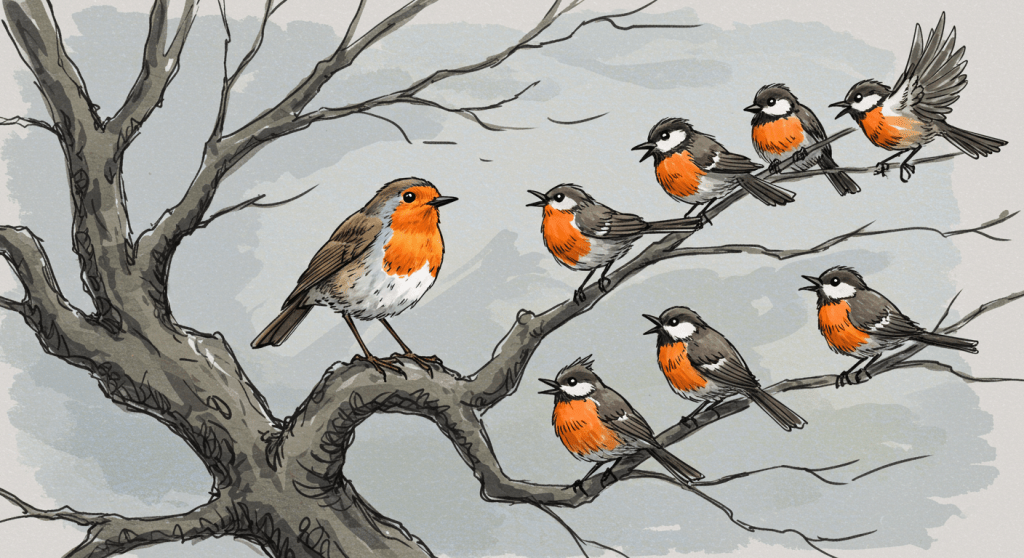
Long ago in Benares when a king called Brahmadatta ruled, the Enlightenment Being was born as a king of birds. In his flock of birds, one female bird got plenty of food. And while she was eating this food, one day she thought, “If other birds come to this location, I will lose this plentiful fare. It is better not to let them come.” Thinking this way, she went back to the flock and said, “That road is packed with lots of bullocks which pull chariots, and with many other troublesome animals. It is not good to go there as it is dangerous.”

Hearing this, other birds never wanted to go there.

As she was wandering as was her wont in that location by herself, a fast chariot came up behind her. She turned her neck and saw the chariot coming up behind, but neglected to get out of the way as she was greedily eating food and thought the chariot was far off. Unfortunately, when the chariot came near her, she could not fly off. She was cut into two pieces and died. The Enlightenment Being while flying overhead in the sky, asked the other birds, “Where is that female bird who was warning others?” And they saw her dead on the road. The Enlightenment Being said, “Look at her. She died being enslaved to her own craving. Because of that, she is dead in vain.” They went away, leaving her body behind.

The female bird at that time that was warning others was the present nun. And the king of the birds at that time was I who became the enlightened one.

The moral: “It is not good to be greedy.”

Further,

“False admonitions to others have a way of befalling oneself.”

115. The Story of a Bird (The Story of a Bird That Warned Others)

Link: https://hhdorjechangbuddhaiiiinfo.com/2025/03/25/115-the-story-of-a-bird-the-story-of-a-bird-that-warned-others/

#Buddhisttalesforyoungandold #Buddhiststories #storiesforkids #moralstories #Buddha #Jatakastories #PansiyaPanasJataka #JatakaTalesofSakyamuniBuddha #JatakaTales

32. The Dancing Peacock [Pride and Modesty]

32. The Dancing Peacock [Pride and Modesty]

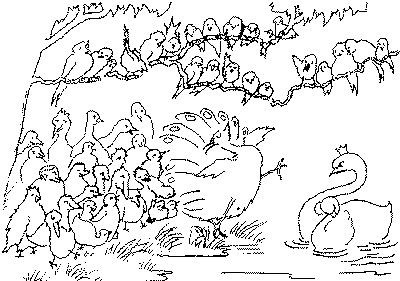
Once upon a time, a very long time ago, the four-footed animals made the lion their king. There was a gigantic fish that roamed the oceans, and the fish made him their king. The birds were attracted to beauty, so they chose the Golden Swan as their king.

King Golden Swan had a beautiful golden daughter. While she was still young, he granted her one wish. She wished that, when she was old enough, she could pick her own husband.

When his daughter was old enough, King Golden Swan called all the birds living in the vast Himalayan Mountains of central Asia to a gathering. The purpose was to find a worthy husband for his golden daughter. Birds came from far away, even from high Tibet. There were geese, swans, eagles, sparrows, humming birds, cuckoos, owls and many other kinds of birds.

The gathering was held on a high rock slab, in the beautiful green land of Nepal. King Golden Swan told his lovely daughter to select whichever husband she wished.

She looked over the many birds. Her eye was attracted by a shining emerald-green long-necked peacock, with gorgeous flowing tail feathers. She told her father, “This bird, the peacock, will be my husband."

Hearing that he was the lucky one, all the other birds crowded around the peacock to congratulate him. They said, “Even among so many beautiful birds, the golden swan princess has chosen you. We congratulate you on your good fortune."

The peacock became so puffed up with pride, that he began to show off his colorful feathers in a fantastic strutting dance. He fanned out his spectacular tail feathers and danced in a circle to show off his beautiful tail. Being so conceited, he pointed his head at the sky and forgot all modesty, so that he also, showed his most private parts for all to see!

The other birds, especially the young ones, giggled. But King Golden Swan was not amused. He was embarrassed to see his daughter’s choice behave in this way. He thought, “This peacock has no inner shame to give him proper modesty. Nor does he have the outer fear to prevent indecent behavior. So why should my daughter be shamed by such a mindless mate?"

Standing in the midst of the great assembly of birds, the king said, “Sir peacock, your voice is sweet, your feathers are beautiful, your neck shines like an emerald, and your tail is like a splendid fan. But you have danced here like one who has no proper shame or fear. I will not permit my innocent daughter to marry such an ignorant fool!"

Then King Golden Swan married his golden daughter to a royal nephew. The silly strutting peacock flew away, having lost a beautiful wife.

The moral is: If you let pride go to your head, you’ll wind up acting like a fool.

Link: https://hhdorjechangbuddhaiiiinfo.com/2022/08/23/32-the-dancing-peacock-pride-and-modesty/

INTERPRETER’S INTRODUCTION – BUDDHIST TALES FOR YOUNG AND OLD, VOLUME 1, STORIES 1-50

#Buddhisttalesforyoungandold #Buddhiststories #storiesforkids #moralstories #Buddha #Jatakastories #PansiyaPanasJataka

10. The Happy Monk [Joys of the Spiritual Life]

10. The Happy Monk [Joys of the Spiritual Life]

Buddhist Tales for Young and Old, volume 1, Prince Goodspeaker, Stories 1-50

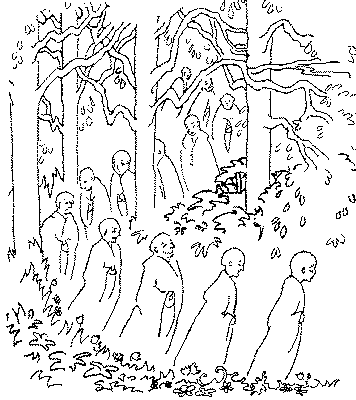
Once upon a time, there was a high class rich man. As he became older, he realized that the suffering of old age was about the same for rich and poor alike. So he gave up his wealth and class position, and went into the forest to live as a poor monk. He practiced meditation, and developed his mind. He freed himself from unwholesome thoughts, and became contented and happy. His peacefulness and friendliness gradually drew 500 followers to his side.

At that time, long ago, most monks usually looked pretty serious. But there was one monk who, even though he was quite dignified, always wore at least a little smile. No matter what happened, he never lost this glimmer of inner happiness. And on happy occasions, he had the broadest smile, and the warmest laughter of all.

Sometimes monks, as well as others, would ask him why he was so happy that he always wore a smile. He chuckled and said, “If I told you, you wouldn’t believe me! And if you thought I spoke a lie, it would be a dishonor to my master." The wise old master knew the source of the happiness that could not be wiped from his face. He made this happiest monk his number one assistant.

One year, after the rainy season, the old monk and his 500 followers went to the city. The king permitted them to live in his pleasure garden for the springtime.

This king was a good man, who took his responsibilities as ruler seriously. He tried to protect the people from danger, and to increase their prosperity and welfare. He always had to worry about neighbouring kings, some of whom were unfriendly and threatening. He often had to make peace between his own rival ministers of state.

Sometimes his wives fought for his attention, and for the advancement of their sons. Occasionally, a dissatisfied subject even threatened the life of the king himself! And, of course, he had to worry constantly about the finances of the kingdom. In fact, he had so much to worry about, that he never had time to be happy!

As summer approached, he learned that the monks were preparing to return to the forest. Considering the health and welfare of the old leader, the king went to him and said, “Your reverence, you are now very old and weak. What good does it do to go back to the forest? You can send your followers back, while you remain here."

The chief monk then called his number one assistant to him and said, “You are now to be the leader of the other monks, while you all live in the forest. As I am too old and weak. I will remain here as offered by the king." So the 500 returned to the forest and the old one remained.

The number one assistant continued practicing meditation in the forest. He gained so much wisdom and peace that he became even happier than before. He missed the master, and wanted to share his happiness with him. So he returned to the city for a visit.

When he arrived, he sat on a rug at the feet of the old monk. They didn’t speak very much, but every so often the number one assistant would say, “What happiness! Oh what happiness!"

Then the king came to visit. He paid his respects to the chief monk. However, the one from the forest just kept saying, “What happiness! Oh what happiness!" He did not even stop to greet the king and show proper respect. This disturbed him, and he thought, “With all my worries, as busy as I am looking after the kingdom, I take time out for a visit and this monk does not respect me enough to even recognize me. “How insulting!" He said to the senior of the two monks, “Venerable sir, this monk must be stupid from overeating. That must be why he is so full of happiness. Does he lie around here so lazy all the time?"

The head monk replied, “Oh king, have patience and I will tell you the source of his happiness. Not many know it. He was once a king, just as rich and mighty as you! Then he was ordained a monk and gave up his kingly life. Now he thinks his old happiness was nothing compared to his present joy!"

He used to be surrounded by armed men, who guarded and protected him. Now, sitting alone in the forest with nothing to fear, he has no need for armed guards. He has given up the burden of worrying about wealth that has to be protected. Instead, free of the worry of wealth and the fear of power, his wisdom protects himself and others. He advances in meditation to such inner peace, that he cannot keep from saying, “What happiness! Oh what happiness!"

The king understood at once. Hearing the story of the happy monk made him feel at peace. He stayed for a while and received advice from both of them. Then he honoured them, and returned to the palace.

Later the happy monk, who once had been a king, paid his respects to his master and returned to the lovely forest. The old chief monk lived out the remainder of his life, died, and was reborn in a high heaven world.

The moral is: Unattached to wealth and power, happiness increases.

10. The Happy Monk [Joys of the Spiritual Life]

Link: https://hhdorjechangbuddhaiiiinfo.com/2021/12/21/10-the-happy-monk-joys-of-the-spiritual-life/

INTERPRETER’S INTRODUCTION – BUDDHIST TALES FOR YOUNG AND OLD, VOLUME 1, STORIES 1-50

#Buddhisttalesforyoungandold #Buddhiststories #storiesforkids #moralstories #Buddha #Jatakastories #PansiyaPanasJataka

9. The King With One Grey Hair [Ordination]

9. The King With One Grey Hair [Ordination]

Buddhist Tales for Young and Old, volume 1, Prince Goodspeaker, Stories 1-50

A very very long time ago, there were people who lived much longer than they do today. They lived many thousand years. At that time, the Enlightenment Being was born as a baby named Makhadeva. He lived 84,000 years as a child and crown prince. At the time of our story, he had been a young king for 80,000 years.

One day, Makhadeva told the royal barber, “If you see any grey hair on my head, you must tell me immediately!" Of course, the barber promised to do so.

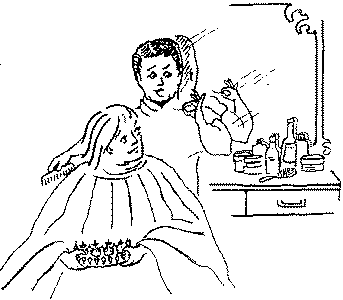
Another 4,000 years passed, until Makhadeva had been a young king for 84,000 years. Then one day, while he was cutting the king’s hair, the royal barber saw just one little grey hair on all the king’s head. So he said, “Oh my lord, I see one grey hair on your head." The king said, “If this be so, pull it out and put it in my hand." The barber got his golden tweezers, plucked out the single little grey hair, and put it in the king’s hand.

At that time, the king still had at least another 84,000 years left to live as an old king! Looking at the one grey hair in his hand, he became very afraid of dying. He felt like death was closing in on him, as if he were trapped in a burning house. He was so afraid, that the sweat rolled down his back, and he shuddered.

King Makhadeva thought, “Oh foolish king, you have wasted all this long life and now you are near death. You have made no attempt to destroy your greed and envy, to live without hating, and to get rid of your ignorance by learning the truth and becoming wise."

As he thought this, his body burned and the sweat kept rolling down. Then he decided once and for all, “It is time to give up the kingship, be ordained as a monk, and practice meditation!" Thinking so, he granted the income of a whole town to the barber. It amounted to one-hundred-thousand gold coins per year.

Then the king called his oldest son to him and said, “My son, I have seen a grey hair. I have become old. I have enjoyed the worldly pleasures of great wealth and power. When I die, I want to be reborn in a heaven world, to enjoy the pleasures of the gods. So I will be ordained as a monk. You must now take the responsibility of ruling the country. I will live the life of a monk in the forest."

Hearing of this, the royal ministers and the rest of the court rushed to the king and said, “Our lord, why do you suddenly want to be ordained?"

The king held up the grey hair in his hand and said, “My ministers and subjects, I have realized that this grey hair shows that the three stages of life — youth, middle age and old age — are coming to an end. This first grey hair was the messenger of death sitting on my head. Grey hairs are like angels sent by the god of death. Therefore, this very day is the time for me to be ordained."

The people wept at the news of his departure. King Makhadeva gave up his royal life, went into the forest, and was ordained as a monk. There he practiced what holy men call the ‘Four Heavenly States of Mind’. First is loving-kindness, tender affection for all. Second is feeling sympathy and pity for all those who suffer. Third is feeling happiness for all those who are joyful. And the fourth state is balance and calm, even in the face of difficulties or troubles.

After 84,000 years of great effort meditating and practicing these states as a humble forest monk, the Bodhisatta died. He was reborn in a high heaven world, to live a life a million years long!

The moral is: Even a long life is too short to waste.

The King With One Grey Hair [Ordination]

Link:https://hhdorjechangbuddhaiiiinfo.com/2021/11/23/the-king-with-one-grey-hair-ordination/

INTERPRETER’S INTRODUCTION – BUDDHIST TALES FOR YOUNG AND OLD, VOLUME 1, STORIES 1-50

#Buddhisttalesforyoungandold #Buddhiststories #storiesforkids #moralstories #Buddha #Jatakastories #PansiyaPanasJataka

2. Finding a New Spring [Perseverance]

Story 2

Finding a New Spring

 [Perseverance]

Buddhist Tales for Young and Old, volume 1, Prince Goodspeaker, Stories 1-50

Once upon a time a certain tradesman was leading a caravan to another country to sell his goods. Along the way they came to the edge of a severe hot-sand desert. They asked about and found that during the day time the sun heats up the fine sand until it’s as hot as charcoal, so no one can walk on it — not even bullocks or camels! So the caravan leader hired a desert guide, one who could follow the stars, so that they could travel only at night when the sand cools down. They began the dangerous night time journey across the desert.

A couple of nights later, after eating their evening meal, and waiting for the sand to cool, they started out again. Later that night the desert guide, who was driving the first cart, saw from the stars that they were getting close to the other side of the desert. He had also overeaten, so that when he relaxed, he dozed off to sleep. Then the bullocks who, of course, couldn’t tell directions by reading the stars, gradually turned to the side and went in a big wide circle until they ended up at the same place they had started from!

By then it was morning, and the people realized they were back at the same spot they’d camped at the day before. They lost heart and began to cry about their condition. Since the desert crossing was supposed to be over by now, they had no more water and were afraid they would die of thirst. They even began to blame the caravan leader and the desert guide — “We can do nothing without water!", they complained.

Then the tradesman thought to himself, “If I lose courage now, in the middle of this disastrous situation, my leadership has no meaning. If I fall to weeping and regretting this misfortune, and do nothing, all these goods and bullocks and even the lives of the people, including myself, may be lost. I must be energetic and face the situation!" So he began walking back and forth, trying to think out a plan to save them all.

Remaining alert, out of the corner of his eye, he noticed a small clump of grass. He thought, “Without water, no plant could live in this desert." So he called over the most energetic of his fellow travellers and asked them to dig up the ground on that very spot. They dug and dug, and after a while they got down to a large stone. Seeing it they stopped, and began to blame the leader again, saying “This effort is useless. We’re just wasting our time!" But the tradesman replied, “No no, my friends, if we give up the effort we will all be ruined and our poor animals will die — let us be encouraged!"

As he said this, he got down into the hole, put his ear to the stone, and heard the sound of flowing water. Immediately, he called over a boy who had been digging and said, “If you give up, we will all perish – so take this heavy hammer and strike the rock."

The boy lifted the hammer over his head and hit the rock as hard as he could — and he himself was the most surprised when the rock spilt in two and a mighty flow of water gushed out from under it! Suddenly, all the people were overjoyed. They drank and bathed and washed the animals and cooked their food and ate.

Before they left, they raised a high banner so that other travellers could see it from afar and come to the new spring in the middle of the hot-sand desert. Then they continued on safely to the end of their journey.

The moral is: Don’t give up too easily – keep on trying until you reach the goal

Finding a New Spring

Link: https://hhdorjechangbuddhaiiiinfo.com/2021/09/20/2-finding-a-new-spring-perseverance/

INTERPRETER’S INTRODUCTION – BUDDHIST TALES FOR YOUNG AND OLD, VOLUME 1, STORIES 1-50

#Buddhisttalesforyoungandold #Buddhiststories #storiesforkids #moralstories #Buddha #Jatakastories #PansiyaPanasJataka #preserverance