123. The Story of a Plough Handle [NanÄgalīsa-Jātaka]

Once while the Buddha was living in Jetavana monastery, this story was delivered about Venerable KāÀudāyi. He used to go to preach to gatherings. As he often could not understand the purpose of the gatherings, sometimes he would preach sad things to a happy community and happy things to a grieving community. As he could not preach appropriately to communities, he obtained a bad name. The community of monks knew this. One time, the monks who were assembled in the hall of law for the evening preaching were talking about this matter.
When the Buddha came there, he asked, “Oh monks, what were you talking about before I arrived?” The monks said, “Your lordship, we were talking about the lack of understanding of Venerable KāÀudāyi in preaching.” Then the Buddha said, “Monks, KāÀudāyi not only acts like this today. Even in the past, he has acted in the same way.” And Buddha was invited to disclose the story of the past that had been hidden by the course of time. Buddha preached the story of the past.
This is how it was:
Long ago in the past, there was a king called Brahmadatta in Benares. At that time, the Enlightenment Being was a prominent teacher in the city. He lived by giving instruction to students. People who were rich enough to afford it gave a thousand gold coins to the teacher. Some, who had not much money, got their education by working as servants to the master. And in this way, they were able to study.
Once there came a poor foolish man to get an education from the Enlightenment Being. He was paying for his education by working. One day he was massaging his master’s feet, and the master requested that he raise up his feet. The student agreed, and under one side of the foot of the bed he placed folded cloth. As he had nothing for the other side, he placed his thigh under the bed. All that night, until the next morning, he kept his thigh under the bed forgoing his rest. In the morning, when the master awoke, he saw that the student was sitting at his foot, and he became very sad. He thought, “This poor foolish man works here as a slave, and cannot learn anything. Therefore, it would be good to somehow teach this man something.” Thinking so, he said to the foolish student, “Whatever you see daily, you must tell me. And also relate to me a comparable thing [upamā].” The Enlightenment Being thought that by the student making a comparison, he would be able to develop his thinking.
The next day, the teacher asked the student to bring some firewood. When the student returned, the master requested, “Tell me whatever you have seen.” The student said, “I have seen a snake in the forest.” The master asked,
“What did the snake resemble?” The student responded, “The snake was like a plough handle.” The master thought, “A snake is long, and a plough handle is also long. Therefore his example is correct.” Thinking so, he was satisfied.
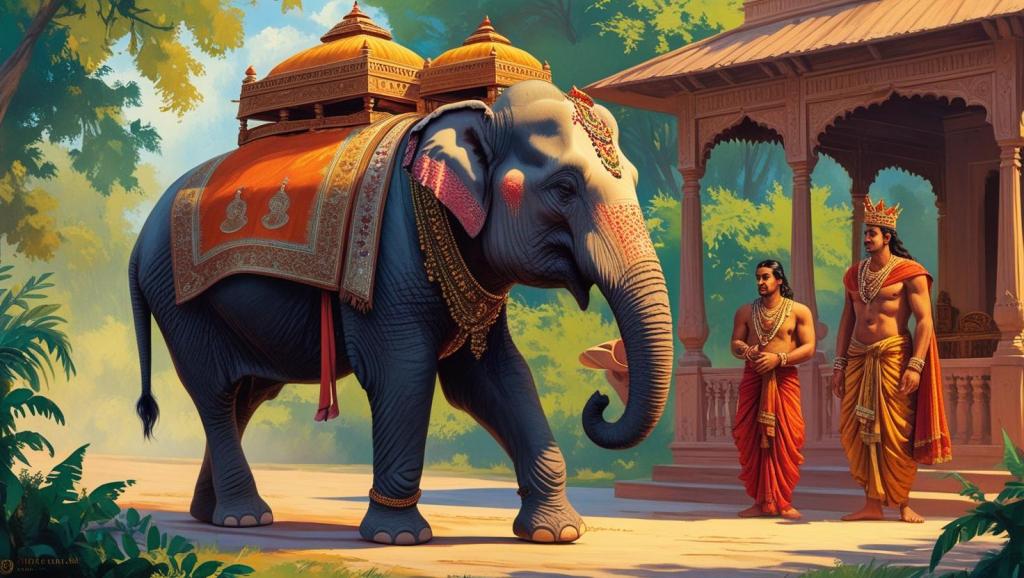
The following day, he also went to the forest to bring firewood. And on that day, he saw an elephant. On returning, he said to his master that he had seen an elephant. The master asked him for a comparison. The student said, “It is like a plough handle.” The teacher thought, “The end of an elephant’s trunk is similar to a snake’s head. Therefore it is a good comparison.” And he was satisfied.
On still the next day, he went again into the forest. There he saw sugarcane. When he returned, he told his master, “I have seen sugarcane.” The master again asked for a comparison. He said, “It is like a plough handle.” The master thought, “Sugarcane is long, and the trunk of an elephant is also long. Therefore the comparison is correct.” And he was satisfied.
The next day, when he went to the place where lunch was to be given, he ate curd and rice. After eating the curd and rice, he returned. He told his master, “I have eaten curd and rice.” His master asked for a similar thing to curd and rice. He said, “It is like a plough handle.”
The teacher had been satisfied with the previous three answers. But in this case he thought, “What a foolish man this is. No matter how hard I try, I will not be able to make him a wise man.” And he gave up his efforts to make the student a person with understanding.
The foolish student at that time is today KāÀudāyi. I who am the Buddha was his master at that time.
Saying so, he completed the discourse of the Jātaka story.
The moral: “Even if good luck is in an unwise man’s pocket, he will lose it.”
123. The Story of a Plough Handle [NanÄgalīsa-Jātaka]
Link: https://hhdorjechangbuddhaiiiinfo.com/2025/07/15/123-the-story-of-a-plough-handle-nanagalisa-jataka/
#Buddhisttalesforyoungandold #Buddhiststories #storiesforkids #moralstories #Buddha #Jatakastories #PansiyaPanasJataka #JatakaTalesofSakyamuniBuddha #JatakaTales
 頂禮 H.H. 第三世多杰羌佛- 眾善奉行