150. The Story of Sañjīva [Sañjīva-Jātaka]
150. The Story of Sañjīva [Sañjīva-Jātaka]

When the Buddha was in Jetavanārāma, the king Ajātasattu was friendly with Devadatta. Even though unrighteous and sinful, Ajātasattu was pleased with him. He built for Devadatta a temple in Gayāsīsa, which he gave to him. And he assisted him by giving him all the necessary perquisites. In the meantime, following Devadatta’s words, he sent the elephant NāÀāgiri to kill the Buddha and he sent bowmen to shoot at the Buddha. Many bad things such as these were done by him. After that, his father who was a very righteous king and who was one who had attained the stream entrance state of mind [sotāpanna], was killed by him through the persuasion of Devadatta.

Later, he heard that Devadatta had died and had gone to hell sinking down through the earth. On hearing this, he became afraid for his life believing that if anything happened to Devadatta, no doubt it would happen to him, too. He was very much afraid day and night. He spent the daytime in the routine activities of his daily life. But at night, when he went to bed, he dreamed that he was falling through the earth that had opened up and was shooting forth the fires of hell. From this, he became even more afraid as if he were a chicken that had its neck twisted and had been thrown into the hot sun to die. In this way, he suffered day and night despite his royal luxuries.

He had a keen interest in questioning the Buddha about the dream he was having, but he was reluctant to express that interest to Jīvaka. One day he saw the moonlight bright as if it were daylight, and he said to his minister Jīvaka, “The moonlight is so clear that one can see the distance of forty- five arrow shots as if it were daytime. It is not good to waste our time by staying here. This night is pleasant, calm, attractive, and beautiful. Let us go to a good ascetic, to someone like that, to listen to the Dhamma. I have now such an intention. Do you know to whom we can go?” The other ministers who heard him started to mention the names of the various religious masters to whom they each paid obeisance. Most of them were NigaÏæha-s. One minister said, “There is the ascetic PūraÏa Kassapa. He is a Buddha. Let us go to see him.” Another minister said, “It would be good to go to the Buddha Makkhali Gosāla.” Another minister said, “Instead of going to him, let us go to the Buddha Ajita Keśakambala.” Then some other minister wanted to go to the Buddha Kakudha Kaccāyana. After, another said, “I think it would be good to go to the Buddha Sañjaya Belaææhiputta.” The sixth one said, “I suggest that more than any other Buddha, NigaÏæha Nāthaputta is the best one to whom to go.”

In this way, all the ministers said what they thought, mentioning various NigaÏæha-s, all of who were like children [with regard to spiritual advancement]. The king did not listen to them seriously, thinking, “No doubt Jīvaka will respond  to  my  question.”   But  Jīvaka  was  silent.

Understanding his silence, the king addressed Jīvaka. He asked, “Jīvaka, these people are all praising their own Buddha-s whom each of them follows. Why do you not say something? Do you have no such a Buddha?”

Jīvaka heard this and got up from his seat. He paid respect toward the direction in which the Buddha was, and he recited the nine-fold virtuousness of the Buddha. He said, “Such a virtuous, omnipresent one is now living in my mango park followed by 1,800 monks. Therefore, I suggest that it would be good for your lordship to go there.”

On listening to him, the king said, “It is wonderful. Let us go there.” And he made arrangements to go there by elephants together with his retinue. He went to the Buddha in royal magnificence. He approached the Buddha’s residence and dismounted his elephant. He then came to the followers of the Buddha who were wearing neat and clean clothes, who had tranquil faculties, who all were seated still with arms and feet close to their bodies, and of whom not even one sneezed or coughed. He was very pleased by seeing this. First he paid his respects to the monks, and then to the Buddha. He sat down and said, “Sir, I would like to ask a question.” “Well, your lordship, ask your question.” Then the king said, “Venerable sir, what is the result that one can gain by being a monk?” The Buddha said the discourse called the Sāmaññaphala Sutta divided into two sections [bhāÏavāra-s] and into 500 points to be explained [grantha-s].23

After this preaching, Ajātasattu knelt down in the presence of the Buddha to pay his respect and said, “Revered sir, please excuse my wrong deeds that I have done out of ignorance.” Buddha accepted his apology, and the king went away.

Then the Buddha addressed the monks, saying, “Oh monks, this King Ajātasattu by being associated with a bad person both killed his father and at the same time ruined his chance for future salvation. If he did not do so, he would today be one who has entered into the stream entrance state of mind [sotāpanna].”

The next day, the monks assembled in the preaching hall were discussing how King Ajātasattu had lost his good fortune to become a Sotāpanna. The fully enlightened one entered the preaching hall then and asked the monks, “Oh monks, what were you discussing before I came here?” The monks mentioned the previous day’s incident. And the Buddha said, “Oh monks, not only in this life but even in the past, Ajātasattu by associating with evil ones created for himself misfortune.” The monks invited the Buddha to disclose the past story.

“At one time, when King Brahmadatta was ruling in Benares, the Enlightenment Being was born in a Brahmin family in that city. When he was grown, he went to a well- known teacher who used to teach in the city and began to study under him. After studying under him, he started to teach students on his own.

“While he was teaching students like this, he had a student named Sañjīvaka. He taught him a spell that could be used to bring the dead to life. And when they gain life, they can walk—but only a short distance. He did not teach him the spell to immobilize them if they come near.

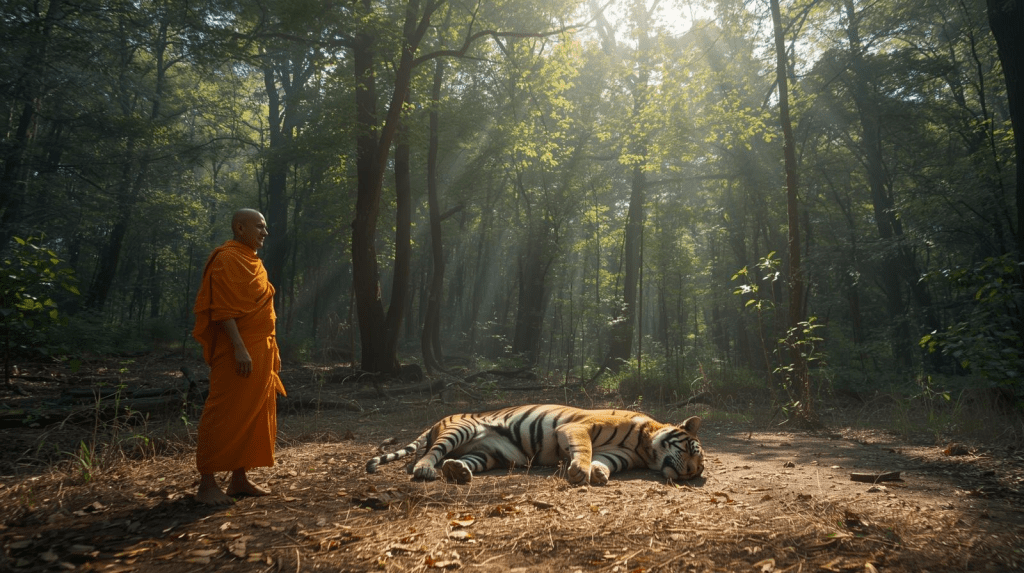
“Once, that student went with a group of other students to fetch firewood from the forest. On their way, they saw a dead tiger on the ground. Sañjīvaka said to the other students, ‘Do you want to see my power? I will bring this tiger back to life.’ The other students said, ‘How can you bring a dead being back to life? It will never happen.’ Sañjīvaka said, ‘Just look at what I do.’ And he started to recite the spell. The other students said, ‘Who knows what will happen!’ And they climbed up trees.

“While Sañjīvaka was repeating the spell, he threw some pebbles toward the dead body of the tiger. When he was throwing the pebbles, the tiger started to get up. He came forward, and jumping up on the very person who was chanting the spell, he killed him. The tiger that had been brought back to life also fell dead at that spot.

“The other students collected the firewood and returned to where they were studying. They told the teacher what had happened. On hearing the news, the teacher said to the students, “It is not good to help an evil friend. If you do so, such is the result.” And he advised them to live generous and peaceful lives. He himself lived such a life, did many meritorious deeds, and acquired much merit. At the end of his life he died, and was born in heaven.

“Sañjīvaka was King Ajātasattu at that time. The teacher of Benares was I who have become the Buddha.” In this way, the Buddha ended the story of Sañjīva.

23 The Sāmaññaphala Sutta is to be found in the Dīghanikāya, but it is not divided there into two sections.

The moral: “Choose your friends wisely.”

150. The Story of Sañjīva [Sañjīva-Jātaka]

Link: https://hhdorjechangbuddhaiiiinfo.com/2026/01/27/150-the-story-of-sanjiva-sanjiva-jataka/

#Buddhisttalesforyoungandold #Buddhiststories #storiesforkids #moralstories #Buddha #Jatakastories #PansiyaPanasJataka #JatakaTalesofSakyamuniBuddha #JatakaTales #SakyamuniBuddha’sPast

149. The Story of One Leaf (The Story of Shining Forth) [EkapaÏÏa-Jātaka (Virocana-Jātaka)]

149. The Story of One Leaf (The Story of Shining Forth) [EkapaÏÏa-Jātaka (Virocana-Jātaka)]

When the Buddha was living in the city of Vesāli, he lived in the mansion called, “The Gabled House”. At that time, the city of Vesāli was surrounded by three walls each the distance of sixteen Gāvuta-s21 one from the other, and each having gates and watchtowers. In addition there were 7,707 crowned kings to rule the country, with an equal number of viceroys, generals, and treasurers. Among these there was one bad prince, who was known as Wicked [Duææha]. He was aggressive, rough, and if one would speak something to him, he would use insulting words toward that one. Everyday he was like a snake that had been beaten with a stick. He was consumed with anger, and this shone forth to others. When people came to see him, they did not get a chance to speak more than two or three words. Parents, younger brothers, other relatives, and even his own children were uncomfortable in his presence. His wife and all his friends were afraid of him as if he were a snake that bit off flesh little piece by little piece, or as if they had come to a forest in which there were thieves, or as if they had seen a demon. Every time they saw him, they were in fear.

On hearing of this from someone, the Buddha went to see him and advised him: “A man who behaves fiercely like you, no doubt will be reborn in the fourfold hell and suffer from birth to birth. When people get angry, their face is unpleasant looking even though it had been beautiful like a lotus. It looks like a golden mirror covered with filth. In such anger, men hit themselves, or die by hanging themselves with a rope around the neck, or die falling down off a high precipice. By whatever way he dies, in his next birth he will be reborn in hell. After suffering a lot in hell, whenever he gets a human birth, he will suffer from the day of his birth with eye diseases, ear diseases, and so forth, endlessly. If he lives with loving kindness toward living beings, or with gentleness, compassion, and kindness, then he will not be confronted with such situations. He will be able to enjoy all kinds of happiness without such sufferings.”

From the time the prince heard this, he gave up his pride and anger. He became gentle and restrained like a cobra whose venom had been extracted, like a crab whose claw had been broken, and like a bull with cut horns. If someone hit him, or hurt him, or verbally abused him, he kept silent, not even asking whom it was who did this. If someone behind him mocked him or laughed at him, he did not even turn his head to see who it was. He behaved in this way from that point on.

One day the monks assembled in the preaching hall were talking about this. One monk said, “It is amazing that even his parents constantly advising the prince could not change him. But the Buddha tamed him with a single admonition as a mahout tames an elephant.”  Then another monk said, “It is commendable, of course, that a horse trainer breaking in his horse guides his horse from east to west, and south to north, according to his will. Just so an elephant trainer and an ox trainer. Also, in the same way, the Buddha goes to wherever there are beings, whether in the human world, heaven, or the Brahma world, and guides them aright. Who can do like that except the Buddha?” Then the Buddha entered, and said, “Oh monks, what were you talking about before I came?” The monks told him they were talking about the taming of the prince. The Buddha said, “Not only today, even in the past I tamed him with a single admonition.” And the monks invited the Buddha to disclose the hidden story.

The Buddha disclosed the story:

At one time King Brahmadatta was ruling the city of Benares. At that time the Enlightenment Being was born in a well-known Brahmin family. After his parents’ death, he renounced their wealth and went to the Himalayan Mountains to become an ascetic. After a while, he returned to Benares in search of salt and sours.22 He wandered the streets of Benares for alms.

The king saw him walking on the street and sent one of his ministers to bring him. The minister went to him and told him of the king’s invitation. The ascetic said to the minister, “Sir, I have no previous acquaintance with the king. I live in the Himalayan Mountains as an ascetic. Further, since I am an ascetic, I have no close association with him. Therefore, why should he invite me to his palace?”

Hearing this, the minister returned to the palace and said to the king, “Your lordship, he will not come!” Then the king said, “Tell him that I have no close association with any ascetic. Further, up to now, I have not seen an ascetic. Therefore, please come.” Saying so, he sent the minister for the second time.

The ascetic, on hearing this, came to the palace. The king paid him obeisance and asked, “Where do you go, and where do you live?” The ascetic said, “Your lordship, I live in the Himalayan forest. And as it is time to observe the rainy season retreat, I am searching now for a place to live.” The king, hearing him, said, “Please live in my pleasure garden.” Saying so, he gave him food to eat.

After that, the king led the ascetic to his pleasure garden. He requested the watchman to make arrangements for the ascetic to stay there, and told him to look after the ascetic very carefully. Giving the watchman this responsibility, the king returned to his palace. Since then, the king would go two or three times a day to see the ascetic.

At this time, the king had a son called Wicked [Duææha]. The young prince was very rough and arrogant, and always acted with anger as if he were a snake hit with a stick. He paid no attention to the words of his parents, his relatives, his friends, or others. The king, worried about this situation, took the prince one day to see the ascetic. He said, “Reverend sir, my son is very rough and arrogant. Kindly tame him.” Saying so, the king handed over the prince to the ascetic’s care, and he went away.

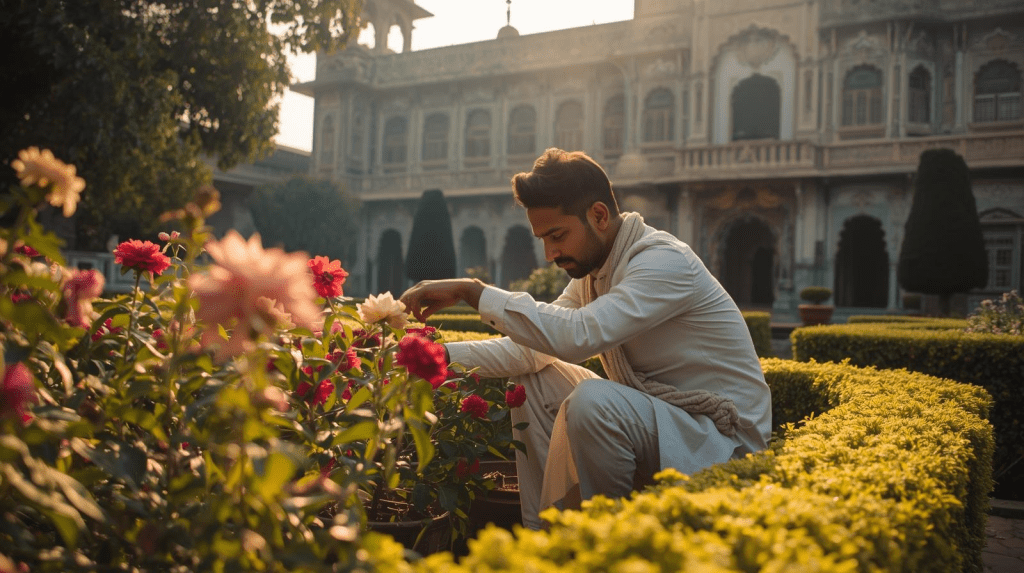
The ascetic became friendly with the prince. Holding his hand while walking in the pleasure garden, he showed him a young neem tree shoot that had only two leaves on it. He said, “Look at this neem tree shoot. Take one of its leaves and taste it.” The prince did so, and as the leaf was very bitter, he spit it out with saliva. He then uprooted the young tree with one hand, and said, “If this is bitter like this now, when it becomes a big tree no doubt it will cause unhappiness for many.”

The ascetic said, “Look at this. The neem tree was bitter so you uprooted it. In the same way, your father’s ministers think of you that you are very rough and arrogant, and that if you become the king no doubt you will do many disastrous things. Thinking so, they too will kill you. Therefore, you must decide not to be rough, arrogant, and bad to people, and must live in a righteous and gentle way.” The ascetic advised the prince to be tame in this way.

On hearing this advice, the prince started to lead a life that was not rough and arrogant. After the death of his father, the king, he passed a very righteous and peaceful life and the people of the country prospered. In the end, he passed away leading a righteous life.

“At that time, the wicked prince was the wicked prince of today. The king at that time was the Venerable Ānanda. And the ascetic was I who am today the Buddha who is supreme in the whole world.” Saying this, the Buddha ended this Jātaka story.

The moral: “Wise advice can help one change.”

21 1 Gāvuta = ¼ Yojana, or a little less than 2 miles.

22 Salt and sours are not obtainable in the forest. In ancient times it was believed that these things were necessary to maintain one’s bodily health.

149. The Story of One Leaf (The Story of Shining Forth) [EkapaÏÏa-Jātaka (Virocana-Jātaka)]

Link: https://hhdorjechangbuddhaiiiinfo.com/2026/01/20/149-the-story-of-one-leaf-the-story-of-shining-forth-ekapaiia-jataka-virocana-jataka/

#Buddhisttalesforyoungandold#Buddhiststories #storiesforkids #moralstories #Buddha #Jatakastories #PansiyaPanasJataka #JatakaTalesofSakyamuniBuddha #JatakaTales #SakyamuniBuddha’sPast
148. The Story of a Jackal [Sigāla-Jātaka]

148. The Story of a Jackal [Sigāla-Jātaka]

The Buddha disclosed this Jātaka story while he was in the Jetavanārāma in Sāvatthi. While he was there in Jetavanārāma, there were 500 new monks who had just come into the order. In the middle of a certain night, in all their minds, they all had lustful thoughts. Buddha, at that same time, was examining the minds of his disciples, thinking out of compassion, “What do my disciples have on their minds?” He realized that these 500 new monks all had lustful thoughts, and he thought, “This is as if a group of enemies have entered into a Universal Monarch’s city. While I am living in my temple, these monks have developed lustful thoughts in their minds. I have to remove these lustful thoughts immediately by preaching to them.” Thinking so, he addressed the Venerable Ānanda.

Venerable Ānanda was the Buddha’s chief attendant for 25 years. Among other things, he helped the Buddha by watching over the temple during the night. He was guarding the temple, walking around carrying a lamp in his hand. On hearing the Buddha address him, he came to the Buddha and said, “Yes, sir.” Meanwhile, the Buddha was thinking, “It would be good to summon all those monks who were experiencing confusion, and it would be good to preach to them to eliminate their unwholesome thoughts. But if I preach to them, they will know that the Buddha realized that they had bad thoughts on their minds, and they will be agitated on account of that. They will not be able to listen to the Dhamma. When the mind is agitated, it cannot realize the Dhamma. My preaching will not help them realize a higher state. Therefore, I will preach to all the monks at the same time.” He then asked the Venerable Ānanda to summon all the monks.

Hearing the Buddha’s words, the Venerable Ānanda took the keys for the doors of all the chambers in the monastery, and went from door to door informing everyone of the Buddha’s request. The monks all came to the preaching hall where the Buddha was like a golden rock covered by a golden cloth, and they paid obeisance to him by kneeling down, and then sat around him.

The Buddha was shining with rays of the six colors18, which became like an aura around him equal in brightness to a thousand suns and a thousand moons. Sitting, with such an appearance, he started to preach. “Oh, monks, there are three types of thoughts that monks must not think—lustful thoughts, angry thoughts, and injurious thoughts. If you think even a little about women, it may cause you to acquire much demerit. The reason is this: If a snake bites you, the wound is very small, but the venom goes through your whole body and kills you. From a small place where lightning has struck, many trees and creepers may be caused to burn and turn into ashes.  Lustful thoughts and women are also like that. By being attached to women, the same thing may happen as what happened to a jackal who became attached to an elephant carcass that he thought could give him unlimited meat.” The monks asked about the story of the jackal. The Buddha then disclosed this story of the past:

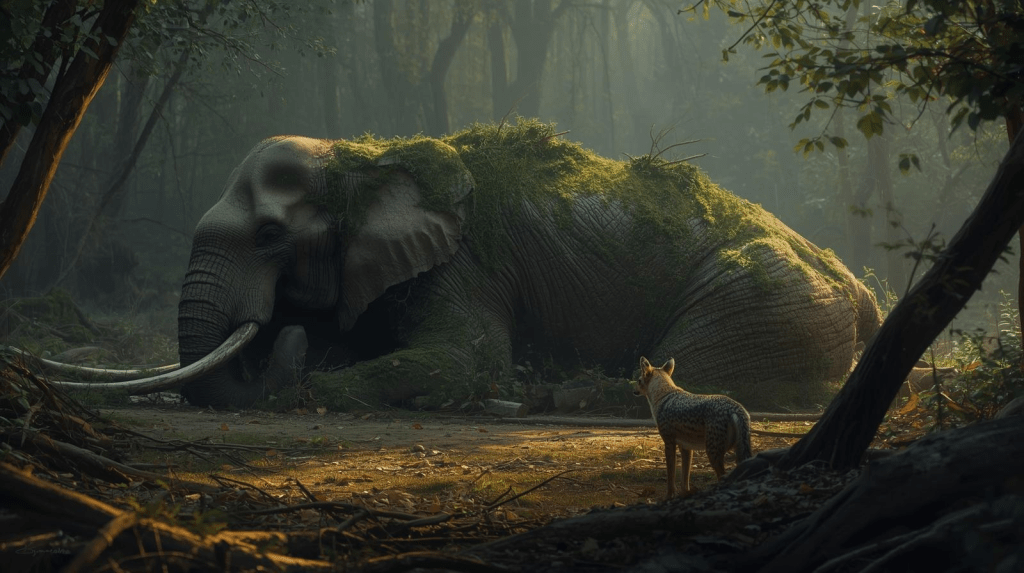
At one time when King Brahmadatta was ruling in Benares, the Enlightenment Being was born as a jackal living in the forest.   Once, he saw the dead body of an elephant lying in the forest. He thought, “This is enough food for me to eat for my whole lifetime. I would not have to go anywhere else in search of food. Thinking so, he approached the elephant carcass and took a bite of the trunk. It felt as if he were biting a plough handle. Then he bit the tusk. It felt as if it were the hard core of hard wood. Then he bit the stomach. It felt as if it were bamboo matting. Then he bit the anus. It felt like an oil cake. Then he was satisfied, thinking that he had finally found soft meat. He then ate his way into the belly and decided he could live there as if in a den with plenty of meat to eat and blood to drink. When he got sleepy, he would place his head on the lungs as if two pillows and he would lie on the liver as if it were a soft mattress. While he was living like this, he thought, “Why should I ever leave this place?” He decided to live inside the elephant carcass permanently, and he spent days on end in it. After such a situation went on for days on end, there came a severe drought. The elephant’s skin dried and shrunk. The whole carcass of the elephant also dried up and shrunk. The meat became very tough and there was no longer any blood. Inside, the hollow in which he was living became dark as if it were the dark space between worlds.

The jackal became afraid, and started to think about a way to get out. He could not find an exit, and so he ran to and fro, and jumped up and down, until he became exhausted. In the meantime, there was a rainfall. The elephant carcass became wet and absorbed water, and light came through the hole through which he had originally entered like a star. The jackal backed up as far as the head of the elephant and darted toward the hole with all his strength as fast as he could. When he jumped like that, all the fur from his body stuck inside the hole in the elephant and his body became smooth like the skin of a Palmyra palm. Seeing his body like this, be became fearful and thought, “Due to my strong craving, I have become like this. I will never again be greedy or eat meat from an elephant carcass.”

Saying this, the Buddha preached the four noble truths.

He finalized this story, emphasizing them.

After the disclosure of this Jātaka story, the 500 monks, ending their old defilements, became Arahant-s. Other monks attained to the mental status of those who have entered the stream entrance state of mind [sotāpanna-s], of those who have attained the once-returner state of mind19 [sakadāgāmin-s], and of those who have attained the non- returner state of mind20 [anāgāmin-s], and this Dhamma sermon further became very helpful to many others.

The Buddha added, “I was born as the jackal at that time.”

The moral: “Uncontrolled greed leads to difficulty.”

18 The six colors are blue, yellow, red, white, amber, and all the colors mixed.

19 That is, of those who will not be reborn on earth more than once.

20 That is, of those who do not return, those who are not reborn.

148. The Story of a Jackal [Sigāla-Jātaka]

Link: https://hhdorjechangbuddhaiiiinfo.com/2026/01/13/148-the-story-of-a-jackal-sigala-jataka/

#Buddhisttalesforyoungandold #Buddhiststories #storiesforkids #moralstories #Buddha #Jatakastories #PansiyaPanasJataka #JatakaTalesofSakyamuniBuddha #JatakaTales #SakyamuniBuddha’sPast
147. The Story of Safflower [Puppharatta-Jātaka]

147. The Story of Safflower [Puppharatta-Jātaka]

At one time the Buddha was living in Jetavanārāma in Sāvatthi. He disclosed this Jātaka story on seeing a monk disturbed by infatuation with his former wife. The Buddha asked him, “Why, monk, have you become so disturbed with infatuation?” He said, “Your lordship, my former wife is very clever in cooking the daintiest foods, and in other womanly household arts.” The Buddha said, “Oh monk, because of her you were impaled in the past, and suffered rebirth in hell.” On hearing these words, the other monks requested the Buddha to disclose the story of the past.

This is how the Buddha stated the story:

At one time, King Brahmadatta was ruling the kingdom of Benares. At this time, the Enlightenment Being was born as an aerial deity. Once, when people were celebrating the summer Kattikā festival, a certain poor man in the city had only one cloth to wear for both him and his wife for the festival. Just before the festival, he tore the cloth into two pieces, washed and dried them, and folded them over and over a hundred times until they were small. On the first festival day, he took them out, unfolded them, and gave one of the pieces of cloth to his wife to wear. She said, “I would like to have a cloth to wear that is colored with safflower.

While wearing such a safflower colored cloth, I want to go into the street with you and kiss you.” The husband said, “What are you saying? I am a poor man. I do not have safflower colored cloth. Here is the white cloth that I kept clean after washing it. Wear this cloth as your skirt, and let us go and play in the street.” Then his wife said, “No. I do not want to go and play without wearing a safflower colored cloth. If you want to play in the street with a woman wearing a white cloth, then take your cloth to another woman, and play with her.”

On hearing this, he pleaded with her again and again. His wife said, “If a man has a will, what can he not do. Why cannot you go to the king’s flower garden and bring some flowers from his garden?” The husband said, “Oh, what are you saying? I not only cannot bring flowers from the king’s garden. I cannot even see it.” The wife said, “Why cannot you steal some flowers during the night?” Then, on account of his wife’s pleading, the husband could not say “no” to her. Finally, he agreed to go and steal the flowers. He went out from the city to the king’s flower garden, and jumped up on the fence surrounding it. The security guards heard the noise from this, and went to where he was. They seized the husband, handcuffed him, and the next morning they took him to the king. The king sentenced him to death saying, “Why do you show him to me? Take him, go to the execution ground, and impale him.” The guards took him to the execution ground while the execution drums were being beaten, and impaled him alive on a stake. He suffered the pains of the impaling, and while he was still living, crows came and pecked out his eyes.  Even though the pain was very severe, he could not stop thinking about his wife. He thought, “All my good wife wanted to do was to go to the festival and enjoy herself while wearing a safflower colored cloth.” While he was thinking such thoughts, he died and was reborn in the hell where there is burning fire.

The husband and wife at that time are today this monk and his former wife. The aerial deity who saw this happen as it was is today the Buddha who preaches to you now.

The moral: “Unending craving causes much suffering.”

147. The Story of Safflower [Puppharatta-Jātaka]

#Buddhisttalesforyoungandold #Buddhiststories #storiesforkids #moralstories #Buddha #Jatakastories #PansiyaPanasJataka #JatakaTalesofSakyamuniBuddha #JatakaTales #SakyamuniBuddha’sPast

Link: https://hhdorjechangbuddhaiiiinfo.com/2026/01/06/147-the-story-of-safflower-puppharatta-jataka/

146. The Story of a Crow [Kāka-Jātaka]

146. The Story of a Crow [Kāka-Jātaka]

At one time Buddha was living in the Jeta Grove monastery. There was a group of aged gentlemen landowners, and jointly they did meritorious deeds. One day, they got together and while they were chatting, they thought that as they were in old age, it would be good to become ascetics, and by doing so they would be able to obtain Arahant-ship [sainthood]. They approached the Buddha and said, “Venerable sir, kindly ordain us. If you can do so, it would be a great thing for us.” Buddha agreed to their request, and they were ordained.

After their ordination, they made little huts for themselves beside Jetavanārāma. And as they had been ordained in old age, they could not study anything. Even by practicing meditation in accord with the Buddha’s guidance, they failed to achieve any results.17 When they went on alms rounds, they usually went to their own former family members’ homes.  They would take what they obtained to the home of the former wife of the chief monk of the group and eat it there, obtaining from her special sauces cooked by her for their food. In the course of time, this chief monk of the group’s wife fell into sickness and died. On hearing this news those old monks, lamenting that the old woman who was skilled in cooking had now passed away, started to cry together.

While they were crying together, other monks heard their cries and came to see what the trouble was. They asked the old monks why they were crying. The old monks said, “We cry because our benefactress who was clever in cooking sauces for us has died. It is because of this that we cry.” After hearing this, the monks who came in the evening to the preaching hall were talking about this when the Buddha entered. Buddha asked, “Monks, what were you talking about before my coming?” The monks mentioned the news about the passing away of the wife of the chief monk of the group of old monks, and how the old monks were crying.

Then the Buddha said, “Oh monks, this old chief monk and the group of old monks cry not only in this life. They did so even in the past when the old chief monk’s wife died, and they were trying to bail out the water from the ocean and they failed to do it. At that time, because of the help of a good advisor they did not die on account of their futile exertions.” The monks requested the Buddha to disclose the past story.

The Buddha said:

At one time, King Brahmadatta was ruling in Benares. At that time, the Enlightenment Being was born as a divine being of the ocean.

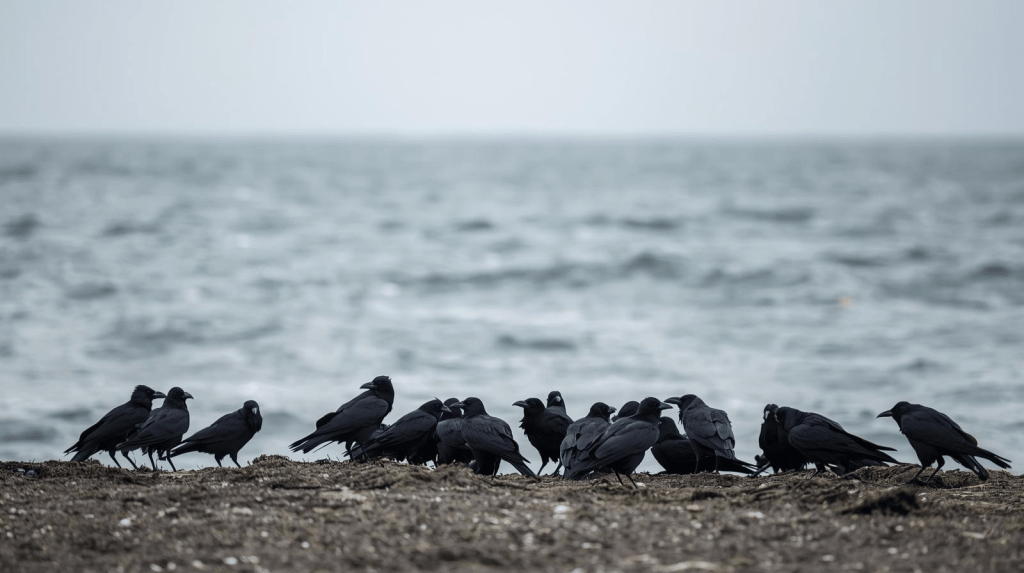
Once, some people got together and made offerings to deities and Nāga-s who lived in the ocean with rice, meat, and alcoholic beverages in accord with vows they had made. They placed all these food items on the sand of the beach. When they left, a certain crow and his hen, wandering on the sand, saw these food items there and ate and drank as much as they could. They became intoxicated thereby from both the alcoholic beverages and the rich food. Because they were intoxicated, they decided, using poor judgment, to take a bath in the ocean. While they were bathing in the ocean, a big wave came. It swept the hen-crow out to sea, and a big fish came and swallowed her. On seeing this, the male crow thought that a wave had swallowed his hen. He cried with sorrow.

When they heard his cries, other crows came around and they asked, “Why are you crying?” He told them, “Your friend, the hen-crow who was my wife, was taken by the ocean.” The other crows also became very upset. They said, “We have such a large number of crows here. Why should we not just bail the water out of the ocean?”

They then all got together and started to bail out the water of the ocean with their beaks. In this way, they tried for a long time to empty the ocean until they became tired. They then stopped to rest on the sand of the beach, with their beaks being sore from the salty water, their throats being dry, their cheeks being irritated, and their eyes being red from having gotten salt water in them. Very tired from their task, they began to cry, “We have lost our beautiful hen-crow who had a beautiful beak like a parrot, a beautiful color like a peacock, and a sweet voice like a cuckoo. Our beautiful hen- crow was stolen by the thief-like ocean.” Saying so, they cried in one voice.

The Enlightenment Being, who had been born as a divine being of the ocean, on hearing the noise of the crows, assumed a dreadful disguise as a bird of prey. Coming there, he made them go away. In this way, he stopped them from being sad any longer.

The Buddha said:

The hen-crow at that time was the dainty woman who today cooked sauces for the old monks. The male crow was the chief monk of the group of old monks. The other crows were the group of old monks. And the divine being of the ocean of whom they were made to be afraid, thereby causing them to fly away, was I who am today the Buddha.

Thus he finished the story.

The moral: “Grieving for the lost is vain.” Also,

“Think before acting out of grief.”

17 When a person gets old, his mind is not as sharp as when he was young, his memory does not work as well, and he cannot concentrate the same as a young person. Because of this, it is difficult for him to study or meditate. Ideally, a person should be ordained when he is young.

146. The Story of a Crow [Kāka-Jātaka]

Link: https://hhdorjechangbuddhaiiiinfo.com/2025/11/13/146-the-story-of-a-crow-kaka-jataka/

#Buddhisttalesforyoungandold #Buddhiststories #storiesforkids #moralstories #Buddha #Jatakastories #PansiyaPanasJataka #JatakaTalesofSakyamuniBuddha #JatakaTales #SakyamuniBuddha’sPast

145. The Story of Rādha [Rādha-Jātaka]

145. The Story of Rādha [Rādha-Jātaka]

At one time when Buddha was living in the Jeta grove, one monk who was infatuated with his former wife after his ordination was ready to disrobe. Buddha heard this. The reason for disclosing the following Jātaka story comes in the Indriya-Jātaka [No. 423] further on.

[At one time, a householder when he was advanced in years wanted to give up his lay life and be ordained. When he was ordained, he felt that it was difficult to lead a life without a woman as in monkhood. According to his foolish thought of becoming a layman again, the chief ascetic said, “If you disrobe, you will have to suffer a lot. …” Finally, the monk who wanted to disrobe realized, as his teacher had explained, “If I go and live a lay life again, I will have to kill animals for meat. Then I will be reborn in hell and I will have to suffer. In my lay life, my present physical strength will not last forever. I will suffer when I am physically weak.” Thinking such thoughts, he gave up his thought to be a layman and he began to meditate as before. He knelt down, begging pardon in the presence of his teacher, and he started to meditate. … Finally, he meditated and learned to control his lust, he gained mental absorption, and he was reborn in the Brahma world.]

To the monk who had become infatuated with his former wife and was trying to disrobe, the Buddha said, “Not only in this life are you trying to do this, but such was so also in a former life. Even in the past, you could not control your unwholesome lust. Therefore it is not surprising that you have such urges.” Saying so, the other monks requested the Buddha to disclose the past story, and Buddha related this story:

At one time, a king called Brahmadatta was ruling in Benares. At that time, the Enlightenment Being was born as a parrot.

A Brahmin captured the Enlightenment Being, who was a parrot, and his younger brother also. He brought them to his home. The Enlightenment Being was named Poææhapāda, and his brother was named Rādha. He brought both up as his own children.

Once, the Brahmin wanted to leave his home on business. He summoned his two parrot children and said to them, “If your Brahmin mother does something wrong when I am gone, you must admonish her not to do so. If you do not think you can stop her misconduct, say nothing.” Saying so, he left.

From that time, there were limitless people coming in and going out of the house. On seeing this, the Enlightenment Being’s brother said to the Enlightenment Being, “When the Brahmin left, he asked us to admonish his wife if there was any wrongdoing. Shall I admonish her?” The Enlightenment Being parrot said, “My brother, you are not yet matured. You say this because you do not understand, and have no experience with women. During the ten hours of the morning, the number of men who come here are not countable. In the ten hours of the afternoon, it is also difficult to say the number of those people who come. Therefore, in such a situation, what advice can we give?” He asked his younger brother, therefore, not to speak. After a few days, the Brahmin returned.

When the Brahmin returned, he asked the Enlightenment Being, “How was my wife’s behavior?” The Enlightenment Being said, “There was a myriad of bad behavior. She behaved in this way because she does not love you. Therefore, it is not good to keep her in your home.” He further said, “From this point on, it is not good for myself and my brother to stay here.” And he thought that he should leave. He summoned his younger brother, went to the Brahmin, knelt down in homage, and begged pardon for his faults. They then returned to the forest.

The Buddha finalized this story, saying, “The Brahmin woman at that time was the former wife of the monk today. The Brahmin was this monk. The parrot Rādha, the younger brother, was the Venerable Ānanda. And the parrot Poææhapāda was I who am today the Buddha.”

The moral: “Misplaced lust will not bring you to the correct path.”

145. The Story of Rādha [Rādha-Jātaka]

Link: https://hhdorjechangbuddhaiiiinfo.com/2025/11/13/145-the-story-of-radha-radha-jataka/

#Buddhisttalesforyoungandold #Buddhiststories #storiesforkids #moralstories #Buddha #Jatakastories #PansiyaPanasJataka #JatakaTalesofSakyamuniBuddha #JatakaTales #SakyamuniBuddha’sPast

143. The Story of Shining Forth [Virocana-Jātaka]

143. The Story of Shining Forth [Virocana-Jātaka]

At one time when Buddha was living at the Jeta Grove, Devadatta came to the Buddha and requested him to impose four new practices on all the monks. The first was that all monks should wear robes stitched together from the clothing of the departed that could be picked up in the cemetery. The second was that all monks should live under trees, not in houses. The third was that monks should not eat meat or fish during their lifetime. The fourth was that monks should live all the time in the forest, not in a village or city. The Buddha responded that he had monks in his community who had been very rich, and who had before their ordination comfortable lives. Therefore, those who wish to do as Devadatta suggests, let them do it. Those who do not so wish, let them not do it. He was not going to impose such regulations as might be objectionable to them. Devadatta got angry because the Buddha refused to do as he wanted. He took away 500 monks who were followers of the Venerable Sāriputta and who had only recently been ordained, and went with them to Gayāsīsa. He said that he had not gotten anything from the Buddha, not even a blade of grass. And he created a schism in the order. With the 500 monks, he went to Gayāsīsa north of the Ganges River, and claimed there that he also was a Buddha.

At one point, the Buddha came to understand that the 500 monks who had gone off with Devadatta had the potentiality at that time of becoming Arahants on account of their previous births. Understanding so, the Buddha summoned the Venerable Sāriputta and Moggallāna and requested that they go to Devadatta’s community and preach to the 500 monks, bringing them back into the Buddha’s fold. Then the two chief disciples of the Buddha, Sāriputta and Moggallāna, left for Devadatta’s community.

Devadatta saw from afar the two chief disciples coming toward him, and he imagined that they were giving up the Buddha, and were coming to join his community. Thinking so, he claimed that like the Buddha he too had back pain. He requested that in his stead, they might preach to the community. He lay down near the preaching chair and went to sleep. The Venerable Sāriputta preached then, and all the 500 monks attained Arahantship. They all then returned with him and Moggallāna to the Buddha at the Bamboo Grove.

Kokālika, the chief disciple of Devadatta, came to Devadatta’s temple and saw that it was empty of people. He went into the temple, and saw Devadatta sleeping there. He got angry and said to Devadatta, “You are sleeping deeply while your disciples have been taken away by the two chief disciples of the Buddha. Our temple is empty now.” With his left foot, he kicked Devadatta’s chest. This caused Devadatta to vomit blood.

When the Venerable Sāriputta and Moggallāna came to the Buddha with the 500 monks, the Buddha asked, “How was Devadatta when you were there?” The Venerable Sāriputta said, “Revered one, when we were there, Devadatta was pretending to be a Buddha. He was preaching.” And Sāriputta then explained all that had happened, including Devadatta’s being kicked by Kokālika. The Buddha heard that news and said, “Sāriputta, not only today, but also in the past has Devadatta imitated me. And by doing so, he fell into a big calamity.” The Venerable Sāriputta then invited the Buddha to disclose the former story.

This is how it was:

At one time, King Brahmadatta was ruling in Benares. At that time, the Bodhisatta was born as a lion. He lived in a den hollowed into a big rock.

One day, he left his den and killed a water buffalo, eating the meat. He went to a nearby pool and drank some water. Returning to his den, he met a jackal. The jackal did not see the lion till the lion came very close. He became very much afraid as he had no way of fleeing. Kneeling down, he paid obeisance to the lion. The lion said, “Jackal! Why do you want to kneel down like that?” The cunning jackal said, “Oh, your lordship. I did so, as I would like to serve you.” The lion, who was the Enlightenment Being, then took him to his den in the rock and showed him a place to lie down. He said, “Whenever you see any animal you would like to eat in this area, let me know. Then I will kill him, and we will both have food to eat.” The jackal said, “Yes, sir.”

The jackal followed this advice. And the jackal and lion both ate the same food. As the jackal got enough food from the lion’s killing animals, he became very fat and strong.  He then became conceited.  “The lion is a beast.  I also am a beast. Why should I eat meat killed by someone else? I will kill animals for myself.” Thinking so, he went to the lion and said, “Your lordship! I have eaten the meat of the animals that you killed. From now on whatever you kill, you can eat yourself.” The lion said, “But you cannot kill animals such as elephants, as I do.” He said this several times. Even though the lion prevented the jackal from hunting on its own several times, the jackal did not want to listen. Eventually, the lion said, “Let him learn a lesson.” The jackal said, “You should not go to hunt in the morning. I will go.” The lion agreed.

In the morning, the jackal got up and came out from the den. He shook his body three times, as the lion always did. And as the lion always roared, he shouted. As the lion would do, he looked in the four directions and he saw an elephant. He ran, and jumped up on the elephant.

When he jumped up on the elephant, he could not remain on the elephant’s back. He fell down in front of the elephant. The angry elephant crushed him under his foot. He trampled the carcass, collected the bones in one pile, dropped dung on them, and urinated on them. Then he trumpeted, and went away.

The lion saw this and thought, “The jackal deserved this lesson.” Thinking so, he went into his den and sat down.

“The jackal who was crushed by the elephant at that time was Devadatta. And I, who today am the Buddha, the enlightened one, was the lion at that time.” Saying so, he ended the Jātaka story of shining forth.

The moral: “One must be true to his nature.”

143. The Story of Shining Forth [Virocana-Jātaka]

Link: https://hhdorjechangbuddhaiiiinfo.com/2025/11/13/143-the-story-of-shining-forth-virocana-jataka/

#Buddhisttalesforyoungandold #Buddhiststories #storiesforkids #moralstories #Buddha #Jatakastories #PansiyaPanasJataka #JatakaTalesofSakyamuniBuddha #JatakaTales #SakyamuniBuddha’sPast
142. The Story of a Jackal [Sigāla-Jātaka]

142. The Story of a Jackal [Sigāla-Jātaka]

When the Enlightenment Being was living in the Bamboo Grove temple of Rājagaha, one day old monks assembled in the preaching hall and were discussing Devadatta’s attempts to kill the Buddha. They said, “Devadatta sent the elephant NāÀāgiri to kill the Buddha, but he failed to do so. Then he tried to kill him by pushing rocks from Gijjhakūæa Mountain. And then he sent bowmen to shoot at him. With many such strategies, he was not able to kill the Buddha.” While they were discussing this, the Buddha entered the hall and asked, “Monks, what were you talking about before my arrival?” The monks answered, “Revered one, we were discussing about the attempts of Devadatta to assassinate the Buddha.” The Buddha said, “Oh monks, it is not only in this life that Devadatta has tried to kill me. Even in the past he tried and could not do so.” The monks invited the Buddha to disclose the ancient story. The Buddha then delivered this story of the past:

At one time, King Brahmadatta was ruling in Benares.

At that time, the Enlightenment Being was born a jackal. He lived in a certain cemetery followed by thousands of jackals. Once there was a certain festival in Benares for which people prepared plenty of meat and toddy that they kept everywhere here and there. The people partied day and night until midnight. But they could not finish the prepared toddy. One man came asking for meat and toddy. Many people said, “There is no more meat.” But a certain man said, “While I am here, why do you say there is no meat?” Saying so, he took a club. As the gates of the city were closed, he went out through the sewer ditches, and went to a nearby cemetery. He lay down on the cemetery ground as if he were a dead body. In the meantime, the Enlightenment Being, who was a jackal, went to eat meat. He saw this man lying there and thought, “No doubt, this man is not dead. Nevertheless, it would be wise to test it.” Thinking so, he went to the opposite side of the wind and smelling, he found out that the man was not dead. Thinking that he would make the man look foolish, so as to deceive the man, he made as if he were running away. Then he went near to the club. He took it in his mouth and pulled on it. The man who was holding it, pulled back on it. Then the jackal went away a little bit, and said, “It is difficult to know whether someone who is lying down is dead or alive. But when the club is pulled back, how can that person be dead? He is not even sleeping.”

The man got up and got angry. He threw the club toward the jackal, but missed. He said, “You got away from me!” Then the jackal said, “Yes. I survived! But you will not survive from the four-fold hell!”

Then that man went back alone to the city in the same way as he had come. He entered the city and washed off both himself and his soiled and dirty clothing in the city moat.

At that time the man who went to kill the Enlightenment Being, who was then a jackal, was Devadatta. And I who was born as the king of jackals am today the Buddha.

The moral: “Ill-conceived stratagems cannot deceive a wise person, no matter what his station.”

142. The Story of a Jackal [Sigāla-Jātaka]

Link: https://hhdorjechangbuddhaiiiinfo.com/2025/11/13/142-the-story-of-a-jackal-sigala-jataka/

#Buddhisttalesforyoungandold #Buddhiststories #storiesforkids #moralstories #Buddha #Jatakastories #PansiyaPanasJataka #JatakaTalesofSakyamuniBuddha #JatakaTales #SakyamuniBuddha’sPast

141. The Story of an Iguana [Godha-Jātaka]

141. The Story of an Iguana [Godha-Jātaka]

When the Buddha was living in the Bamboo Grove, he disclosed this Jātaka story because of a certain disobedient monk. The present story for the reason behind this story was explained in detail in the Mahilāmukha-Jātaka [No. 26].

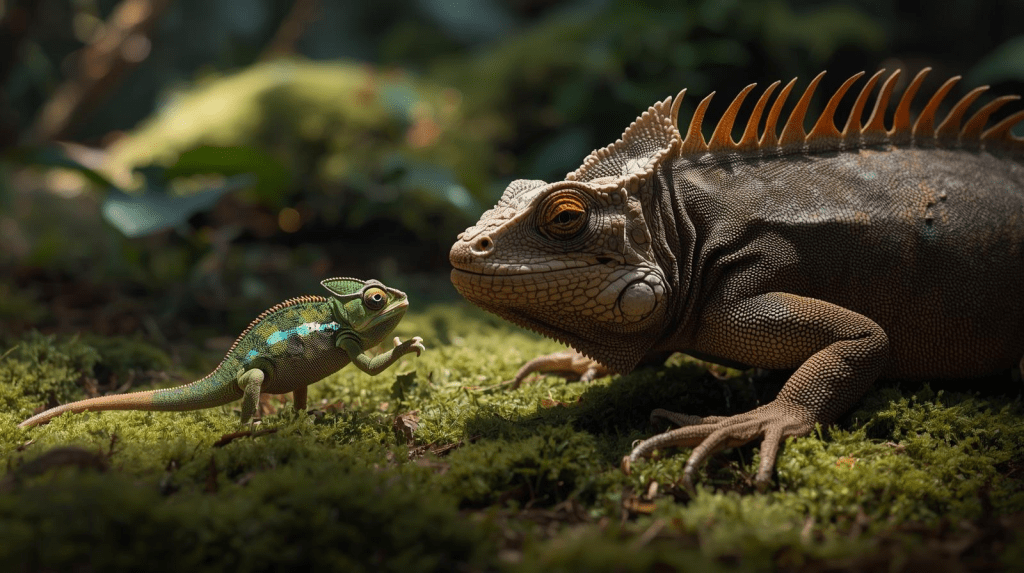
At one time, King Brahmadatta was ruling in Benares. At that time, the Enlightenment Being was born as an iguana with a following of thousands of iguanas. They lived in a big termite hill.

The Enlightenment Being had a son who was friendly with a chameleon. On seeing this, many iguanas complained about it to the Bodhisatta. The Bodhisatta summoned his son, and warned him not to be friendly with the chameleon. Because of such a friendship, there would be a great disaster for the community of iguanas. Even though he was so warned, the young iguana did not listen to him. He continued to play with the chameleon, and they continued to embrace each other. In the course of time, the iguana became large and fat. Bearing such a heavy body, when the iguana embraced the chameleon the big-bodied iguana sometimes hurt the chameleon, who had a small body. The small chameleon perceived the play of the iguana to be as if a big rock were falling over his body. And he became angry.

The king of the iguanas, in doubt about his son’s continued relationship with the chameleon, thought that one day calamity might befall upon the community of iguanas. He therefore made a secret tunnel so as to be able to flee away.

In the meantime, there came a certain unexpected rain. Swarms of flying termites came out from the termite hill. On a certain iguana hunter’s seeing this, he thought, “Now is a good time to hunt, because iguanas come out to eat flying termites.” So thinking, he entered the forest. While he was wandering in the forest, the chameleon saw him and enquired as to why he was wandering in the forest. The hunter said, “I am searching for iguanas.” As the chameleon was angry with his friend, the iguana, he said, “Do not be bothered by searching for iguanas. I can show you a place where there are plenty. What you need is some hay and fire.” Hearing this, the hunter brought some hay and fire. When he did this, the chameleon said, showing him the termite hill hole, “Put hay inside it and set it on fire. When the smoke goes in, the iguanas will come out. When they come out, hit them with your club or chase after them with your dogs. You can easily kill as many as you want.” The hunter did this.

The Enlightenment Being thought, “This type of a calamity came upon my relatives because of the evil chameleon.”

The Enlightenment Being fled away through the secret tunnel.

“The chameleon at that time was Devadatta. The disobedient little iguana was this monk today who is disobedient. And I who have now obtained supreme Buddhahood was at that time the king of the iguanas.” Saying so, the Buddha ended this Jātaka story of an iguana.

The moral: “Choose your friends wisely.”

141. The Story of an Iguana [Godha-Jātaka]

Link: https://hhdorjechangbuddhaiiiinfo.com/2025/11/13/141-the-story-of-an-iguana-godha-jataka/

#Buddhisttalesforyoungandold #Buddhiststories #storiesforkids #moralstories #Buddha #Jatakastories #PansiyaPanasJataka #JatakaTalesofSakyamuniBuddha #JatakaTales #SakyamuniBuddha’sPast