青春期女儿撞上更年期妈妈,我成了“夹心饼干”

青春期女儿撞上更年期妈妈,我成了“夹心饼干”

“嘉莹,吃饭了!”

“妈,你干嘛那么大声?我有耳朵呢!”女儿一边埋怨着,一边不情愿地关电视。等她磨磨蹭蹭洗完了手,坐到饭桌前,还噘着嘴,一副不高兴的样子。

太太做好一桌菜,前一分钟还兴高采烈呢,这会儿好像哑了火的炮,不出声了。家里突然安静了,我们围坐在一起,就有点尴尬。满桌的美食,感觉都不香了。

女儿读寄宿学校,周六才回家。为了给女儿做顿好吃的,太太昨天就开始张罗食材,今天一大早还去菜市场逛了一圈。忙了一上午,看得出来是以最高规格迎接女儿,煎煮炖炒齐上手,荤素搭配不重样,想必她自己对这一桌菜也格外满意。没承想,高兴得过劲了,大声喊女儿吃饭破了功。

我看不下去了,就问女儿:“你刚刚为什么对妈妈态度不好?”

“她那么大声,说小声一点我又不是听不到。”女儿没好气地跟我说,把不满也转移到我身上了。“不给看电视就直接说好了,叫那么大声,指桑骂槐。”原来,女儿认为她妈妈是在含沙射影,有意骂她,并非热情地叫她吃饭……

听了这话,我觉得女儿真的钻了牛角尖,把好意当成驴肝肺。虽然太太平时看到女儿守着电视,确实喜欢唠叨,怕她看坏了眼睛,也怕耽误了学习,但这次实在是没有其他意思啊。

我忍耐着,告诉自己别发火,要是发火岂不是跟小孩一样小心眼了?吵闹只会影响大家吃饭的心情,也枉费了太太的辛苦付出。

我耐着性子说:“你妈妈辛辛苦苦忙了一上午,做了七八道菜,没见你过来帮忙,也没听你说一句谢谢。做好了一桌菜,人家自己高兴,说话声音大了点,你就埋怨上了。叫你吃饭有什么问题?难道我们自己吃,不叫你?你妈妈不让你看电视会直接说,不会借题发挥,你理解错啦。”

我尽量把语气放平缓说话,女儿听了也没像平时一样顶嘴了。她意识到自己误会了妈妈,有点内疚了。

“好了,吃饭吧。”太太看女儿低了头,赶紧给她夹菜。气氛缓和后,我们吃得津津有味。当然,我也不会忘记夸奖太太的手艺。

这场饭前小矛盾经过一番诚意沟通,很快平息了。

其实人与人之间的矛盾,很多是由误会引发的。自己若抱着一个“我”字,只从自己的角度,去猜测别人,很容易就猜错了。一次好意招呼“吃饭”,不就被女儿误会成“指责她不该看电视”吗?

当然,这与女儿正处于青春期,性格敏感多疑,自尊心强也有一定的关系。她经常误会别人,一点小事执着起来,就成了她眼中的“大事”。

有一次,女儿感冒流鼻涕,擤鼻涕的纸巾乱扔,地上甚至床上都一片狼藉,一进她房间,简直到了“灾难现场”。

太太看到这情景,就发脾气了,说了女儿几句。女儿小气劲上来了,委屈得不行,哭得一把鼻涕一把泪,扔的纸巾更多了。太太看到更生气了,恨不得将她扫地出门。

女儿生病了还挨骂倍感委屈,太太看孩子不听话叛逆气不打一处来。

当时一个哭得“地动山摇”,一个气得头晕脑胀。两边都不好说话,我只好先让太太出门散散步了。

直到第二天,等女儿缓和后,我才对她说,偶尔犯次懒就算了,但要讲卫生。不爱干净、邋里邋遢的人,大家都会讨厌。你看到一个不讲卫生的人,你会喜欢吗?

女儿想想也是。但她也表达了自己的感受,生病了还挨骂,她觉得妈妈不关心她,所以才和妈妈顶嘴。不过乱扔擤鼻涕的纸,确实是有点过分了……

女儿容易以自我为中心,常觉得外在的话语和评价是在教训她,她觉得冤枉和委屈,认为人家对自己不尊重,容易着急上火。太太呢,希望女儿听大人的,别太多个人想法,也别动不动生气,因为她还嫩着呢。

一个青春期少女,跟一个临近更年期的妈妈对上了,确实像火山遇上火山,火花四射呀!

作为“夹心饼干”的我,就要两边灭火。这时不实行慈悲喜舍四无量心,更待何时?佛法在世间,不离世间觉啊。

人与人的不理解,皆因万事以自己为尺度,执著一个“我对你错”造成的。若我们都能考虑对方的情绪和感受,再来摆事实,讲道理,很多问题也就大事化小,小事化了。

更关键的一点,家是充满爱的港湾。好的家庭氛围就要——先倾听,再表达。您认同吗?

撰稿:明讯

编辑:悦色

青春期女儿撞上更年期妈妈,我成了“夹心饼干”

此文章链接:https://hhdorjechangbuddhaiiiinfo.com/2023/09/12/%e9%9d%92%e6%98%a5%e6%9c%9f%e5%a5%b3%e5%84%bf%e6%92%9e%e4%b8%8a%e6%9b%b4%e5%b9%b4%e6%9c%9f%e5%a6%88%e5%a6%88%ef%bc%8c%e6%88%91%e6%88%90%e4%ba%86%e5%a4%b9%e5%bf%83%e9%a5%bc%e5%b9%b2/

#第三世多杰羌佛 #第三世多杰羌佛正法 #学佛受用

52, 539 King fruitful and Queen sivali [Chapter 3. Giving up Power]

52, 539 King fruitful and Queen sivali [Chapter 3. Giving up Power]

This story happened very long ago, at a time when people lived much longer lives, even 10,000 years! After King Fruitful had ruled for about 7,000 years, it just so happened that the royal gardener brought him an especially wonderful collection of fruits and flowers. He liked them so much that he wanted to see the garden. So the gardener arranged and decorated the garden, and invited him to visit.

The king set out on a royal elephant, followed by the entire court and many of the ordinary people of Mithila. When he entered through the garden gate he saw two beautiful mango trees. One was full of perfectly ripe mangoes, while the other was completely without fruit. He took one of the fruits and enjoyed its delicious sweet taste. He decided to eat more of them on his return trip.

When the people saw that the king had eaten the first fruit, they knew it was all right for them to eat. In no time at all the mangoes had been eaten. When the fruits were gone, some even broke the twigs and stripped the leaves looking for more.

When King Fruitful returned he saw that the tree was stripped bare and nearly destroyed. At the same time, the fruitless tree remained as beautiful as before, its bright green leaves shining in the sunlight.

The king asked his ministers, “What has happened here?" They explained, “Since Your Majesty ate the first fruit, the people felt free to devour the rest. Searching for more fruits they even destroyed the leaves and twigs. The fruitless tree was spared and remains beautiful since it has no fruit."

This saddened the king. He thought, “This fruitful tree was destroyed, but the fruitless one was spared. My kingship is like the fruitful tree —- the more the power and possessions, the greater the fear of losing them. The holy life of a simple monk is like the fruitless tree —- giving up power and possessions leads to freedom from fear."

So the Great Being decided to give up his wealth and power, to leave the glory of kingship behind, to abandon the constant task of protecting his position. Instead he decided to put all his effort into living the pure life of a simple monk. Only then could he discover lasting deep happiness, which would spread to others as well.

He returned to the city. Standing next to the palace gate, he called for the commander of the army. He said, “From now on, no one is to see my face except a servant bringing food and a servant bringing water and toothbrush. You and the ministers will rule according to the old law. I will live as a simple monk on the top floor of the palace."

After he had lived for a while in this way, the people began to wonder about the change in him. One day a crowd gathered in the palace courtyard. They said, “Our king is not as he was before. He no longer wants to see dancing or listen to singing or watch bull fights and elephant fights or go to his pleasure garden and see the swans on the ponds. Why does he not speak to us?" They asked the servants who brought the king his food and water, “Does he tell you anything?"

They said, “He is trying to keep his mind from thinking about desirable things, so it will be peaceful and wholesome like the minds of his old friends, the Silent Buddhas. He is trying to develop the purity of the ones who own nothing but good qualities. Once we even heard him say out loud, “I can think only of the Silent Buddhas, free from chasing ordinary pleasures. Their freedom makes them truly happy — who will take me to where they live?"

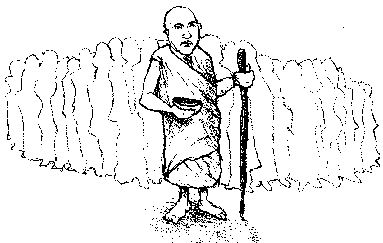
King Fruitful had been living on the top floor of the palace trying to be a simple monk for only about four months. At that point he realised there were too many distractions in the beautiful kingdom of Mithila. He saw them as only an outer show keeping him from finding inner peace and Truth. So he decided, once and for all, to give up everything and become a forest monk and go live in the Himalaya Mountains.

He had the yellow robes and begging bowl of a monk brought to him. He ordered the royal barber to shave his head and beard. Then early the next morning, he began walking down the royal staircase.

Meanwhile Queen Sivali had heard about his plans. She gathered together the 700 most beautiful queens of the royal harem and took them up the staircase. They passed King Fruitful coming down, but didn’t recognise him dressed as a monk. When they got to the top floor, Queen Sivali found it empty, with only the king’s shaven hair and beard still there. Instantly she realised the unknown monk must be her husband.

All 701 queens ran down the stairs to the palace courtyard. There they followed the king-turned-monk. As Queen Sivali had instructed them, they all let down their hair and tried to entice the king to stay. They cried and cried, pleading with him, “Why are you doing this?" Then all the people of the city became very upset and began following him. They were weeping as they cried out, “We have heard that our king has become a simple monk. How can we ever find such a good and fair ruler again?"

The 700 harem queens, wearing all their lovely veils and rich jewellery, crying and begging, did not change the mind of the Enlightenment Being. For he had made his decision and was determined to stick to it. He had given up the gold anointing bowl of state, which had passed the power of the royal family to him. Instead he now carried only the plain clay-begging bowl of a humble monk, a seeker of Truth.

Finally Queen Sivali stopped crying. She saw that the beautiful queens from the harem had not stopped her husband. So she went to the commander of the army. She told him to set a fire among the slum houses and abandoned buildings that were in the king’s path. She told him to set fires of brush and wet leaves in different areas of the city, to make a lot of smoke.

When this was done she fell to the ground at the king’s feet and cried, “All Mithila is burning, my lord! The beautiful buildings with their valuable art works, precious metals and jewels, and treasures are all being destroyed. Return, oh king, and save your riches before it is too late."

But the Enlightenment Being replied, “All these things belong to others. I own nothing. So I’m not afraid of losing anything. And losing things can’t make me sad. My mind is at peace."

Then he left the city through the northern gate, still followed by all 701 queens. According to Queen Sivali’s instructions, they showed him villages being robbed and destroyed. There were armed men attacking, while others seemed wounded and dead. But what looked like blood was really just red dye, and the dead were only pretending. The king knew it was a trick, since there were no actual robbers and plunderers in the kingdom in the first place.

After walking still farther, the king stopped and asked his ministers, “Whose kingdom is this?" “Yours, oh lord," they said. “Then punish any who cross this line," he ordered, as he drew a line across the road. No one, including Queen Sivali, dared to cross the line. But when she saw the king continuing on down the road, with his back to her, she was grief-stricken. Beating her breast she fell across the line. Once the line was crossed, the whole crowd lost its fear and followed her.

Queen Sivali kept the army with her as the entire crowd kept following King Fruitful. He continued for many miles, heading for the Himalayas in the north.

Meanwhile, there was a very advanced monk named Narada, who lived in a golden cave in the Himalayas. He was a very wise man. By great mental effort he had gained supernatural powers that only the highest holy men are said to have. After meditating in a wonderful trance for a full week he suddenly shouted, “What happiness! Oh what happiness!"

Then, using his special powers, he looked out over all India to see if there was anyone who was sincerely seeking that same happiness, free of all the distractions of the world. He saw only King Fruitful, the Bodhisatta who would some day become the Buddha. He saw that he had given up all his earthly power. And yet he was still blocked, still hindered by the obstacle of the crowd following him from his previous worldly life. In order to help and encourage him, he magically flew through the air and floated in front of the king.

He asked King Fruitful, “Oh monk, why is this crowd with all its noise following you?" The king replied, “I have given up the power of kingship and left the world for good. This is why my former subjects follow me, even though I leave them happily."

The holy monk said, “Don’t be too confident, oh monk. You haven’t succeeded in leaving the world quite yet. For there are still obstacles inside of you. These are the ‘Five Hindrances’ — the desire for ordinary pleasures of sight, sound and so forth; the desire to harm others; laziness; nervous worrying; and unreasonable doubts. Therefore, practice the Perfections, be patient, and don’t think either too much or too little of yourself."

He finished by saying, “I give you my blessing — may goodness, knowledge and Truth protect you on your way." Then he disappeared and reappeared back in his golden cave.

Due to this wise advice, King Fruitful became even less concerned with the crowd outside, realising that the greatest obstacles, or hindrances, are the ones inside.

Meanwhile Queen Sivali fell at his feet once again. She pleaded, “Oh king, hear the wails of your subjects. Before leaving them for good, comfort them by crowning your son to rule in your place."

He replied, “I have already left my subjects, friends, relatives and my country behind. Have no fear, the nobles of Mithila have trained Prince Longlife well, and they will protect and support you both."

She continued, “Oh king, by becoming a monk you are leaving me without a husband. What a shame! What am I to do?"

He said, “Only be careful to teach the prince no unwholesome thoughts, words or deeds. Otherwise you would bring painful results to yourself."

As the sun set, the queen made camp while the king went into the forest to sleep at the foot of a tree. The next day she continued to follow him, bringing the army with her. They approached a small city.

It just so happened that a man in the city had bought a fine piece of meat from a butcher. After cooking it he placed it on a table to cool, when a stray dog grabbed it and ran off. The man followed the dog as far as the southern gate of the city. There he gave up because he was too tired to continue.

The escaping dog crossed the path of King Fruitful and Queen Sivali. Frightened by them, he dropped the meat on the road. The king saw that it was a good piece of meat and that the real owner was unknown. So he cleaned the meat, put it in his begging bowl, and ate it.

Queen Sivali, who was used to eating the delicacies of the palace, was disgusted. She said to him, “Even at the point of death a high class person would not eat the leavings of a dog! Eating such disgusting food shows you are completely unworthy!" But he replied, “It is your own vanity that keeps you from seeing the value of this meat. If rightfully obtained, all food is pure and wholesome!"

As they continued to approach the city, King Fruitful thought, “Queen Sivali keeps following me. This is a bad thing for a monk. People say, ‘He has given up his kingdom, but he can’t get rid of his wife!’ I must find a way to teach her she must go."

Just then they came upon some playing children. Among them was a girl with one bracelet on one wrist and two on the other. Thinking she was a wise child, the king asked her, “My child, why does your one arm make noise with every movement, while the other does not?"

The little girl replied, “Oh monk, it’s because on one arm there are two bracelets, while on the other there is only one. Where there are two, it’s the second that clangs against the first and makes noise. The arm with only one bracelet remains silent. So if you would be happy, you must learn to be contented when alone."

The Bodhisatta said to the queen, “Do you hear the wisdom of this child? As a monk, I would be ashamed to let you stay with me in front of her. So you go your way and I’ll go mine. We are husband and wife no more – good-bye!"

The queen agreed and they took separate paths. But she became grief-stricken again and returned to follow the king. They entered the city together, so he could collect alms food.

They came to the house of an arrow maker. They watched him wet the red-hot arrow, and straighten it while sighting down the shaft with only one eye open. The king asked him, “Friend, to make the arrow perfectly straight, why do you view it with one eye open and the other shut?"

The arrow maker answered, “With both eyes open, the wide view of the second eye is distracting. Only by concentrating my view in one eye can I truly see the straightness of the arrow. So if you would be happy, you must learn to be contented when alone."

The king collected alms food and then they left the city. He said to the queen, “Did you hear the same wisdom again from that craftsman? As a monk, I would be ashamed to let you stay with me in front of him. So you go your way and I’ll go mine. We are husband and wife no more – good-bye!" But still she followed him.

Then the Great Being cut a stalk of tall grass. He said to Queen Sivali, “Just as the two pieces of this stalk of grass cannot be joined again, so I will not join you again in the marriage bed! We two can never be joined together again. Like a full stalk of uncut grass, live on alone, my ex-wife Sivali."

On hearing this the queen went crazy with shock and grief. She beat herself with both hands until she fell to the ground — completely unconscious. Realising this, the Bodhisatta quickly left the roadway. He erased his footsteps and disappeared into the jungle.

First he had given up the power and wealth of a king. Now he had given up the power and desire of a husband. At last he was free to follow the path of a Truth-seeking wandering monk. He made his way to the Himalayas and in only one week he was able to develop special mental powers. Never again did he return to the ordinary world.

Meanwhile the royal ministers, who had been following at a distance, reached the fainted queen. They sprinkled water on her and revived her. She asked, “Where is my husband the king?" They said, “We don’t know. Don’t you know?" In a panic she ordered, “Search for him!" They looked and looked, but of course he was gone.

When Queen Sivali recovered from her fear and grief, she realised she felt no anger, jealousy or vengeance towards the monk Fruitful. Instead she admired him more than at any time since the day they met, when she gave him her hand and led him to the throne.

She had monuments erected to honour the courageous King Fruitful on four sites: where he had spoken with the floating holy man Narada, where he had eaten the good meat left by the dog, where he had questioned the little girl, and also the arrow maker.

Beside the two mango trees in the royal garden, she had Prince Longlife crowned as the new king. Together with the army and crowds of followers, they returned to the city of Mithila.

In spite of herself, Queen Sivali had learned something by following, and finally losing, her husband King Fruitful. She too had tasted freedom!

The wise lady gave up her royal duties. She retired to meditate in the garden by the mango trees. With great effort, she gained a high mental state leading to rebirth in a heaven world.

The moral is: It’s easier to gain power than to give it up.

52, 539 King fruitful and Queen sivali [Chapter 3. Giving up Power]

Link:https://hhdorjechangbuddhaiiiinfo.com/2023/09/05/52-539-king-fruitful-and-queen-sivali-chapter-3-giving-up-power/

#Buddhisttalesforyoungandold #Buddhiststories #storiesforkids #moralstories #Buddha #Jatakastories #PansiyaPanasJataka

52,539. King Fruitful and Queen Sivali [Chapter 2. Gaining Power]

52,539. King Fruitful and Queen Sivali [Chapter 2. Gaining Power]

The baby grew into a little boy. His friends took to making fun of him for not being of high-class birth like they were. So he went and asked his mother who his father was. She told him to pay no attention to what the other children said. She told him his father was the dead King Badfruit of Mithila, and how his brother, Prince Poorfruit, had stolen the throne. After that, it didn’t bother him when the others called him “son of a widow."

Before he was sixteen, the bright young Fruitful learned all there was to know about religion, literature and the skills of a warrior. He grew into a very handsome young man.

He decided it was time to regain his rightful crown, which had been stolen by his uncle. So he went and asked his mother, “Do you have any of the wealth that belonged to my father?" She said, “Of course! I did not escape empty-handed. Thinking of you, I brought pearls, jewels and diamonds. So there is no need for you to work for pay. Go directly and take back your kingdom."

But he said, “No Mother, I will take only half. I will sail to Burma, the land of gold, and make my fortune there." His mother said, ‘No my son, it is too dangerous to sail abroad. There is plenty of fortune here!" He said, “I must leave half with you, my mother, so you can live in comfort as a queen should." So saying, he departed by ship for Burma.

On the same day that Prince Fruitful set sail, his Uncle King Poorfruit became very ill. He was so sick that he could no longer leave his bed.

Meanwhile, on the ship bound for Burma, there were some 350 people. It sailed for seven days. Then there was a violent storm that damaged and weakened the ship. All except the prince cried out in fear and prayed for help to their various gods. But the Bodhisatta did not cry out in fear; the Enlightenment Being did not pray to any god for help. Instead, he helped himself.

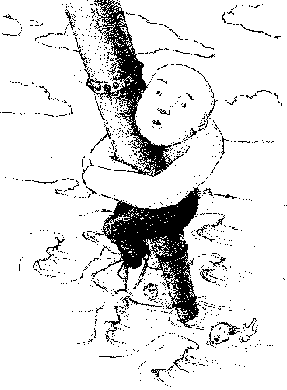
He filled his belly with concentrated butter mixed with sugar since he didn’t know how long it would be before his next meal. He soaked his clothes in oil to protect himself from the cold ocean water and help him stay afloat. Then when the ship began to sink, he went and held on to the mast, for it was the tallest part of the ship. As the deck sank underwater, he pulled himself up the mast.

Meanwhile, his trembling praying shipmates were sucked underwater and gobbled up by hungry fish and huge turtles. Soon the water all around turned red from blood.

As the ship sank, Prince Fruitful reached the top of the mast. To avoid being devoured in the sea of blood, he jumped mightily from the tip of the mast — in the direction of the kingdom of Mithila. And at the same time as he saved himself from the snapping jaws of the fish and turtles, King Poorfruit died in his bed.

After his mighty leap from the top of the mast, the prince fell into the emerald-coloured sea. His body shone like gold as he swam for seven days and seven nights. Then he saw it was the fasting day of the full moon. So he purified his mouth by washing it out with salt water and observed the “Eight Training Steps".

Once upon a time in the very distant past, the gods of the four directions had appointed a goddess to be the protector of the oceans. They had told her that her duty was to protect especially all those who honour and respect their mothers and other elders. All such, who did not deserve to fall into the sea, were to be protected by her.

It just so happened that Prince Fruitful was one who deserved the protection of the ocean goddess. But for the seven days and seven nights that he had been swimming through the sea, the goddess had not been paying attention and doing her duty! She had been too busy enjoying heavenly pleasures to remember to keep watch on the oceans.

Finally she remembered her duty and looked over the oceans. Then she was the golden prince struggling in the emerald sea after seven days and seven nights of swimming. She thought, “If I let this Prince Fruitful die in the ocean, I will no longer be welcome in the company of the gods. For truly, he is the Enlightenment Being!"

So she took on a form of splendour and beauty, and floated in the air near him. Wishing to learn Truth from him, she asked, “Without seeing the shore of the ocean, why are you trying to reach the ocean’s end?"

Hearing those words the prince thought, “For the seven days I’ve been swimming, I have met no one who can this be?" When he saw the goddess above him he said, “Oh lovely goddess, I know that effort is the way of the world. So as long as I am in this world, I will try and try, even in mid-ocean with no shore to be seen."

Wishing to learn more from him, she tested him by saying, “This vast ocean stretches much farther than you can see, without reaching a shore. Your effort is useless for here you must die!"

The prince replied “Dear goddess, how can effort be useless? For he who never gives up trying cannot be blamed, either by his relatives here below or by the gods above. So he has no regrets. No matter how impossible it seems, if he stops trying he causes his own downfall!"

Pleased with his answers, the protecting goddess tested him one last time. She asked, “Why do you continue, when there really is no reward to be gained except pain and death?"

He answered her again, like a teacher to a pupil, “It is the way of the world that people make plans and try to reach their goals. The plans may succeed or fail — only time will tell — but the value is in the effort itself in the present moment."

“And besides, oh goddess, can’t you see that my actions have already brought results? My shipmates only prayed and they are dead! But I have been swimming for seven days and seven nights and low and behold here you are, floating above me! So I will swim with all my might, even across the whole ocean, to reach the shore. While I have an ounce of strength I’ll try and try again."

Completely satisfied, the ocean goddess who protects the good said, “You who bravely fight the mighty ocean against hopeless odds, you who refuse to run from the task before you, go wherever your heart desires! For you have my protection and no one can stop you. Just tell me where I may carry you to."

The prince told her he wished to go to Mithila. The goddess gently lifted him like a bouquet of flowers and laid him on her chest, Like a loving mother with a newborn baby. Then she flew through the air, while the Enlightenment Being slept, cradled against her heavenly body.

Arriving at Mithila, she laid him on a sacred stone in a garden of mangoes, and told the garden goddesses to watch over him. Then the protector goddess of the oceans returned to her heaven-world home.

The dead King Poorfruit had left behind only a daughter, no sons. She was well-educated and wise, and her name was Princess Sivali.

When the king was dying, the ministers asked him, “Who will be the next king?" King Poorfruit said, “Whoever can satisfy my daughter Sivali; whoever recognises the head of the royal square bed; whoever can string the bow that only a thousand men can string; or whoever can find the sixteen hidden treasures."

After the funeral of the king, the ministers began searching for a new king. First they looked for one who could satisfy the princess. They called for the General of the Army.

Princess Sivali wished to test him, so Mithila could be ruled by a strong leader. She told him to come to her. Immediately he ran up the royal staircase. She said, “To prove your strength, run back and forth in the palace." Thinking only of pleasing her, the general ran back and forth until she motioned for him to stop. Then she said, “Now jump up and down." Again the general did as he was told without thinking. Finally the princess told him, “Come here and massage my feet." He sat in front of her and began rubbing her feet.

Suddenly she put her foot against his chest and kicked him down the royal staircase. She turned to her ladies in waiting and said, “This fool has no common sense. He thinks the only strength is in running around and jumping up and down and following orders without thinking. He has no strength of character. He lacks the willpower needed to rule a kingdom. So throw him out of here at once!"

Later the general was asked about his meeting with Princess Sivali. He said, “I don’t want to talk about it. She is not human!"

The same thing happened with the treasurer, the cashier, the keeper of the royal seal and the royal swordsman. The princess found them all to be unworthy fools.

So the ministers decided to give up on the princess and find someone who could string the bow that only a thousand men can string. But again they could find no one. Similarly, they could find no one who knew the head of the royal square bed, or who could find the sixteen treasures.

The ministers became more and more worried that they could not find a suitable king. So they consulted the royal family priest. He said to them, “Calm down, my friends. We will send out the royal festival carriage. The one it stops for will be able to rule over all India."

So they decorated the carriage and yoked the four most beautiful royal horses to it. The high priest sprinkled the carriage with holy water from a sacred golden pitcher. He proclaimed, “Now go forth, riderless carriage, and find the worthy one with enough merit to rule the kingdom."

The horses pulled the carriage around the palace and then down the main avenue of Mithila. They were followed by the four armies — the elephants, chariots, cavalry and foot soldiers.

The most powerful politicians of the city expected the procession to stop in front of their houses. But instead it left the city by the eastern gate and went straight to the mango garden. Then it stopped in front of the sacred stone where Prince Fruitful was sleeping.

The chief priest said, “Let us test this sleeping man to see if he is worthy to be king. If he is the one, he will not be frightened by the noise of the drums and instruments of all four armies." So they made a great clanging noise, but the prince just turned over on his other side, remaining asleep. Then they made the noise again, even louder. Again the prince simply rolled over from side to side.

The head priest examined the soles of the feet of the sleeping one. He said, “This man can rule not only Mithila, but the whole world in all four directions." So he awakened the prince and said, “My lord, arise, we beg you to be our king."

Prince Fruitful replied, “What happened to your king?" “He died," said the priest. “Did he have any children?" asked the prince. “Only a daughter, Princess Sivali," answered the priest. Then Prince Fruitful agreed to be the new king.

The chief priest spread jewels on the sacred stone. After bathing, the prince sat among the jewels. He was sprinkled with perfumed water from the gold anointing bowl. Then he was crowned King Fruitful. The new king rode in the royal chariot, followed by a magnificent procession, back to the city of Mithila and the palace.

Princess Sivali still wished to test the king. So she sent a man to tell him she wished him to come at once. But King Fruitful ignored him, simply continuing to inspect the palace with its furnishings and works of art.

The messenger told this to the princess and she sent him back two more times with the same results. He reported back to her, “This is a man who knows his own mind, not easily swayed. He paid as little attention to your words as we pay to the grass when we step on it!"

Soon the king arrived at the throne room, where the princess was waiting. He walked steadily up the royal staircase — not hurrying, not slowing down, but dignified like a strong young lion. The princess was so impressed by his attitude that she went to him, respectfully gave him her hand, and led him to the throne. He gracefully sat on the throne.

Then he asked the royal ministers, “Did the previous king leave behind any advice for testing the next king?" “Yes lord," they said, “Whoever can satisfy my daughter Sivali." The king responded, “You have seen the princess give me her hand. Was there another test?"

They said, “Whoever recognises the head of the royal square bed." The king took a golden hairpin from his head and gave it to Princess Sivali, saying, “Put this away for me." Without thinking, she put it on the head of the bed. As if he had not heard it the first time, King Fruitful asked the ministers to repeat the question. When they did, he pointed to the golden hairpin.

“Was there another test?" asked the king. “Yes lord," replied the ministers, “Whoever can string the bow that only a thousand men can string." When they brought the bow, the king strung it without even rising from the throne. He did it as easily as a woman bends the rod that untangles cotton for spinning.

“Are there any more tests?" the king asked. The ministers said, “Whoever can find the sixteen hidden treasures." These are the last tests."

“What is the first on the list?" he asked. They said, “The first is the treasure of the rising sun." King Fruitful realised that there must be some trick to finding each treasure. He knew that a Silent Buddha is often compared to the glory of the sun. So he asked, “Where did the king go to meet and feed Silent Buddhas?" When they showed him the place, he had them dig up the first treasure.

The second was the treasure of the setting sun. King Fruitful realised this must be where the old king had said good-bye to Silent Buddhas. In the same manner he found all the hidden treasures.

The people were happy that he had passed all the tests. As his first official act, he had houses of charity built in the center of the city and at each of the four gates. He donated the entire sixteen treasures to be given to the poor and needy.

Then he sent for his mother, queen of the dead King Badfruit, and also for the kind wise man of Campa. He gave them both the honour they deserved.

All the people of the kingdom came to Mithila to celebrate the restoration of the royal line. They decorated the city with fragrant flower garlands and incense. They provided cushioned seats for visitors. There were fruits, sweets, drinks and cooked foods everywhere. The ministers and the wealthy brought musicians and dancing girls to entertain the king. There were beautiful poems recited by wise men, and blessings chanted by holy men.

The Enlightenment Being, King Fruitful, sat on the throne under the royal white umbrella. In the midst of the great celebration he seemed as majestic as the heavenly god, King Sakka. He remembered his great effort struggling in the ocean against all odds, when even the ocean goddess had abandoned him. Only because of that almost hopeless effort, he himself was now as magnificent as a god. This filled him with such joy that he spoke this rhyme:

“Things happen unexpectedly, and prayers may not come true: But effort brings results that neither thoughts nor prayers can do."

After the wonderful celebration, King Fruitful ruled in Mithila with perfect righteousness. And he humbly gave honour and alms food to Silent Buddhas — enlightened ones living in a time when their teachings could not be understood.

In the fullness of time Queen Sivali gave birth to a son. Because the wise men of the court saw signs of a long and glorious life ahead of him, he was named Prince Longlife. When he grew up, the king made him second in command.

52,539. King Fruitful and Queen Sivali [Chapter 2. Gaining Power]

Link:https://hhdorjechangbuddhaiiiinfo.com/2023/08/29/52539-king-fruitful-and-queen-sivali-chapter-2-gaining-power

#Buddhisttalesforyoungandold #Buddhiststories #storiesforkids #moralstories #Buddha #Jatakastories #PansiyaPanasJataka
52, 539 King Fruitful and Queen Sivali, [Chapter 1. Rebirth of the Bodhisattva]

52, 539 King Fruitful and Queen Sivali, [Chapter 1. Rebirth of the Bodhisattva]

Once upon a time in the city of Mithila, there was a king who had two sons. The older one was named Badfruit, and his younger brother was called Poorfruit.

While they were still fairly young, the king made his older son the crown prince. He was second in command and next in line to the throne. Prince Poorfruit became commander of the army.

Eventually the old king died and Prince Badfruit became the new king. Then his brother became crown prince.

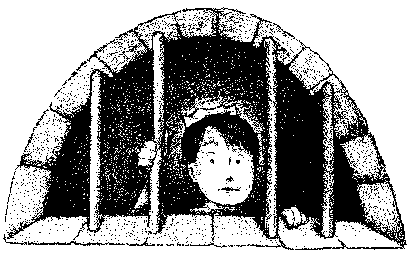
Before long, a certain servant took a disliking to Crown Prince Poorfruit. He went to King Badfruit and told a lie — that his brother was planning to kill him. At first the king did not believe him. But after the servant kept repeating the lie, the king became frightened. So he had Prince Poorfruit put in chains and locked up in the palace dungeon.

The prince thought, “I am a righteous man who does not deserve these chains. I never wanted to kill my brother. I wasn’t even angry at him. So now I call on the power of Truth. If what I say is true, may these chains fall off and the dungeon doors be opened!" Miraculously the chains broke in pieces, the door opened, and the prince fled to an outlying village. The people there recognised him. Since they respected him they helped him, and the king was unable to capture him.

Even though he lived in hiding, the crown prince became the master of the entire remote region. In time he raised a large army. He thought, “Although I was not an enemy to my brother at first, I must be an enemy to him now." So he took his army and surrounded the city of Mithila.

He sent a message to King Badfruit — “I was not your enemy, but you have made me so. Therefore I have come to wage war against you. I give you a choice — either give me your crown and kingdom or come out and fight." Hearing of this, most of the city people went out and joined the prince.

King Badfruit decided to wage war. He would do anything to keep his power. Before going out with his army, he went to say good-bye to his number one queen. She was expecting a baby very soon. He said to her “My love, no one knows who will win this war. Therefore, if I die you must protect the child inside you." Then he bravely went off to war and was quickly killed by the soldiers of his enemy brother.

The news of the king’s death spread through the city. The queen disguised herself as a poor dirty homeless person. She put on old rags for clothes and smeared dirt on herself. She put some of the king’s gold and her own most precious jewellery into a basket. She covered these with dirty rice that no one would want to steal. Then she left the city by the northern gate. Since she had always lived inside the city, the queen had no idea where to go from there. She had heard of a city called Campa. She sat down at the side of the road and began asking if anyone was going to Campa.

It just so happened that the one who was about to be born was no ordinary baby. This was not his first life or his first birth. Millions of years before, he had been a follower of a long-forgotten teaching “Buddha" — a fully “Enlightened One". He had wished with all his heart to become a Buddha just like his beloved master.

He was reborn in many lives — sometimes as poor animals, sometimes as long-living gods and sometimes as human beings. He always tried to learn from his mistakes and develop the “Ten Perfections". This was so he could purify his mind and remove the three root causes of unwholesomeness — the poisons of craving, anger, and the delusion of a separate self. By using the perfections, he would someday be able to replace the poisons with the three purities — non-attachment, loving-kindness, and wisdom.

This “Great Being" had been a humble follower of the forgotten Buddha. His goal was to gain the same enlightenment of a Buddha — the experience of complete Truth. So people call him “Bodhisatta", which means “Enlightenment Being". No one really knows about the millions of lives lived by this great hero. But many stories have been told — including this one about a pregnant queen who was about to give birth to him. After many more rebirths, he became the Buddha who is remembered and loved in the entire world today.

At the time of our story, the Enlightenment Being had already achieved the Ten Perfections. So the glory of his coming birth caused a trembling in all the heaven worlds, including the Heaven of 33 ruled by King Sakka. When he felt the trembling, being a god he knew it was caused by the unborn babe inside the disguised Queen of Mithila. And he knew this must be a being of great merit, so he decided to go and help out.

King Sakka made a covered carriage with a bed in it and appeared at the roadside in front of the pregnant queen. He looked just like an ordinary old man. He called out, “Does anyone need a ride to Campa?" The homeless queen answered, “I wish to go there, kind sir." “Come with me then", the old man said.

Since the birth was not far off, the pregnant queen was quite large. She said, “I cannot climb up into your carriage. Simply carry my basket and I will walk behind." The old man, the king of the gods, replied, “Never mind! Never Mind! I am the cleverest driver around. So don’t worry. Just step into my cart!"

Lo and behold, as she lifted her foot, King Sakka magically caused the ground under her to rise up! So she easily stepped down into the carriage. Immediately she knew this must be a god, and fell fast asleep.

Sakka drove the cart until he came to a river. Then he awakened the lady and said, “Wake up, daughter, and bathe in this river. Dress yourself in this fine clothing I have brought you. Then eat a packet of rice." She obeyed him, and then lay down and slept some more.

In the evening she awoke and saw tall houses and walls. She asked, “What is this city, Father?" He said, “This is Campa." King Sakka replied, “I took a shortcut. Now that we are at the southern gate of the city, you may safely enter. I must go on to my own far-off village." So they parted and Sakka disappeared in the distance, returning to his heaven world.

The queen entered the city and sat down at an inn. There happened to be a wise man living in Campa. He recited spells and gave advice to help people who were sick or unfortunate. While on his way to bathe in the river with 500 followers, he saw the beautiful queen from a distance. The great goodness of the unborn one within gave her a soft warm glow, which only the wise man noticed. At once he felt a kind and gentle liking for her, just as if where were his own youngest sister. So he left his followers outside and went into the inn.

He asked her, “Sister, what village are you from?" She replied, “I am the number one queen of King Badfruit of Mithila."

He asked, “Then why did you come here?" “My husband was killed by the army of his brother, Prince Poorfruit," she said. “I was afraid, so I ran away to protect the unborn one within me." The wise man asked, “Do you have any relatives in this city?" She said, “No sir." Then he said, “Don’t worry at all. I was born in a rich family and I myself am rich. I will care for you just as I would for my own young sister. Now you must call me brother and grab hold of my feet and cry out."

When she did this, the followers came inside. The wise man explained to them that she was his long lost youngest sister. He told his closest followers to take her to his home in a covered cart. He told them to tell his wife that this was his sister, who was to be cared for.

They did exactly as he had said. The wife welcomed her, gave her a hot bath, and made her rest in bed.

After bathing in the river the wise man returned home. At dinnertime, he asked his sister to join them. After dinner, he invited her to stay in his home.

In only a few days the queen gave birth to a wonderful little baby boy. She named him fruitful. She told the wise man this was the name of the boy’s grandfather, who had once been King of Mithila.

52, 539 King Fruitful and Queen Sivali, [Chapter 1. Rebirth of the Bodhisattva]

Link:https://hhdorjechangbuddhaiiiinfo.com/2023/08/22/52-539-king-fruitful-and-queen-sivali-chapter-1-rebirth-of-the-bodhisattva/

#Buddhisttalesforyoungandold #Buddhiststories #storiesforkids #moralstories #Buddha #Jatakastories #PansiyaPanasJataka
51. King Goodness the Great [Perseverance]

51. King Goodness the Great [Perseverance]

Once upon a time, in Benares in northern India, the Enlightenment Being was born into the royal family. When he became king he was called Goodness the Great. He had earned this title by trying to do good all the time, even when the results might not benefit him. For example, he spent much of the royal treasury on the building and running of six houses of charity. In these houses good and aid were given freely to all the poor and needy who came along, even to unknown travellers. Soon King Goodness the Great became famous for his patience, loving-kindness and compassion. It was said that he loved all beings just like a father loves his young children.

Of course King Goodness observed the holy days by not eating. And naturally he practiced the ‘Five Training Steps’, giving up the five unwholesome actions. These are: destroying life, taking what is not given, doing wrong in sexual ways, speaking falsely, and losing one’s mind from alcohol. So his gentle kindness became more and more pure.

Since he wished to harm no one, King Goodness the Great even refused to imprison or injure wrongdoers. Knowing this, one of his highest ministers tried to take advantage of him. He cooked up a scheme to cheat some of the women in the royal harem. Afterwards it became known by all and was reported to the king.

He called the bad minister before him and said, ‘I have investigated and found that you have done a criminal act. Word of it has spread and you have dishonoured yourself here in Benares. So it would be better for you to go and live somewhere else. You may take all your wealth and your family. Go wherever you like and live happily there. Learn from this lesson.’

Then the minister took his family and al his belongings to the city of Kosala. Since he was very clever indeed, he worked his way up and became a minister of the king. In time he became the most trusted adviser to the King of Kosala. One day he said, ‘My lord, I came here from Benares. The city of Benares is like a beehive where the bees have no stingers! The ruling king is very tender and weak. With only a very small army you can easily conquer the city and make it yours.’

The king doubted this, so he said, “You are my minister, but you talk like a spy who is leading me into a trap!’ He replied “No my lord. If you don’t believe me, send your best spies to examine what I say. I am not lying. When robbers are brought to the King of Benares, he gives them money, advises them not to take what is not given, and then lets them go free,"

The king decided to find out if this was true. So he sent some robbers to raid a remote border village belonging to Benares. The villagers caught the looters and brought them to King Goodness the Great. He asked them, “Why do you want to do this type of crime?"

The robbers answered, “Your worship, we are poor people. There is no way to live without money. As your kingdom has plenty of workers, there is no work for us to do. So we had to loot the country in order to survive." Hearing this, the king gave them gifts of money, advised them to change their ways, and let them go free.

When the King of Kosala was told of this, he sent another gang of bandits to the streets of Benares itself. They too looted the shops and even killed some of the people. When they were captured and brought to king Goodness, he treated them just the same as the first robbers.

Learning of this, the King of Kosala began marching his troops and elephants towards Benares.

In those days the King of Benares had a mighty army which included very brave elephants. There were many ordinary soldiers, and also some that were as big as giants. It was known that they were capable of conquering all India.

The giant soldiers told King Goodness about the small invading army from Kosala. They asked permission to attack and kill them all.

But King Goodness the Great would not send them into battle. He said, “My children, do not fight just so I may remain king. If we destroy the lives of others we also destroy our own peace of mind. Why should we kill others? Let them have the kingdom if they want it so badly. I do not wish to fight."

The royal ministers said, “Our Lord, we will fight them ourselves. Don’t worry yourself. Only give us the order." But again he prevented them.

Meanwhile the King of Kosala sent him a warning, telling him to give up the kingdom or fight. King Goodness the Great sent this reply: “I do not want you to fight with me, and you do not want me to fight with you. If you want the country, you can have it. Why should we kill people just to decide the name of the king? What does it matter even the name of the country itself?"

Hearing this, the ministers came forward and pleaded, “Our Lord, let us go out with our mighty army. We will beat them with our weapons and capture them all. We are much stronger than they are. We would not have to kill any of them. And besides, if we surrender the city, the enemy army would surely kill us all!"

But King Goodness would not be moved. He refused to cause harm to anyone. He replied, “Even if you do not wish to kill, by fighting many will be injured. By accident some may die. No one knows the future – whether our attackers will kill us or not. But we do know whether our present actions are right or wrong. Therefore I will not harm, or cause others to harm, any living being!"

Then King Goodness ordered the city gates be opened up for the invaders. He took his ministers to the top floor of the palace and advised them, “Say nothing and try to remain calm."

The King of Kosala entered the city of Benares and saw that no one was against him. So he and his soldiers entered and went up to the top floor. They capture the innocent King Goodness the Great. The soldiers tied the hands of the defeated king and all of his ministers.

Then they were taken to the cemetery outside the city. They were buried up to their necks, standing straight up, with only their heads above ground. But even while the dirt was being trampled down around his neck, the Great Being remained without anger in his mind and said nothing.

Their discipline and obedience to King Goodness were so great that not a single minister spoke a word against anyone. But the King of Kosala had no mercy. He said roughly, “Come night time, let the jackals do as they please!"

And so it came to pass that, at midnight, a large band of jackals wandered into the cemetery. They could smell a feast of human flesh waiting for them.

Seeing them coming, King Goodness and his ministers shouted all at once and scared the jackals away. Twice more this happened. Then the clever jackals realised, “These men must have been put here for us to kill and eat." No longer afraid, they ignored the shouts. The jackal king walked right up to the face of King Goodness.

The king offered his throat to the beast. But before he could bite into him, the king grabbed the jackal’s chin with his teeth. No harming him, King Goodness gripped him tightly so the jackal king howled in fear. This frightened his followers and they all ran away.

Meanwhile the jackal king thrashed back and forth, trying madly to free himself from the might jaws of the human king. In so doing, he loosened the dirt packed around the king’s neck and shoulders. Then King Goodness released the screaming jackal. He was able to wiggle himself free from the loosened earth and pull himself up onto the ground. Then he freed all his frightened ministers.

Nearby there was a dead body. It just so happened that it was lying on the border of the territories claimed by two rival demons. They were arguing over the division of the body, insulting each other in ways that only demons can.

Then one demon said to the other, “Why should we continue quarrelling instead of eating? Right over there is King Goodness the Great of Benares. He is famous in all worlds for his righteousness. He will divide the dead body for us.

They dragged the body to the king and asked him to divide it between them fairly. He said, ‘My friends, I would be glad to divide this for you. But I am filthy and dirty, I must clean myself first."

The two demons used their magic powers to bring scented water, perfume, clothing, ornaments and flowers from the king’s own palace in Benares. He bathed, perfumed himself, dressed, and covered himself with ornaments and flower garlands.

The demons asked King Goodness if there was anything else they could do. He replied that he was hungry. So, again by their magic powers, the demons brought the most delicious flavoured rice in a golden bowl and perfumed drinking water in a golden cup — also from the royal palace in Benders.

When he was satisfied, king Goodness asked them to bring him the sword of state from the pillow of the King of Kosala, who was sleeping in the palace in Benares. With magic that too was easily done. Then the king used the sword to cut the dead boy into two halves, right down the spine. He washed the sword of state and strapped it to his side.

The hungry demons happily gobbled up the fairly divided dead body. Then they gratefully said to King Goodness, “Now that our bellies are full, is there anything else we can do to please you?"

He replied, “By your magic, set me in my own bedroom in the palace next to the King of Kosala. In addition, put all these my ministers back in their homes." Without a word, the demons did exactly as the king had asked.

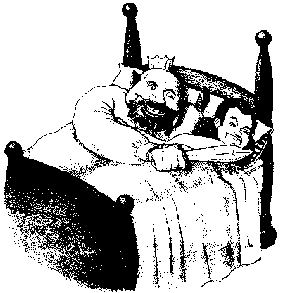
At that moment the King of Kosala was fast asleep in the royal bedchamber. King Goodness the Great gently touched the belly of the sleeping king with the sword of state. The king awoke in great surprise. In the dim lamplight he was frightened to see King Goodness leaning over him with sword in hand. He had to rub his eyes to make sure he was not having a nightmare!"

Then he asked the great king, “My lord how did you come here in spite of all my guards? You were buried up to your neck in the cemetery — how is it you are spotlessly clean, sweet smelling, dressed in your own royal robes, and decorated with fine jewellery and the loveliest flowers?"

King Goodness told him the story of his escape from the band of jackals. He told of the two demons that came to him to settle their quarrel. And he told how they gratefully helped him with their magic powers.

On hearing this, the King of Kosala was overcome by his own shame. He bowed his head to King Goodness the Great and cried, “Oh great king, the stupid ferocious demons, who live by eating the flesh and drinking the blood of dead bodies — they recognised your supreme goodness. But I, who was lucky enough to be born as an intelligent and civilised human being — I have been too foolish to see how wonderful your pure goodness is.

“I promise never again to plot against you, my lord —- you who have gained such perfect harmlessness. And I promise to serve you forever as the truest of friends. Please forgive me, great king." Then, as if he were a servant, the King of Kosala laid King Goodness the Great down on the royal bed, while he himself lay on a small couch.

The next day the King of Kosala called all his soldiers into the palace courtyard. There he publicly praised the king of Benares and asked his forgiveness once again. He gave back the kingdom and promised that he would always protect King Goodness. Then he punished his adviser, the criminal minister, and returned to Kosala with all his troops and elephants.

King Goodness the Great was sitting majestically on his golden throne, with its legs like those of a gazelle. He was shaded from the sun by the pure white royal umbrella. He taught his loyal subjects saying, “People of Benares wholesomeness begins with giving up the five unwholesome actions once and for all. The highest qualities of the good person, whether ruler or subject, are loving-kindness and compassion. Filled with these qualities, one cannot harm another —- no matter what the reason or the cost. No matter how dangerous the threat, one must persevere until the greatness of the good heart wins in the end."

Throughout the rest of his reign, the people of Benares lived peacefully and happily. King Goodness the Great continued performing wholesome works. Eventually he died and was reborn as he deserved.

The moral is: Refusing to harm others, the good heart wins over all.

51. King Goodness the Great [Perseverance]

Link:https://hhdorjechangbuddhaiiiinfo.com/2023/08/15/king-goodness-the-great-perseverance/

#Buddhisttalesforyoungandold #Buddhiststories #storiesforkids #moralstories #Buddha #Jatakastories #PansiyaPanasJataka
活用这几句话,让你的人际关系更融洽

活用这几句话,让你的人际关系更融洽

近期,笔者看到某文有四句话——“把自己当自己,把自己当别人,把别人当别人,把别人当自己”颇有感悟。能够深入践行这几句话的人,可以说是“人间清醒第一人”。

一、把自己当自己

人生最大的敌人,不是别人,而是自己。南无羌佛说:“识己方能立人。”如果连自己的个性、能力都不了解,不能知己知彼,又如何在社会立足?恐怕只会走向两个极端:自卑或自负。

认识到了自己的恐惧、退缩,战胜了懒惰、自私和狭隘,走向自立、自强,便超越了自己原有的层次,拓宽了格局,人生就有无限可能。另一方面,把自己当自己,就是要求自己,别为他人的几句闲言碎语,或者一个不屑的眼神而怒发冲冠,要以平静淡泊的心态,去面对生活中的荣辱得失和爱恨情仇。

二、把自己当别人

人生在世,注定要历经诸多喜怒哀乐之事,坎坷过了就是坦途。只有把自己当成了别人,才不会在喜事面前若狂,在困苦面前痛悲。人生在世难免会涉及到功名利禄之事,也只有把自己当成了别人,才不会为名所累、为利所动、为权所困、为情所恼,跳出自我束缚,进而达到“不以物喜,不以己悲”的境界。

三、把别人当别人

人与人之间有一定界限,有自己的个性与生活。如果不体谅他人,一味要求对方付出,索要关注、关爱;一方对一方控制,要求顺从、服从。强压之下,两者失去平衡,最后可能导致两败俱伤。比如现今社会上的“妈宝男”与“强势妈”,一方软弱一方控制。试问在强势妈妈的管控下,孩子又如何自立自强呢?温室的花朵耐不住暴风雨的摧残,一点磨难恐怕就连连哀叹!

四、把别人当自己

人的一生不可能总是一帆风顺、花好月圆,每个人或多或少会遇到大大小小的磨难。看到别人的不幸,把别人当成自己,才会真情实意地拿出同理心,理解别人的苦衷,并且在别人需要帮助的时候,主动地伸出援助之手,做雪中送炭之事。对自己而言,人生经历了悲欢离合,心境有所改变,也是一种成长。

其实,佛门所倡导的慈悲喜舍四无量心,已经超越了以上四句话的境界。

愿一切众生永具安乐及安乐的因,

愿一切众生永离诸苦及诸苦因,

愿一切众生永具无苦之乐、种无苦的因,

愿一切众生脱离贪嗔痴心住无执性空。

细细品鉴,良言数语间,蕴含人生真谛。我们若以同理心思考,以仁爱心面世,以友善心待人,祈愿他人离苦得乐,相信恶缘会转变为善缘,善缘更增上缘,人际关系自然越来越和谐。

愿每个人都能不忘初心,面带笑意,善待生活!

撰稿:南风知我意

活用这几句话,让你的人际关系更融洽

此文章链接: https://hhdorjechangbuddhaiiiinfo.com/2023/08/01/%e6%b4%bb%e7%94%a8%e8%bf%99%e5%87%a0%e5%8f%a5%e8%af%9d%ef%bc%8c%e8%ae%a9%e4%bd%a0%e7%9a%84%e4%ba%ba%e9%99%85%e5%85%b3%e7%b3%bb%e6%9b%b4%e8%9e%8d%e6%b4%bd/

#第三世多杰羌佛 #第三世多杰羌佛正法 #学佛受用

无常离我们真的很远吗?

无常离我们真的很远吗?

看似普通的一个中午,平地起了一声惊雷。小弟来电告诉我:二侄子在上班时间晕倒了!

二侄子是大哥家的孩子,刚三十岁出头,一米九的大个子,一百八十多斤,一直健健康康的,什么病症都没有。我想,应该没有什么大事。这几年无论亲戚朋友还是小区里的邻居,突然晕倒的,轻点是低血糖,严重点可能是心肌梗塞,或是脑出血,送进医院,经过一段时间治疗也就出院了。

当时小弟只是告诉我,侄子送去了哪家医院的急救中心。当我赶到时,离得老远就听到了撕心裂肺的哭喊声,进去一看,侄子脸色惨白地躺在急救中心的床上,一动也不动。侄媳妇双眼红肿,拉着侄子的手哭喊着:“超啊,你再睁开眼看看我们吧,孩子还等着你回家吃饭呢,你怎么狠得下心啊!”

我整个人都蒙了!天啊!这种情况怎么落到了我们家?我的父亲母亲皆是热心肠,经常帮助左邻右舍、亲朋好友,却要承受白发人送黑发人的心痛和悲伤!风华正盛的侄子,上有老下有小,还没来得及好好尽为人父、为人子、为人孙的责任,就让无常带走了!

就在两年前,母亲被病魔夺走了生命,她万般不舍地离开了围绕膝下的子孙。我的内心痛苦无比,身体也好像不是自己的了,整天空空落落!父亲一下子苍老了很多,没想到仅仅过了两年,我们又失去了一位亲人。人生在世,要直面生离死别,哪有真正的幸福可言?

母亲离世后,同事带我去了一所寺庙,正巧赶上放生,放生的鱼都装在一个大盆里。随喜名单上的功德金约有一千多元,大盆里的鱼却寥寥无几。后来偶然路过河边,我见到一个大姐带着孩子在放生,鱼儿悠然戏水,便上去询问。大姐给我的感觉特别亲切,她带着我一起放生,并领我恭闻南无第三世多杰羌佛的法音,我才真正接触到佛法。

那时我虽然接触佛法不久,但也知道家属对逝去的亲人有再多的不舍,一切哀嚎、哭喊、拍打,对逝者来说,没有一丝帮助,反而会增加其执念和痛苦。

人死后灵知心识,也就是灵魂,没有马上离开身体,应停放两三天,家人不宜搬动逝者的身体。因为逝世不久的人正面临着八苦交加,一丝轻微的声音,也如雷鸣般难以忍受;一下触碰就像针扎一样疼痛,像钝刀割肉一样痛苦。更不用说到了殡仪馆,被送入冰棺,那就如坠冰河。逝者难以表达心中之痛,该是多么无助、绝望和愤恨!家属应一心不乱称念佛号,为逝者助念,这才是对逝者的最大帮助!

于是,我强忍着悲痛,同时也告诉家人别再哭了,赶紧念“南无阿弥陀佛”圣号,帮助刚刚离世的侄子提起正念,千万不要随其生前的恶业而堕入三恶道中。

死亡,是一把双刃剑。在痛失爱侄的同时,我的家人们也认识到:佛法能真正帮助到去世的亲人。家人们不杀生而行放生,我的大哥买一万多元的鱼苗放进湖里,把功德回向给我二侄子,希望他能往生善道。

在做佛事的同时,我的家人也懂得了无常的迅猛,黄泉路上无老少,无常到来之际,什么都带不走,最爱的亲人,时限已到不得不别离。唯有珍惜时光,虔诚学习佛法、精进修行,无一善不修,无一恶不断,善业筑壁,才能远离恶业。人们脱离了轮回苦海,才有真正的幸福可言啊。

母亲,侄儿,你们现在还好吗?我把共修闻法、做佛事的功德都回向给你们,祈愿你们能早日学到真正的佛法,望将来我们能在佛土重逢……

撰稿:爱心

编辑:对白云天

无常离我们真的很远吗?

此文章链接:https://hhdorjechangbuddhaiiiinfo.com/2023/07/25/%e6%97%a0%e5%b8%b8%e7%a6%bb%e6%88%91%e4%bb%ac%e7%9c%9f%e7%9a%84%e5%be%88%e8%bf%9c%e5%90%97%ef%bc%9f

#第三世多杰羌佛 #第三世多杰羌佛正法 #学佛受用

众生成就解脱的依怙在哪里,法依何处?

众生成就解脱的依怙在哪里,法依何处?

当前,因佛陀佛母为众生承担黑业而示现涅槃、返​驾​报身佛土,正信佛弟子们闻之悲痛万分。大家纷纷忏悔自己的无明黑业,至诚祈请佛陀佛母返回人间,​救渡​无量苦难众生。

然而,部分学佛人士乃至出家人缺乏正知正见,不仅不忏悔,反而怨天尤人,对佛陀、佛法失去信心,开始怀疑佛陀、怀疑佛法。更严重​的​是,有些人大肆诽谤,甚至焚烧经书,撤掉、损毁佛像,犯下五逆重罪。这些人不明信因果,还唆使初基学佛者离开佛教正法团队,贻害众生慧命。他们犯下须弥山般的罪业,其所作所为愚蠢至极,也令人愤慨至极!

这些邪恶之行举,正是魔力侵蚀了他们的正知正见所致。可见一个佛弟子,如果失去了正知正见是多么可怕!面对此情此景,令人不禁思考:众生成就解脱的依怙在哪里?法依何处?这正是笔者所要阐述的根本所在。

众生初学佛时都是满腔热血,虔诚皈依佛法僧三宝,立志当圆,将自己的身语意三业全部依止佛陀、佛法与圣贤僧。而佛陀住世,以佛为师,佛弟子自然把南无始祖报身佛作为归向和依靠的楷模,以此而求授皈依,依教奉行,誓愿得到成就解脱,这就是皈依学佛的根本,也是成就解脱的依怙所在。

然而随着时间的推移,众生由于业力牵引,懒散懈怠,不闻正法,导致法理不明、知见不正,再加上不依教奉行,​自然学​无受用。糟糕的是,有些人不反省自身修行,忏悔自身罪业,反而把自己的无知和无能怪罪到佛菩萨身上。

佛陀教导了我们走向成就解脱的方法,最终还得靠自己修行,才能转换自身的因果业力,依法自修、自悟、自证。佛陀涅槃本就是为众生担黑业所致,这些谤佛谤法之人,不仅不觉醒,反而以佛陀涅槃为由来揣度佛法有问题,简直大逆不道!佛法会依佛陀涅槃而消失吗?南无释迦世尊涅槃了,但是八万四千法门流传于世,成就者无数。南无始祖报身佛涅槃了,《解脱大手印》《什么叫修行》《藉心经说真谛》与《了义经》等法宝流传于世,依佛陀法源而成就的佛弟子和高僧大德比比皆是。

要知道我们所依是佛陀所说永恒不变的真谛。那些见佛陀涅槃而自甘堕落,焚烧经书佛像之人,你是真心皈依的佛弟子,还是假修行真​魔行​的邪恶之人?答案一目了然。

请你自问:当你看到南无第三世多杰羌佛报身佛所​展显​佛陀无上觉量时,当你看到H.H.第三世多杰羌佛报身佛说法百问百答无题不解时,当你看到佛教正法​展显​实证圣量而非空洞理论时,当你看到南无始祖报身佛的弟子因海圣尊圆寂后法体神变,创佛​史空​前未有圣迹时,当你看到禄东赞法王生死自由、说走就走刹那坐化圆寂时,当你看到侯玉善居士获得先到极乐世界参观再返回人间,按约定时间再往生极乐世界的殊胜境界时,你是如何汹涌澎湃,热血沸腾,真切感​受到​这是真实不虚的如来正法?!曾几何时你激动不已,曾发心好好依佛教戒修学,你怎么都忘了?你曾感慨颇多,怎么今天都忘了?正如南无始祖报身佛之​法音​《你是真心皈依吗?你已经忘了》里说的,你忘了当初皈依的发愿,忘了、都忘了!当初的誓愿、当初的豪言壮语,早已消失殆尽!请问你是真正的佛弟子吗?

佛陀佛母悲心无量,担挑众生黑业而报化涅槃,你不仅不感恩,反而诽谤佛陀正法,成为波旬魔王的帮凶,成为无明烦恼的俘虏,种下入地狱之苦因,苦果恶报能不等着你吗?

当年南无释迦世尊看到众生愚痴业力深重,甚是无奈,涅槃前,开示众生以戒为师。当今南无始祖报身佛教导我们要“穿钉耙拄拐杖”,同样不离严持戒律,从树立正知正见入手,踏实修行。南无始祖报身佛纯正的佛陀教法与南无释迦世尊的教法无二无别,你却反目成仇,公开反对南无始祖报身佛,这不是欺师灭祖吗?你不是妖魔是什么?你为什么不好好审视一下自己丑恶的嘴脸呢?

请你凭良心自问:我是佛弟子吗?我三业相应佛菩萨了吗?我在真修行吗?我在依佛陀教导修正自己的言行吗?如果没有,你为什么把自己的愚痴、烦恼强加到佛陀的身上?佛陀涅槃你就不学佛了吗?即使佛陀住世,你不依佛陀教戒奉行,同样不得成就解脱。反之,如法修行自然成就。当年南无释迦世尊涅槃后,不是也有很多佛弟子如法修行成就解脱了吗?

正如南无始祖报身佛涅槃前所说法:“真正的佛法我带给这个世界了,大家依照《解脱大手印》和《藉心经说真谛》如法修持,一定成就解脱的。”奉劝这些曾学佛陀正法又业际颠倒的人士,赶紧忏悔,苦海无边,回头是岸。

佛陀正法实在殊胜难得,我们必须倍加珍惜,​依​128条邪恶见和错误​知​见作为鉴别正邪的标准,依南无始祖报身佛和南无释迦世尊的教法而行,行法双运而修,这才是我们所依、所行之处,这才是走向成就解脱的基石。

众生成就解脱的依怙在哪里,法依何处?

此文章链接: https://hhdorjechangbuddhaiiiinfo.com/2023/07/18/%e4%bc%97%e7%94%9f%e6%88%90%e5%b0%b1%e8%a7%a3%e8%84%b1%e7%9a%84%e4%be%9d%e6%80%99%e5%9c%a8%e5%93%aa%e9%87%8c%ef%bc%8c%e6%b3%95%e4%be%9d%e4%bd%95%e5%a4%84%ef%bc%9f/

#第三世多杰羌佛 #第三世多杰羌佛正法 #学佛受用

爱茶之人的品与味

爱茶之人的品与味

自从我做茶了,才知道大家有多爱茶,也越来越发现很多人惜茶,爱茶,学茶,藏茶,研究茶,迷恋茶……

小磊惜茶但不讲究,他喝茶即使喝到嘴里基本都没啥茶味了,只要还有点茶色他都不舍得倒掉。常跟我们说这叫惜福。

小田爱茶,下班回家换下衣服就端出茶盘茶具,就自个把茶泡上了。他虽爱茶,但没耐性,也许并非没耐性,只是时间不允许他那样慢饮细品,一口一杯,一杯一口就这么喝着,直到打出茶嗝,茶劲上来时,疲惫消除了,精神抖擞,再哼着小曲到厨房做饭了。茶带给他的乐趣应该不只是解渴,更多的是身体的愉悦、精神的享受。

小浩是做文学创作的,他爱茶真是有讲究。他不仅对茶的口感品质有要求,对喝茶的情趣之美更有要求。他喝一壶茶要留给自己充足的时间,品其味,闻其香,悟其韵,恨不得把这款茶的每个细微之味都捕捉到,还很引以为傲。他常常会在夜深人静时,在自家茶室的贵妃榻上,双腿散盘,只开一盏宫灯,燃起一根沉香,沏上一泡好茶,就这样抿一口茶,闭眼冥想一阵。他说,自己很多创作灵感就是在那样的静坐品茗,冥想中产生的。

小严学茶,他是农大茶叶专业毕业的学士。他对茶的产地,茶树生长环境,采摘时期,采摘标准,制茶工艺,茶树品种,树龄大小,茶的转化,茶的香型等等,那真是颇有研究,我们都称他是“学者”。

常说:高手在民间。小马绝对属于其中高手之一。他对茶熟悉到什么程度超乎我的想象。普洱茶有一山一味的特点,各产区的茶口感差异很大。有次,他用三个不同产区的普洱茶拼了两壶让我们一起喝。可以很确定地说,如果你不是亲眼看到他拼配的话,单从口感就是十多年的茶客都喝不出来这两壶茶的差别在哪里,真的太像了。最后在场的都茶醉了,每个人喝了碗红糖荷包蛋才回去休息了。

人绝对不只是这一世的光阴,以前就有你。很多东西都是累生累世在做,延续下来的,很多人在某些方面天生自带优势,你再怎么努力都很难超越,为什么?那是因为他的前世就是从事这个的。

当然,有的人未必相信人有前世,但无论你信与不信,前世今生就在哪里。所谓的“天生禀赋”,那可不是指老天爷眷顾你,给你一个什么特长,而是自己在前世或更前世所修的福报积累。

我就遇到这么一个人,对茶超乎常人敏锐,就像俗语说的:天生为茶而生的。她对茶的酸、甜、苦、麻、涩、香、生津、回甘捕捉得那是丝丝分明。谁想拿一泡茶去糊弄她,那是没门的事。

我曾问她:“你对茶气的体感如此灵敏,是学来的吗?”

她笑笑回答:“你以为这是学可以学得来的啊,天生的吧!”

你问好茶的人,有没有离不开茶的、近乎痴迷的?还真有。

有一位老伯伯,七十多岁,老伴不在了,他跟着儿子一起生活。儿子家境也很一般,儿媳可能挺厉害。老伯伯好喝茶,但又生怕给儿子带来不必要的烦恼。生活本来就不容易,还天天喝茶,怕招人嫌弃。他呢,就和茶店商量能不能每月付茶店三十块钱,茶店每天给他两壶水,随便给他一泡什么茶都行。他也不在店里喝,续上水,泡了茶,人家就走。这么懂事的又让人怜的老伯伯怎能不答应呢。

他每天总是拎着一个老辈人用的那种铁壶来到茶店,随便抓了一泡茶,加满了开水就出去了。他在一个台阶上安静地坐着,一会儿一口,一会儿一口,感觉时间都静止了,喝完了又到店里续满水,又回去安静地坐着,喝完两壶水,时间到中午了,自己刷刷壶放在茶店的角落就走了……

就这样一个人和着阳光喝,和着风喝,和着雨喝,和着雪喝,日复一日,年复一年地不知喝了多久,直到再也见不到老人了,壶还留在那里。

老王头也是这样的一个人,无论走到哪里,他手里都拎着个保温杯,一泡茶叶加上水,没事啜一口,举手张嘴成了条件反射一样,全是自然的动作。茶淡了,倒掉再加上茶叶又来一壶。不知道一天他要喝几壶,反正他那保温杯即便没有茶叶,倒进白开水出来的也是茶水,足见杯中“沉茶”之分量。他的整个牙都是黑的,茶垢包裹得很严实,我说怎么每次见他一笑就觉得怪怪的。所以我称他“茶鬼”。

生活中真的不乏各路品茗、喝茶的高手,印象最深也是我最佩服的一个小伙子,虽然他来喝茶次数不很多,但每次都能感觉到他心静如水,眼睛炯炯有神,个子不高,瘦瘦的,穿着朴素。他是我做茶、喝茶遇到的这么多人中,唯一喝茶体验超越美学艺术,不假雕琢,不沾染世俗习气,心境平静纯洁的一位。

好久没见了,据说他出家了,真希望有因缘还能和他共饮一壶。

撰文:行茶

编辑:萨依/西边的彩虹

爱茶之人的品与味

Link: https://hhdorjechangbuddhaiiiinfo.com/2023/07/11/%e7%88%b1%e8%8c%b6%e4%b9%8b%e4%ba%ba%e7%9a%84%e5%93%81%e4%b8%8e%e5%91%b3/