It was just before New Year’s in Benares, in northern India. Everyone in the city was getting ready for the three day celebration, including the gardener of the king’s pleasure garden.
There was a large troop of monkeys living in this pleasure garden. So they wouldn’t have to think too much, they always followed the advice of their leader, the monkey king.
The royal gardener wanted to celebrate the New Year’s holiday, just like everybody else. So he decided to hand over his duties to the monkeys.
He went to the monkey king and said, “Oh king of monkeys, my honourable friend, would you do a little favour for me? New Years is coming. I too wish to celebrate. So I must be away for three full days. Here in this lovely garden, there are plenty of fruits and berries and nuts to eat. You and your subjects may be my guests, and eat as much as you wish. In return, please water the young trees and plants while I’m gone."
The monkey king replied, “Don’t worry about a thing, my friend! We will do a terrific job! Have a good time!"
The gardener showed the monkeys where the watering buckets were kept. Feeling confident, he left to celebrate the holiday. The monkeys called after him, “Happy New Year!"
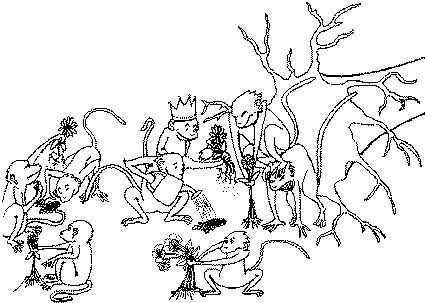
The next day, the monkeys filled up the buckets, and began watering the young trees and plants. Then the king of the monkeys addressed them: “My subjects, it is not good to waste water. Therefore, pull up each young tree or plant before watering. Inspect it to see how long the roots are. Then give more water to the ones with long roots, and less water to the ones with short roots. That way we will not waste water, and the gardener will be pleased!"
Without giving it any further thought, the obedient subjects followed their king’s orders.
Meanwhile, a wise man was walking by outside the entrance to the garden. He saw the monkeys uprooting all the lovely young trees and plants, measuring their roots, and carefully pouring water into the holes in the ground. He asked, “Oh foolish monkeys, what do you think you’re doing to the king’s beautiful garden?"
They answered, “We are watering the trees and plants, without wasting water! We were commanded to do so by our lord king."
The man said, “If this is the wisdom of the wisest among you – the king – what are the rest of you like? Intending to do a worthwhile deed, your foolishness turns it into disaster!"
The moral is: Only fools can make good deeds into bad ones.
Once upon a time, there was an old carpenter with a shiny bald head. On sunny days, his head shined so brightly that people shaded their eyes when talking to him!
On just such a sunny day, a hungry mosquito was attracted to the old carpenter’s bright bald head. He landed on it and started biting into it.
The carpenter was busy smoothing a piece of wood with a plane. When he felt the mosquito biting him, he tried to chase him away. But the hungry mosquito would not leave such a good looking meal. So the man called over his son and asked him to get rid of the stubborn pest.
Unlike his father’s shiny head, the son was not so bright. But he was hard working and obedient. He said, ‘Don’t worry Dad, be patient. I’ll kill that bug with just one blow!"
Then he picked up a very sharp ax, and took careful aim at the mosquito. Without thinking, he came down with the ax and split the mosquito in two! Unfortunately, after slicing through the mosquito, the ax also split the old carpenter’s shiny bald head in two.
Meanwhile, an adviser to the king happened to be passing by with his followers. They saw what had just happened, and were quite shocked that anyone could be so stupid!
The king’s adviser said, “Don’t be so surprised by human stupidity! This reminds me of a similar event that occurred just yesterday.
“In a village not far from here, a woman was cleaning rice. She was pounding it in a mortar with a pestle, to separate the husks. As she worked up a sweat, a swarm of flies began buzzing around her head. She tried to chase them away, but, the thirsty flies would not leave.
“Then she called over her daughter and asked her to shoo away the bothersome bugs. Although she was a rather foolish girl, the daughter always tried her best to please her mother.
“So she stood up from her own mortar, raised her pestle, and took careful aim at the biggest and boldest of the flies. Without thinking, she pounded the fly to death! But of course, the same blow that killed the fly, also ended her mother’s life.
“You all know what they say," said the adviser, finishing his story, “‘With friends like these, who needs enemies!"‘
The moral is: A wise enemy is less dangerous than a foolish friend.
On January 1, 2022, His Holiness Dorje Chang Buddha III imparted a Dharma for living beings in His Vajra Mandala in Las Vegas on “Greed Can Destroy One’s Realizations,” also titled “Greed is the Foremost Culprit in Destroying One’s Realization.” After Namo Dorje Chang Buddha III imparted Dharma, Fomu, Holy Mother the Great Mahasattva, saw the flowers offered by disciples in the Mandala, then gave a short Discourse: When offering flowers, we must do so with utmost sincerity. There are four main types of flowers for offering to Buddhas: peony, orchid, sunflower, and lotus. Many other flowers, such as Chinese peony 芍藥, should not be offered to Buddhas. After Fomu, Holy Mother the Great Mahasattva, gave the Discourse, She blessed each disciple in the Mandala with a Vajra pill, then announced that she will bear dark karma for living beings.
On the evening of January 4, His Holiness Dorje Chang Buddha III summoned four types of disciples and told them: “Now being the Dharma Ending Era, living beings’ dark karmic forces are too heavy and getting worse. Fomu cannot bear them on Her own. This time, I am going to bear the dark karma together with Fomu for living beings. Therefore, starting tomorrow, I will go into seclusion to perform Dharma. During this period, I will no longer see you! As long as each of you cultivate yourself in accordance with the Dharma, you will attain liberation.”
After some days, when the disciple Tsemeng 翟芒 rushed to Las Vegas to see if His Holiness Dorje Chang Buddha III was well, the Buddha said to him: “Tsemeng, in the Dharma Ending Age, the dark karmic forces of living beings are too heavy. When I said I would bear dark karma for living beings, those were not empty words. To bear dark karma is not to enter dhyāna, but rather, truly and continuously practice shifting the mind-consciousness to suffer on behalf of living beings. What Fomu and I said is what we do. At all times,we must think about bringing auspiciousness, serenity, happiness, and peace to living beings and to the world,to the extent of giving our all and even our lives. I have already brought true Buddha Dharma to this world. Everyone who practices in accordance with The Supreme and Unsurpassable Mahamudra of Liberation and Imparting the Absolute Truth Through the Heart Sutra will surely attain liberation. That’s all. I wish all living beings happiness.”
From then on, other than giving instructions to Dharma King Jinba 金巴法王 and Dharma King Mohe 摩訶法王, Namo Dorje Chang Buddha III did not impart Dharma openly. After almost a month of bearing dark karma for living beings, Namo Dorje Chang Buddha III and Fomu, Holy Mother the Great Mahasattva, looked very sick. In the past few decades, His Holiness Dorje Chang Buddha III had often borne dark karma for living beings, sometimes for a month or two, during which He looked seriously ill. Yet once His Holiness Dorje Chang Buddha III had completed that particular deed of bearing dark karma, Hewould immediately be full of energy as usual.One second, Namo Dorje Chang Buddha III was a gravely ill patient, the next second, He would be strong and healthy without any sickness. That’s why the close disciples have gotten used to that. However, this time, Buddhist disciples did not see His Holiness Dorje Chang Buddha III or Fomu, Holy Mother the Great Mahasattva, return to the human world. Namo Dorje Chang Buddha III and Fomu, Holy Mother the Great Mahasattva, have peacefully entered parinirvana and returned to the Sambhogakaya Buddha Land.
His Holiness Dorje Chang Buddha III, the supreme Primordial Sambhogakaya Buddha and the foremost master in the Dharma realm, came to this world to benefit living beings, and has now left this world as a result of benefitting living beings. All that His Holiness Dorje Chang Buddha III did have always been for the sole purpose of benefitting living beings. His Holiness Dorje Chang Buddha III is always of holy purity! Always altruistic! Always selfless! All of us Buddhist disciples must be grateful to the supremely great compassion and empathy of Namo Dorje Chang Buddha III and Fomu, Holy Mother the Great Mahasattva. We must truly repent our sins and beseech Namo Dorje Chang Buddha III and Fomu to return to this world!
Among all Buddhas in the Dharma realm, Dorje Chang Buddha is the Primordial Buddha, the first Buddha with form, and the only Supreme Lord of Buddhism throughout the entire universe. Dorje Chang Buddha propagated Dharma throughout the universe, hence, all other Buddhas and Great Mahasattvas learned Dorje Chang Buddha’s Dharma and cultivation to attain holy state and liberation, and eventually became Buddhas and Great Bodhisattvas. Dorje Chang Buddha is the primordial ancestor of all Buddhas and Bodhisattvas. Samantabhadra, the Dharmakaya from which Dorje Chang Buddha perfectly manifested, is the Tathagata that has no form at all. The words and deeds of Dorje Chang Buddha are the compass and guiding principles of cultivation for all ordinary and holy beings in the universe.
To help Shakyamuni Buddha, Namo Dorje Chang Buddha II —Venerable Virmalakirti—applied His supreme wisdom and limitless supernormal power to edify Hinayana Arhats who then advanced themselves and eventually became Mahayana Bodhisattvas who helped living beings attain liberation. And, innumerable living beings attained liberationby learning the teachings of Venerable Virmalakirti.
After coming to the sahā world with the Buddha level enlightenment of the Primordial Sambhogakaya Buddha, His Holiness Dorje Chang Buddha III established countless number one records in the world, every one of which was for the sake of benefiting living beings. At a very young age, He saved others without any regard to His own life and was honored with the title “Young Hero.” As He grew older, His Holiness Dorje Chang Buddha III applied His inherent Healing Vidya to heal the sick, purely on a voluntary basis. More than 500 patients used to seek His help every day. His Holiness Dorje Chang Buddha III never accepted one penny from them. Plaques and pennants with words of gratitude sent by the recovered piled up in the Buddha’s house.
As His Holiness Dorje Chang Buddha III continued to benefit living beings on a larger scale, the Central Newsreels and Documentary Studio of China produced a documentary, “One Who Is Dedicated to Advance Himself,” about His life and work. The film was shown nationwide.
In 1987, the highly respected young His Holiness Dorje Chang Buddha III was named Chairman of the Chinese Painting Research Association of the National Commission of China for UNESCO. Honorary chairpersons of the Association included Liao Jingdan 廖井丹, Li Wenqing 李文清, Lü Ji 呂驥, Yuan Xiaoyuan 袁曉園, Wu Zhangshu 吳丈蜀, Qian Juntao 錢君匋, Xie Zhiliu 謝稚柳, and others. Advisors to the Association included Luo Zhanglong 羅章龍, Zhang Kejia 臧克家, and so forth.
In 1992, His Holiness Dorje Chang Buddha III was accorded the “Art Maestro of the East” title. In 1994, during the fourth conference of the World Poets and Culture Congress held in Hungary, 5,612 experts and scholars unanimously voted to confer the “Preeminent Distinguished International Master” title, which was a Head of State level honor, to His Holiness Dorje Chang Buddha III. The conferment certificate was signed by Juan Antonio Samaranch, the then President of the International Olympic Committee. In the same year, the Museum of Master Yi Yungao officially opened in Dayi 大邑, the hometown of His Holiness Dorje Chang Buddha III in Sichuan. That was the first memorial museum in China, or even in the world, being built by a government for a living person.
In 1995, when His Holiness Dorje Chang Buddha III went from Mainland China to visit Taiwan for the first time, Taiwanese people spontaneously gave His Holiness Dorje Chang Buddha III an overwhelmingly ceremonious welcome. More than 20,000 people went to the airport to greet and pay respect to His Holiness Dorje Chang Buddha III. A motorcade of more than 1,700 cars followed the lead of police motorcycles to escort His Holiness Dorje Chang Buddha III from the airport to the hotel. That became the largest welcoming event in human history. Within the short three weeks that His Holiness Dorje Chang Buddha III stayed in Taiwan, General Chiang Wei-kuo 蔣緯國, former Secretary-General of the Taiwan National Security Council, and many other high level government officials formally requested to become disciples of His Holiness Dorje Chang Buddha III. They expressed that they wanted to truly emulate the noble morality, humanistic ethics, thoughts, and deeds of His Holiness Dorje Chang Buddha III.
After His Holiness Dorje Chang Buddha III moved to the United States, His noble morality and unparalleled achievements won the love and admiration of the American people from all walks of life. In 2002, His Holiness Dorje Chang Buddha III was presented with the “Presidential Gold Medal" by the Commissioner to the President’s Advisory Commission on Asian Americans, on behalf of President Bush.
In 2003, the Organization of American States, composing of 34 countries including the United States, Canada, and Mexico,organized the Master Wan Ko Yee Yun Sculpture Exhibition in Washington D.C. at the Capitol of the United States. The Master Wan Ko Yee Yun Sculpture Exhibition was also held at the Congressional Office Building. That was the first time the U.S. Congress held an art exhibition in their Congressional Office Building. Visitors expressed their praises in the guest book, exclaiming that the exhibition was “unprecedented,” and that the artworks were “treasures brought to the human realm by God.”
In 2004, His Holiness Dorje Chang Buddha III was named “Fellow” of the Royal Academy of Arts in the U.K.. Professor Phillip King, President of the Royal Academicians of the Royal Academy of Arts, presented the certificate to His Holiness Dorje Chang Buddha III at the British Embassy in Washington D.C., capital of the United States. The Cultural Attaché of the British Embassy personally attended the ceremony. Professor Phillip King stated that His Holiness Dorje Chang Buddha III was the first artist ever accorded this title in their renowned academy’s more than 200-year history.
The mayor of the U.S. capital Washington D.C.pronounced January 19, 2011 as “His Holiness Dorje Chang Buddha III Day” and called on people to salute to His Holiness Dorje Chang Buddha III.
His Holiness Dorje Chang Buddha III was also accorded the “King Legacy Award for International Service & Leadership” by An International Salute to The Life and Legacy of Dr. Martin Luther King, Jr.. Dozens of great honors have also been presented to His Holiness Dorje Chang Buddha III by U.S. senators, members of the House of Representatives, governors, and governments of all levels.
More remarkably exceptional, Namo Dorje Chang Buddha III was awarded the 2010 World Peace Prize Top Honor Prize, presented to Him at the United States Congress on June 14, 2011 at the U.S. Capitol. On occasions of the holy birthday of His Holiness Dorje Chang Buddha III, the U.S. Congress has held ceremonies to raise the national flag to celebrate, and President Trump and President Biden have sent personal congratulations.
In 2018, the World Peace Prize Awarding Council and the World Peace Prize Religious Leader Title Awarding Council resolved that His Holiness Dorje Chang Buddha III was the Pope of Buddhism of this world and decided to present the Pope of Buddhism Scepter to Him. Namo Dorje Chang Buddha III, however, did not accept the Scepter, but returned it instead. In September 2020, the World Peace Prize Awarding Council and the World Peace Prize Religious Leader Title Awarding Council made a joint resolution that solemnly stated, “The title, status, and authority of the Pope of Buddhism belong only to His Holiness Dorje Chang Buddha III and cannot be exercised by anyone else. This is a permanent and unalterable determination!” The two Councils also entrusted the World Buddhism Association Headquarters to present the Pope of Buddhism Scepter on their behalf to His Holiness Dorje Chang Buddha III.
Upon coming to this world, His Holiness Dorje Chang Buddha III immediately started teaching and saving living beings. He has always called Himself a “nameless cultivator.” His Holiness Dorje Chang Buddha III voluntarily served living beings and did not accept any offerings. One incident clearly shows how Namo Dorje Chang Buddha III taught and saved living beings selflessly. At the Heart Sutra Mandala on Xinhua West Road, Chengdu, Dharma Master Guozhang 果章法師 once recounted to some people that when he received initiation from His Holiness Dorje Chang Buddha III on Paoma Mountain 跑馬山, His Holiness the Buddha was only two and a half years old! After the identity of Namo Dorje Chang Buddha III being the true incarnation of the Primordial Buddha was formally recognized by Dharma kings, regent Dharma kings, and great rinpoches of major Buddhist sects in written congratulations and corroboration letters, His Holiness Dorje Chang Buddha III continued, as always, to teach and save living beings solely on a voluntary basis, and whole-heartedly devoted Himself to serving living beings. Whenever people made offerings to His Holiness Dorje Chang Buddha III, whether they were big or small offerings, in amounts as little as one dollar or as large as a few million US dollars, in the form of 37 acres of land in the city of San Francisco, or even a planeload or a shipload of gold, Namo Dorje Chang Buddha III categorically refused to accept. His Holiness Dorje Chang Buddha III was whole-heartedly dedicated to serving living beings voluntarily.
In the many years that His Holiness Dorje Chang Buddha III was propagating Dharma to save living beings, He imparted more than 2,000 Dharma Discourses in response to living beings’ levels and karmic conditions. Those Dharma Discourses were audio-recorded, and some of which such as What Is Cultivation 什麽叫修行, Sutra on Understanding and Realizing Definitive Truth 了義經, Imparting the Absolute Truth Through the Heart Sutra 藉心經說真諦, and Learning from Buddha 學佛, have been published into books. Not only did His Holiness Dorje Chang Buddha III reveal the truth about humanity and the universe, He also elucidated the truths relevant to various stages of practices, from elementary to profound accomplishment levels.
In restoring Buddhist texts to their original meaning, His Holiness Dorje Chang Buddha III pointed out that the morning and evening chants used in Buddhist temples nowadays had been tampered with by the descendants of Mara, and those texts are filled with evil views and fallacies. Namo Dorje Chang Buddha III has corrected many errors made by patriarchs and translators in their interpretations of Dharma principles, and directly revealed the chaotic phenomena in Buddhism during this Dharma Ending Era. His Holiness Dorje Chang Buddha III pointed out the path that everyone who wants to attain liberation must take: That is to build our foundation on practicing cultivation. After cultivating ourselves well, we can then learn Dharma, and naturally attain liberation and accomplishment. The correct truths and Dharmas imparted by His Holiness Dorje Chang Buddha III enable listeners to develop their wisdom and good fortune, to help each other, care about each other, and be compassionate to all living beings.
In different countries, Namo Dorje Chang Buddha III has performed great Dharmas including Holy Amrita Bestowed by Buddhas 佛降甘露, Xianliang Great Perfection 現量大圓滿, Holy Fire Offering 勝義火供, Vajra Faman Determination by Holy Selection 金剛法曼擇決, Hayagrīva Raja Water Mandala Bead Divination 馬頭明王水壇珠卦, Determination by Holy Selection on the Regression or Progression on the Bodhi Path 菩提道損減增益法, Guaranteed Delivery to Buddha Land Dharma 保送法, Vajra Array 金剛陣, and Eight Wind Array 八風陣, all of which manifested authentic holy states, enabling living beings to see with their own eyes that Buddha Dharmas are scientific, have veritable power, and absolutely are not just empty talk or theory. More importantly, Namo Dorje Chang Buddha III has brought The Supreme and Unsurpassable Mahamudra of Liberation to living beings in the sahā world, showing humanity the shortcut to attaining liberation. The Supreme and Unsurpassable Mahamudra of Liberation is the highest Dharma that Dorje Chang Buddha transmitted to Amitabha Buddha as well as Buddhas and Great Bodhisattvas in the ten directions during their cultivation stage.
In The Supreme and Unsurpassable Mahamudra of Liberation, His Holiness Dorje Chang Buddha III has made the biggest and highest vow in the entire Dharma realm, “I bear all the sinful karma for living beings, I give living beings all the good karma and merit that I have planted.” Namo Dorje Chang Buddha III has actualized the greatest and holiest vow, sacrificed His life to save the lives of numerous living beings, and returned to the Sambhogakaya Buddha Land!
The unprecedented records established by Namo Dorje Chang Buddha III in this world:
Namo Dorje Chang Buddha III was, historically, the first Buddha to have received the largest, unprecedented number of status-recognition and congratulatory letters by top level great Dharma kings and rinpoches.
Namo Dorje Chang Buddha III was recognized with the highest status in history: an Ancient Buddha.
Namo Dorje Chang Buddha III is the first Ancient Buddha who manifested perfect mastery in Exoteric and Esoteric Buddhism, and perfection of the Five Vidyas. No one else has been able to accomplish the same in the past few thousand years.
Namo Dorje Chang Buddha III manifested Buddha-level wisdom in the creation of Yun Sculpture, which nobody has been able to replicate. Historically, this is the first art form that cannot be replicated.
Namo Dorje Chang Buddha III is the first Ancient Buddha throughout history who only benefited others but did not accept any offerings.
Namo Dorje Chang Buddha III is, historically, the first Ancient Buddha who manifested the most holy miracles.
Namo Dorje Chang Buddha III is, historically, the only Buddha who could offer the kind of Buddha Dharma that enables disciples to attain liberation within two hours: Xianliang Great Perfection, the quickest path to successfully enter the Buddha Land.
Namo Dorje Chang Buddha III had the largest number of disciples who attained accomplishments; for example: Dharma King Daxila of the Tsalpa Kagyu Sect attained the rainbow body; respected layperson Wang Lingze 王靈澤 and Dharma King Gar Tongstan attained freedom from death and rebirth and passed away in a sitting meditative pose; Dharma Master Puguan 普觀法師 and Elder Monk Wuming 悟明長老 attained incorruptible flesh bodies; the Elder Monk Yizhao 意昭老和尚 vowed to return to the sahā world to save living beings; and many others.
Namo Dorje Chang Buddha III has transmitted Dharma to disciples and invoked Avalokiteshvara Bodhisattva to come at a specific time to take the disciple to the Buddha Land; even non-Buddhists saw with their own eyes when the disciple Zhao Yusheng 趙玉勝 was taken away by Avalokiteshvara Bodhisattva. Some disciples, such as Hou Yushan 侯欲善 and Lin Liu Hui-Hsiu 林劉惠秀, were able to visit the World of Ultimate Bliss, then return to the human world before ascending at a specific time to the Buddha Land. The above listed are just a few examples of the numerous Buddhist disciples who followed Namo Dorje Chang Buddha III and attained liberation.
Namo Dorje Chang Buddha III possessed Buddha-level physical constitution and physical strength that are unmatched in the world. Just about a little more than a month ago, on December 23, 2021, at the Holy Miracles Temple, His Holiness Dorje Chang Buddha III lifted the Supreme Holy Vajra Pestle that weighs 437.2 pounds, by using just four fingers to hook on to the Pestle, lifted it up, and held it for more than 13 seconds, surpassing His own base weight standard by 72 levels. Taizun Poshan Waxiang 破山瓦象太尊 asserted: “In this world, from the ancient past up to now, and even before Maitreya Bodhisattva attain Buddhahood, no ordinary or holy being will be able to lift the Buddha Pestle that Namo Dorje Chang Buddha III lifted, surpassing His own base weigh standard by 72 levels!”
The morality of Namo Dorje Chang Buddha III is so noble, His accomplishments so great, and the holy miracles He performed so numerous that it is impossible for us to list them all. What was listed above was just a drop in the ocean. If we were to tell you about all the magnificent feats of His Holiness Dorje Chang Buddha III, it would take more than ten days and ten nights. The magnificent greatness of Namo Dorje Chang Buddha III is not limited to His well-respected humanistic ethics, His noble personality and morality, His erudition, His distinguished accomplishments, His selfless compassion toward humanity and all living beings, and His passion in teaching and actualizing the practice of Buddha Dharma.Through altruistic endeavors, His Holiness Dorje Chang Buddha III truthfully, sincerely, and persistently actualized the principle of compassion, and He diligently worked toward the development of world peace. Many people are moved and motivated by His Holiness Dorje Chang Buddha III. Many people in this world aspire to Namo Dorje Chang Buddha III as their model, referencing His state of morality as their standard, and using His teachings as guidance to elevate their own morality and to benefit living beings. In doing so, not only have they fulfilled happiness in their lives, but many of them have ascended to the Buddha Land, attained freedom from death and rebirth, or attained even higher states of realization and accomplishments.
More importantly, Namo Dorje Chang Buddha III pointed out a bright path for humanity to stay far away from violence, a path that leads to benevolence and loving kindness, successful endeavors, happy families, peace in humanity, and prosperity in societies. Throughout different countries and regions in the world, more and more people of different ethnicities and cultures are actively learning and following the teachings of Namo Dorje Chang Buddha III to cultivate themselves and benefit living beings. Consequently, they have greatly elevated the level of morality in society, advanced human civilization, motivating more and more people in this world to become good, kind, and ethical people, and enabling the world to become an auspicious and green planet. These are the tremendous and inexhaustible contributions that Namo Dorje Chang Buddha III has brought to all human and other sentient beings in this world, so they may increase their happiness.
Fomu, Holy Mother the Great Mahasattva, Professor Yuhua Shouzhi Wang, was profoundly erudite. She was a top world-class art master who had been officially conferred with the “International First Class Artist” title and certificate. Professor Yuhua Shouzhi Wang was the Lifetime Honorary Chairwoman of the International Art Museum of America, and an all-rounded painter whose versatility has never been seen before in history. Fomu, Holy Mother the Great Mahasattva, stands at the summit of world-class artistry in both Western oil painting and Eastern ink painting and founded the Imagery-Naturalism painting style. The paintings of Fomu, Holy Mother the Great Mahasattva, have been exhibited in the Gold Room at the United States Congress, in Shenzhen, Shanghai, Bangkok, as well as at the Palais du Louvre in Paris. Every one of Her exhibitions was overwhelmingly well received, sending shockwaves throughout the art world. Art critics and renowned painters from Europe and Asia acclaimed that every one of her paintings is the apex of art, at the Class of Ease, and an inspiration to future generations. The accomplishments in her water lily and lotus paintings “have never been attained by anyone before and will inspire generations to come.” In August 2021, the Art Who’s Who Museum of Paintings in Dialogue organized theshow “Claude Monet and Yuhua Shouzhi Wang: An Exhibition of Water Lily Paintings in Dialogue” in Southern California. Visitors were overwhelmingly enthusiastic; art collectors and critics acclaimed that Professor Yuhua Shouzhi Wang was indeed an International First Class Artist whose artistry is at the same level as great masters such as Da Vinci, Gauguin, Van Gogh, and Monet.
Fomu is a Great Mahasattva who is the perfect embodiment of great wisdom and compassion, noble morality, kindness, altruism, and selflessness. She always considers other people’s well-being and is humble and very approachable. The compassion and kindness of Fomu, Holy Mother the Great Mahasattva, are pure and flawless. For example, in 2015, someone sneaked into the International Art Museum of America in San Francisco and tried to steal an artwork that had been acclaimed by the World Federation of UNESCO (WFUCA). This person was arrested by the police on site and subsequently detained. Since the artwork that he tried to steal was one of Fomu’s masterpieces, the court repeatedly requested Fomu to provide a valuation of the artwork, so that they could use her valuation to determinethe term for sentencing. When Fomu, Holy Mother the Great Mahasattva, knew about this person’s distress, She provided a statement saying that the artwork was rather ordinary and had no value. The court had no way of sentencing the person to any term and had to release him.
Another time, Fomu, Holy Mother the Great Mahasattva, saved a butterfly that had fallen into the water. Worried about the butterfly’s safety, Fomu brought it home and kept it for a few days to make sure the butterfly is well-recovered before letting it fly away. Fomu relentlessly led disciples to conduct life-releases. She went every week to woodlands to feed ducks and birds and never missed a week. She paid for it with Her own money and never accepted offerings from Buddhist disciples. Fomu, Holy Mother the Great Mahasattva, is well known for Her diligence and thriftiness. For many decades, the noble Fomu, Holy Mother the Great Mahasattva, always cooked Her own meals and washed Her own clothes. She never entrusted others to do Her chores. She would save the food that She could not finish eating and finish it the next day or two. She was never wasteful. Usually, Fomu, Holy Mother the Great Mahasattva, would even save the water that She did not finish drinking, the water used for washing vegetables or hands, or wastewater from the filter and use it for irrigating flowers or flushing toilet. Through Her deeds, the Great Fomu, Holy Mother the Great Mahasattva, was teaching us how to start with the small things, cherish our good fortune, and actualize our cultivation practices.It is impossible to recount all the numerous exemplary deeds of Fomu.
Wherever Fomu, Holy Mother the Great Mahasattva, went, dragon Dharma protectors were present, and holy miracles manifested. When Fomu performed initiation and transmitted Dharma, holy states were manifested. For example, at the Antelope Valley, Fomu’s hat turned into a black garuda. In New Jersey, the hair of Fomu, Holy Mother the Great Mahasattva, suddenly went up and wrapped around a tall building in Manhattan on the opposite shore. In San Francisco, a twin Buddha light suddenly appeared, centered around where Fomu stood. All cultivators are touched by the compassion and morality of Fomu, Holy Mother the Great Mahasatva.
Now, for the sake of saving our lives and our happiness, Namo Dorje Chang Buddha III and Fomu, Holy Mother the Great Mahasattva, have sacrificed themselves and went to the Sambhogakaya Buddha Land. Great Holy Gurus have said: “When learning from Namo Dorje Chang Buddha III and Fomu, Holy Mother the Great Mahasattva, we must not do any bad deeds, and do all kinds of good deeds. We must respectfully listen to the audio-recorded Dharma Discourses imparted by Namo Dorje Chang Buddha III and use the teachings of Namo Dorje Chang Buddha III to examine our every word and deed. We must actualize the teachings of His Holiness Dorje Chang Buddha III by sincerely carrying them out in our practice. Only in this way can we become a good person of noble morality who compassionately benefits others. From there, we can then advance ourselves to become holy beings with attainment of liberation from death and rebirth. More importantly, we must pass on the teachings of Namo Dorje Chang Buddha III from one generation to another, so that humanity in the sahā world can learn the Buddha Dharma taught by Namo Dorje Chang Buddha III to serve other people, attain liberation, and eventually, everyone will attain liberation!
Namo Dorje Chang Buddha III, our Fundamental Guru!
Namo Shakyamuni Buddha, Lord of Buddhism of the Sahā World!
Namo All Buddhas in the Ten Directions!
Office of His Holiness Dorje Chang Buddha III February 6, 2022
We have received Dharma transmissions from a Buddha.
Everyone who practices in accordance with The Supreme and Unsurpassable Mahamudra of Liberation and Imparting the Absolute Truth Through the Heart Sutra will surely attain liberation as stated in announcement 62 from H.H. Dorje Chang Buddha III Office.
We have found the treasure and it is in our hands.
The Buddha has done it all for us.
We have got everything we need.
What is next?
Tomorrow will be better.
It is up to you what you will do with the rest of your life.
Once upon a time, there was a teacher who meditated much and developed his mind. Gradually his fame spread. Those who wished to be guided by a wise man came to hear him. Considering what he said to be wise indeed, 500 decided to become his followers.
One of these 500, who considered his teachings to be wise, was a certain pet lover. In fact, he loved pets so much that there was no animal he did not wish to keep as a pet.
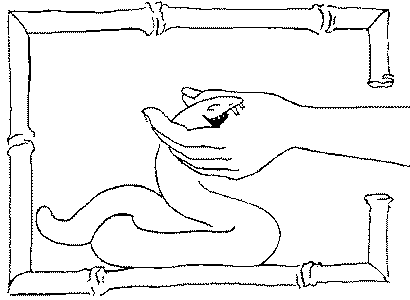
One day he came upon a cute little poisonous snake, who was searching for food. He decided he would make an excellent pet. So he made a little bamboo cage to keep him in when he had to leave him alone. The other followers called the little snake, ‘Bamboo’. Because he was so fond of his pet, they called the pet lover, ‘Bamboo’s Father’.
Before long, the teacher heard that one of his followers was keeping a poisonous snake as a pet. He called him to him and asked if this was true. Bamboo’s Father said, “Yes master, I love him like my own child!"
The wise teacher said, “It is not safe to live with a poisonous snake. Therefore, I advise you to let him go, for your own good."
But Bamboo’s Father thought he knew better. He replied, “This little one is my son. He wouldn’t bite me. I can’t give him up and live all alone!".
The teacher warned him, “Then surely, this little one will be the death of you!" But the follower did not heed his master’s warning.
Later on, all 500 of the teacher’s followers went on a trip to collect fresh fruits. Bamboo’s Father left his ‘son’ locked up in the bamboo cage.
Since there were many fruits to collect, it was several days before they returned. Bamboo’s Father realized that poor Bamboo had not eaten the whole time he was away. So he opened the cage to let him out to find food.
But when he reached inside, his ‘son’ bit his hand. Having been neglected for all that time, Bamboo was angry as well as hungry. Since he was only a snake, he didn’t know anything about poison!
But his ‘father’ should have known better. After all, he had been warned by the very teacher he himself considered wise.
Within minutes of being bitten, Bamboo’s Father dropped dead!
The moral is: There’s no benefit in following a teacher if you don’t listen to what he says.
“Mangala” means something auspicious, a blessing, happiness, a good or lucky sign, or an omen.
In the Mangala Sutra, Shakyamuni Buddha told us what to do so we can live an auspicious/happy life.
I heard these words of the Buddha one time when the Lord was living in the vicinity of Savatthi at the Anathapindika Monastery in the Jeta Grove. Late at night, a deva appeared whose light and beauty made the whole Jeta Grove shine radiantly. After paying respects to the Buddha, the deva asked him a question in the form of a verse:
My gratitude to H.H. Dorje Chang Buddha III and Namo Guan Yin Bodhisattva for giving me my children to raise and love.
My gratitude to the correct teaching of H.H. Dorje Chang Buddha III for transforming me from a caring mother to a caring woman who sees all living beings in suffering and in need of my help too.
May you all enjoy the Buddha name chant during the holiday season.
It is the best time to show our homage / gratitude to the greatest guru of all times.
(莫知尊者合掌恭敬而白羌佛提問:First of all, I, Disciple Mozhi, prostrate to my Buddha Master, Namo Your Holiness Dorje Chang Buddha III!
Today, I would like to beseech Buddha Master to impart a Dharma. I know that in the course of imparting Dharmas Buddha Master often revealed unfavorable opinions toward Tibetan Esoteric Buddhism. However, in my poor knowledge, there are many Dharmas within Tibetan Esoteric Buddhism. According to my understanding, the Vajra Dharmas in the Tantric Division are the highest Dharmas. The ten major Vajra Dharmas are the core and key constituents commanding the entirety of Buddha Dharma for attaining accomplishment. Therefore, I beseech my Buddha Master to impart the Dharma that tells us Buddhist disciples: What should we do to be able to learn the best and highest Vajra Dharmas, in order to ensure attaining accomplishment in this current lifetime? Additionally, do these Vajra Dharmas all have rituals and detail procedures or steps of practicing? How should we practice these Dharmas?)
(莫知尊者再度合掌恭敬白羌佛提問:Thank you, Buddha Master. Namo Your Holiness Dorje Chang Buddha III! After hearing the impartations from my Buddha Master, off the many Vajra Dharmas in various sects of Esoteric Buddhism, we are truly astounded and are like being brought to a new world. Then, how can we accurately distinguish and correctly select with a one-hundred-percent certainty among all those Vajra Dharmas, in order to truly achieve great accomplishment and liberation? Also, how do we know the right or wrong of our own Dharma practice? How do we know if we have made progress to develop accomplishment through our practice?)
(莫知尊者合掌恭敬而白羌佛說:I am so grateful to the kindness of Namo Your Holiness Dorje Chang Buddha III! Thank You, my beneficent Buddha Master. Thank you so much for opening the door to the supreme true Buddha Dharma today for us Buddhist disciples. This is actually the Invincible Vajra Dharma! This Dharma is more than sufficient for enabling living beings to become liberated! I am so extremely grateful! I am so grateful!)
Once upon a time, the people of Benares were fond of setting up bird houses. This was an act of generosity and kindness, done for the comfort of birds. It also made the people happy to hear the friendly birds singing.
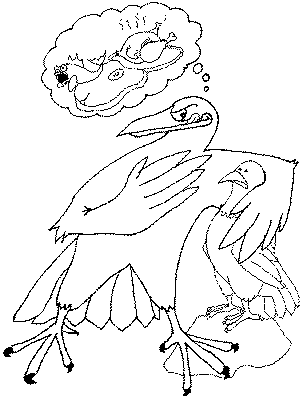
The richest man in the city had a cook. He kept such a bird house near the kitchen. In it lived a gentle and careful pigeon. He was so gentle that he did not care to eat meat. And he was careful to keep his distance from the cook. For he knew the cook was in the habit of roasting and boiling dead animals, even including birds!
So the pigeon always left the bird house early in the morning. After spending the day finding and eating his food, he returned each night to sleep in the bird house. He was quite contented with his calm and harmless life.
Nearby there was a crow who was quite a different sort of character. For one thing, he would eat anything! And he was not known for being gentle and careful. Instead, he often became overly excited, and acted without considering the danger. And far from being contented, he often got himself into trouble.
One day the crow smelled the delicious food being cooked in the rich man’s kitchen. He was so attracted by the odour that he could not take his mind off it. He decided that he must have the rich man’s meat at any cost. So he began spying on the kitchen, trying to figure out a way to get some of the meat and fish.
As usual, that evening the pigeon returned with his little belly satisfied, and contentedly entered his little home for the night. Seeing this, the hungry crow thought, “Ah, wonderful! I can make use of this dull pigeon to grab a delicious feast from the kitchen."
The next morning, the crow followed the pigeon when he left for the day. The pigeon asked him, “Oh my friend, why are you following me?" The crow replied, “Sir, I like you very much, and I admire your calm and regular way of life. From now on, I would like to assist you and learn from you."
The pigeon said, “Friend crow, your life style is much more exciting than mine. You would get bored following me around. And you don’t even eat the same food I do. So how can you assist me?"
The crow said, “When you go each day to find your food, we will separate and I will find my food. In the evening, we will come back together. Being together, we will be able to help and protect each other." The pigeon said. “That sounds all right to me. Now go your own way and work hard finding food."
The pigeon spent his usual day eating grass seeds. It took some time patiently searching for a few little grass seeds, but he was satisfied and contented.
The crow spent the day turning over cow dung patties, so he could gobble up the worms and insects he found there. This was fairly easy work, but he kept thinking it would be even easier to steal from the rich man’s kitchen. And no doubt the food would be better too!
When he was full, he went to the pigeon and said, “Sir pigeon, you spend too much time searching for and eating food. It is no good wasting the whole day that way. Let us go home." But the pigeon kept on steadily eating grass seeds, one by one. He was quite happy that way.
At the end of the day, the impatient crow followed the pigeon back to his bird house. They slept in it together peacefully. They spent several days and nights in this way.
Then one day there was a delivery of many kinds of fresh meat and fish. The cook hung them on hooks in the kitchen for storage.
The crow saw this and was overwhelmed by the sight of so much food. His desire became greed, and he began plotting a way to get it all for himself. He decided to pretend to be sick. So he spent the entire night groaning and moaning.
The next morning, the pigeon was ready to go look for food as usual. The crow said, “Go without me, sir pigeon, I have been sick to my stomach all night long."
The pigeon replied, “My dear crow, that sounds so strange. I’ve never heard of a crow getting an upset stomach. But I have heard they sometimes faint from hunger. I suspect you want to gobble up as much as you can of the meat and fish in the kitchen. But it’s for people, not crows. People don’t eat pigeon food. Pigeons don’t eat crow food. And it would not be wise for you to eat people food. It might even be dangerous! So come with me as usual, and be satisfied with crow food, sir crow!"
The crow said, “I’m too sick, friend pigeon, I’m too sick. Go ahead without me."
“Very well," said the pigeon, “but your actions will speak louder than your words. I warn you, don’t risk safety for the sake of greed. Be patient until I return." Then the pigeon left for the day.
But the crow paid no attention. He thought only about grabbing a big piece of fish, and was glad to be rid of the pigeon. “Let him eat grass seeds!" he thought.
Meanwhile, the cook prepared the meat and fish in a big stew pot. While it was cooking, he kept the lid slightly off, to allow the steam to escape. The crow smelled the delicious fragrance in the rising steam. Watching from the bird house, he saw the cook go outside to rest from the heat.
The crow saw that this was the chance he’d been waiting for. So he flew into the kitchen and sat on the edge of the stew pot. First he looked for the biggest piece of fish he could find. Then he stuck his head inside and reached for it. But in so doing, he knocked the lid off! The clattering sound brought the cook into the kitchen at once.
He saw the crow standing on the edge of the pot with a fish bigger than he was, hanging from his beak! Immediately, he closed the door and window of the kitchen. He thought, “This food is for the rich man. I work for him, not for some mangy crow! I will teach him a lesson he’ll never forget!"
The poor crow could not have picked a worse enemy. This cook just happened to be rather ignorant, so he did not mind being cruel when he had the upper hand. He took no pity at all on the clever crow.
He grabbed him, and plucked out all his feathers. The poor crow looked ridiculous without his shining black feathers. Then the vengeful cook made a spicy paste from ginger, salt and chilli peppers. He rubbed it all over the crow’s pink sore skin. Then he put him on the floor of the bird house, and laughed.
The crow sweated and suffered from the terrible burning pain. He cried in agony all day long.
In the evening, the pigeon returned from a quiet day searching for and eating grass seeds. He was shocked to see the terrible state of his friend the crow. He said, “Obviously, you didn’t listen to me at all. Your greed has done you in. I’m so sad there’s nothing I can do to save you. And I’m afraid to stay in this bird house so close to that cruel cook. I must leave at once!"
So the careful pigeon flew away in search of a safer bird house. And the plucked and pasted crow died a painful death.
The moral is: Greed makes one deaf to sound advice.