5. The Price Maker [Foolishness]

Story 5

5. The Price Maker [Foolishness]

Buddhist Tales for Young and Old, volume 1, Prince Goodspeaker, Stories 1-50

5. The Price Maker [Foolishness]

Long ago and far away, there was a king who ruled in Benares, in northern India. One of his ministers was called the Royal Price Maker, and he was a very honest man. His job was to set a fair price for anything the king wanted to buy or sell.

On some occasions, the king did not like his price making. He did not get as big a profit as he wanted. He did not want to pay so much when he bought, or sell for what he thought was not enough. So he decided to change the price maker.

One day he saw a nice looking young man and he thought, “This fellow will be good for my price making position." So he dismissed his former honest price maker, and appointed this man to be the new one. The man thought, “I must make the king happy by buying at very low prices and selling at very high prices." So he made the prices ridiculous, without caring at all what anything was worth. This gained the greedy king a lot of money, and made him very happy. Meanwhile, all the others who dealt with the new price maker, including the king’s other ministers and ordinary people, became very unhappy.

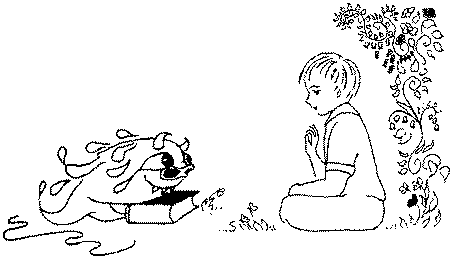
Then one day a horse merchant arrived in Benares with 500 horses to sell. There were stallions, mares and colts. The king invited the merchant to the palace, and called upon his Royal Price Maker to set a price for all 500 horses. Thinking only of pleasing the king, he said, “The entire herd of horses is worth one cup of rice." So the king ordered that one cup of rice be paid to the horse dealer, and all the horses were taken to the royal stables.

Of course the merchant was very upset, but he could do nothing at the moment. Later he heard about the former price maker, who had a reputation for being very fair and honest. So he approached him and told him what had happened. He wanted to hear his opinion, in order to get a proper price from the king. The former price maker said, “If you do as I say, the king will be convinced of the true value of the horses. Go back to the price maker and satisfy him with a valuable gift. Ask him to tell the value of one cup of rice, in the presence of the king. If he agrees, come and tell me. I will go with you to the king."

Following this advice, the merchant went to the price maker and gave him a valuable gift. The gift made him very happy, so that he saw the value of pleasing the horse dealer. Then the merchant said to him, “I was very happy with your previous evaluation. Can you please convince the king of the value of one cup of rice?" The foolish price maker said, ‘Why not? I will explain the worth of one cup of rice, even in the presence of the king."

So the price maker thought the horse dealer was satisfied with his cup of rice. He arranged for another meeting with the king, as the merchant was departing for his own country. The merchant reported back to the old price maker, and they went together to see the king.

All the king’s ministers and his full court were in the royal meeting hall. The horse merchant said to the king, “My lord, I understand that in this your country, my whole herd of 500 horses is worth one cup of rice. Before I leave for home, I want to know the value of one cup of rice in your country." The king turned to his loyal price maker and said, “What is the value of one cup of rice?"

The foolish price maker, in order to please the king, had previously priced the herd of horses at one cup of rice. Now, after receiving a bribe from the horse dealer, he wanted to please him too. So he replied to the king, in his most dignified manner, “Your worship, one cup of rice is worth the city of Benares, including even your own harem, as well as all the suburbs of the city. In other words, it is worth the whole kingdom of Benares!"

On hearing this, the royal ministers and wise men in the assembly hall started to roar with laughter, slapping their sides with their hands. When they calmed down a little, they said, “Earlier we heard that the kingdom was priceless. Now we hear that all Benares, with its palaces and mansions, is worth only a cup of rice! The decision of the Royal Price Maker is so strange! Where did your highness find such a man? He is good only for pleasing a king such as you, not for making fair prices for a merchant who sells his horses from country to country."

Hearing the laughter of his whole court, and the words of his ministers and advisers, the king was ashamed. So he brought back his former price maker to his official position. He agreed to a new fair price for the herd of horses, as set by the honest price maker. Having learned a lesson, the king and his kingdom lived justly and prospered.

The moral is: A fool in high office can bring shame even to a king.

5. The Price Maker [Foolishness]

Link: https://hhdorjechangbuddhaiiiinfo.com/2021/10/17/5-the-price-maker-foolishness/

INTERPRETER’S INTRODUCTION – BUDDHIST TALES FOR YOUNG AND OLD, VOLUME 1, STORIES 1-50

#Buddhisttalesforyoungandold #Buddhiststories #storiesforkids #moralstories #Buddha #Jatakastories #PansiyaPanasJataka #foolishness #Banares #India

4. The Mouse Merchant [Diligence and Gratitude]

Story 4

4. The Mouse Merchant [Diligence and Gratitude]

Buddhist Tales for Young and Old, volume 1, Prince Goodspeaker, Stories 1-50

Once upon a time, an important adviser to a certain king was on his way to a meeting with the king and other advisers. Out of the corner of his eye, he saw a dead mouse by the roadside. He said to those who were with him. “Even from such small beginnings as this dead mouse, an energetic young fellow could build a fortune. If he worked hard and used his intelligence, he could start a business and support a wife and family."

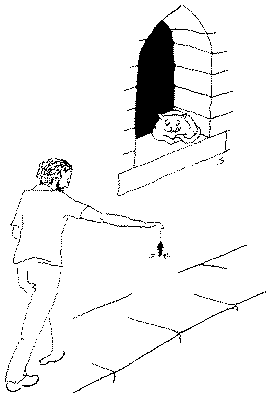
A passerby heard the remark. He knew this was a famous adviser to the king, so he decided to follow his words. He picked up the dead mouse by the tail and went off with it. As luck would have it, before he had gone even a block, a shopkeeper stopped him. He said, “My cat has been pestering me all morning. I’ll give you two copper coins for that mouse." So it was done.

With the two copper coins, he bought sweet cakes, and waited by the side of the road with them and some water. As he expected, some people who picked flowers for making garlands were returning from work. Since they were all hungry and thirsty, they agreed to buy sweet cakes and water for the price of a bunch of flowers from each of them. In the evening, the man sold the flowers in the city. With some of the money he bought more sweet cakes and returned the next day to sell to the flower pickers.

This went on for a while, until one day there was a terrible storm, with heavy rains and high winds. While walking by the king’s pleasure garden, he saw that many branches had been blown off the trees and were lying all around. So he offered to the king’s gardener that he would clear it all away for him, if he could keep the branches. The lazy gardener quickly agreed.

The man found some children playing in a park across the street. They were glad to collect all the branches and brush at the entrance to the pleasure garden, for the price of just one sweet cake for each child.

Along came the king’s potter, who was always on the lookout for firewood for his glazing oven. When he saw the piles of wood the children had just collected, he paid the man a handsome price for it. He even threw into the bargain some of his pots.

With his profits from selling the flowers and the firewood, the man opened up a refreshment shop. One day all the local grass mowers, who were on their way into town, stopped in his shop. He gave them free sweet cakes and drinks. They were surprised at his generosity and asked, “What can we do for you?" He said there was nothing for them to do now, but he would let them know in the future.

A week later, he heard that a horse dealer was coming to the city with 500 horses to sell. So he got in touch with the grass mowers and told each of them to give him a bundle of grass. He told them not to sell any grass to the horse dealer until he had sold his. In this way he got a very good price.

Time passed until one day, in his refreshment shop, some customers told him that a new ship from a foreign country had just anchored in the port. He saw this to be the opportunity he had been waiting for. He thought and thought until he came up with a good business plan.

First, he went to a jeweler friend of his and paid a low price for a very valuable gold ring, with a beautiful red ruby in it. He knew that the foreign ship was from a country that had no rubies of its own, where gold too was expensive. So he gave the wonderful ring to the captain of the ship as an advance on his commission. To earn this commission, the captain agreed to send all his passengers to him as a broker. He would then lead them to the best shops in the city. In turn, the man got the merchants to pay him a commission for sending customers to them.

Acting as a middle man in this way, after several ships came into port, the man became very rich. Being pleased with his success, he also remembered that it had all started with the words of the king’s wise adviser. So he decided to give him a gift of 100,000 gold coins. This was half his entire wealth. After making the proper arrangements, he met with the king’s adviser and gave him the gift, along with his humble thanks.

The adviser was amazed, and he asked, “How did you earn so much wealth to afford such a generous gift?" The man told him it had all started with the adviser’s own words not so long ago. They had led him to a dead mouse, a hungry cat, sweet cakes, bunches of flowers, storm damaged tree branches, children in the park, the king’s potter, a refreshment shop, grass for 500 horses, a golden ruby ring, good business contacts, and finally a large fortune.

Hearing all this, the royal adviser thought to himself, “It would not be good to lose the talents of such an energetic man. I too have much wealth, as well as my beloved only daughter. As this man is single, he deserves to marry her. Then he can inherit my wealth in addition to his own, and my daughter will be well cared for."

This all came to pass, and after the wise adviser died, the one who had followed his advice became the richest man in the city. The king appointed him to the adviser’s position. Throughout his remaining life, he generously gave his money for the happiness and well being of many people.

The moral is: With energy and ability, great wealth comes even from small beginnings.

4. The Mouse Merchant [Diligence and Gratitude]

Link: https://hhdorjechangbuddhaiiiinfo.com/2021/10/09/4-the-mouse-merchant-diligence-and-gratitude/

INTERPRETER’S INTRODUCTION – BUDDHIST TALES FOR YOUNG AND OLD, VOLUME 1, STORIES 1-50

#Buddhisttalesforyoungandold #Buddhiststories #storiesforkids #moralstories #Buddha #Jatakastories #PansiyaPanasJataka #diligence #gratitude

3. The Golden Plate

Story 3

The Golden Plate

 [Greed and Honesty]

Buddhist Tales for Young and Old, volume 1, Prince Goodspeaker, Stories 1-50

Once upon a time in a place called Seri, there were two salesmen of pots and pans and handmade trinkets. They agreed to divide the town between them. They also said that after one had gone through his area, it was all right for the other to try and sell where the first had already been.

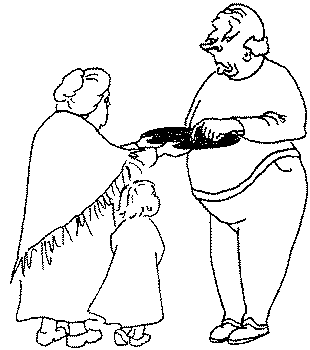
One day, while one of them was coming down a street, a poor little girl saw him and asked her grandmother to buy her a bracelet. The old grandmother replied, “How can we poor people buy bracelets?" The little girl said, “Since we don’t have any money, we can give our black sooty old plate." The old woman agreed to give it a try, so she invited the dealer inside.

The salesman saw that these people were very poor and innocent, so he didn’t want to waste his time with them. Even though the old woman pleaded with him, he said he had no bracelet that she could afford to buy. Then she asked, “We have an old plate that is useless to us, can we trade it for a bracelet?" The man took it and, while examining it, happened to scratch the bottom of it. To his surprise, he saw that underneath the black soot, it was a golden plate! But he didn’t let on that he had noticed it. Instead he decided to deceive these poor people so he could get the plate for next to nothing. He said, “This is not worth even one bracelet. There’s no value in this. I don’t want it!" He left, thinking he would return later when they would accept even less for the plate.

Meanwhile the other salesman, after finishing in his part of town, followed after the first as they had agreed. He ended up at the same house. Again the poor little girl begged her grandmother to trade the old plate for a bracelet. The woman saw that this was a nice tender looking merchant and thought, “He’s a good man, not like the rough-talking first salesman." So she invited him in and offered to trade the same black sooty old plate for one bracelet. When he examined it, he too saw that it was pure gold under the grime. He said to the old woman, “All my goods and all my money together are not worth as much as this rich golden plate!"

Of course the woman was shocked at this discovery, but now she knew that he was indeed a good and honest fellow. So she said she would be glad to accept whatever he could trade for it. The salesman said, “I’ll give you all my pots and pans and trinkets, plus all my money, if you will let me keep just eight coins and my balancing scale, with its cover to put the golden plate in." They made the trade. He went down to the river, where he paid the eight coins to the ferry man to take him across.

By then the greedy salesman had returned, already adding up huge imaginary profits in his head. When he met the little girl and her grandmother again, he said he had changed his mind and was willing to offer a few cents, but not one of his bracelets, for the useless black sooty old plate. The old woman then calmly told him of the trade she had just made with the honest salesman, and said, “Sir, you lied to us."

The greedy salesman was not ashamed of his lies, but he was saddened as he thought, “I’ve lost the golden plate that must be worth a hundred thousand." So he asked the woman, “Which way did he go?" She told him the direction. He left all his things right there at her door and ran down to the river, thinking, “He robbed me! He robbed me! He won’t make a fool out of me!"

From the riverside he saw the honest salesman still crossing over on the ferry boat. He shouted to the ferry man, “Come back!" But the good merchant told him to keep on going to the other side, and that’s what he did.

Seeing that he could do nothing, the greedy salesman exploded with rage. He jumped up and down, beating his chest. He became so filled with hatred towards the honest man, who had won the golden plate, that he made himself cough up blood. He had a heart attack and died on the spot!

The moral is: “Honesty is the best policy."

The Golden Plate  [Greed and Honesty]

Link: https://hhdorjechangbuddhaiiiinfo.com/2021/10/01/3-the-golden-plate/

INTERPRETER’S INTRODUCTION – BUDDHIST TALES FOR YOUNG AND OLD, VOLUME 1, STORIES 1-50

#Buddhisttalesforyoungandold #Buddhiststories #storiesforkids #moralstories #Buddha #Jatakastories #PansiyaPanasJataka #greedandhonesty

2. Finding a New Spring [Perseverance]

Story 2

Finding a New Spring

 [Perseverance]

Buddhist Tales for Young and Old, volume 1, Prince Goodspeaker, Stories 1-50

Once upon a time a certain tradesman was leading a caravan to another country to sell his goods. Along the way they came to the edge of a severe hot-sand desert. They asked about and found that during the day time the sun heats up the fine sand until it’s as hot as charcoal, so no one can walk on it — not even bullocks or camels! So the caravan leader hired a desert guide, one who could follow the stars, so that they could travel only at night when the sand cools down. They began the dangerous night time journey across the desert.

A couple of nights later, after eating their evening meal, and waiting for the sand to cool, they started out again. Later that night the desert guide, who was driving the first cart, saw from the stars that they were getting close to the other side of the desert. He had also overeaten, so that when he relaxed, he dozed off to sleep. Then the bullocks who, of course, couldn’t tell directions by reading the stars, gradually turned to the side and went in a big wide circle until they ended up at the same place they had started from!

By then it was morning, and the people realized they were back at the same spot they’d camped at the day before. They lost heart and began to cry about their condition. Since the desert crossing was supposed to be over by now, they had no more water and were afraid they would die of thirst. They even began to blame the caravan leader and the desert guide — “We can do nothing without water!", they complained.

Then the tradesman thought to himself, “If I lose courage now, in the middle of this disastrous situation, my leadership has no meaning. If I fall to weeping and regretting this misfortune, and do nothing, all these goods and bullocks and even the lives of the people, including myself, may be lost. I must be energetic and face the situation!" So he began walking back and forth, trying to think out a plan to save them all.

Remaining alert, out of the corner of his eye, he noticed a small clump of grass. He thought, “Without water, no plant could live in this desert." So he called over the most energetic of his fellow travellers and asked them to dig up the ground on that very spot. They dug and dug, and after a while they got down to a large stone. Seeing it they stopped, and began to blame the leader again, saying “This effort is useless. We’re just wasting our time!" But the tradesman replied, “No no, my friends, if we give up the effort we will all be ruined and our poor animals will die — let us be encouraged!"

As he said this, he got down into the hole, put his ear to the stone, and heard the sound of flowing water. Immediately, he called over a boy who had been digging and said, “If you give up, we will all perish – so take this heavy hammer and strike the rock."

The boy lifted the hammer over his head and hit the rock as hard as he could — and he himself was the most surprised when the rock spilt in two and a mighty flow of water gushed out from under it! Suddenly, all the people were overjoyed. They drank and bathed and washed the animals and cooked their food and ate.

Before they left, they raised a high banner so that other travellers could see it from afar and come to the new spring in the middle of the hot-sand desert. Then they continued on safely to the end of their journey.

The moral is: Don’t give up too easily – keep on trying until you reach the goal

Finding a New Spring

Link: https://hhdorjechangbuddhaiiiinfo.com/2021/09/20/2-finding-a-new-spring-perseverance/

INTERPRETER’S INTRODUCTION – BUDDHIST TALES FOR YOUNG AND OLD, VOLUME 1, STORIES 1-50

#Buddhisttalesforyoungandold #Buddhiststories #storiesforkids #moralstories #Buddha #Jatakastories #PansiyaPanasJataka #preserverance

1. Demons in the Desert [The Correct Way of Thinking]

Story 1

Demons in the Desert 

[The Correct Way of Thinking]

Buddhist Tales for Young and Old, volume 1, Prince Goodspeaker, Stories 1-50

Once upon a time there were two merchants, who were friends. Both of them were getting ready for business trips to sell their merchandise, so they had to decide whether to travel together. They agreed that, since each had about 500 carts, and that they were both going to the same place along the same road, it would be too crowded to go at the same time.

One decided that it would be much better to go first. He thought, “The road will not be rutted by the carts, the bullocks will be able to choose the best of all the grass, we will find the best fruits and vegetables to eat, my people will appreciate my leadership and, in the end, I will be able to bargain for the best prices."

The other merchant considered carefully and realized there were advantages to going second. He thought, “My friend’s carts will level the ground so we won’t have to do any road work, his bullocks will eat the old rough grass and new tender shoots will spring up for mine to eat. In the same way, they will pick the old fruits and vegetables and fresh ones will grow for us to enjoy. I won’t have to waste my time bargaining when I can take the price already set and make my profit." So he agreed to let his friend go first. This friend was sure he’d fooled him and gotten the best of him – so he set out first on the journey.

The merchant who went first had a troublesome time of it. They came to a wilderness called the ‘Waterless Desert’, which the local people said was haunted by demons. When the caravan reached the middle of it, they met a large group coming from the opposite direction. They had carts that were mud smeared and dripping with water. They had lotuses and water lilies in their hands and in the carts. The head man, who had a know-it-all attitude, said to the merchant, “Why are you carrying these heavy loads of water? In a short time you will reach that oasis on the horizon with plenty of water to drink and dates to eat. Your bullocks are tired from pulling those heavy carts filled with extra water – so throw away the water and be kind to your overworked animals!"

Even though the local people had warned them, the merchant did not realize that these were not real people, but demons in disguise. They were even in danger of being eaten by them. Being confident that they were helpful people, he followed their advice and had all his water emptied onto the ground.

As they continued on their way they found no oasis or any water at all. Some realized they’d been fooled by beings that might have been demons, and started to grumble and accuse the merchant. At the end of the day, all the people were tired out. The bullocks were too weak from lack of water to pull their heavy carts. All the people and animals lay down in a haphazard manner and fell into a deep sleep. Lo and behold, during the night the demons came in their true frightening forms and gobbled up all the weak defenseless beings. When they were done there were only bones lying scattered around — not one human or animal was left alive.

After several months, the second merchant began his journey along the same way. When he arrived at the wilderness, he assembled all his people and advised them — “This is called the ‘Waterless Desert’ and I have heard that it is haunted by demons and ghosts. Therefore we should be careful. Since there may be poison plants and foul water, don’t drink any local water without asking me." In this way they started into the desert.

After getting about halfway through, in the same way as with the first caravan, they were met by the water soaked demons in disguise. They told them the oasis was near and they should throw away their water. But the wise merchant saw through them right away. He knew it didn’t make sense to have an oasis in a place called ‘Waterless Desert’. And besides, these people had bulging red eyes and an aggressive and pushy attitude, so he suspected they might be demons. He told them to leave them alone saying, “We are business men who don’t throw away good water before we know where the next is coming from."

Then seeing that his own people had doubts, the merchant said to them, “Don’t believe these people, who may be demons, until we actually find water. The oasis they point to may be just an illusion or a mirage. Have you ever heard of water in this ‘Waterless Desert’? Do you feel any rain-wind or see any storm clouds?" They all said, “No", and he continued, “If we believe these strangers and throw away our water, then later we may not have any to drink or cook with – then we will be weak and thirsty and it would be easy for demons to come and rob us, or even eat us up! Therefore, until we really find water, do not waste even a drop!"

The caravan continued on its way. That evening it reached the place where the first caravan’s people and bullocks had been killed and eaten by the demons. They found the carts and human and animal bones lying all around. They recognized that the fully loaded carts and the scattered bones belonged to the former caravan. The wise merchant told certain people to stand watch around the camp during the night.

The next morning the people ate breakfast, and fed their bullocks well. They added to their goods the most valuable things left from the first caravan. So they finished their journey very successfully, and returned home safely so that they and their families could enjoy their profits.

The moral is: One must always be wise enough not to be fooled by tricky talk and false appearances.

1. Demons in the Desert [The Correct Way of Thinking]

Link: https://hhdorjechangbuddhaiiiinfo.com/2021/09/12/1-demons-in-the-desert-the-correct-way-of-thinking/

INTERPRETER’S INTRODUCTION – BUDDHIST TALES FOR YOUNG AND OLD, VOLUME 1, STORIES 1-5

#Buddhisttalesforyoungandold #Buddhiststories #storiesforkids #moralstories #Buddha #Jatakastories #PansiyaPanasJataka #thecorrectwayofthinking

From the Storyteller to the Listeners

from the storyteller to the listeners

Buddhist Tales for Young and Old, volume 1, Prince Goodspeaker, Stories 1-50

When you read or listen to these very old stories, if you wonder how much is really true, the Buddha gave some advice that might help. He said that when you listen to what a monk says you should test the meaning, weigh or consider it, and depend on your own insights to know the truth of it. Then follow and practice what you know to be true.

Let us praise

the Exalted, Worthy, Fully Self-Enlightened One

 and follow the Truth.

from the storyteller to the listeners

Link:https://hhdorjechangbuddhaiiiinfo.com/2021/09/12/from-the-storyteller-to-the-listeners/

#Buddhisttalesforyoungandold #Buddhiststories #storiesforkids #moralstories #Buddha #Jatakastories #PansiyaPanasJataka
“食物银行”的免费食品被哄抢秒空,再次拷问人性之贪

“食物银行”的免费食品被哄抢秒空,再次拷问人性之贪

“食物银行”的免费食品被哄抢秒空,再次拷问人性之贪

近日,“上海食物银行”的免费食品一经上架瞬间被哄抢一空的视频刷屏了,评论区出现最多的基本上是说“人性经不住考验”以及“好在冰箱还在”这类讽刺的留言。

上海食物银行是上海肯德基在当地街道部门指导下推出的免费提供食物的一项公益活动,主要面向于年纪大的失独家庭,为他们以及一些确实有需要的人提供帮助。

此活动为设置“自取冰箱”每天将余量食物放置里面,食物种类包括肯德基原味鸡、辣鸡翅、鸡块、华夫可颂等,并在包装上写明日期。

从视频中可以看到:3月4日首家肯德基食物银行在上海杨浦区出现,食品还没放稳就遭到早已守候在旁边的市民哄抢,场面一时失控。

活动当日尽是老年人,只见他们就像伺服在猎物旁边的狼一样,当食物上架后他们仿佛立刻化身“黄飞鸿”动作神速、一拥而上身手敏捷程度一点都不像公交车上需要让座的“某大爷”。

这帮老人他们是在抢真正有需要帮助的人的食物,食物银行存的是食物放的是善心,但凡衣足饭饱的人不求你出来付出,但至少应该有同情心,不能对这些有特殊用途的食物产生贪心。

大多数人思索对错的关键点就在于利于自己的就是对的,不利于自己的就是错的。

其实世间最可怕的不是做错事而是用错心,事情做错了可以改正,心思用错了还会继续错下去。

因此做每一件事情的时候要知道自己在做什么,要有所为有所不为。

胡适曾经说过:“如果人人讲规则而不是空谈道德,社会会充满人味,道德也会逐渐回归。如果人人都不讲规则却大谈道德谈高尚,最终只会增加无数的伪君子”。

从视频不难看出今天这个哄抢场景可以说是吃相极其难看、丑态毕露,人性贪婪的一面表露无遗。

就目前这种情况来讲食物银行的做法还不如北京、杭州、山东某些有善心的商家推出的那种给有特殊帮助需求的人群提供的免费单人套餐来的实在和直接。

有些不差钱的人也去吃了,但他们付了更多的钱,他们用自己的善意行动声援支持商家的善举,这样的做法才能实际帮到真正有需要的人,也传递出更多的善意。

然而,说到“善”其实每个人的骨子里都有善念存在。古语有云:“人之初,性本善”。只不过是后天受身边的生活环境影响,慢慢的善念不知被压在了心底的哪个地方,但是当因缘成熟的时候它就会自然跳出来。

这种善行、善举可能是被动的、可能是功利的。比如,为了达到某种自身的利益而不得不去做的。也可能是发自本心的善良,就像那些提供免费单人套餐的商家。

不禁想起《八仙传说》里一个小故事。

当年八仙之一的吕洞宾想拜钟离权为师,钟离权对他说你功德行善尚未圆满,我教你点石成金之术用来济世救人,待你圆满三千功德、八百行善我再渡你成仙。吕洞宾满心欢喜却忍不住问师父:“点石成金的金子还会变成石头吗?”

钟离权对他说:“石头终归是石头,三千年后还是会变回石头。”

吕洞宾说:“这样的话此法术弟子不敢学。”

钟离权问:“为什么?”

吕洞宾回答道:“我今虽借此法可以快速功成三千功德、八百行善,但是三千年后拥有这些黄金的人却只剩下一堆石头,那时富者叹息穷者更穷,这岂不是害了三千年后得到这些黄金的人吗?” 钟离权不禁感叹道:“三千功德、八百行善、一念之善已修行圆满,于是当下就收他为徒。”后来吕洞宾果然不负所望成为一代高仙 。

南无第三世多杰羌佛有云:“育己利人慈于行,造良为善责其身”

予人玫瑰手留余香,你手上留下的余香就是你起心动念后而得到的信息和满足感,这与玫瑰无关,只关于那一刻你起的善心。亦即是所谓的修来之福皆为行善之果。

可现实中却恰恰相反,我们现在与古人相比虽说是物质丰富了,但是精神层面还远远不足。“食物银行”的食品被哄抢秒空,再次拷问着我们的本性——人真的就可以这么自私,这么贪婪吗?

撰 稿:在路上

编 辑:西边的彩虹

“食物银行”的免费食品被哄抢秒空,再次拷问人性之贪

此文章链接:https://hhdorjechangbuddhaiiiinfo.com/2021/08/31/%e9%a3%9f%e7%89%a9%e9%93%b6%e8%a1%8c%e7%9a%84%e5%85%8d%e8%b4%b9%e9%a3%9f%e5%93%81%e8%a2%ab%e5%93%84%e6%8a%a2%e7%a7%92%e7%a9%ba%ef%bc%8c%e5%86%8d%e6%ac%a1%e6%8b%b7%e9%97%ae%e4%ba%ba/

#H.H.第三世多杰羌佛第三世多杰羌佛佛法

What is the Best Way to Celebrate a Birthday?

What is the Best Way to Celebrate a Birthday?

What is the best way to celebrate a birthday? Often we want to give our family members or loved ones a special surprise on this day.  What can we do to make this special day even more special?  When we google it, we will find all kinds of answers and ideas.  One answer I found: The best way to celebrate your birthday is to do something new each year. And this suggestion I am about to share with all of you is something many people have never done – hosting a fish release in celebration of your own birthday.

What is so special about releasing fish or any captive animals to celebrate a birthday? All living beings are equal.  When we set them free, it is as if they are reborn again.  They are given another chance to live as a result of our kind deed.  Celebrating a birthday is as celebrating many birthdays for all the lives we have just saved. We accumulate countless merits from saving lives. It is said that the merits from saving lives will prolong our life and improve our health.  There are numerous miracle stories in which people get ill and later on their health is dramatically improved after releasing many captive animals.

Other than celebrating our own birthday, we can also release captive animals in honor of someone we highly respect.  Every year in August, we release captive marine animals in celebration of the holy birthdays of Fomu佛母 and Jinba Dharma King金巴法王. This year we released lives on August 8 at San Rafael, CA. Ruo Hui Dharma Master, the Abbess of Hua Zang Si in San Francisco, together with the monastics conducted the fish release.  It was nice to see everyone there again with the same mind of saving living beings in pain and fear, and setting them all free back to the ocean. When I held the bucket of water with a couple of big crabs in it, I chanted the Six-Character Great Bright Mantra of Guan Yin Bodhisattvas.  Wishing them all the best, I then poured the water and crabs back to the ocean.  It was a quick hello and goodbye.  I wish them a safe and sound journey back home.

May all living beings be treated equally because we all have the Buddha nature in us.  All of us have the same chance to live happily, practice, and eventually become an enlightened one.

May the merits from today bring comfort and hope to those in pain impacted by the pandemic and all the natural disasters.

May the fearlessness of Guan Yin Bodhisattva bring us the courage, and never ever will we give up on our practice to become a better person and make the world a better place.

May all living beings have the karmic condition to embrace the teachings of H.H. Dorje Chang Buddha III and His grace.

-Western Lotus

What is the Best Way to Celebrate a Birthday?

Link: https://hhdorjechangbuddhaiiiinfo.com/2021/08/19/what-is-the-best-way-to-celebrate-a-birthday/

#FishRelease #H.H.DorjeChangBuddhaIII #GuanYinBodhisattva #Birthday #HuaZangSi #Fomu佛母 #JinbaDharmaKing金巴法王 #RuoHuiDharma Master

Interpreter’s Introduction – Buddhist Tales for Young and Old, volume 1, Stories 1-50

Interpreter’s Introduction

Buddhist Tales for Young and Old, volume 1, Stories 1-50

PRINCE GOODSPEAKER

This image has an empty alt attribute; its file name is picture17.jpg

It is a pleasure to rewrite the Jataka stories in modern English understandable by western readers. To achieve this goal, the stories are being retold in order to convey the spirit and meaning. They are not scholarly word-for-word translations as have been done by others. The Pali Text Society published the whole text in English translation a hundred years ago. In Sri Lanka they were translated into Sinhalese in the 14th century, where they were known as Pansiya Panas Jataka.

In all Buddhist countries the Jataka tales were the major sources for developing the character of the people. They were used widely in preaching by monks and lay preachers. King Dutugemunu (2nd century B.C.), in Anuradhapura, paid for the support of preachers to teach Dharma, the teachings of the Buddha. They usually used these stories in their sermons. Even the Venerable Arahant Maha Mahinda, who introduced Dharma into Sri Lanka, used these stories to illustrate the truth of the teachings. Some were even used by the Lord Buddha in his teachings, and from him his followers learned them and passed them into popular use in society. Even earlier, the same types of stories were present in Vedic literature.

Greek myths, as well as the fables of Aesop, inherited them from the Vedas and Buddhism; Persia also took them from India. They later migrated into the stories of Chaucer in England and Boccaccio in Italy. The stories were used for a variety of purposes. In Sanskrit, the Pancatantra used them to teach Law and Economics, and the Katha Sarit Sagara used them for the development of knowledge, as well as just for enjoyment. In the past, people have been satisfied and fulfilled in many ways by hearing them in forms ranging from lessons to fairy tales.

By reading these stories, children and adults can develop their knowledge and learn how to face the difficult experiences of modern life. They can easily develop human values and good qualities like patience, forbearance, tolerance and the four sublime states of mind – loving-kindness, compassion, sympathetic joy and equanimity. The major purpose of these stories is to develop the moral and ethical values of the readers. Without them, people cannot be peaceful and happy in their hearts and minds. And the reader will find that these values are very different from those of the wider, violently acquisitive, ego-based society.

In this interpretation, changes are being made to the style of the old Jataka stories, and explanations are added, as is appropriate for children in the modern world. The lovely artwork is also sometimes in a modern setting, to attract young and old to the truths contained in the tales.

The sources used have been as follows:

1. Jataka Pali (Colombo: Buddha Jayanti Tripitaka Series Publication Board, 1983) – original Pali stanzas.
2. Jataka Pali (Colombo: Simon Hewavitarane Bequest, 1926) – original Pali Jataka stories in Sinhalese characters.
3. Sinhala Jataka Pot Vahanse (Colombo: Jinalankara Press, 1928) – Sinhalese translation of Pali Jataka stories.
4. Sinhala Jalaka Pot Vahanse (Colombo: Ratnakara Bookshop, 1961) – Sinhalese translation of Pali Jataka stories.
5. Jataka Pota, ed. Lionel Lokuliyana (Colombo: M. D. Gunasena & Co., 1960) – Sinhalese translation of first fifty Pali Jataka stories.
6. The Jataka or Stories of the Buddha’s Former Lives, ed. E. B. Cowell (London: Pali Text Society, 1981), 6 vols., index
English translation of Pali Jataka stories.
7. Pansiyapanas Jataka Pot Vahanse (Bandaragama: H. W. N. Prematilaka, 1987) – Sinhalese summaries of Pali Jataka stories.

In addition, “From the Storyteller to the Listeners" (below), contains a paraphrase taken from “Discourse With Canki," Middle Length Sayings (Majjhima-Nikaya), trans. I. B. Horner (London: Pali Text Society, 1975), 11, 95, pp. 362-3. The title of the fourth story, “The Mouse Merchant", was originally in Somadeva, The Ocean of Story (Katha Sarit Sagara), trans. C. H. Tawney (London: C. J. Sawyer, 1924).

The sequence numbers used for the stories are in the same order as in the Jataka Pali and The Jataka or Stories of the Buddha’s Former Lives (above). Multiple sequence numbers indicate that identical, similar or partial stories are told in one version. The most complex example is “The Curse of Mittavinda" which requires explanation. Here the Losaka (41), the three Mittavinda (82, 104, 369) and the Catu-Dvara (439) Jatakas are combined. This is because the stanzas of 82, 104 and 369 all refer directly to the palaces described in 41 and 439, as well as to the wheel of torture described in 439. The latter retells the four palaces portion of 41, and then leads directly into the wheel of torture (Ussada hell) portion. To allow continuity, the ending of the wheel of torture portion is taken from 369, since in it Mittavinda does not die.

Since the stories include legends which are not actually canonical, the character traditionally said to be the Bodhisatta (the Buddha in a past life) is not necessarily identified in each rewritten story.

It is hoped that these stories will be picked up by teachers and used to teach children. They can serve as examples in guiding children to use the morals in their daily activities. By drawing their minds into thinking properly, their thinking power will be developed. This will prove invaluable in facing difficulties, unexpected circumstances and disasters, without being confused.

The stories teach valuable lessons to correct our current life style. For instance, the second story, “Finding a New Spring", teaches the value of perseverance. Today people who are enslaved to the Modern development of science and technology, are lazy due to the easy availability of things they need (and things they don’t need). They become used to giving up their efforts to achieve goals when there are even minor difficulties. They give up, change their minds, and try something else. Having become lazy, their thinking power declines, as does their effort to overcome difficulties. Consequently, they also do not understand how to solve the problems of living with others, and their human values decline as well.

Mankind has achieved the present level of civilization over a long period of time, by using vast human energy to control his weaknesses. Deep and immeasurable dedication and effort have been required to develop human physical and intellectual skills. We need to preserve these qualities for the future peace and happiness of the world. Our highest efforts are needed to preserve declining human qualities and values. If not, the future will be in turmoil with quarrels and conflict.

Mature and compassionate people of diverse cultures are realising the danger. The cause is the discouragement of the teaching of an internal moral code. Modern educators and psychologists have neglected the function of the moral development of children. This is the major cause of the world-wide increasing crime rate. Fifty years ago children were taught moral values, but there is no such subject in modern schools, while churches and temples are poorly attended. Without such teaching, where will a young child learn what is good and bad, from cartoons, commercials and movies? Why has the subject been neglected in the field of education and in the society at large?

In “Finding a New Spring", when the caravan lost its way, the leader did not blame others or grumble, he was determined to overcome the unexpected circumstances. In the midst of the weakened thinking of the others, he was the only one who could be depended on to lead the search for water. Even after tiring digging led to the great rock obstacle, he was not to give up. His perseverance broke through the slab and reached the goal. How joyful they all were! Why do we not teach our children to follow such examples in their unexpected encounters? The adults who read these stories to children must point out morals like these and help them to develop their tender minds.

May all beings be well and happy!

Kurunegoda Piyatissa

November 30, 1994

Buddhist Literature Society
New York Buddhist Vihara
84-32 124th Street, Kew Gardens
New York, N.Y. 11415 USA

Interpreter’s Introduction

Buddhist Tales for Young and Old, volume 1, Stories 1-50

Link: https://hhdorjechangbuddhaiiiinfo.com/2021/08/14/interpreters-introduction-buddhist-tales-for-young-and-old-volume-1-stories-1-50/

#Buddhisttalesforyoungandold #Buddhiststories #storiesforkids #moralstories #Buddha #Jatakastories #PansiyaPanasJataka