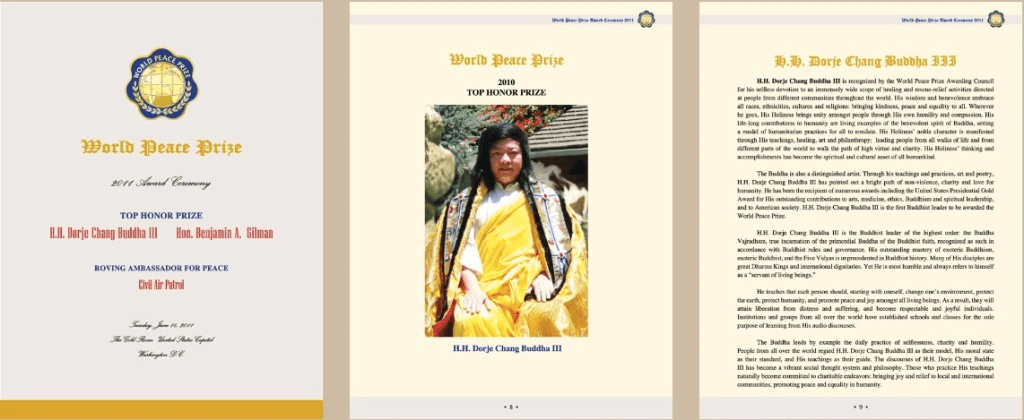
H.H. Wan Ko Yeshe Norbu Holiest Tathagata is the only Dorje Chang Buddha III in the history of Buddhism who has been recognized by greatly accomplished beings of the highest order in the world as well as famous dharma kings and rinpoches from various sects who have issued written recognition documents in accordance with the dharma! The Twelve Points of the Incarnation of Dorje Chang Buddha III are conclusive.
1. The first Buddha in history to have received such a large number of recognitions and written congratulations from great dharma kings and rinpoches of the highest order in the world.
2. The first ancient Buddha in history to have been recognized as having such a high status.
3. The first ancient Buddha in history who has shown such outstanding and complete proficiency and mastery of exoteric Buddhism, esoteric Buddhism, and the Five Vidyas, which nobody else has ever done.
4. The first ancient Buddha in history who has manifested such a large number of holy feats.
5. Buddhas bestowed nectar from the sky into a bowl in front of several dozen dharma teachers, persons of great virtue, and others.
6. When transmitting dharma to disciples, predictions were made as to when those disciples would become accomplished in the dharma. Those disciples were able to take a trip to the Western Paradise of Ultimate Bliss. After they returned to the human realm, they passed on to that paradise at the predicted time.
7. Many incarnations of extremely famous and virtuous patriarchs from Tibet and other countries are disciples of this ancient Buddha.
8. Dragon spirits, birds, and land animals became disciples of and came to hear dharma discourses of this ancient Buddha.
9. At a dharma assembly attended by many people during which offerings were made to the Buddhas, nectar pills that partially filled a bowl suddenly increased in number about one hour after the dharma assembly began. Even after some of those nectar pills were distributed as blessings to the fifty-nine people in attendance, the nectar pills that remained in the bowl still formed a dome that rose above the brim of the bowl and were still greater in number than at the beginning of the dharma assembly.
10. Manifesting the wisdom of a Buddha, wondrous multicolored sculptures and sculptures with mist inside them were created. Nobody else in the world can replicate such works.
11. The first ancient Buddha who benefits living beings but does not accept any offerings.
12. The only one who possesses Buddha-dharma that causes a disciple to attain enlightenment and liberation within two hours. It is the fastest Buddha-dharma practice where a disciple can enter and leave a Buddha-land at will.
The Buddha delivered this story about Anāthapiϯika’s true friend when he was in the Jetavanārāma of Anāthapiϯika in Sāvatthi. The millionaire Anāthapiϯika had a friend and he helped him as stated earlier in the Kālaka::i-Jātaka [No. 83].
At one time there was a king called Brahmadatta in Benares. At that time the Enlightenment Being lived in the pleasure garden of the king and was a friend of the deity who possessed that park and who lived in the most prominent Sāla tree in the park. The Enlightenment Being lived in a clump of Kusa grass.
The king of Benares lived in a palace that had only one pillar supporting it. One day this pillar was shaken by the wind. The king decided to further support it. He summoned his carpenter and asked him to cut down any good tree with a core from the pleasure garden. The chief carpenter went to the pleasure garden, looked for an appropriate tree to cut down, and not seeing one decided finally with his assistant to cut down the prominent Sāla tree in the garden. He went back to the palace and reported about the problem, and about the prominent tree to the king.
The king said, “Even if it is the prominent tree, you cut it and repair the palace.” Then the carpenter went with his assistant to cut down the tree. They made an appropriate reverence [pūjā], asking the deity who possessed the tree to move away from the tree. Hearing this request, the deity thought, “I do not have any other tree this large in the pleasure garden in which to stay.” He began to cry, and his children also began to cry while they all embraced one another. All the other deities who were visiting there also started to cry. The deity who resided in the clump of Kusa grass also came upon hearing all this crying. He asked the reason for the crying. On hearing the reason, he said, “Please, do not be afraid. I know a way to save the tree.” The next day, when the carpenters came to cut the tree, he made himself into a chameleon. He went through the roots of the tree, came up the tree on the far side so that people could not see him, and went to a top branch of the tree.
On seeing the chameleon on the top branches of the tree, the carpenter and his assistant thought, “This tree is hollow inside.” They gave up the idea of cutting down the tree because it had no core inside.
Then the tree deity summoned the other deities and said, “Even though I was the highest deity in the pleasure garden, I did not know how to save my tree and palace. The deity who lived in a clump of Kusa grass understood how to protect it with his wisdom. Therefore, we must always associate with wise people, and not with the unwise.” In this way, he preached to his fellow deities, and he became friendlier with the deity who possessed the clump of Kusa grass. Later, he passed away.
The pleasure garden deity was the Venerable Ānanda at that time. And I was born as the deity of the clump of Kusa grass.
And in this way, the Buddha finalized the KusanāÀi story.
The moral: “Associate with the wise no matter what their station, not the unwise.”
When the Buddha was living in the Jeta Grove, the Buddha related this story regarding the Brahmin girl Ciñcā. Its present story is explained in the Mahāpaduma-Jātaka in the twelfth book [No. 472].
[After the Buddha’s attainment of enlightenment, the Jains and other ascetics found that their gains had fallen. Therefore, the Jain recluses became upset and angry, and they hatched a conspiracy to defame the Buddha. Ciñcā, the Brahmin girl, became their instrument. In accord with the conspiracy, she came from home toward the Jetavana monastery every evening wearing a red cloth. Then she slept at a recluse’s home, and returned to her home each morning as if she were a person coming from Jetavana monastery. People asked, “Where did you go?” She answered, “Do not care about where I go. Do not think about me.” And she behaved so as to create doubts in people’s minds about her.
She continued in this fashion for four months. By doing this, she led people to believe that she was no doubt coming from the Buddha’s chamber. She used to say, “Now I am one month pregnant.” “Now I am two months pregnant.” “Now I am three months pregnant.” And so forth. When ten months had passed like this, she pretended to be a woman who was about to deliver a baby.7 Then she went to the Buddha having stuffed something around her belly, and when Buddha was preaching, in the middle of the congregation she accused the Buddha, saying, “Ah, you are preaching here as if a person who is innocent. I am now ten months pregnant and I have to deliver my baby. I have no home in which to deliver. Why do you not prepare the food and other items that I need for my delivery of the baby? Mention it to King Kosala or to millionaire Anāthapiϯika and arrange someplace for me to stay.”
The Buddha said, “Oh sister, the truth of this incident is known by both of us. Except for the two of us, who will know the truth?” At the same moment, there came four deities as rats. They scurried up her body, and cut the strings holding what was tied around her belly. The cloths that were tightened there fell down to the ground.
Everyone started to censure her. People attacked her because she had falsely accused the Buddha. And they kicked her out of the hall. Suddenly there came a big fire from hell (Avici), and the ground opened and took her.]
Regarding this, there was then discussion in the preaching hall. The Buddha revealed the story of the past thus:
Once the Enlightenment Being was born as a Brahmin advisor to King Brahmadatta, who ruled in Benares. He had a very beautiful queen who loved him very much. Because the king loved her so much, he once said to her, “For whatever you desire, you may ask.” The queen responded, “I have everything I want. I have nothing to ask. And so, I ask you not to look at any other woman with passion. That is my boon.” The king said, “Since there are 16,000 beautiful women in my possession, I may not be able to give that boon.” She then pleaded, again and again. Very ardently, she continued to so plead. Finally, the king was unable to say “no” to her, and agreed.
While they were living in such a manner, deeply in love with one another, there was a riot in a remote village. His minister could not settle it. Finally, the king went there with his fourfold army. Before he left, he summoned his queen and said, “War is doubtful. It is difficult to bring women to the battlefield. One cannot retreat quickly with women beside you. Therefore, I cannot take you to the battlefield. Stay at home.” The queen said, “No. Let me come with you.” But the king was steadfast.
Then the queen said, “If such be so, please inform me of all news every Yojana.8” The king and queen both agreed to this. And the king left, asking his ministers to look after the queen. The chief Brahmin advisor undertook her protection within the confines of the city. Every Yojana the king sent a messenger to inform her of his affairs, and to inquire about her well being.
When each messenger came, the queen asked, “Why did you come?” Each messenger replied, “I came to inquire about your safety and happiness.” Thereupon the queen summoned each to her chamber, was intimate with each of them, and then sent each back. Meanwhile, on the battlefield, the king won. During his thirty-two Yojana long trip, the queen was intimate with thirty-two messengers. Coming back, he also sent thirty-two messengers, and each of these was also intimate with the queen. The queen in this way was intimate with sixty-four messengers.
Finally, the king came near the city and camped overnight. He informed the chief Brahmin advisor the news of his arrival. The chief advisor decorated the city to welcome the king and his army. And he went to the palace to inform the queen of the king’s arrival. The queen, seeing the beauty of his body, said, “Come and sit on the bed.” The advisor, who was the Enlightenment Being, said, “Your majesty, the king who is your husband is handsome. I am both afraid of him, and of what might befall me in my next birth.” When she heard this, she said, “Were not those sixty- four messengers who came to me also afraid of the king the same as you are? And were they also not afraid of their next birth?” Then the advisor said, “Even though I have reached my present age, I have never seen a woman with such a lustful mind. Therefore, please do not speak to me in this way.” She said, “If you say ‘no’ to me, then I will ask the king to behead you complaining that you have asked me to be intimate with you.” The advisor, who was the Enlightenment Being, said, “Not only in one life, but also in a thousand lives, even if you have me beheaded, I will not agree to your desires.” Saying so, he left.
The queen got angry. She scratched her body everywhere, and applied oil to the wounds. Wearing a dirty garment, she lay in her bedroom. She told her servant girls that when the king comes and asks about her, to tell him that she was sick and was lying in her bed.
The Enlightenment Being went forward to welcome the king and his army, who returned to the city triumphantly with a very big procession. The king came into the palace after circumambulating the city and not seeing the queen in the palace, he asked the servant girls about her. They said she was sick. Then the king went into her sleeping room and saw that she was lying in bed. Touching her back, he asked how she was feeling. After asking her two or three times, she turned around toward him and replied, “Ah, your lordship also has come. Now I am with my husband.” Hearing these words, the king asked, “Why do you speak so?” Then she complained about the advisor, saying, “He did what no husband would ask him to do.” And she showed her bruises to the king. The king got very angry, and ordered his security people to handcuff the Brahmin advisor and to kill him.
The security people, hearing these words, took the Brahmin advisor and brought him to the place of execution beating the death drums. Then the Enlightenment Being thought, “This happened because of the queen. But I must use my common sense here.” Thinking so, he said to the executioners, “I know many places where wealth is hidden. Please do not kill me until I show them to the king.” Then they asked, “What can you show the king?” The advisor said, “Because of me, the king has much wealth hidden. If you kill me, he will lose all this wealth not knowing where it is. Therefore, my death will be a big loss for him.” The executioners heard this, and thought, “He says the truth.” So they took him back to the king.
On seeing him, the king asked, “You, Brahmin, without having fear or shame did such a bad deed. Why did you do it?” The Enlightenment Being said, “Your lordship, I never did such a thing. From the earliest time I can remember, I have never even killed a louse. I have never even taken so much as a piece of grass that was not given. I have never looked at another’s woman with lustful thoughts, and have never looked at another’s woman with head raised.9 Even in jest, I have never said falsehoods. I have never tasted alcohol, even as little as would be on a blade of grass. The sixty-four messengers are the people who misbehaved with the queen. Even though she trapped me in the same way, I did not get involved. That is why she complained about me.”
On hearing this, the king summoned all the sixty-four messengers and also the queen. He questioned them as to whether or not this was true. They all admitted to their wrongdoing. The king ordered all of them to be killed. But the Enlightenment Being said, “Your lordship, these people did what the queen requested. Therefore, it is not right to punish them.” And they were saved from punishment, and were retained in their positions. And he said further, “This is the nature of women. Therefore, it would be correct to excuse the queen as well.” He in this way saved her also.
Finally he thought, “All this happened to me as I was in the life of a householder. Therefore, it would be good to renounce lay life.” Thinking so, while his relatives cried, giving up all his wealth behind him, he went to the Himalayan forest and became ordained as an ascetic. After meditating there, he generated the fivefold higher knowledge and the eightfold high achievements of concentration. After his death, he was born in the Brahma world.
Buddha said, “The queen at that time was Ciñcā. The king was the Venerable Ānanda. And the advisor Brahmin was myself, the Buddha.” And in this way he ended the story of release from bondage [bandhanamokkha].
Once when the Buddha was living in Jetavana monastery, there were two monks who did not do their monastic duties at the proper times. They would go to bed late at night, and they did not wake up at the proper time. When they woke up, they made a lot of noise. Because of this, the monks who slept normal hours nearby could not get sound sleep.
This story was spread among the monks who assembled for the evening Dhamma sermon of the Buddha in the preaching hall. The Buddha went in the evening to preach and asked, “Oh monks, what was your discussion before I came here?” The monks said, “Venerable sir, such-and-such monks shout and make noise at improper times during the night. We were discussing that.” Buddha said, “Oh monks, it is not only today but also in the past that these two monks have been noisy at improper times.” Buddha was then invited to disclose the story of the past. He delivered this story to disclose the previous life:
When Brahmadatta was ruling in Benares in the past, the Enlightenment Being was born in a notable Brahmin family. He was well educated, became the chief instructor in the area, and taught 500 students.
The students had a certain rooster who crowed at the proper times. They woke up at the proper time each day, and studied every morning learning their lessons by heart.
Then the rooster died.
After that, one student went to the forest to collect firewood. There he caught a wild rooster. He put it in a cage, and fed it regularly.
That rooster did not crow at the proper times. Sometimes, he would crow at midnight. Hearing the noise of the rooster, the students would get up at midnight and read their lessons so as to learn them by heart. But as it was too early to wake up, they became very upset. Sometimes, this rooster would crow in the middle of the morning. When they got up at that time, they did not have enough time to do their studies during the morning hours. So the rooster became very unpopular among the students. They killed it and complained to the teacher.
The teacher said, “Without teachers and parents, and without proper instruction, this fowl came to such a fate. Therefore, students must follow the guidance of teachers.”
Buddha then compared these two incidents, and finished this story disclosing, “The fowl that crowed at the improper time was one of these monks who has no set time for his work. The students were you who are assembled here. The teacher was I, the Buddha, who attained Nibbāna.”
Since the public emergence of the teachings of His Holiness Dorje Chang Buddha III several decades ago, interest in the authentic Dharma has steadily grown across the globe. In the early stages, access to these teachings was limited and scattered. Individuals seeking the Dharma from H.H. Dorje Chang Buddha III often found that authentic materials were not readily available online. However, over time, it became evident that the prerecorded oral teachings of the Buddha could be accessed in temples that uphold the correct Dharma and at certified Dharma-Listening Centers, under the guidance of certified Masters of Dharma-Listening Sessions.
The Dharma from H.H. Dorje Chang Buddha III is no longer a mystery. Trustworthy resources such as the official website of the Office of H.H. Dorje Chang Buddha III provide access to several complete and unedited Dharma teachings, both in Chinese and English, ensuring broader and more reliable access for seekers of the true Dharma.
In recent years, the Office of H.H. Dorje Chang Buddha III has made significant efforts to transcribe these oral teachings into printed form. In 2023 and 2024, several volumes of sutras expounded by H.H. Dorje Chang Buddha III were published in hard copy. Continuing this effort, an additional set of printed sutras in Chinese will be officially presented on May 30 and 31, 2025, during the Dharma Assembly Respectfully Honoring the Holy Birthday of H.H. Dorje Chang Buddha III in Glendale, California.
The newly released volumes are as follows:
Volume VII: Namo Dorje Chang Buddha III Secretly Recorded Various Disciples’ Reports on Their Dharma Practices
Volume VIII: Namo Dorje Chang Buddha III Expounds Dharma on How to Discern Evil Monastics
Volume IX: Namo Dorje Chang Buddha III Expounds Dharma in Response to Questions Raised by Disciples
Volume X: Namo Dorje Chang Buddha III Expounds Dharma in the United States
Volume XI: Holy Views
These sacred texts will be available for respectful purchase at the venue of the Dharma Assembly.
The Dharma of H.H. Dorje Chang Buddha III is no longer shrouded in mystery—it is reaching the hearts and minds of people across the world. Disciples from all walks of life are warmly invited to attend this momentous occasion, to respectfully request these sutras, and to bring their study and practice into the comfort of their homes.
This gathering is not only a celebration but also a powerful spiritual event where Buddhist disciples unite in prayer for themselves, their families, their communities, and the world. Many attendees have expressed how deeply moved they were by the collective goodwill and spiritual energy of the Assembly, vowing to return year after year to partake the Dharma joy.
When the enlightened one was living in Jetavana monastery, this Jātaka story was delivered regarding the millionaire called Uttara.
While the millionaire Uttara was living in the city of Sāvatthi, a certain very highly meritorious prince was conceived in his wife’s womb, and after ten months he was delivered. He grew up and became a youth.
At one time, there was a Kattikā festival. Many millionaires’ children came out with their wives onto the streets and celebrated in the streets for seven days. Uttara also, thinking his son should celebrate with them, went to him and told him of his intentions, saying, “You also go, along with the young women of the household, and celebrate the Kattikā festival.”
As the son of Uttara came from the Brahma world, he did not do as his father wished. Thereupon, without his consent, his friends got together and summoned a certain prostitute from the village. She, decorated with ornaments and fancy clothes, tried to entice him. But, on seeing her, he did not want to have anything to do with her. His friends tried to persuade him, letting her show him her feminine wiles, but he only smiled.
The millionaire Uttara’s son, looking at her with a distracted mind, saw her as bones only. Seeing her as impurities, he was averse to her. But he thought, “Why should I send her back empty-handed?” So, he gave her all that she needed. She left, and while she was walking in the street, a certain rich official saw her. He led her to his home.
When the Kattikā celebration was over, the prostitute’s mother did not see her daughter. She went to the millionaires’ sons and accused them of taking her daughter. She asked, “Where is she now? Show me.” Hearing her accusation, the youths said, “We sent her, on the very same day she was summoned, to the millionaire Uttara’s son. Go and ask him.” Then she went to him and asked about her daughter. He said, “I sent her away, on the very same day. I do not know where she went.” The woman took him to court, and cried before the king. The king examined the case and said, “If she was in your house, you will have to produce her.” The young millionaire’s son said, “Sir, I do not know where she is.”
The king then said, “If it is so, I will order you to be punished.” And he did so.
The ministers, hearing the king’s order, put cuffs around the millionaire Uttara’s son’s hands and led him away as punishment drums were beating. On hearing this noise, many people came and surrounded him crying and weeping. They said, “Such a punishment has fallen on such a virtuous person as you!”
The millionaire’s son, who was the victim, thought, “If I get rid of this punishment, I will be ordained as a monk in the monastic order of the Buddha.”
Meanwhile, the prostitute heard the news that he was sentenced to death because of her. Knowing this, she came from the official’s mansion where she had been staying and appeared before the executioners. Some people in the crowd, who saw her, handed her over to her mother. Then, the millionaire Uttara’s son was released.
The millionaire’s son after being freed from death went to the lake and washed his hair, taking a bath. He then ate rice. After that, he paid respect to his parents, and obtained permission from them to become ordained as a monk. And he went to the forest. He became a monk, and received his higher ordination [upasampadā]. Within a few days, gaining insight from meditation, he obtained the status of Arahant.
On the very same day, the elders assembled in the preaching hall were talking about him. When the Buddha entered, he asked the monks, “Oh monks, what were you talking about before I came here?” When they mentioned that the story of the millionaire’s son and his attainment of the status of Arahant was being discussed by them, the Buddha said, “Oh monks, not only today but even in the past wise people have been released from death’s grip as was this monk today.” The Buddha was invited to disclose the story of the past. The Buddha then disclosed this story:
Long ago a king called Brahmadatta was ruling in Benares. At that time, the Enlightenment Being was born among quails. A certain quail hunter in Benares at one point went to the forest and came back having caught a lot of quails. Keeping them at home and feeding them, he sold them to people.
One day, the quail that was the Enlightenment Being got trapped in the net placed down by the quail hunter. He also was brought to the hunter’s home. The quail hunter gave the quails that he had caught food to eat to make them fat. But the Enlightenment Being did not eat the food, thinking, “If I eat, I will be fat, and I will not be able to escape through the small holes of the net which is confining me.” The quail hunter, seeing that this quail was not eating over a few days, took him into his hand and examined him in the palm of his hand so as to ascertain why this quail was not eating. Meanwhile, this quail saw a moment’s inattention on the part of the quail hunter, and he flew away to the forest.
When he went home, his relatives surrounded him and asked, “What happened to you? Why were you away for such a long time?” He said that he had been captured by a hunter, and related how he had obtained his release. Buddha said, comparing the two stories, “Wise people are released from death as this quail. The quail at that time was I who have attained Buddhahood, the master who became the teacher of the three worlds.”
The moral: “Parents love children.”
Further,
“The practice of common sense is essential for a safe life.”
When Buddha was living in Jetavana monastery, the Venerable Devadatta’s right hand disciple Kokālika caused a disruption among the monks. Because of that, the Buddha related this Jātaka story. The story of its cause is detailed in the thirteenth book in the Takkāriya-Jātaka [No. 481].
[During a certain spring retreat the two chief disciples of the Buddha, Sāriputta and Moggallāna, went to the monk called Kokālika and said, “With your help to us, and with our help to you, we can live together happily in this temple for this rainy season period of three months.” The two chief disciples said this so as to try to avoid being bothered by the public. Kokālika asked, “What is the happiness that you can gain because of me?” The two chief disciples said, “If you do not disclose to anyone that we are here, then we can live happily. That is the help you can give us. During these three months, we will teach you the discourses (sutta-s) and the philosophical and psychological analyses (abhidhamma) of the Buddha. This is how we can help you.”
Then the Venerable Kokālika prepared shelter for them. This was not known to anyone. At the end of the rainy season retreat, they requested Kokālika to visit the Buddha with them. On the way to seeing the Buddha, they came to a certain village. After the two chief disciples left the village, the Venerable Kokālika came back and said to the villagers, “You devotees are ignorant like animals. Our chief disciples were with me nearby for the last three months. And now, these two have left to go back to Sāvatthi.”
Hearing this, the villagers became very upset and taking many offerings chased after the two chief disciples. Meeting them, they begged pardon and said, “Bhante, we could not recognize you. Please pardon us and accept these offerings.” Then the chief disciples refused to accept the gifts and instructed the villagers even not to give them to Kokālika. The villagers invited the two chief disciples to come back again to the village. Kokālika thought, “The chief disciples did not accept these gifts, and they did not even allow me to accept them.” And he became angry with them.
The two chief disciples, in Sāvatthi with the Buddha for a short time, again left this time with their 500 disciples to go to the village where Kokālika lived. The villagers treated them with the four requisites of monks (food, clothing, shelter, and medicine). Those monks who went with the two chief disciples shared all the gifts given by the villagers with each other, and did not give any to Kokālika.
Because of this, Kokālika got angry and said, “Both Sāriputta and Moggallāna have bad motives. They did not accept the gifts given before by the villagers when they were here alone. Now they are accepting them when they are together with a retinue of 500 monks.” And he accused the two chief disciples in this way, with an evil mind.
However, hearing this the two chief disciples thought, “Kokālika acquires a great amount of demerit because of us. Therefore it is not good to stay here. So, let us go.” And they left the place along with their retinue.
Seeing this, the villagers started to cry and plead with them to stay. But they were firm in their decision. Meanwhile, a young monk spoke to the villagers and said, “Oh villagers, how can the two chief disciples stay here without the consent of Kokālika?”
The villagers got angry and went to Kokālika and requested, “Go, please, and invite the venerable two chief disciples to stay here and beg their pardon. If not, you must leave this village.” Then he became afraid of the villagers and requested the two chief disciples to stay. The two chief disciples said, “You, monk, do not go. You stay here. But we will not come back.”
Kokālika returned, but he could not stay in the village without the help of the villagers. He became very melancholy and taking his robes and books, left to see the Buddha who was in Jetavanārāma. He complained, “Your lordship, Sāriputta and Moggallāna have bad motives. They have gone over to earning gifts.” The Buddha said, “Kokālika, do not say so. They both are very highly virtuous and are endowed with good qualities.”
Then Kokālika said, “Sir, your chief disciples’ words are unwholesome. I know it. And they are not virtuous.” In this way, while Buddha was objecting to his saying so, he left.
Kokālika returned, but he could not stay in the village without the help of the villagers. He became very melancholy and taking his robes and books, left to see the Buddha who was in Jetavanārāma. He complained, “Your lordship, Sāriputta and Moggallāna have bad motives. They have gone over to earning gifts.” The Buddha said, “Kokālika, do not say so. They both are very highly virtuous and are endowed with good qualities.” Then Kokālika said, “Sir, your chief disciples’ words are unwholesome. I know it. And they are not virtuous.” In this way, while Buddha was objecting to his saying so, he left.
Within a short time, everywhere on his body there developed big boils which started to bleed and fester. He could not bear the pain, and screaming lay down near the gate of Jetavanārāma. His bad reputation spread everywhere, even up to the Brahmaloka.
This was seen by a certain higher deity (brahma) named Tudu who thought, “It is my duty now to go and advise Kokālika to beg pardon for his fault.” Staying in the sky, he said, “Kokālika, you have done a very bad deed. Go hurry up and beg pardon.” Then Kokālika asked, “Who are you, sir?” And Tudu said, “I am Tudu, your former master.” “What? You are a non-returner to this world? If so, how can you come from the Brahmaloka to this human world? No doubt, you are like a hungry ghost who comes to a heap of garbage.” Then the deity went back to his place saying, “If you speak so, then you look out for yourself.” And he left. And Kokālika died because of the same disease, and was born in a woeful state called the Hell of Paduma. The Sahāmpati Brahma deity saw this and informed the Buddha. On this occasion, Buddha said, “Kokālika not only in this life, but also in the past, faced difficulties because of his words.”]
Buddha stated that the monk Mahā-Kokālika, by speaking too much, faced death even in the past. The monks requested him to disclose the story. The Buddha explained it thus:
At one time, when a king called Brahmadatta reigned in Benares, the Enlightenment Being was born in a well-known Brahmin family of Benares. After growing up, he became ordained as a Rsi. He became the head of many ascetics and lived in a Himalayan forest.
Then, a certain ascetic who was malnourished, taking an axe, went into the forest to cut firewood so as to warm the hermitage.
Another ascetic came to where he was, and told him, “Cut this, cut this, and cut that.” In this way, he was ordering the first ascetic how to cut the wood. The first ascetic got angry and said, “Are you my teacher, that you are teaching me to cut firewood?” He picked up his sharp axe and he slashed him, killing him.
The Enlightenment Being, hearing the news, made all necessary rites and rituals for the dead ascetic. Meanwhile, near the hermitage where the Enlightenment Being was living, there was a certain partridge that was crying loudly on a fruit tree. A partridge hunter, hearing its cries, caught him and killed him. The Enlightenment Being, not hearing its cries for a few days, asked, “What happened to that partridge that cried up until a few days ago?” The other ascetics told him what happened. On hearing this, the Enlightenment Being compared the stories of the dead ascetic and the partridge. Both clamored uselessly. And he advised his fellow ascetics to meditate. He himself meditated on the fourfold sublime statuses of the mind, and gained rapturous ecstasies [jhāna-s]. Without failing to maintain those achievements, he was born among the Brahma beings.
Buddha finished this story saying, “At that time, the ascetic who got slashed in the head by the axe was the elder Kokālika. The Rsi who became the head of the group of ascetics was myself, the Buddha.”
H.H. Dorje Chang Buddha IIIutilizes contemporary language to impart the profound teachings of the Dharma in a manner that is both accessible and deeply meaningful. Th expositions are clear, comprehensive, insightful, and at times imbued with a subtle sense of humor if you have not yet listened respectfully to the Dharma expounded by H.H. Dorje Chang Buddha III.
At Hua Zang Si, in the Sakyamuni Buddha Hall, numerous prerecorded Dharma discourses are reverently displayed on an altar table before the statue of Sakyamuni Buddha. These Dharma CDs symbolize correct and authentic teachings within this sacred temple. Several Dharma discourses expounded by H.H. Dorje Chang Buddha III have been transcribed and available online. Notably, a complete transcription of The Great Dharma of Zen Practice can be accessed through Announcement No. 40 on the official website of The Office of H.H. Dorje Chang Buddha III.
Meditation, often a gateway through which many first encounter Buddhism, is addressed in this Dharma. It serves as a guiding light for sentient beings, leading them into the study and cultivation of the mind and conduct in accordance with the Buddha’s teachings.