95. Clear-sighted the Great, King of the World [Impermanence]

95. Clear-sighted the Great, King of the World [Impermanence]

It is said that there are two ways to practice religion. One is to live apart from the ordinary everyday world as a monk, a nun or a holy one. Those who are sincere in this way have as their highest goal the direct experience of complete Truth — full Enlightenment.

The other way to practice religion is within the ordinary world. Those who are sincere in this way have as their highest goal the harmony of an undivided world, living peacefully under a perfectly wholesome ruler — a ‘King of the World’.

Once upon a time the Enlightenment Being was born and given the name ‘Clear-sighted’. As he grew up he developed ten rules of good government: absence of hidden ill will, absence of open hostility, harmlessness, self-control, patience, gentleness, charity, generosity, straightforwardness and goodness.

The people of the world began to notice the wholesomeness and fairness of Clear-sighted, who lived strictly according to these rules. Gradually those in his vicinity volunteered to live under his authority as king, rather than under the dishonest politicians of the time.

As his reputation spread, every king in the world came to Clear-sighted and said, “Come, oh lord, you are welcome, my kingdom is your kingdom, advise me how to rule in your name."

Then Clear-sighted said, “Do not destroy life. Do not take what is not given. Do not behave wrongly in sexual desires. Do not speak falsely. Do not take alcohol that clouds the mind. My commands to the world are only these five. As long as these five are obeyed, my sixth rule is freedom for all to follow local customs and religions."

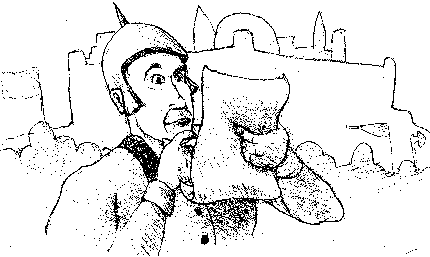
After all the people on earth had come to live under his peaceful rule, he became known as Clear-sighted the Great, King of the World. His royal city, the capital of the whole world, was called Kusavati. It was a beautiful and prosperous city with four magnificent gates — one golden, one silver, one jade and one crystal.

Outside the gates, Kusavati was surrounded by seven rows of palm trees — a row with golden trunks and silver leaves and fruits; a row with silver trunks and golden leaves and fruits; a row with cat’s-eye trunks and crystal leaves and fruits; a row with crystal trunks and cat’s-eye leaves and fruits; a row with agate trunks and coral leaves and fruits; a row with coral trunks and agate leaves and fruits; and finally a row with trunks and leaves and fruits of every kind of jewel found in the world!

When breezes blew through these marvelous palms the sweet sounds of gentle music were heard throughout the city. This music was so enticing and pleasant that some of the citizens were enchanted into stopping their work and dancing for joy!

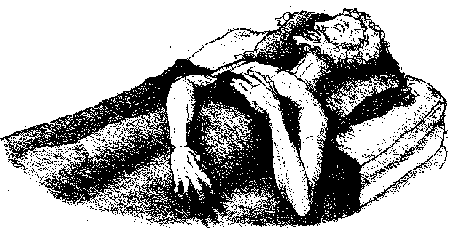
Clear-sighted the Great, King of the World, had a couch encrusted with jewels from the wonderful palms. After a long, righteous and peaceful reign, he lay on the rich couch for the last time. He knew that his end was near.

Of all his 84,000 queens, the one who loved him most was called, ‘Most-pleasant’. Sensing the state of his mind she said, “You rule over all the cities of the world, including this beautiful Kusavati with its four magnificent gates and seven rows of marvelous palms. Think about this and be happy!"

The King of the World said, “No, my dear queen don’t say that. Instead you should advise me to give up attachment to the cities of the world and all they contain." Surprised she asked, “Why do you say this, my lord?" “Because today I will die," he said.

Then Queen Most-pleasant started to cry, wiping away the tears as they flowed. And all the other 84,000 queens also broke into tears. And the king’s ministers and his whole court, both men and women, could not keep from weeping and sobbing. All eyes overflowed with tears.

But King Clear-sighted the Great said, “Your tears are useless. Be at peace." Hearing this the wailing subsided and his subjects became silent. Then he said to Queen Most-pleasant, “Oh my queen, do not cry, do not lament. Anything that comes into being, whether it be a kingdom including the whole world, or just a tiny sesame seed — it cannot last forever. Anyone who comes into being, whether it be the King of the World, or the poorest petty thief — all must decay and die. Whatever is built up, falls apart. Whatever becomes, decays. The only true happiness is in the moment when becoming and decaying are not."

In this way the Enlightenment Being got them to think about what most people don’t want to think about — that all things come to an end. He advised them to be generous and wholesome. Then the King of the World, like everyone else, died. He was reborn as a god in a heaven world, where in time, like everyone else, he died.

The moral is: “All good things come to an end."

95. Clear-sighted the Great, King of the World [Impermanence]

Link: https://hhdorjechangbuddhaiiiinfo.com/2024/09/17/95-clear-sighted-the-great-king-of-the-world-impermanence-2/

#Buddhisttalesforyoungandold #Buddhiststories #storiesforkids #moralstories #Buddha #Jatakastories #PansiyaPanasJataka

95. Clear-sighted the Great, King of the World [Impermanence]

95. Clear-sighted the Great, King of the World [Impermanence]

It is said that there are two ways to practice religion. One is to live apart from the ordinary everyday world as a monk, a nun or a holy one. Those who are sincere in this way have as their highest goal the direct experience of complete Truth — full Enlightenment.

The other way to practice religion is within the ordinary world. Those who are sincere in this way have as their highest goal the harmony of an undivided world, living peacefully under a perfectly wholesome ruler — a ‘King of the World’.

Once upon a time the Enlightenment Being was born and given the name ‘Clear-sighted’. As he grew up he developed ten rules of good government: absence of hidden ill will, absence of open hostility, harmlessness, self-control, patience, gentleness, charity, generosity, straightforwardness and goodness.

The people of the world began to notice the wholesomeness and fairness of Clear-sighted, who lived strictly according to these rules. Gradually those in his vicinity volunteered to live under his authority as king, rather than under the dishonest politicians of the time.

As his reputation spread, every king in the world came to Clear-sighted and said, “Come, oh lord, you are welcome, my kingdom is your kingdom, advise me how to rule in your name."

Then Clear-sighted said, “Do not destroy life. Do not take what is not given. Do not behave wrongly in sexual desires. Do not speak falsely. Do not take alcohol that clouds the mind. My commands to the world are only these five. As long as these five are obeyed, my sixth rule is freedom for all to follow local customs and religions."

After all the people on earth had come to live under his peaceful rule, he became known as Clear-sighted the Great, King of the World. His royal city, the capital of the whole world, was called Kusavati. It was a beautiful and prosperous city with four magnificent gates — one golden, one silver, one jade and one crystal.

Outside the gates, Kusavati was surrounded by seven rows of palm trees — a row with golden trunks and silver leaves and fruits; a row with silver trunks and golden leaves and fruits; a row with cat’s-eye trunks and crystal leaves and fruits; a row with crystal trunks and cat’s-eye leaves and fruits; a row with agate trunks and coral leaves and fruits; a row with coral trunks and agate leaves and fruits; and finally a row with trunks and leaves and fruits of every kind of jewel found in the world!

When breezes blew through these marvelous palms the sweet sounds of gentle music were heard throughout the city. This music was so enticing and pleasant that some of the citizens were enchanted into stopping their work and dancing for joy!

Clear-sighted the Great, King of the World, had a couch encrusted with jewels from the wonderful palms. After a long, righteous and peaceful reign, he lay on the rich couch for the last time. He knew that his end was near.

Of all his 84,000 queens, the one who loved him most was called, ‘Most-pleasant’. Sensing the state of his mind she said, “You rule over all the cities of the world, including this beautiful Kusavati with its four magnificent gates and seven rows of marvelous palms. Think about this and be happy!"

The King of the World said, “No, my dear queen don’t say that. Instead you should advise me to give up attachment to the cities of the world and all they contain." Surprised she asked, “Why do you say this, my lord?" “Because today I will die," he said.

Then Queen Most-pleasant started to cry, wiping away the tears as they flowed. And all the other 84,000 queens also broke into tears. And the king’s ministers and his whole court, both men and women, could not keep from weeping and sobbing. All eyes overflowed with tears.

But King Clear-sighted the Great said, “Your tears are useless. Be at peace." Hearing this the wailing subsided and his subjects became silent. Then he said to Queen Most-pleasant, “Oh my queen, do not cry, do not lament. Anything that comes into being, whether it be a kingdom including the whole world, or just a tiny sesame seed — it cannot last forever. Anyone who comes into being, whether it be the King of the World, or the poorest petty thief — all must decay and die. Whatever is built up, falls apart. Whatever becomes, decays. The only true happiness is in the moment when becoming and decaying are not."

In this way the Enlightenment Being got them to think about what most people don’t want to think about — that all things come to an end. He advised them to be generous and wholesome. Then the King of the World, like everyone else, died. He was reborn as a god in a heaven world, where in time, like everyone else, he died.

The moral is: “All good things come to an end."

95. Clear-sighted the Great, King of the World [Impermanence]

Link: https://hhdorjechangbuddhaiiiinfo.com/2024/09/10/95-clear-sighted-the-great-king-of-the-world-impermanence/

#Buddhisttalesforyoungandold #Buddhiststories #storiesforkids #moralstories #Buddha #Jatakastories #PansiyaPanasJataka
94. The Holy Man Who Tried To Be Too Holy [Extremism]

94. The Holy Man Who Tried To Be Too Holy [Extremism]

Once upon a time, the Enlightenment Being lived in a world where most religions were very similar. They taught that the way to remove suffering from the mind was to make the body suffer instead. As strange as it seems, most people thought that the holiest of the holy were the ones who tortured their bodies the most! Since everyone seemed to agree with this, the Bodhisatta decided to find out for himself if it was true.

He stopped living as an ordinary everyday person and became a holy man according to the custom of the times. This meant that he gave up everything, even his clothes. He went naked, with his body covered only by dust and dirt.

So he wouldn’t be spoiled by the taste of good food, he forced himself to eat only filthy things — dirt, ashes, urine and cow dung.

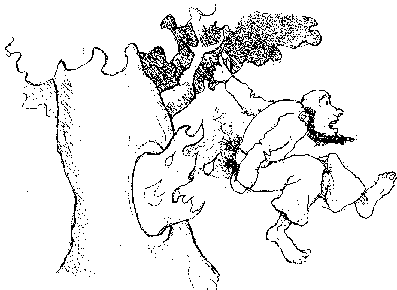
So he could concentrate without being interrupted by anyone, he went to live in the most dangerous part of the forest. If he did see a human being, he ran away like a timid deer.

In the wintertime he spent his days under the trees and his nights out in the open. So in the daytime he was soaked by the cold water dripping from the icicles hanging from the tree branches. And at night he was covered by the falling snow. In this way, in winter, he made his body suffer the most extreme cold in both day and night.

In the summertime he spent his days out in the open and his nights under the trees. So in the daytime he was burned by the most severe rays of the sun. And at night he was blocked from the few cooling breezes of the open air. In this way, in summer, he made his body suffer the most extreme heat in both day and night.

This was how he struggled, trying to bring peace to his mind. He was so determined that he lived his entire life in this way.

Then, just as he was about to die, he saw a vision of himself reborn in a hell world. The vision struck him like lightning, and instantly he knew that all the ways he had tortured his body were completely useless! They had not brought him peace of mind. Lo and behold, as he gave up his false beliefs and held on to the truth, he died and was reborn in a heaven world!

The moral is: Even at the very last moment, “The truth shall make you free."

94. The Holy Man Who Tried To Be Too Holy [Extremism]

Link: https://hhdorjechangbuddhaiiiinfo.com/2024/09/03/94-the-holy-man-who-tried-to-be-too-holy-extremism/

#Buddhisttalesforyoungandold #Buddhiststories #storiesforkids #moralstories #Buddha #Jatakastories #PansiyaPanasJataka

93. The Careless Lion [Circumspection]

93. The Careless Lion [Circumspection]

Once upon a time, the Five Training Steps were not yet known in the world. There was a very wealthy man living in Benares who owned a large herd of cattle. He hired a man to look after them.

During the time of year when the rice paddies were filled with the green growing rice plants, the herdsman took the cattle to the forest to graze. From there he brought the milk and butter and cheese to the rich man in Benares.

It just so happened that being in the forest put the cattle in a very frightening situation. There was a meat eating lion living nearby. Sensing the presence of the lion kept the cattle in constant fear. This made the cows tense and high-strung, leaving them too weak to give more than a little milk.

One day the owner of the cattle asked the herdsman why he was bringing such a small amount of milk and butter and cheese. He replied, “Sir, cows need to be calm and contented to give much milk. Due to a nearby lion, your cows are always afraid and tense. So they give hardly any milk."

“I see", said the rich man. Thinking like an animal trapper, he asked, “Is the lion closely connected to any other animal?" The herdsman answered, “Sir, there happens to be a variety of deer living in the forest. They are called ‘minideer’ because they are so small. Even the adults only grow to be about one foot tall. The lion has become very friendly with a certain minideer doe."

The rich man of Benares said, “So that my cows will be at peace and able to give their usual milk, this is what you are to do. Capture the lion’s friend and rub poison all over her body. Then wait a couple days before releasing her. She will be like bait in a trap for the lion. When he dies, bring his body to me. Then my cows will be safe and happy again."

The herdsman followed his boss’s orders exactly. When the lion saw his favorite minideer doe he was so overjoyed that he threw all caution to the wind. Without even sniffing the air around her, he immediately began licking her excitedly all over. Because of too much joy and not enough caution, he fell into the poisonous trap. The poor lion died on the spot.

The moral is: Too much of a good thing can be dangerous.

93. The Careless Lion [Circumspection]

Link: https://hhdorjechangbuddhaiiiinfo.com/2024/08/27/93-the-careless-lion-circumspection/

#Buddhisttalesforyoungandold #Buddhiststories #storiesforkids #moralstories #Buddha #Jatakastories #PansiyaPanasJataka
92. The Mystery of the Missing Necklace [Chapter 2. The Mystery is Solved]

92. The Mystery of the Missing Necklace [Chapter 2. The Mystery is Solved]

Meanwhile, the royal minister who happened to be the Enlightenment Being had seen and heard all that had taken place in the pleasure garden. He realized that the mystery could be solved only by careful examination. Jumping to conclusions could lead to the wrong answers. So he started examining and analyzing the situation in his mind.

He thought, “The necklace was lost inside the pleasure garden. But the poor villager was captured outside the pleasure garden. The gates had strong guards standing watch. Therefore, the villager could not have come in to steal the necklace. Likewise, no one from inside the garden could have gotten out through the guarded gates with the stolen necklace. So it can be seen that none of these people could have gotten away with Most Precious, either from inside or outside!

“What a mystery! The poor man who was first accused must have said he gave it to the Chief Financial Adviser just to save himself. The Chief Financial Adviser must have thought it would go easier for him if the Royal Teacher Priest were involved. The priest must have blamed the Official Court Musician so that music would make their time in the palace dungeon pass more pleasantly. And the Official Court Musician probably thought that being with the high class prostitute would take away the misery of prison life. So he said he gave the necklace to her.

“After examining carefully, it is easy to see that all five suspects must be innocent. But the garden is full of monkeys who are known to cause mischief. No doubt some she-monkey thought Most Precious would set her above the rest, and the necklace is still in her hands."

So he went to the king and said, “Your excellency, if you hand over the suspects to me, I will do the investigation for you." “By all means, my wise minister," said the king, “examine into it yourself."

The minister called for his servant boys. He told them to keep the five suspects together in one place. They were to hide nearby, listen to all that was said, and then report back to him.

When the five prisoners thought they were alone they began talking freely to each other. First the Chief Financial Adviser said to the poor villager, “You little crook! We never saw each other before. So when did you give the stolen Most Precious to me?"

He replied, “My lord sir, most exalted adviser to the great king, I have never had anything of any value whatsoever, not even a broken down bed or chair. I certainly have not seen any such Most Precious necklace! I don’t know what you people are talking about. Being scared to death by the king’s guards, I only mentioned you in the hope that one as important as you could free us both. Please, my lord, don’t be angry at me."

The Royal Teacher Priest said to the Chief Financial Adviser. “You see, this man admits he has not given it to you, so how could you have given it to me?" He replied, “We are both in high positions. I thought that if we got together and backed each other up, we could settle this matter."

The Official Court Musician asked, “Oh Royal Teacher Priest, when did you give the queen’s pearl necklace to me?" “I thought that if you were imprisoned with me," said the priest, “your music would make it much more pleasant. That’s why I lied."

Then the woman said to the Official Court Musician, “You miserable crook! When did I come to you? When did you come to me? We have never met each other before. So when could you possibly have given me the stolen Most Precious?" He said to her, “Oh dear young lady, please don’t be angry with me. I only accused you so that when we five are imprisoned together, your being with us will make us all happy."

Not being either a poor frightened stranger or a slippery government official, the high class prostitute was the only one who had told the truth. So there was no one to accuse her of shifting the blame.

Of course the wise minister’s servants had been eavesdropping on the entire conversation. When they reported it all back to him, he realized his suspicion was confirmed — some she-monkey must have taken the necklace. So he thought, “I must come up with a plan to get it back."

First he had a bunch of cheap imitation jewel ornaments made. Then he had several she-monkeys captured in the royal pleasure garden. He had them decorated with the imitation ornaments — necklaces on their necks, and bracelets on their wrists and ankles. Then they were released in the garden. The minister ordered his servants to watch all the she-monkeys carefully. When they saw anyone with the missing pearl necklace, they were to scare her into dropping it.

The she-monkey who had taken Most Precious was still guarding it in the hollow of the tree. The other she-monkeys strutted back and forth saying, “See how fine we look. We have these beautiful necklaces and bracelets." She couldn’t stand seeing and hearing this. She thought, “Those are nothing but worthless imitations." To show them all up, she put on her own neck the Most Precious necklace of real pearls.

Immediately the servants frightened her into dropping it. They took it to their master, the wise minister. He took it to the king and said, “Your majesty, here is the pearl necklace, the one called Most Precious. None of the five who admitted to the crime was really a thief. It was taken instead by a greedy little she-monkey living in your pleasure garden."

The amazed king asked, “How did you find out it was taken by a she-monkey? And how did you get it back?" The minister told the whole story.

The king said, “You were certainly the right one for the job. In times of need, it is the wise who are appreciated most." Then he rewarded him by showering him with wealth, like a heavy rain of the seven valuables — gold, silver, pearls, jewels, lapis lazuli, diamonds and coral.

The moral is: Theft from greed, lies from fear, truth from examining.

92. The Mystery of the Missing Necklace [Chapter 2. The Mystery is Solved]

Link: https://hhdorjechangbuddhaiiiinfo.com/2024/08/20/92-the-mystery-of-the-missing-necklace-chapter-2-the-mystery-is-solved/

#Buddhisttalesforyoungandold #Buddhiststories #storiesforkids #moralstories #Buddha #Jatakastories #PansiyaPanasJataka
92. The Mystery of the Missing Necklace [Chapter 1. One Crime Leads to Another]

92. The Mystery of the Missing Necklace [Chapter 1. One Crime Leads to Another]

Once upon a time, King Brahmadatta was ruling in Benares in northern India. After completing his education, the Enlightenment Being became one of his ministers.

One day the king went on an outing to his pleasure garden. A big crowd from the court went with him. They visited many parts of the lovely park. Near a cool forest they came upon a beautiful clear pond. The king decided to go for a swim. So he dove into the water. Then he invited all the ladies of his harem to join him in the refreshing pond.

Laughing together, the harem women took off all their ornaments and jewelry – from their heads, necks, ears, wrists, fingers, waists, ankles and toes. Along with their outer clothing, they handed all these over to their servant girls for safekeeping. Then they jumped into the pond with King Brahmadatta.

The king had given one of his favorite queens a very valuable pearl necklace. She was so fond of it that she called it by a pet name, ‘Most Precious’.

It just so happened that a curious she-monkey had been watching all this from a branch of a nearby tree. Peering between the green leaves, she had paid very close attention. When she had caught sight of the Most Precious pearl necklace, her eyes had nearly popped out of her head!

Imagining how grand she would look wearing the queen’s beautiful necklace, she patiently watched the servant girl who was guarding it. In the beginning the girl watched very carefully. But the heat of the day soon made her drowsy. When the she-monkey saw her start to snooze, she swung down from the tree as fast as the wind. In a flash she grabbed the necklace called Most Precious, put it around her neck, and ran back up the tree.

Afraid that the other monkeys would see it, the little thief hid the gleaming pearl necklace in a hollow of the tree. Then she sat guarding her loot, remaining silent and pretending to be as innocent as a nun!

In a minute or two the servant girl awoke from her accidental nap. Frightened, she immediately looked over the queen’s possessions. When she saw the necklace was missing she yelled out in terror, “Help! Help! Some man has taken the queen’s pearl necklace, the one called Most Precious!"

After running to her side, security guards went and reported the theft to the king. He ordered them to stop at nothing, and to catch the thief immediately. Frightened of the king’s wrath, the guards began dashing madly around the pleasure garden searching for the thief.

At that very moment there happened to be a poor man walking just outside the garden. He was on his way back to his far-off home village after paying his meager taxes to the royal treasury. The commotion from inside the park scared him and he started running away.

Unfortunately, the security guards saw him running and said to each other, “That must be the thief!" They rushed through the garden gate and after a short chase easily captured the innocent man. They began beating him as they shouted, “You no good thief! Confess that you robbed the queen’s pearl necklace, the one she calls Most Precious."

The poor man thought, “If I say I didn’t take it, these men will beat me to death for sure. But if I confess, they will have to take me to the king." So he said, “Yes, I admit it, I took the necklace." Hearing this the security guards handcuffed him and hauled him off to the king.

After being told of the man’s confession, the king asked him, “Where is the Most Precious necklace now? What have you done with it?"

Being a somewhat clever fellow, the prisoner replied, “My lord king, I am a very poor man indeed. I have never in my life owned anything at all valuable, not a Most Precious bed or a Most Precious chair – and certainly not a Most Precious pearl necklace. It was your majesty’s own Chief Financial Adviser who made me steal this Most Precious. I gave it to him. He alone knows where it is now."

King Brahmadatta summoned his Chief Financial Adviser and asked, “Did you take Most Precious from this man’s hands?" “Yes my lord," said he. “Where is it now?" asked the king. “I gave it to the Royal Teacher Priest."

The Royal Teacher Priest was called for and asked about the stolen necklace. He claimed, “I gave it to the Official Court Musician."

He in turn was summoned and questioned. He answered, “I gave Most Precious to a high class prostitute."

When she was identified and brought to the king, he demanded to know what she had done with the queen’s pearl necklace. But she alone replied, “Your majesty, I don’t know anything about a pearl necklace!"

As the sun began to set, the king said, “Let us continue this investigation tomorrow." He handed the five suspects over to his ministers and returned to his palace for the night.

92. The Mystery of the Missing Necklace [Chapter 1. One Crime Leads to Another]

Link: https://hhdorjechangbuddhaiiiinfo.com/2024/08/13/92-the-mystery-of-the-missing-necklace-chapter-1-one-crime-leads-to-another/

#Buddhisttalesforyoungandold #Buddhiststories #storiesforkids #moralstories #Buddha #Jatakastories #PansiyaPanasJataka
91. Poison Dice [Deception]

91. Poison Dice [Deception]

Once upon a time there was a rich man living in Benares who was addicted to gambling. He played dice with another gambling addict, a man whose mind worked in tricky ways.

While the rich gambler was very honest and above board, the tricky one was dishonest. When he kept on winning he kept on playing. But when he began to lose he secretly put one of the dice in his mouth and swallowed it. Then he claimed it was lost and stopped the game.

The rich gambler began to notice this trick. Then one day he decided to teach him a lesson. He smeared poison on the dice and let it dry so it was invisible. He took these dice to the usual place and said, “Let’s play dice!"

His friend agreed. They set up the gambling board and began to play. As usual the tricky one began by winning every throw of the dice. But as soon as he began to lose he sneaked the dice into his mouth.

Seeing this the rich gambler said, “Swallow now, and then something you don’t expect will happen. Your own dishonesty will make you suffer much."

After swallowing the poison dice the trickster fell down sick and fainted. The rich gambler, who was basically good at heart, thought, “Enough is enough. Now I must save his life."

He made a medical mixture to cause vomiting. He made him swallow it, and he threw up the poison dice. He gave him a drink made with clear butter, thick palm syrup, honey and cane sugar. This made the trickster feel just fine again.

Afterwards he advised him not to deceive a trusting friend again. Eventually both gamblers died and were reborn as they deserved.

The moral is: Deceiving a friend may be hazardous to your health.

91. Poison Dice [Deception]

Link: https://hhdorjechangbuddhaiiiinfo.com/2024/08/06/91-poison-dice-deception/

#Buddhisttalesforyoungandold #Buddhiststories #storiesforkids #moralstories #Buddha #Jatakastories #PansiyaPanasJataka

90, 363. One Way Hospitality [Ingratitude]

90, 363. One Way Hospitality [Ingratitude]

Once upon a time there were two merchants who wrote letters back and forth to each other. They never met face to face. One lived in Benares and the other lived in a remote border village.

The country merchant sent a large caravan to Benares. It had 500 carts loaded with fruits and vegetables and other products. He told his workers to trade all these goods with the help of the Benares merchant.

When they arrived in the big city they went directly to the merchant. They gave him the gifts they had brought. He was pleased and invited them to stay in his own home. He even gave them money for their living expenses. He treated them with the very best hospitality. He asked about the well-being of the country merchant and gave them gifts to take back to him. Since it is easier for a local person to get a good price, he saw to it that all their goods were fairly traded. They returned home and told their master all that had happened.

Later on, the Benares merchant sent a caravan of 500 carts to the border village. His workers also took gifts to the country merchant. When they arrived he asked,

“Where do you come from?" They said they came from the Benares merchant, the one who wrote him letters.

Taking the gifts, the country merchant laughed in a very discourteous way and said, “Anyone could say they came from the Benares merchant!" Then he sent them away, giving them no place to stay, no gifts, and no help at all.

The caravan workers went downtown to the marketplace and did the best they could trading without local help. They returned to Benares and told their master all that had happened.

Before too long, the country merchant sent another caravan of 500 carts to Benares. Again his workers took gifts to the same merchant. When his workers saw them coming, they said to him, “We know just how to provide suitable lodgings, food and expense money for these people."

They took them outside the city walls to a good place to camp for the night. They said they would return to Benares and prepare food and get expense money for them.

Instead they rounded up all their fellow workers and returned to the campsite in the middle of the night. They robbed all 500 carts, including the workers’ outer garments. They chased away the bullocks, and removed and carried off the cart wheels.

The villagers were terrified. They ran back home as fast as their legs could carry them.

The city merchant’s workers told him all they had done. He said, ‘Those who forget gratitude and ignore simple hospitality wind up getting what they deserve. Those who do not appreciate the help they have received soon find that no one will help them anymore."

The moral is: If you don’t help others, you can’t expect them to help you.

90, 363. One Way Hospitality [Ingratitude]

Link: https://hhdorjechangbuddhaiiiinfo.com/2024/07/30/90-363-one-way-hospitality-ingratitude/

#Buddhisttalesforyoungandold #Buddhiststories #storiesforkids #moralstories #Buddha #Jatakastories #PansiyaPanasJataka

89. The Phoney Holy Man [Hypocrisy]

89. The Phoney Holy Man [Hypocrisy]

Once upon a time there was a man who looked and acted just like a holy man. He wore nothing but rags, had long matted hair, and relied on a little village to support him. But he was sneaky and tricky. He only pretended to give up attachment to the everyday world. He was a phoney holy man.

A wealthy man living in the village wanted to earn merit by doing good deeds. So he had a simple little temple built in the nearby forest for the holy man to live in. He also fed him the finest foods from his own home.

He thought this holy man with matted hair was sincere and good, one who would not do anything unwholesome. Since he was afraid of bandits, he took his family fortune of 100 gold coins to the little temple. He buried it under the ground and said to the holy man, “Venerable one, please look after this my family fortune."

The holy man replied, “There’s no need to worry about such things with people like me. We holy ones have given up attachment to the ordinary world. We have no greed or desire to obtain the possessions of others."

“Very well, venerable one," said the man. He left thinking himself very wise indeed, to trust such a good holy man.

However, the wicked holy man thought, “Aha! This treasure of 100 gold coins is enough for me to live on for the rest of my life! I will never have to work or beg again!" So a few days later he dug up the gold and secretly buried it near the roadside.

The next day he went to the wealthy villager’s home for lunch as usual. After eating his fill he said, “Most honourable gentleman, I have lived here supported by you for a long time. But holy ones who have given up the world are not supposed to become too attached to one village or supporter. It would make a holy man like me impure! Therefore, kindly permit me to humbly go on my way."

The man pleaded with him again and again not to go, but it was useless. “Go then, venerable sir," he agreed at last. He went with him as far as the boundary of the village and left him there.

After going on a short way himself, the phoney holy man thought, “I must make absolutely sure that stupid villager does not suspect me. He trusts me so much that he will believe anything. So I will deceive him with a clever trick!" He stuck a blade of dry grass in his matted hair and went back.

When he saw him returning, the wealthy villager asked, “Venerable one, why have you come back?" He replied, “Dear friend, this blade of grass from the thatched roof of your house has stuck in my hair. It is most unwholesome and impure for a holy one such as myself to ‘take what is not given’."

The amazed villager said, “Think nothing of it, your reverence. Please put it down and continue on your way. Venerable ones such as you do not even take a blade of grass that belongs to another. How marvellous! How exalted you are, the purest of the holy. How lucky I was to be able to support you!" More trusting than ever, he bowed respectfully and sent him on his way again.

It just so happened that the Enlightenment Being was living the life of a trader at that time. He was in the midst of a trading trip when he stopped overnight at the village. He had overheard the entire conversation between the villager and the ‘purest of the holy’. He thought, “That sounds ridiculous! This man must have stolen something far more valuable than the blade of dry grass he has made such a big show of returning to its rightful owner."

The trader asked the wealthy villager, “Friend, did you perhaps give anything to this holy looking man for safekeeping?" “Yes friend," he replied, “I trusted him to guard my family fortune of 100 gold coins." “I advise you to go see if they are where you left them," said the trader.

Suddenly worried, he ran to the forest temple, dug up the ground, and found his treasure gone. He ran back to the trader and said, “It has been stolen!" “Friend," he replied, “No one but that so-called holy man could have taken it. Let’s catch him and get your treasure back."

They both chased after him as fast as they could. When they caught up with him they made him tell where he had hidden the money. They went to the hiding place by the roadside and dug up the buried treasure.

Looking at the gleaming gold the Bodhisatta said, “You hypocritical holy man. You spoke well those beautiful words, admired by all, that one is not to ‘take what is not given’. You hesitated to leave with even a blade of grass that didn’t belong to you. But it was so easy for you to steal a hundred gold coins!" After ridiculing the way he had acted in this way, he advised him to change his ways for his own good.

The moral is: Be careful of a holy man who puts on a big show.

89. The Phoney Holy Man [Hypocrisy]

Link: https://hhdorjechangbuddhaiiiinfo.com/2024/07/30/89-the-phoney-holy-man-hypocrisy/

#Buddhisttalesforyoungandold #Buddhiststories #storiesforkids #moralstories #Buddha #Jatakastories #PansiyaPanasJataka