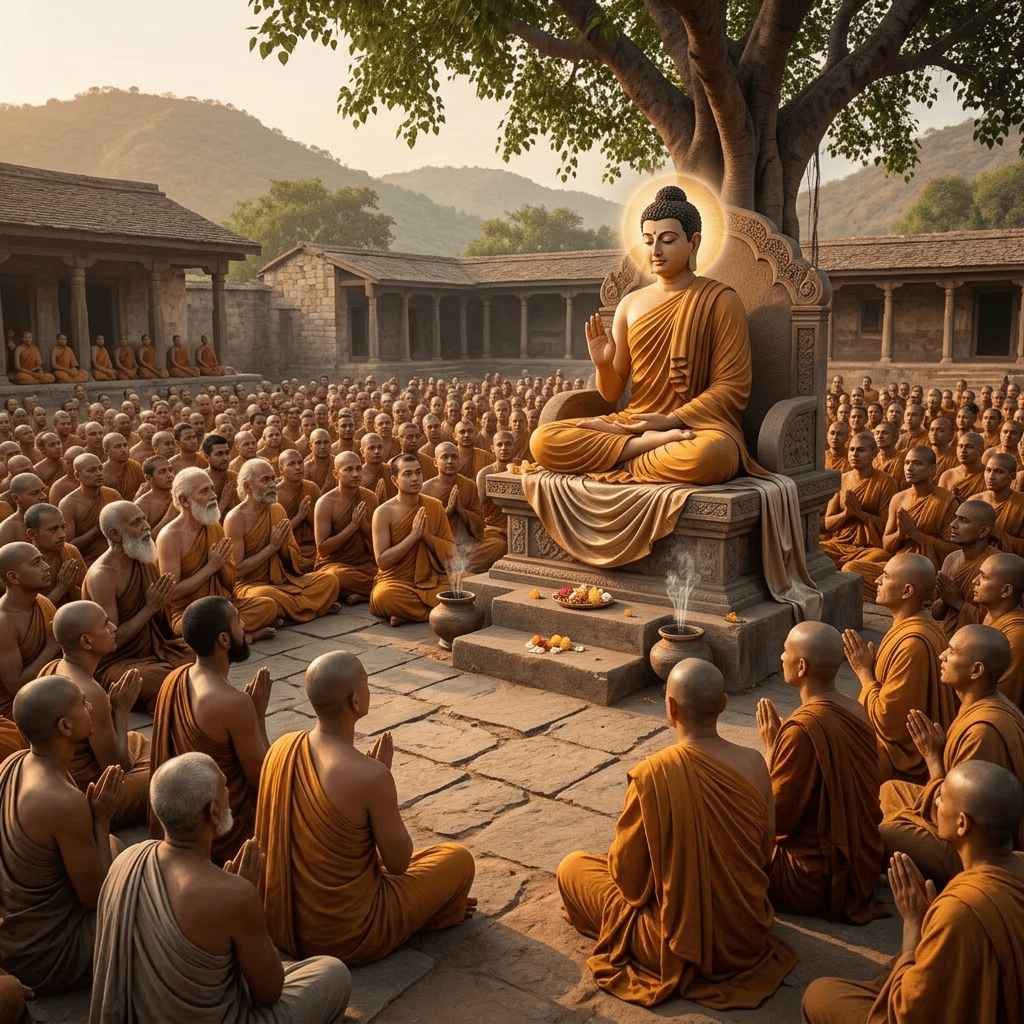
At one time when Buddha was living at the Jeta Grove, Devadatta came to the Buddha and requested him to impose four new practices on all the monks. The first was that all monks should wear robes stitched together from the clothing of the departed that could be picked up in the cemetery. The second was that all monks should live under trees, not in houses. The third was that monks should not eat meat or fish during their lifetime. The fourth was that monks should live all the time in the forest, not in a village or city. The Buddha responded that he had monks in his community who had been very rich, and who had before their ordination comfortable lives. Therefore, those who wish to do as Devadatta suggests, let them do it. Those who do not so wish, let them not do it. He was not going to impose such regulations as might be objectionable to them. Devadatta got angry because the Buddha refused to do as he wanted. He took away 500 monks who were followers of the Venerable Sāriputta and who had only recently been ordained, and went with them to Gayāsīsa. He said that he had not gotten anything from the Buddha, not even a blade of grass. And he created a schism in the order. With the 500 monks, he went to Gayāsīsa north of the Ganges River, and claimed there that he also was a Buddha.
At one point, the Buddha came to understand that the 500 monks who had gone off with Devadatta had the potentiality at that time of becoming Arahants on account of their previous births. Understanding so, the Buddha summoned the Venerable Sāriputta and Moggallāna and requested that they go to Devadatta’s community and preach to the 500 monks, bringing them back into the Buddha’s fold. Then the two chief disciples of the Buddha, Sāriputta and Moggallāna, left for Devadatta’s community.
Devadatta saw from afar the two chief disciples coming toward him, and he imagined that they were giving up the Buddha, and were coming to join his community. Thinking so, he claimed that like the Buddha he too had back pain. He requested that in his stead, they might preach to the community. He lay down near the preaching chair and went to sleep. The Venerable Sāriputta preached then, and all the 500 monks attained Arahantship. They all then returned with him and Moggallāna to the Buddha at the Bamboo Grove.
Kokālika, the chief disciple of Devadatta, came to Devadatta’s temple and saw that it was empty of people. He went into the temple, and saw Devadatta sleeping there. He got angry and said to Devadatta, “You are sleeping deeply while your disciples have been taken away by the two chief disciples of the Buddha. Our temple is empty now.” With his left foot, he kicked Devadatta’s chest. This caused Devadatta to vomit blood.
When the Venerable Sāriputta and Moggallāna came to the Buddha with the 500 monks, the Buddha asked, “How was Devadatta when you were there?” The Venerable Sāriputta said, “Revered one, when we were there, Devadatta was pretending to be a Buddha. He was preaching.” And Sāriputta then explained all that had happened, including Devadatta’s being kicked by Kokālika. The Buddha heard that news and said, “Sāriputta, not only today, but also in the past has Devadatta imitated me. And by doing so, he fell into a big calamity.” The Venerable Sāriputta then invited the Buddha to disclose the former story.
This is how it was:
At one time, King Brahmadatta was ruling in Benares. At that time, the Bodhisatta was born as a lion. He lived in a den hollowed into a big rock.
One day, he left his den and killed a water buffalo, eating the meat. He went to a nearby pool and drank some water. Returning to his den, he met a jackal. The jackal did not see the lion till the lion came very close. He became very much afraid as he had no way of fleeing. Kneeling down, he paid obeisance to the lion. The lion said, “Jackal! Why do you want to kneel down like that?” The cunning jackal said, “Oh, your lordship. I did so, as I would like to serve you.” The lion, who was the Enlightenment Being, then took him to his den in the rock and showed him a place to lie down. He said, “Whenever you see any animal you would like to eat in this area, let me know. Then I will kill him, and we will both have food to eat.” The jackal said, “Yes, sir.”
The jackal followed this advice. And the jackal and lion both ate the same food. As the jackal got enough food from the lion’s killing animals, he became very fat and strong. He then became conceited. “The lion is a beast. I also am a beast. Why should I eat meat killed by someone else? I will kill animals for myself.” Thinking so, he went to the lion and said, “Your lordship! I have eaten the meat of the animals that you killed. From now on whatever you kill, you can eat yourself.” The lion said, “But you cannot kill animals such as elephants, as I do.” He said this several times. Even though the lion prevented the jackal from hunting on its own several times, the jackal did not want to listen. Eventually, the lion said, “Let him learn a lesson.” The jackal said, “You should not go to hunt in the morning. I will go.” The lion agreed.
In the morning, the jackal got up and came out from the den. He shook his body three times, as the lion always did. And as the lion always roared, he shouted. As the lion would do, he looked in the four directions and he saw an elephant. He ran, and jumped up on the elephant.
When he jumped up on the elephant, he could not remain on the elephant’s back. He fell down in front of the elephant. The angry elephant crushed him under his foot. He trampled the carcass, collected the bones in one pile, dropped dung on them, and urinated on them. Then he trumpeted, and went away.
The lion saw this and thought, “The jackal deserved this lesson.” Thinking so, he went into his den and sat down.
“The jackal who was crushed by the elephant at that time was Devadatta. And I, who today am the Buddha, the enlightened one, was the lion at that time.” Saying so, he ended the Jātaka story of shining forth.
When the Enlightenment Being was living in the Bamboo Grove temple of Rājagaha, one day old monks assembled in the preaching hall and were discussing Devadatta’s attempts to kill the Buddha. They said, “Devadatta sent the elephant NāÀāgiri to kill the Buddha, but he failed to do so. Then he tried to kill him by pushing rocks from Gijjhakūæa Mountain. And then he sent bowmen to shoot at him. With many such strategies, he was not able to kill the Buddha.” While they were discussing this, the Buddha entered the hall and asked, “Monks, what were you talking about before my arrival?” The monks answered, “Revered one, we were discussing about the attempts of Devadatta to assassinate the Buddha.” The Buddha said, “Oh monks, it is not only in this life that Devadatta has tried to kill me. Even in the past he tried and could not do so.” The monks invited the Buddha to disclose the ancient story. The Buddha then delivered this story of the past:
At one time, King Brahmadatta was ruling in Benares.
At that time, the Enlightenment Being was born a jackal. He lived in a certain cemetery followed by thousands of jackals. Once there was a certain festival in Benares for which people prepared plenty of meat and toddy that they kept everywhere here and there. The people partied day and night until midnight. But they could not finish the prepared toddy. One man came asking for meat and toddy. Many people said, “There is no more meat.” But a certain man said, “While I am here, why do you say there is no meat?” Saying so, he took a club. As the gates of the city were closed, he went out through the sewer ditches, and went to a nearby cemetery. He lay down on the cemetery ground as if he were a dead body. In the meantime, the Enlightenment Being, who was a jackal, went to eat meat. He saw this man lying there and thought, “No doubt, this man is not dead. Nevertheless, it would be wise to test it.” Thinking so, he went to the opposite side of the wind and smelling, he found out that the man was not dead. Thinking that he would make the man look foolish, so as to deceive the man, he made as if he were running away. Then he went near to the club. He took it in his mouth and pulled on it. The man who was holding it, pulled back on it. Then the jackal went away a little bit, and said, “It is difficult to know whether someone who is lying down is dead or alive. But when the club is pulled back, how can that person be dead? He is not even sleeping.”
The man got up and got angry. He threw the club toward the jackal, but missed. He said, “You got away from me!” Then the jackal said, “Yes. I survived! But you will not survive from the four-fold hell!”
Then that man went back alone to the city in the same way as he had come. He entered the city and washed off both himself and his soiled and dirty clothing in the city moat.
At that time the man who went to kill the Enlightenment Being, who was then a jackal, was Devadatta. And I who was born as the king of jackals am today the Buddha.
The moral: “Ill-conceived stratagems cannot deceive a wise person, no matter what his station.”
When the Buddha was living in the Bamboo Grove, he disclosed this Jātaka story because of a certain disobedient monk. The present story for the reason behind this story was explained in detail in the Mahilāmukha-Jātaka [No. 26].
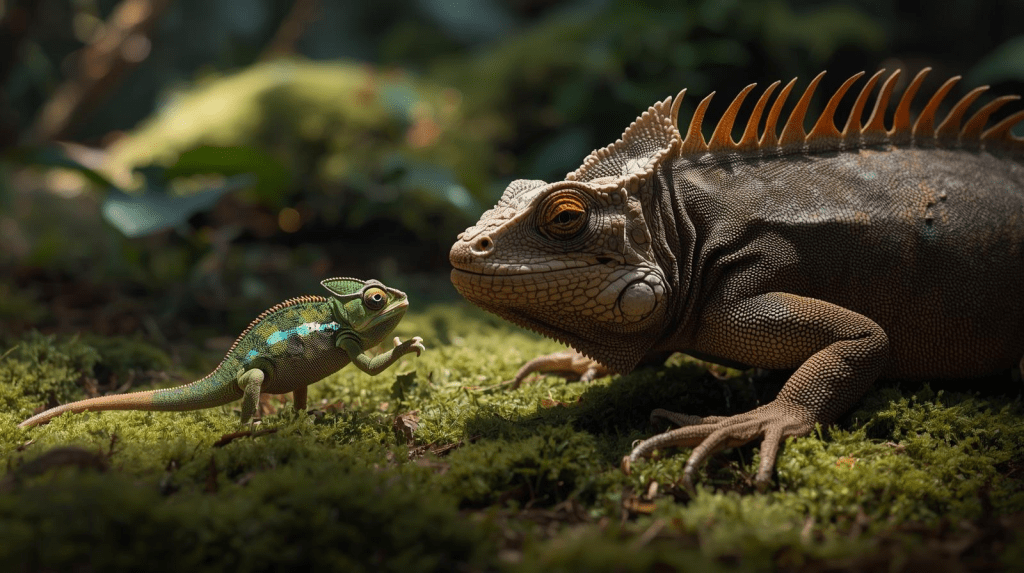
At one time, King Brahmadatta was ruling in Benares. At that time, the Enlightenment Being was born as an iguana with a following of thousands of iguanas. They lived in a big termite hill.
The Enlightenment Being had a son who was friendly with a chameleon. On seeing this, many iguanas complained about it to the Bodhisatta. The Bodhisatta summoned his son, and warned him not to be friendly with the chameleon. Because of such a friendship, there would be a great disaster for the community of iguanas. Even though he was so warned, the young iguana did not listen to him. He continued to play with the chameleon, and they continued to embrace each other. In the course of time, the iguana became large and fat. Bearing such a heavy body, when the iguana embraced the chameleon the big-bodied iguana sometimes hurt the chameleon, who had a small body. The small chameleon perceived the play of the iguana to be as if a big rock were falling over his body. And he became angry.
The king of the iguanas, in doubt about his son’s continued relationship with the chameleon, thought that one day calamity might befall upon the community of iguanas. He therefore made a secret tunnel so as to be able to flee away.
In the meantime, there came a certain unexpected rain. Swarms of flying termites came out from the termite hill. On a certain iguana hunter’s seeing this, he thought, “Now is a good time to hunt, because iguanas come out to eat flying termites.” So thinking, he entered the forest. While he was wandering in the forest, the chameleon saw him and enquired as to why he was wandering in the forest. The hunter said, “I am searching for iguanas.” As the chameleon was angry with his friend, the iguana, he said, “Do not be bothered by searching for iguanas. I can show you a place where there are plenty. What you need is some hay and fire.” Hearing this, the hunter brought some hay and fire. When he did this, the chameleon said, showing him the termite hill hole, “Put hay inside it and set it on fire. When the smoke goes in, the iguanas will come out. When they come out, hit them with your club or chase after them with your dogs. You can easily kill as many as you want.” The hunter did this.
The Enlightenment Being thought, “This type of a calamity came upon my relatives because of the evil chameleon.”
The Enlightenment Being fled away through the secret tunnel.
“The chameleon at that time was Devadatta. The disobedient little iguana was this monk today who is disobedient. And I who have now obtained supreme Buddhahood was at that time the king of the iguanas.” Saying so, the Buddha ended this Jātaka story of an iguana.
Once upon a time the Bodhisatta — the Enlightenment Being — was born into a high class family in northern India. When he grew up he gave up the ordinary desires of the everyday world and became a holy man. He went to the Himalayan Mountains where 500 other holy men became his followers.
He meditated throughout his long life. He gained supernatural powers — like flying through the air and understanding people’s thoughts without their speaking. These special powers impressed his 500 followers greatly.
One rainy season, the chief follower took 250 of the holy men into the hill country villages to collect salt and other necessities. It just so happened that this was the time when the master was about to die. The 250 who were still by his side realized this. So they asked him, “Oh most holy one, in your long life practicing goodness and meditation, what was your greatest achievement?"
Having difficulty speaking as he was dying, the last words of the Enlightenment Being were, “No Thing." Then he was reborn in a heaven world.
Expecting to hear about some fantastic magical power, the 250 followers were disappointed. They said to each other. “After a long life practicing goodness and meditation, our poor master has achieved ‘nothing’." Since they considered him a failure, they burned his body with no special ceremony, honors, or even respect.
When the chief follower returned, he asked, “Where is the holy one?" “He has died," they told him. “Did you ask him about his greatest achievement?" “Of course we did," they answered. “And what did he say?" asked the chief follower. “He said he achieved ‘nothing’," they replied, “so we didn’t celebrate his funeral with any special honors."
Then the chief follower said, “You brothers did not understand the meaning of the teacher’s words. He achieved the great knowledge of ‘No Thing’. He realized that the names of things are not what they are. There is what there is, without being called ‘this thing’ or ‘that thing’. There is no ‘Thing’." In this way the chief follower explained the wonderful achievement of their great master, but they still did not understand.
Meanwhile, from his heaven world, the reborn Enlightenment Being saw that his former chief follower’s words were not accepted. So he left the heaven world and appeared floating in the air above his former followers’ monastery. In praise of the chief follower’s wisdom he said, “The one who hears the Truth and understands automatically, is far better off than a hundred fools who spend a hundred years thinking and thinking and thinking."
By preaching in this way, the Great Being encouraged the 500 holy men to continue seeking Truth. After lives spent in serious meditation, all 500 died and were reborn in the same heaven world with their former master.
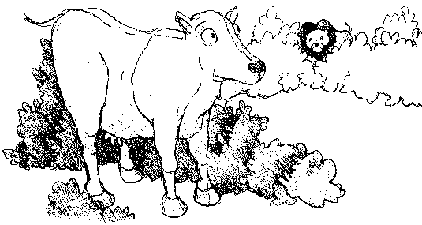
Once upon a time, the Five Training Steps were not yet known in the world. There was a very wealthy man living in Benares who owned a large herd of cattle. He hired a man to look after them.
During the time of year when the rice paddies were filled with the green growing rice plants, the herdsman took the cattle to the forest to graze. From there he brought the milk and butter and cheese to the rich man in Benares.
It just so happened that being in the forest put the cattle in a very frightening situation. There was a meat eating lion living nearby. Sensing the presence of the lion kept the cattle in constant fear. This made the cows tense and high-strung, leaving them too weak to give more than a little milk.
One day the owner of the cattle asked the herdsman why he was bringing such a small amount of milk and butter and cheese. He replied, “Sir, cows need to be calm and contented to give much milk. Due to a nearby lion, your cows are always afraid and tense. So they give hardly any milk."
“I see", said the rich man. Thinking like an animal trapper, he asked, “Is the lion closely connected to any other animal?" The herdsman answered, “Sir, there happens to be a variety of deer living in the forest. They are called ‘minideer’ because they are so small. Even the adults only grow to be about one foot tall. The lion has become very friendly with a certain minideer doe."
The rich man of Benares said, “So that my cows will be at peace and able to give their usual milk, this is what you are to do. Capture the lion’s friend and rub poison all over her body. Then wait a couple days before releasing her. She will be like bait in a trap for the lion. When he dies, bring his body to me. Then my cows will be safe and happy again."
The herdsman followed his boss’s orders exactly. When the lion saw his favorite minideer doe he was so overjoyed that he threw all caution to the wind. Without even sniffing the air around her, he immediately began licking her excitedly all over. Because of too much joy and not enough caution, he fell into the poisonous trap. The poor lion died on the spot.
The moral is: Too much of a good thing can be dangerous.